5 Steps to Build Patience in Trading

Patience in trading means waiting for conditions you defined before the opportunity appeared—and acting when those conditions are met. It does not mean holding every losing position longer, avoiding every uncertain trade, or expecting discipline alone to make an unprofitable strategy work.
Use LuxAlgo’s native charts and Quant, our coding agent, to make your process specific: study the setup, turn explicit rules into a strategy, review the historical results, and compare your decisions with your plan. The following five steps give you a routine you can practice and measure.
- Learn the conditions your setup needs. Define what you are waiting for.
- Write and test your rules. Replace a profit quota with controllable process goals.
- Use a pause routine. Catch rushed decisions before placing an order.
- Respect entry, exit, and risk limits. Patience applies differently before and after entry.
- Review decisions in a journal. Separate rule adherence from trade outcomes.
Step 1: Learn the Conditions Your Setup Needs
“Wait for a good trade” is too vague to follow consistently. Write down the market, timeframe, session, and observable conditions that make a setup eligible. Also define what invalidates it. If a rule requires a completed candle, an intrabar move toward that level is not the same event.
For example, an illustrative trend-following rule might require price to close above a moving average before considering an entry. That is a definition to investigate, not proof of an edge. A moving average summarizes past prices and can produce repeated false signals in a range. Adding more indicators does not automatically provide independent confirmation.
In LuxAlgo’s native charts, keep the chosen symbol and interval consistent while examining both favorable and unfavorable periods. Compare a clean trend with a sideways stretch. Record how frequently your conditions appear and what a losing example looks like, not just the most attractive winners.
A useful waiting rule is concrete: “No entry until the specified candle closes and all checklist conditions are satisfied.” A useful cancellation rule is equally concrete: “If the setup expires or the risk exceeds my limit, skip it.” Missing a move that never met your rules is different from failing to execute a valid setup.
Step 2: Define Goals and Testable Trading Rules
A required daily profit or minimum trade count can create pressure to force opportunities. Prefer goals you can directly control: complete the checklist, stay within your risk limit, and document each decision. A quiet session with no eligible setup can meet those goals.
| Replace this vague goal | With a measurable process | Record after the session |
|---|---|---|
| Make money every day | Follow the entry and exit rules for every trade | Trades following the full plan / trades taken |
| Find more opportunities | Trade only the defined setup and session | Eligible setups, skipped setups, and off-plan entries |
| Recover a loss quickly | Keep the predetermined risk cap unchanged | Any size increases made because of a loss |
| Be more patient | Wait for the exact trigger rather than anticipate it | Entries placed before confirmation |
With Quant, describe entries, exits, and risk rules in plain language. Review the generated Code, then Run the strategy on the intended chart. Check that its simulated trades match your description. A script that compiles is not necessarily a correct implementation or a profitable strategy.
Use Inputs for exposed parameters and Properties for simulation assumptions such as capital, order size, commission, and slippage. Inspect trade count, drawdown, and profit factor alongside net profit and win rate. Then evaluate another period that did not guide your original choices. Repeatedly changing settings until history looks attractive can create overfitting.
Write a short plan before trading: setup, trigger, invalidation, exit, size calculation, session limits, and review date. The purpose of testing is to challenge the plan’s assumptions—not to promise the next trade will win.
Step 3: Use a Pause Routine When You Feel Rushed
You do not need to eliminate emotion before making a decision. You need a repeatable response when urgency starts changing the rules. Before submitting an order, name the trigger: boredom, fear of missing out, frustration after a loss, or excitement after a win.
- Pause the new order. Read the written setup rather than search for a new reason to enter.
- Check the evidence. Has the actual trigger occurred, on the correct symbol and timeframe?
- Check the risk. Is the planned size still within your limit at the current price?
- Decide and document. Take the eligible trade according to the plan, or skip it and record why.
A brief break or slower breathing can be part of your personal routine, but neither establishes that a trade is sound. If you have an open position, follow its existing risk-management plan while pausing new entries. Walking away from a screen is not a substitute for managing an existing order or position.
Write a response in advance for hitting a session loss limit or breaking a rule. For example, stop initiating trades and review the incident before the next session. Choose the limits as part of the plan; do not widen them in the moment to make room for a recovery trade.
Step 4: Apply Patience to Entries, Not to Ignoring Exits
Before entry, patience can mean waiting. After entry, discipline may require acting promptly when the planned exit occurs. Moving a stop farther away because you hope price will recover is a different decision from following a tested trailing-stop rule.
Set position size from the risk budget and the planned stop distance, with appropriate contract values and costs. A stop order does not guarantee its execution price: gaps, liquidity, and order type matter. Review position sizing and slippage when assessing the amount you could lose.
Organize the workspace so the planned markets and tools are easy to find. The short demonstration below shows switching native LuxAlgo workspaces. A prepared layout can reduce repeated setup work; it does not enforce your trading rules or place orders.
Native workspace demonstration: keep your research environment organized before the session begins.
If you use notifications, verify the actual condition, timing, and supported workflow. Do not assume saving a Quant strategy automatically activates an alert. Notifications also should not be treated as guaranteed execution or position protection.
Step 5: Review Decisions, Not Just Profit
A winning impulsive trade can reinforce the wrong habit. A losing trade that followed a reasonable plan does not automatically prove impatience. Review process and performance separately, then look for patterns across a meaningful set of observations.
Use the LuxAlgo Journal to record fills and add notes about decisions. It supports manual records, statement imports, and supported broker connections; availability depends on the account and import format. Journal data stays private when a workspace is shared.
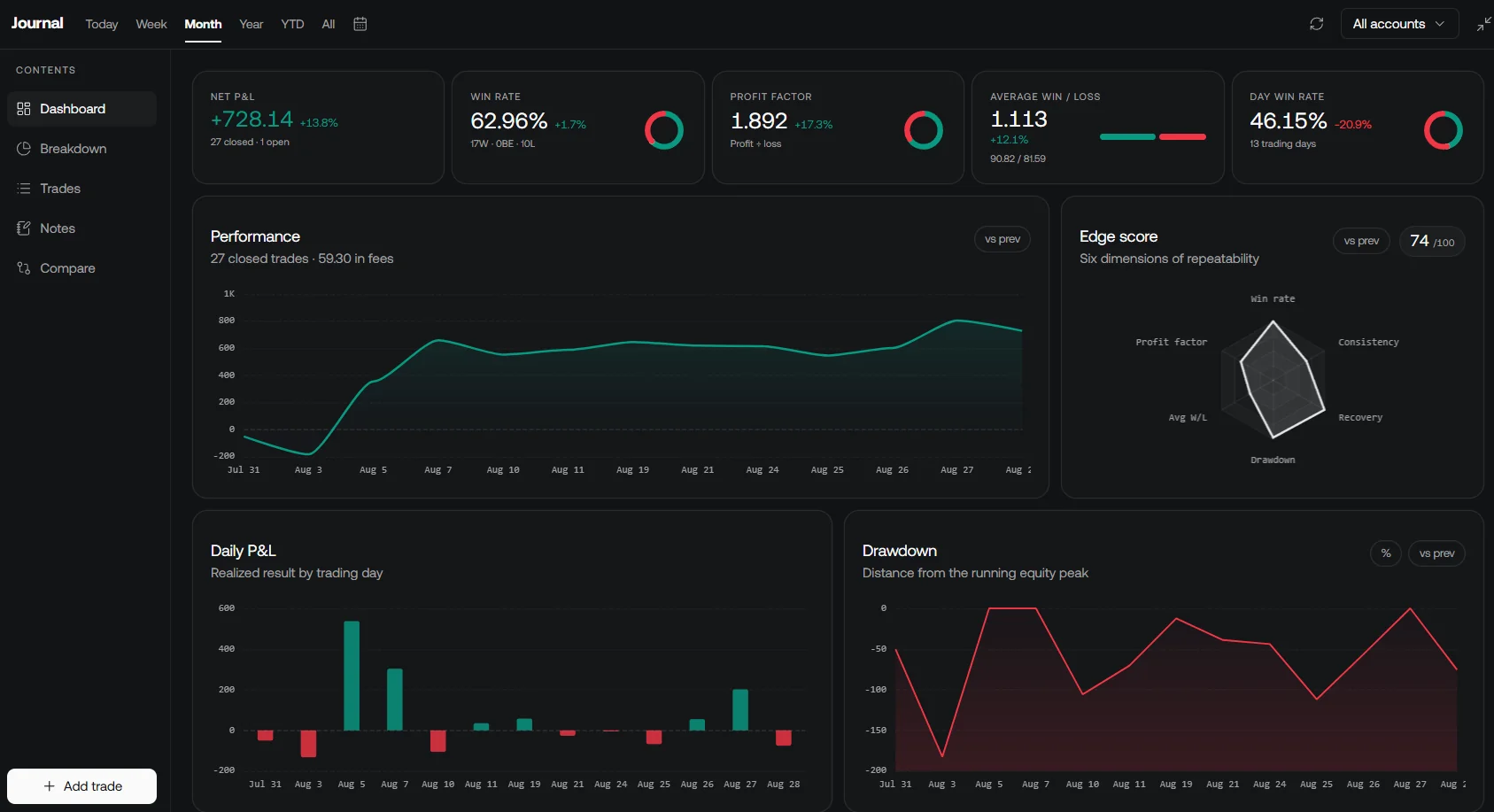
Record the setup, planned trigger, actual entry, intended risk, exit reason, and any rule deviation. Add a separate note for a valid setup you skipped, since a fill-based trading log cannot infer opportunities you never traded. Use neutral descriptions such as “entered before candle close,” rather than labels such as “bad trader.”
At the weekly review, compare planned and unplanned entries, including costs and losses. Also count valid setups missed through hesitation. Avoid concluding that waiting is always better from a handful of selected examples. If the strategy’s evidence is weak, investigate the strategy instead of blaming every loss on psychology; trading psychology is not always the problem.
Change one clearly identified behavior or rule at a scheduled review, and record the reason. Constant mid-session edits make it difficult to learn which version you actually followed.
Your Next-Session Checklist
- Open the planned chart layout and confirm the symbol, interval, and session.
- Read the entry trigger, invalidation, exit, and risk limits.
- Accept that there may be no eligible trade today.
- Pause when urgency changes the decision, while maintaining existing position controls.
- Record both trades and relevant skipped setups for the next review.
Start with one measurable improvement: fewer entries before confirmation, fewer unplanned size changes, or more complete decision notes. Use native LuxAlgo charts, reviewed Quant strategies, and the Journal to make that improvement observable. Patience supports a repeatable process; it does not guarantee a higher win rate or consistent profits.
Read next