Algorithmic Trading Data: Choosing the Right Market Sources

Choose market data around the decisions your strategy makes. A daily stock model, an intraday futures strategy and an order-book strategy need different observations, history and delivery speeds. The best source is one whose coverage, timing, definitions and permitted uses match the job—not simply the fastest or most expensive feed.
Evaluate accuracy, completeness, consistency and timeliness together. Keep the original observations and document any transformations so you can reproduce a result. A good-looking backtest cannot compensate for unavailable historical information, an incompatible live feed or an unrealistic fill model.
Define the Data You Need
| Requirement | Questions to answer |
|---|---|
| Instruments and venues | Which securities, contracts, exchanges and currency pairs are required? |
| Observation type | Trades, bid/ask quotes, depth, candles, fundamentals or calendars? |
| Timing and sessions | Which timezone, session, timestamp convention and delivery delay? |
| Historical coverage | How far back, at what resolution, with which delisted instruments and revisions? |
| Usage and delivery | Which API, rate limits, retention rights and automated-use permissions? |
Specify these requirements before comparing vendors. A candle summarizes activity over an interval; it cannot reconstruct the full sequence of quotes and trades within that interval. A chart subscription also does not automatically include a raw-data API or redistribution rights.
Video: Choosing Data Sources for Algorithmic Trading
The retained QuantInsti tutorial, published March 25, 2021, introduces how to think about obtaining trading data. Use it for the selection framework, while checking current provider coverage, access terms and pricing before using any historical example.
How to Evaluate Market Data Quality
Accuracy and Consistency
Compare like with like. Two providers may report different prices because they cover different venues, use different trade filters, include different sessions or apply different corporate-action adjustments. Investigate the definitions before declaring one source wrong. Agreement between two vendors is useful evidence, but they may share the same upstream source.
Validate schema, symbol mapping, units, ordering and duplicates. For ordinary OHLC bars, check that the high is at least as high as the open and close, and the low is no higher than either. Treat unusual prices or volume changes as items to investigate, not values to delete automatically: a split, auction or genuine market shock can explain them.
Completeness and Trading Calendars
Define the expected observations using the instrument’s calendar and the provider’s bar-construction rules. A closed exchange, early close or interval with no qualifying trades is different from a dropped message. TradingHours.com supplies calendar reference data such as session times, holidays and settlement days; it is not a substitute for a price feed.
There is no universal 93.33% completeness target that makes data suitable for trading. A missing opening auction or exit-period quote can matter more than many quiet intervals. Track missing observations by instrument, session and decision window, and define when an incomplete input should prevent a new signal.
Do not blindly fill missing prices with the previous value. A carried-forward value can be useful for a specifically documented calculation, but it is not evidence that you could trade at that price. Preserve a flag identifying synthetic or stale values and keep them out of fill assumptions unless the model explicitly justifies their use.
Information Available at the Time
Historical research needs the information that was available when the decision would have been made. Include delisted securities where relevant, use historical universe membership, and record publication delays for fundamentals and economic releases. Today’s revised value can introduce information from the future into an older test.
The FRED real-time-period documentation explains how observations and other information can change, and how to request what was known in a past period. For macro-driven strategies, the release vintage and its availability time can be as important as the value itself.
Document equity split and dividend treatment, futures contract changes and roll rules, options expirations and currency conversions. Keep raw and adjusted series distinguishable. Fit preprocessing rules on the development period, then apply those fitted rules to later data; do not let future observations determine earlier transformations.
Measure Speed Without Confusing It with Execution
Separate the exchange event time, the time your system receives the update, the time it finishes processing, and any later order acknowledgement or fill. Comparing a price timestamp with an order placement timestamp combines several delays and does not isolate data-feed latency.
Cross-system timing requires clocks whose synchronization and uncertainty are understood. For elapsed time inside one process, use a suitable monotonic timer. Record normal and stressed behavior, including tail delays and reconnect periods, rather than reporting only an average. Timestamp precision does not by itself prove timestamp accuracy.
A strategy that acts once after the daily close may tolerate a different delay from one reacting to quotes. Benchmark the full workload before buying specialized infrastructure. Co-location, network changes and faster hardware can be relevant to demanding systems, but they are not universal requirements or substitutes for correct data handling.
Compare Providers by Role and Coverage
| Source or service | Useful role | Important distinction |
|---|---|---|
| LuxAlgo native charts | Visual research and strategy analysis using documented chart feeds | Chart coverage and footprint availability vary by market |
| Market-data API vendor | Programmatic historical or streaming observations | Check venue coverage, entitlements, adjustments and request limits |
| Calendar reference provider | Sessions, holidays and settlement schedules | Does not supply executable quotes merely because it covers a market |
| Research or trading platform | Tools for using data and testing or routing strategies | Each data connection and account has its own requirements |
For example, Alpaca’s market-data documentation distinguishes its Basic equity feed’s IEX coverage from broader US-equity coverage. A limited-venue feed is not interchangeable with consolidated market activity. Check the plan, endpoint and feed selected in the actual request rather than relying on a general “real-time data” label.
Likewise, a research engine or execution bridge is not automatically the source of every dataset it can consume. Verify the specific provider connection, authentication, supported instruments and transport. CSV and JSON are formats; REST, streaming connections and FIX-based integrations have different operational behavior. An integration logo does not prove that every feed or order type is supported.
Using LuxAlgo for Data-Aware Research
Begin with LuxAlgo’s native charts and confirm the symbol’s provider, session and timeframe. Ask Quant, our coding agent to implement or explain a defined strategy, inspect the generated code, and run it manually. Keep the data assumptions with the strategy results.
The native data documentation identifies Cboe EDGX for US equities and supported crypto venues. EDGX activity is not the whole consolidated US equity market. The documented footprints are pre-aggregated trade information, not a raw live order book. Forex, commodities and CME futures have candle data on paid plans; footprint-dependent tools are not supported identically across every market.
Regular and extended sessions can produce different inputs and indicator values. History measured in bars also covers a different calendar span at different timeframes, and footprint history has separate limits. Read the current data and plan documentation for the feature you need. Compare annual billing with annual billing rather than presenting its monthly equivalent as a month-to-month price.
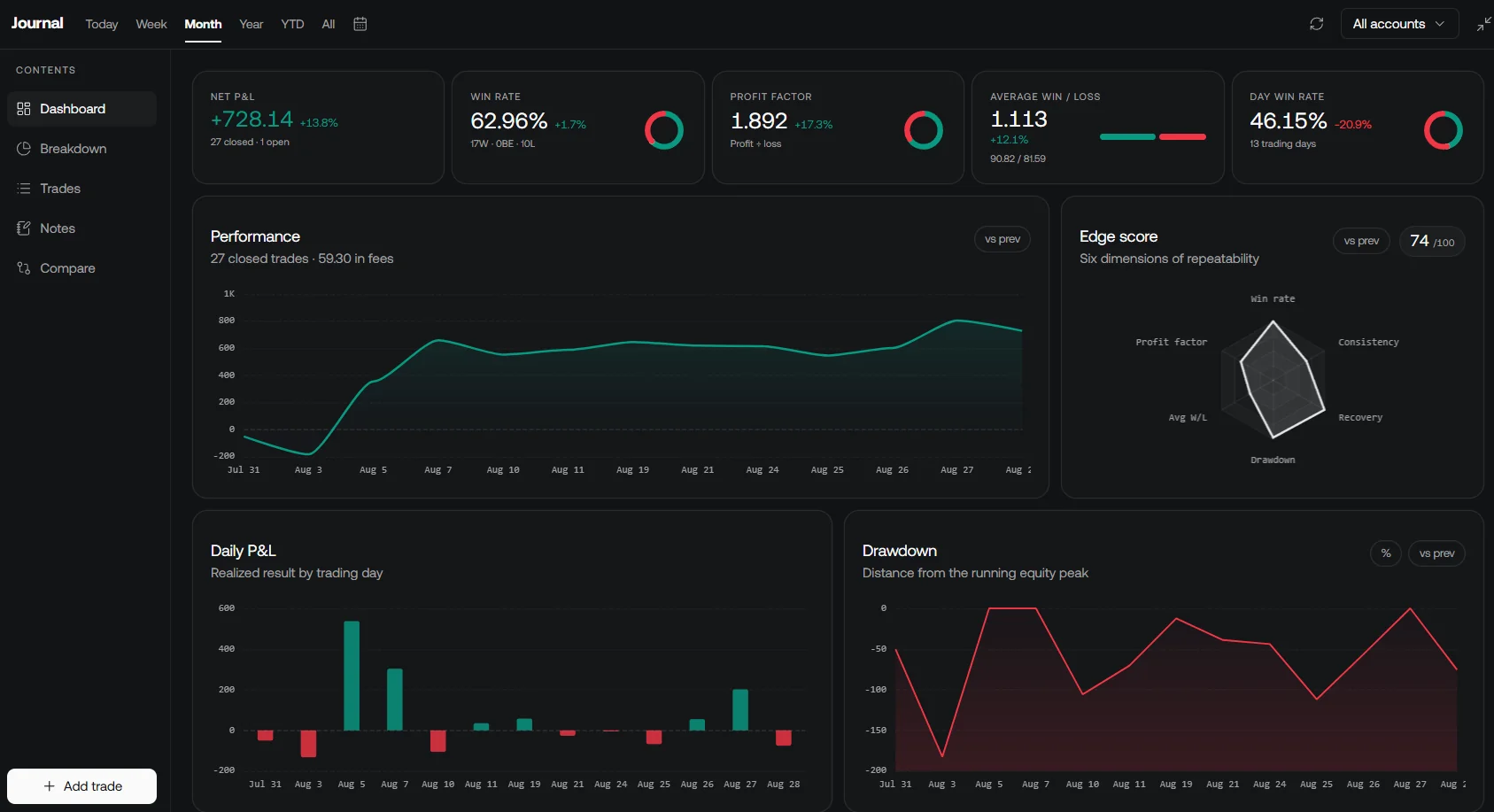
Use the native strategy guide to inspect test settings. Review compatible recorded outcomes in LuxAlgo’s native journal, separating backtests, paper trades and actual fills. Organize baseline charts and experiments in a workspace so changes remain traceable.
Paid Versus Free Data: Compare the Full Cost
There is no useful universal price for “real-time data for one stock.” Cost depends on the feed, professional status, venue entitlements, depth, history, usage rights and delivery method. Compare quotes for the same requirements. Free data may suit learning or some slower research; paid data is not automatically more accurate or suitable.
Include exchange and vendor fees, API limits, storage, transfer costs, support and the right to retain or use observations in automated systems. Confirm whether the license covers display, non-display analysis, commercial use or redistribution as applicable. A cheap feed that omits the decision-critical observations may be more costly than a suitable one.
Build a Reproducible Data Pipeline
- Capture: retain original observations with source, symbol mapping, event and receipt timestamps, and ingestion version.
- Normalize: standardize units, schema and time representation while preserving the original fields needed for audit.
- Validate: detect duplicates, unexpected gaps, invalid records and stale inputs. Quarantine uncertain data rather than silently treating it as valid.
- Version: separate raw and curated datasets, recording correction and adjustment rules so earlier research can be reproduced.
- Recover: implement documented reconnect and resubscription behavior, deduplication, and sequence or snapshot recovery where the feed supports them.
- Monitor: track input age, processing backlog, failed requests, rate-limit events and the effect on strategy decisions.
Test realistic message rates and bursts with the actual parsing, storage and strategy workload. Compression and parallel processing introduce trade-offs; preserve event ordering where it matters. Have an explicit response when the consumer falls behind, rather than allowing an unnoticed queue of stale observations to drive decisions.
The Knight Capital incident illustrates the broader importance of deployment and operational controls, not a proven market-data-quality failure. The SEC described a code-deployment failure and inadequate controls associated with losses exceeding $460 million. Data validation is one part of a reliable system, alongside tested code and effective risk controls.
Storage, Backups and Maintenance
Choose storage for the workload: ingestion rate, query pattern, retention, recovery needs and access controls. Local SSDs, network storage and cloud storage can each serve useful roles. A SAN is not universally better than a NAS, and a monthly backup is not adequate merely because a schedule says so.
A 3-2-1 backup approach—three copies, two media types and one offsite copy—can be a starting point. Adapt it to the architecture and required recovery point. Separate backup access where practical, protect important versions from accidental overwrite, and test restoration. A successful backup job does not establish that a usable dataset can be recovered.
| When | Example check | Response to investigate |
|---|---|---|
| During ingestion | Staleness, malformed records, sequence gaps and backlog | Flag affected inputs and apply the strategy’s defined pause policy |
| After a session or batch | Expected coverage, duplicates and reconciliation | Repair from a documented source and version the change |
| After provider or schema changes | Mapping, units, adjustments and compatibility | Validate before promoting the new feed into regular use |
| On a recovery schedule | Restore a selected dataset and reproduce a known query | Fix missing dependencies or recovery failures |
Choose frequencies based on how quickly an error can affect the strategy and how much data you can afford to lose. Preserve incident records. Unusual markets can change normal volumes and prices, so review anomaly thresholds instead of automatically classifying every extreme observation as corrupt.
Handle Feed Failures Deliberately
A backup feed can help only if its symbols, coverage, sessions and adjustment rules are compatible with the primary feed. Test the switch, reconcile account and data state, and record the source change. Automatically substituting an incompatible feed can create a new error while appearing to restore service.
Define what happens to new signals when data become stale, and manage existing positions through the appropriate execution and risk controls. Pausing data-driven entries does not cancel pending orders or close positions. Make recovery and operator responsibilities explicit, then rehearse the procedure in a controlled environment.
Frequently Asked Questions
Is the fastest market-data feed always best?
No. Match delivery speed to the strategy’s decision interval and required observations. Coverage, definitions, reliability, history and permitted use matter alongside latency.
Why do two providers show different prices?
They may cover different venues, sessions, trade filters or adjustment methods. Align those definitions before treating the difference as an error.
Should I fill every missing bar with the previous price?
No. First distinguish closed sessions, intervals without qualifying trades and actual data loss. A carried-forward value is synthetic and does not prove an executable price existed.
Does a chart subscription include a raw market-data API?
Not necessarily. Chart access, programmatic access, retention and redistribution can have different terms. Check the product and license for the intended use.
How should I compare LuxAlgo strategy results with another platform?
Match the rule, provider, symbol, timeframe, session, costs and fill assumptions. Inspect generated code and run it manually, keeping native charts, TradingView tools and legacy research workflows distinct.
Read next