Ark Invest: Cathie Wood’s Strategy Insights

Cathie Wood’s ARK Invest strategy starts with technological change, then asks which businesses can turn it into shareholder value. The useful lesson is a research process: study adoption and costs, test company economics, examine the price paid, and keep revisiting the thesis. An exciting industry does not make every stock in it a good investment.
- Focus: disruptive innovation across traditional industry boundaries.
- Two time horizons: five-year company models and ARK’s suggested investor horizon of seven years or more serve different purposes.
- Selection: combine market-level research with company valuation and ongoing review.
- Risk: innovation portfolios can suffer substantial losses and share common exposures despite holding different businesses.
- Practical application: connect a written investment thesis with LuxAlgo charts, a Watchlist, and explicit rules tested with Quant.
ARK Invest’s Main Investment Rules
Investing in Industry-Transforming Technology
Cathie Wood founded ARK in 2014. Its official FAQ describes a thematic approach that follows innovation across sectors. That helps explain why an investment idea might connect a chip designer, a medical-testing company and an industrial automation supplier without treating them as the same business.
Start by separating three questions: Is the technology becoming useful? Can a particular company earn attractive profits from it? Does today’s share price leave room for a satisfactory return? A lower production cost can benefit customers while competition pushes down the supplier’s selling price. Rapid adoption and disappointing shareholder returns can occur together.
Five-Year Models and a Seven-Year-Plus Horizon
ARK’s investment process describes five-year revenue and valuation models. Separately, its FAQ suggests a full investment cycle of seven years or more for investors. A forecast window is not a mandatory holding period, and a suggested horizon is not a promise that losses will recover by a certain date.
For personal planning, match the investment to when the money is needed and how much loss can be tolerated. A long horizon does not repair a failed business model. Review evidence throughout the holding period instead of waiting for an arbitrary anniversary to reconsider a deteriorating thesis.
Research Methods and Portfolio Updates
ARK describes an open research ecosystem, cost and demand analysis, company scoring, and weekly thesis reviews. Its models include adoption, costs, share-count changes and valuation assumptions. Positions may change as conviction and relative opportunities change; Cathie Wood has final investment-decision accountability. These are descriptions of ARK’s process, not evidence that its forecasts will prove correct.
Public research can expose assumptions to scrutiny, but popularity is not validation. Read the model inputs, compare them with company filings, and look for evidence that contradicts the investment case. A portfolio disclosure is a snapshot: copying it later does not reproduce the manager’s entry prices, subsequent trades or portfolio constraints.
ARK’s Target Markets and Technology
ARK’s introduction to ARKK identifies artificial intelligence, public blockchains, multiomic sequencing, energy storage and robotics as major innovation platforms. The research questions below are a general framework for evaluating those themes, not ARK portfolio weights or forecasts.
| Theme | Business question | What could undermine the thesis? |
|---|---|---|
| AI and robotics | Do customers obtain measurable savings, and does the supplier retain recurring revenue? | Price competition, weak deployment economics, hardware costs or customers building alternatives. |
| Genomics and biotechnology | Does the product have evidence of clinical usefulness and a viable path to payment? | Unsuccessful trials, regulatory delays, reimbursement limits or financing needs. |
| Digital finance and blockchains | Does usage create durable revenue for the company being valued? | Regulatory restrictions, security failures, intense competition or unstable transaction demand. |
| Energy storage | Can better cost and performance become profitable production at scale? | Manufacturing problems, capital spending, input costs or a competing technology. |
Do not confuse technology themes with accounting sectors or assume that all ARK funds hold identical exposures. Any allocation percentage needs a named fund, an as-of date and a defined classification. Use the specific fund’s current holdings and documents rather than treating an old percentage as the firm’s permanent allocation.
How ARK Picks Investments
Market Trends and Company Research
The top-down stage asks how an industry might change; the bottom-up stage tests a particular business. Turn a large addressable market into a sequence of explicit assumptions: reachable customers, adoption rate, units sold, price per unit, margins and funding requirements. Revenue available to an entire industry is not revenue that one company can automatically capture.
For example, a hypothetical product with one million reachable customers, 10% adoption and $200 annual revenue per customer produces $20 million of annual revenue. If adoption reaches only 5%, that becomes $10 million before considering cancellations or price changes. This calculation does not establish profitability; operating costs and capital needs still matter.
Investment Evaluation: A Worked Valuation Example
Consider a fictional company expected to earn $1 billion of revenue in year five. Assume a 15% net margin, 100 million diluted shares and a price-to-earnings multiple of 25. These are illustrative assumptions, not an ARK forecast or a recommendation.
| Step | Calculation | Result |
|---|---|---|
| Year-five net income | $1 billion × 15% | $150 million |
| Earnings per share | $150 million ÷ 100 million shares | $1.50 |
| Illustrative year-five price | $1.50 × 25 | $37.50 |
| Annualized price growth from $25 | ($37.50 ÷ $25)^(1/5) − 1 | About 8.4%, before costs and taxes |
| Lower valuation multiple | $1.50 × 15 | $22.50, below the initial $25 price |
The same operating forecast can produce a gain or loss depending on the future valuation multiple. Dilution matters too: if shares rise to 125 million, the same $150 million profit becomes $1.20 per share. At 25 times earnings, the modeled price falls to $30. Growth in the business is not necessarily equal to growth in value per share.
Build bear, base and bull cases rather than presenting one price as inevitable. For an unprofitable company, examine the path to cash generation, financing and dilution instead of applying a positive earnings multiple to losses. Compare each assumption with dated evidence and record what would make you revise it.
Portfolio Balance and Risk
The ARKK fund page warns of non-diversification risk and greater volatility than broad market averages. Successful technology adoption does not guarantee that a selected business will profit, or that its shares will outperform. Fund structure, holdings and risk disclosures should be checked for the particular product under consideration.
Different company names can still carry similar exposure to expensive growth valuations, financing conditions or investor sentiment. As a simple stress scenario, a $10,000 innovation allocation losing 40% would reduce a $100,000 portfolio by $4,000, or 4%, if everything else stayed unchanged. A $30,000 allocation under the same assumption would lose $12,000. This is scenario arithmetic, not a worst-case limit; the rest of the portfolio may fall too.
Review position size, overlap and the ability to exit, as well as conviction. Adding after a decline increases exposure; it does not prove the original thesis is intact. Define the evidence that would justify adding, reducing or exiting before the next earnings announcement or sharp price move.
Video: Why Disruptive Innovation Is Inherently Controversial
This April 1, 2022 episode of ARK’s In the Know features Cathie Wood explaining the firm’s perspective. It provides historical context for the approach. Its economic commentary and forecasts belong to that date and should not be read as current market guidance.
Using ARK’s Methods for Personal Investing
Finding High-Growth Companies
Create a short investment memo for each candidate. Identify the customer problem, competitive advantage, path to cash generation, valuation range and disconfirming evidence. Check reported revenue quality, margins, cash flow, debt and diluted shares in the company’s filings. Compare spending ratios with genuinely comparable businesses rather than imposing one technology-index average across unrelated industries.
A research calendar can include earnings releases, product milestones and financing updates. For biotechnology, trial and regulatory milestones may deserve separate attention. Record what was known at each review so later success or failure does not rewrite the original reasoning.
Using LuxAlgo for Market Analysis
LuxAlgo provides a charting and research workflow alongside this fundamental work. Use its Watchlist to organize candidate symbols and inspect available price, financial and news information. Check the underlying company disclosures before treating a summary metric as the basis for an investment.
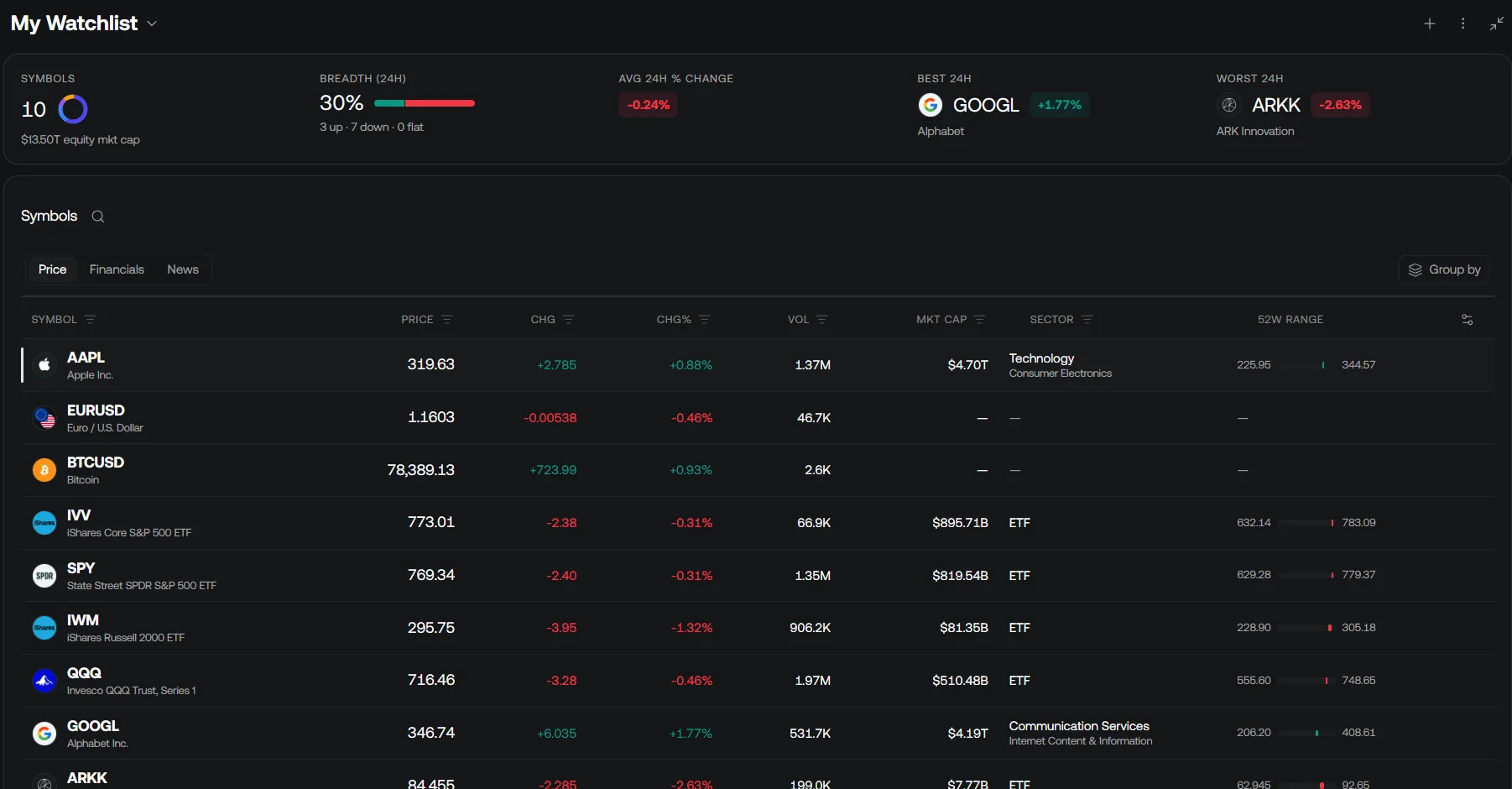
On LuxAlgo charts, examine the relevant symbol, timeframe and trading session. Price trends and volume add context for timing and volatility; they do not validate a clinical outcome, future margin or five-year valuation. Keep the business thesis separate from the chart conditions used to manage a position.
Ask Quant, our coding agent, to implement an explicit chart-based rule. An example research prompt is: “Create a long-only strategy that enters after a completed daily close crosses above its 200-day moving average and exits after a completed close crosses below it. Do not pyramid positions. Expose the lookback as an input.” This tests a defined timing idea, not ARK’s discretionary stock-selection process.
Review the generated code, run the strategy, and set order size, capital, commission and slippage assumptions. Inspect the backtest summary and Trades Log, then evaluate an untouched period. A historical test needs information available at the time; selecting today’s successful companies and testing their past prices creates selection bias. A single-symbol simulation also does not reproduce a changing fund portfolio.
Use the LuxAlgo Journal to review recorded trades and add notes about the thesis and execution. Distinguish a business forecast that failed from a timing rule that behaved poorly. Generated code and simulated returns require review; they do not independently establish investment merit or automatically enforce live portfolio limits.
Summary of ARK’s Investment Strategy
The transferable idea is disciplined research around technological change: identify a plausible opportunity, test the company economics, examine valuation and monitor the thesis. ARK’s FAQ describes its active approach as benchmark agnostic, while also using broad indexes for performance comparisons. That is different from having no useful standard against which to assess results.
Its cited name-turnover and share-turnover figures measure different things and are historical descriptions, not fixed targets for an individual account. Likewise, a long investment horizon should support careful planning rather than excuse unlimited losses or an unchanged thesis.
- Write the business case: connect customer adoption to revenue, profit, cash and value per share.
- Challenge the valuation: vary growth, margins, dilution and the price investors might pay later.
- Size the exposure: consider correlated losses and near-term cash needs.
- Separate research from execution: use charts and tested rules for defined questions, with realistic costs and data.
- Review the evidence: update the thesis when facts change, and compare actual results with the original assumptions.
Read next