Automated Trading vs Manual Trading: Pros and Cons
Automated trading follows programmed rules; manual trading leaves individual trade decisions to the trader. Neither approach is inherently more profitable. The useful question is which parts of your process are clear enough to test and repeat, and which decisions still need your judgment.
LuxAlgo's native charting platform supports the research behind either approach. Use charts to examine a setup, Quant, our coding agent, to help turn explicit rules into code, and built-in backtesting to study their historical behavior. You can test a strategy even if you ultimately place each order manually.
What Are Automated and Manual Trading?
Automated trading uses software to evaluate conditions and, when connected to a supported execution system, submit orders. The trader or developer still decides what the strategy does, which data it uses, how much exposure it can take, and when it should stop. Automation does not remove human responsibility.
Manual trading means a person makes or approves trade decisions and enters orders. It can be discretionary, with judgment applied to market context, or systematic, with a trader following a written checklist. Manual trading does not have to mean improvising every entry.
These are ends of a spectrum. A trader might use automated alerts to find setups, approve entries manually, and place a broker-supported stop or bracket order. Another might automate entries and exits but review the strategy and its performance regularly. The right label matters less than knowing who controls each step.
Automated Trading vs Manual Trading: Comparison
| Factor | Automated trading | Manual trading |
|---|---|---|
| Decision process | Executes the conditions implemented in software | Trader applies rules or judgment to each decision |
| Speed | Can reduce human reaction and order-entry delays | Depends on the trader's availability and process; broker routing still matters |
| Consistency | Repeats coded behavior, including mistakes | Requires consistent interpretation and adherence |
| Adaptability | Depends on the data, logic, and controls built into the system | Can incorporate new context, but judgment can also be wrong |
| Testing | Code can be backtested and execution tested in a paper environment | Explicit rules can be backtested; discretionary decisions can be reviewed with historical examples and a journal |
| Time commitment | Development, testing, monitoring, and maintenance | Preparation, observation, order entry, and review |
| Cost | May include hosting, software, data, and integration costs | May include charting, data, brokerage costs, and substantial attention |
| Market coverage | Can monitor several supported instruments within system limits | Limited by attention, but scanners and alerts can assist |
There is no universal “milliseconds versus seconds” benchmark. Signal calculation, message delivery, risk checks, broker routing, liquidity, and order type all affect the path to a fill. A faster decision also does not guarantee a better price or a profitable trade.
Benefits and Drawbacks of Automated Trading
Where automation helps
Automation is useful when the task has a precise definition. Checking whether a completed candle crossed a moving average is easier to specify than deciding whether a chart “looks strong.” A repeatable rule can be tested, logged, and applied consistently across supported markets.
- Repeatable execution: software can apply the same entry, exit, and sizing instructions without requiring you to enter every order.
- Less repetitive monitoring: tools can evaluate conditions while you focus on research or review, subject to data availability and operating hours.
- Traceable decisions: signal and order logs can show which rule fired and what happened next.
- Structured testing: a coded strategy makes it easier to compare defined variants under consistent assumptions.
These advantages depend on implementation. A signal log is not an execution record, and a request accepted by a broker is not necessarily a filled order. Confirm how the system handles pending orders, rejected requests, and partially filled positions.
What automation cannot solve by itself
A program does not feel fear or greed, but traders can still express those biases by selecting an overfitted strategy, increasing leverage, changing settings after losses, or disabling safeguards. Automation moves some decisions earlier in the process; it does not make the process emotion-free.
It also creates operational dependencies. Data can become stale, connections can fail, and incorrect symbol mappings or duplicate messages can generate unintended exposure. Monitoring many correlated strategies can concentrate risk rather than diversify it.
The SEC's Knight Capital investigation illustrates the importance of deployment and risk controls. On August 1, 2012, an incorrectly deployed system sent millions of erroneous orders during the first 45 minutes of trading; the firm ultimately lost more than $460 million. This was a technology and control failure, not evidence that manual traders always handle unexpected news better.
Backtest overfitting is another risk: repeatedly adjusting parameters until the historical result looks attractive can produce rules that fail on new data. Preserve a separate evaluation period and examine costs, drawdowns, and individual trades before considering execution.
Benefits and Drawbacks of Manual Trading
Where human judgment helps
A manual trader can pause to investigate unusual price behavior, compare conflicting information, or decide that an event falls outside the strategy's assumptions. This flexibility can be useful when the decision depends on context that has not been formalized.
Manual execution also lets you begin with a simple, well-defined process without maintaining a separate automation service. You still need to understand the platform, instrument, order type, and account risks. Fewer components do not eliminate the possibility of mistakes.
Where manual trading becomes difficult
Judgment is not automatically an advantage. A trader may hesitate on a valid setup, chase a move, change position size impulsively, or interpret the same pattern differently after a losing trade. Long periods of observation can also make consistent attention difficult.
Use a written checklist and record the reason for each trade or skipped signal. If you frequently override your rules, review those overrides separately. Otherwise, a strategy may appear inconsistent when the larger problem is inconsistent implementation.
Manual traders can use historical testing too. Rules that can be expressed precisely can be coded and backtested even when live execution remains manual. For discretionary elements, review historical examples without treating hindsight judgments as an exact simulation of what you would have done in real time.
Use LuxAlgo to Test Either Approach
Start in LuxAlgo's native charts and separate the parts of your setup that are measurable from those that require interpretation. Indicators can help define trend, momentum, volatility, or market structure, but a chart signal needs an explicit trading rule before it can be evaluated as a strategy.
- Write the setup. Specify the market, timeframe, entry condition, exit condition, position size, and circumstances in which you will not trade.
- Ask Quant to help code the measurable rules. Review what it produces. For example, “enter after a completed-bar crossover” differs from acting on a condition that appears briefly during an unfinished candle.
- Set the backtest assumptions. Include relevant commissions and slippage, and confirm sizing and capital settings. Test the instrument and timeframe you actually intend to use.
- Inspect the results. Look at drawdown, the number and distribution of trades, losing periods, and the trade log. Compare a reserved evaluation period instead of selecting only the most favorable historical range.
- Choose the execution method separately. You can follow the tested rules manually, use alerts to prompt a decision, or evaluate a compatible external automation workflow.
For example, suppose your rule requires a completed-bar moving-average crossover, an entry on the next eligible bar, and an ATR-based exit. Backtesting can examine that rule. If you also decide to skip “messy” charts, either define what that means or record those discretionary exclusions separately; the coded result does not automatically represent the extra judgment.
A chart alert, a strategy alert and a live broker order are different things; check the platform FAQ before planning an integration.
How to Choose and Combine the Methods
Match the method to your process rather than a fixed budget or daily-hours rule. There is no universal $10,000 software requirement for automation, and it is not necessarily a low-attention alternative to manual trading. Use current plan details and the costs of any broker, data, or hosting services to estimate the setup you actually need.
| Question | What the answer suggests |
|---|---|
| Can I explain every entry and exit precisely? | Explicit rules are candidates for coding and testing. Undefined judgment needs clarification or a manual decision point. |
| Can I monitor the system and respond to failures? | Unattended execution requires a recovery plan and reliable access to the broker. |
| Does the setup depend on context I cannot yet formalize? | Use a manual review stage and record the decision criteria. |
| Am I repeating the same analysis or making order-entry errors? | Consider automating that specific task first, then measure whether the process improves. |
| Can I afford the full operational cost? | Include subscriptions, data, hosting, commissions, spreads, slippage, and maintenance time. |
A practical hybrid workflow
Use chart tools or alerts to identify a candidate, manually confirm that it meets your written criteria, and use supported broker order controls for the trade. Record which decisions were automatic and which were discretionary. Verify where protective orders are held and what happens if your local software disconnects.
If you later automate execution, test it separately from the strategy. Alpaca's paper-trading documentation, for example, explains that simulated trading omits effects such as market impact, latency-related slippage, and order queue position. Paper testing can expose operational mistakes without proving that live fills or returns will match.
For connection and recovery considerations, see Automated Broker Platforms: Pros and Pitfalls. Combining methods adds value only if responsibilities stay clear; it can also introduce delays, duplicated actions, or inconsistent overrides.
Review Results, Not Just the Trading Label
Judge each approach using the same questions: Were the rules followed? Were costs realistic? How large were the losses and drawdowns? Did actual entries and exits match the tested process? How much time did preparation, monitoring, and recovery require?
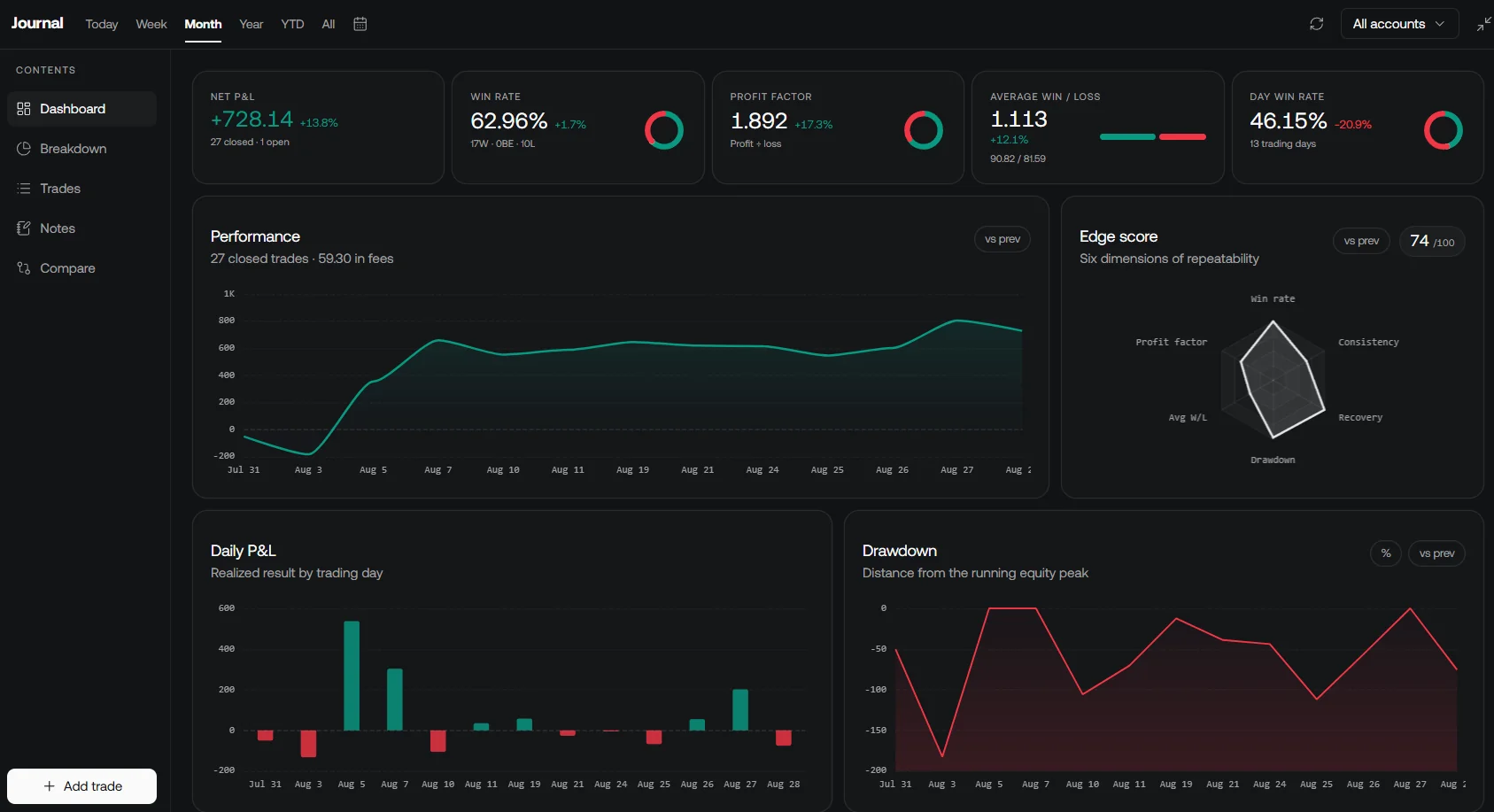
LuxAlgo Journal supports reviewing trades through manual entries, supported imports, and available broker connections. Use consistent tags or notes to distinguish strategies and interventions. Check what your data source includes before comparing results.
A disciplined manual process can be more useful than an unreliable automated one, and well-tested automation can reduce repetitive work in a clear strategy. Start with a process you can explain, test it under realistic assumptions, and expand only when the evidence supports the change.
FAQs
Is algo trading better than normal trading?
Algorithmic trading is not inherently better than manual trading. It can apply explicit rules consistently and reduce repetitive work, but it adds software, data, and execution risks. Manual trading allows judgment but can introduce inconsistent decisions and attention limits. Compare tested results, costs, risk, and operational demands rather than assuming either method is more profitable.
Read next