Avoid Overtrading: Stay Disciplined
Overtrading is activity that exceeds your strategy’s valid opportunities, risk limits, or capacity to make and execute decisions well. It is not defined by one universal number of trades. A planned strategy may trade frequently; a single impulsive position can still violate your plan.
Use LuxAlgo’s native charts, Quant, our coding agent, and the Journal to make the process observable: write down the setup, test explicit rules, and review what you actually did. Discipline is easier to assess when “follow the plan” means something specific.
Recognize the behavior before counting trades
Common signs include entering without the required signal, increasing size to recover a loss, repeatedly re-entering a failed idea, or trading outside your planned session. A winning result does not make a rule violation sound, and a losing result does not prove that a valid trade was a mistake.
OANDA’s discussion of overtrading highlights the roles of fear, greed, attention, and transaction costs. Treat these as prompts for reviewing your own behavior rather than assuming every losing period is a psychological problem.
A strategy can also lose money when followed consistently. Keep two questions separate: did you execute the intended process, and does that process have evidence of positive results after costs?
See how additional trades change the result
Commissions, spread, slippage, and financing can accumulate as turnover rises. In Barber and Odean’s historical study of individual stock investors, frequent trading was associated with substantially weaker net performance. The study used 1990s brokerage-account data; it does not establish a universal daily trade limit for today’s markets.
Consider this hypothetical review using an assumed $5 total transaction cost per completed trade:
| Trade group | Completed trades | Gross result | Costs | Net result |
|---|---|---|---|---|
| Met the written setup | 8 | $160 | $40 | $120 |
| Did not meet the setup | 12 | −$30 | $60 | −$90 |
| Combined activity | 20 | $130 | $100 | $30 |
Here, the extra trades reduced the combined result by $90. This is an illustration, not evidence that fewer trades always earn more. Classify rule compliance from the information available at entry, rather than labeling winners “good setups” afterward. Use consistent cost accounting and do not deduct spread twice if it is already included in your execution prices.
Write a plan you can actually check
| Plan component | Question to answer before the session |
|---|---|
| Eligible setup | Which market, conditions, and completed signal permit an entry? |
| Exit rule | What closes the trade, and what happens if the order does not execute as intended? |
| Position size | What cash exposure is allowed, including existing correlated positions? |
| Trading window | Which session and time zone apply, and when do new entries stop? |
| Daily boundary | What loss, exposure, trade-count, or error threshold ends further entries? |
| Re-entry | What new condition must occur before another attempt is allowed? |
| No-trade conditions | Which spread, volatility, data-quality, or attention problems require sitting out? |
A cap of one to three trades or a 3% daily loss limit might appear in an example plan, but neither is appropriate for every trader. Select limits deliberately, test their consequences, and document why they fit the intended process. A daily limit is a boundary, not a quota to use up.
Define what a “trade” means for the limit. A round trip, an entry order, an added position, and a partial execution are different events. Otherwise, splitting one idea into several orders can disguise how much risk or activity you are taking.
Make pauses operational
Replace “I will be more patient” with a concrete response. For example: after a rule violation, stop submitting new entries, reconcile existing orders and positions, record the event, and review the checklist before any permitted restart. Specify whether reaching the daily loss boundary ends the session entirely.
A pause should not leave an existing position unmanaged. Confirm protective orders and the plan for open exposure before stepping away. Do not assume that closing a chart cancels broker orders or exits a position.
Calculate size before entering
For a simple stock example, divide the chosen cash-loss budget by planned risk per share. The following calculations exclude fees and adverse execution:
| Illustrative account | Chosen loss budget | Planned risk per share | Calculated quantity |
|---|---|---|---|
| $25,000 | $500, or 2% | $20 | 25 shares |
| $10,000 | $200, or 2% | $5 | 40 shares |
| $50,000 | $500, or 1% | $10 | 50 shares |
These percentages illustrate arithmetic, not recommended risk levels. Check position notional, buying power, permitted quantity, and the instrument’s contract multiplier where relevant. Include a realistic allowance for costs and difficult execution.
Fixed-price, percentage-based, and trailing stops describe different ways to set an exit trigger. A stop-market order can execute beyond its trigger price. A stop-limit order adds a price constraint and can remain unfilled. Moving a stop to the entry price does not necessarily produce a net breakeven result after costs.
Review total exposure across positions. Several trades tied to the same sector or market driver can lose together. Cash reserves and exposure limits should support the plan; repeated discretionary rebalancing can itself add turnover. A planned stop distance is not a guaranteed maximum loss.
Handle common emotional triggers
| Trigger | Behavior to watch | Concrete response to define |
|---|---|---|
| Fear of missing out | Chasing after the planned entry has passed | Require a new qualifying setup rather than inventing a late entry |
| Recent losses | Increasing size or re-entering to recover immediately | Keep the established size rule and follow the session’s pause criteria |
| Winning streak | Relaxing filters or exceeding exposure limits | Review compliance independently of recent profit |
| Boredom or fatigue | Trading merely to stay active | End the observation window or take a planned break |
| Social-media pressure | Copying another trader’s visible result | Return to your own setup, costs, timing, and available information |
Record the trigger in neutral language. “Entered without the required close after seeing a large candle” is more useful than “I am a bad trader.” Brief breathing exercises, meditation, or a break may help some people regain focus, but none replaces a defined rule or validates the strategy.
Use the LuxAlgo Journal to review behavior
Open the Journal from the native workspace header. Add a manual account, import supported fills, or connect a supported broker. The Journal belongs to your account and is not included when sharing a workspace.
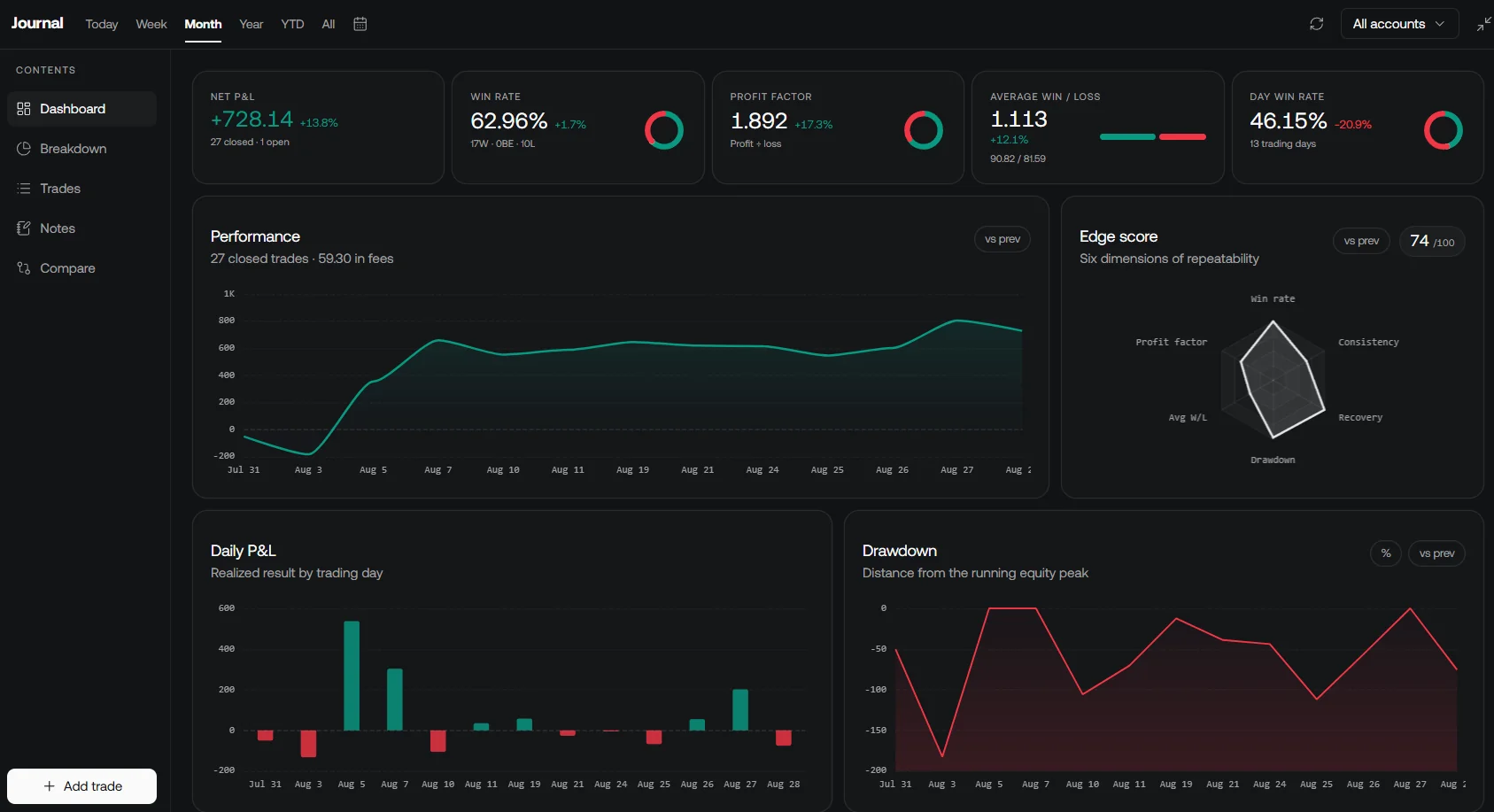
The Journal builds completed round trips from fills and reports net results, fees, and duration. Add notes or tags for your setup and rule compliance. These labels require your judgment; the dashboard does not automatically know whether a trade was impulsive.
Compare compliant and noncompliant trades, session timing, and costs over a meaningful sample. Check whether the same pattern persists in a later period. A few trades or one unusually large winner can give a misleading impression.
For connected accounts, verify that the latest fills have arrived before drawing conclusions. Broker data refreshes daily or when you use Refresh. The Journal is a review tool, not a live broker risk lock.
Test explicit limits with Quant
Ask Quant to express your chart strategy’s entry, exit, and activity limits in code. For example, specify one entry per completed signal, a defined trading session, and no new entries after a chosen simulated daily threshold. Explain the reset time and how the script should manage existing positions.
Review the implementation and inspect strategy settings and the trade log. Compare versions on the same market, period, sizing, and cost assumptions. Evaluate the effect on drawdown, net result, and opportunity count rather than choosing whichever cap produced the best historical profit.
Quant’s code generation and backtesting can support research. They do not automatically enforce your rules at a broker, validate an edge, or create live strategy alerts from every saved run. Keep native chart tools, TradingView toolkits, and execution services distinct.
Automation needs its own controls
Automation can make a flawed rule repeat faster. If a separate execution system supports order limits or protective orders, test duplicate-signal handling, connection failures, manual overrides, and recovery procedures. Confirm its authoritative order and position state before resending uncertain instructions.
An automated pause might block new entries while leaving existing orders or positions active. Define that behavior explicitly. Neither an alert nor a chart indicator is, by itself, a broker-side stop order.
Video: how to stop overtrading
This lesson offers another perspective on trading frequency and discipline. Apply the ideas to a written process and reviewable evidence rather than treating a fixed trade count as a guarantee of success.
Build a repeatable weekly review
Before the week, define the eligible setups, session boundaries, exposure limits, and review questions. During the session, use the checklist and log deviations. Afterward, reconcile fills and costs, review compliance separately from profit, and choose one change to test prospectively. The aim is to make unnecessary activity visible and reduce it without confusing restraint with a proven trading edge.
Read next