Cash vs. Accrual: Tax Tips for Investors

Every taxpayer reports income under an accounting method, a set of rules that decides when an item of income or expense lands on the return. IRS Publication 538 names the two overall methods, cash and accrual, and explains that you choose one when you file your first return and must then use it consistently. For an individual investor the choice is rarely open: nearly all individuals use the cash method, and the events that matter most in a brokerage account, sales of securities, dividends and interest, follow timing rules that apply regardless of method. This guide sets out what each method means according to the IRS, who is allowed to use which, what the method does and does not change for an investor, how prepaid expenses and method changes are handled, and how the Journal in Quant Charts keeps the dated record a year-end cutoff depends on. It covers federal rules only and is not tax advice.
What an Accounting Method Is
Publication 538 defines an accounting method as the set of rules used to determine when and how income and expenses are reported. It covers both your overall method and the treatment of any material item, meaning any item whose treatment affects the year it is included or deducted. You choose a method when you file your first tax return, no approval is needed for that first choice, and you must then use the same method from year to year. The method must clearly reflect income, which the publication defines as treating all items of income and expense the same way each year; if it does not, the IRS may recompute your income under a method that does. Permanent books plus any records needed to support the entries are required under any method.
The publication also allows different methods for different things. You may account for business items under one method and personal items under another, and a taxpayer with two separate and distinct businesses, each with its own complete set of books, may use a different method for each. A hybrid that combines cash, accrual and special methods is permitted if it clearly reflects income and is used consistently, with one restriction that matters here: if you use the cash method for income you must use it for expenses, and if you use an accrual method for expenses you must use it for income.
The Cash Method
Under the cash method, Publication 538 says you include in gross income all items actually or constructively received during the tax year, at fair market value if received as property or services, and you deduct expenses in the year you actually pay them. Most individuals and many small businesses use it.
The word that does the work is constructive. Income is constructively received when it is credited to your account or made available to you without restriction, whether or not you take possession of it. The publication's example is bank interest credited and made available in December that the taxpayer did not withdraw or record until the following year: it is income for the December year. It adds that you cannot hold checks or postpone taking possession of property from one year to the next to defer tax. Publication 550 applies the same principle to investment accounts: interest, dividends and other earnings on a deposit or account are received when they are credited to the account and subject to your withdrawal, even if withdrawal requires notice, even amounts or a penalty.
| Item | Cash method timing | Accrual method timing |
|---|---|---|
| Income | Year actually or constructively received | Year the all-events test is met: the right to the income is fixed and the amount can be determined with reasonable accuracy |
| Expenses | Year paid, except prepaid amounts that extend beyond the 12-month rule | Year incurred, once all events fixing the liability have occurred, the amount can be determined and economic performance has occurred |
| Interest on an account | When credited and available (Publication 550) | As earned over the term of the instrument |
| Sale of listed securities | Year of the trade date, regardless of settlement or payment | Year of the trade date |
The Accrual Method
Under an accrual method, Publication 538 says you generally report income in the year it is earned and deduct or capitalize expenses in the year incurred, with the purpose of matching income and expenses to the correct year. Income is included when the all-events test is met: all events have occurred that fix your right to receive the income and the amount can be determined with reasonable accuracy. Taxpayers with an applicable financial statement must include an item no later than when it is reported as revenue in that statement. Expenses are deductible when all events fixing the liability have occurred, the amount can be determined and economic performance has taken place, which for property or services provided to you means as they are provided. The publication's example is office supplies received and billed in December but paid in January: deductible in December, because the liability was fixed and performance occurred then.
Publication 550 gives the investment version. An accrual-method taxpayer reports interest as it is earned over the term of the instrument, whether or not it has been received, while a cash-method taxpayer reports it in the year actually or constructively received. For a note that pays all its interest at maturity, the two methods put the same dollars in different years.
Who May Use Which Method
Individuals are not restricted, and in practice almost all of them use the cash method. The restrictions in Publication 538 fall on entities. A corporation other than an S corporation, a partnership with such a corporation as a partner, and any tax shelter generally cannot use the cash method, unless the corporation or partnership meets the gross receipts test, which looks at average annual gross receipts for the three prior tax years against a threshold that is indexed for inflation. A business that keeps an inventory generally must use an accrual method for its purchases and sales, again subject to a small business exception.
Two points follow for investors. First, the size of a personal portfolio has nothing to do with the gross receipts test; the test is about a business entity's receipts, not an individual's holdings. Second, the accrual method is not a performance-tracking tool. An investor who wants to see results as they occur can keep books that way, but the tax return follows the method on file, and for an individual holding securities that is almost always the cash method.
What the Method Does Not Change for an Investor
Most of the timing questions an investor actually faces are settled by rules that override the general method.
- Sales of securities follow the trade date. Publication 550 states that for securities traded on an established market the holding period ends on the trade date, and warns not to confuse the trade date with the settlement date, which is when the stock must be delivered and paid for. Its example is a cash-method taxpayer who sells stock on December 31 with settlement and payment in January: the gain or loss is reported on the December year's return. The publication also bars the installment method for publicly traded securities, so the whole gain is reported in the year of the trade date.
- Dividends and interest are income when credited. Under the constructive receipt rules above, a dividend or interest payment credited to a brokerage account on December 31 is that year's income even if it is swept, reinvested or withdrawn in January. Payers report on that basis, and Tax Topics 403 and 404 note that Forms 1099-INT and 1099-DIV are issued for payments of $10 or more.
- Holding periods are independent of method. The one-year line between short-term and long-term gains is counted from the day after acquisition to the trade date of the sale under either method.
- Broker reporting matches the trade date. Form 1099-B reports sales by trade date, so a return prepared on any other basis will not reconcile with what the IRS receives.
Prepaid Expenses and the 12-Month Rule
Paying an expense early does not always bring the deduction forward. Publication 538 states that an expense paid in advance is deductible only in the year to which it applies, unless it qualifies for the 12-month rule, under which you need not capitalize amounts paid for a right or benefit that does not extend beyond the earlier of 12 months after the benefit begins or the end of the tax year following the year of payment. A one-year data or software subscription paid in December generally fits within the rule; a multi-year prepayment does not. The publication adds that a taxpayer who has not been applying the general rule or the 12-month rule must get IRS approval before starting to, because doing so is a change of method.
Changing Methods
Once a method is established on a filed return, Publication 538 says you generally need IRS approval to change it. A change from cash to accrual or the reverse, a change in inventory valuation, a change in depreciation method other than certain permitted changes to straight-line, and the adoption or discontinuance of any specialized method all count as changes requiring approval. Correcting a math or posting error, correcting an error in figuring tax, and adjusting an item in a way that does not affect its timing are not method changes and need no approval. The request is made on Form 3115, Application for Change in Accounting Method, which the IRS describes as the form for a change in either an overall method or the treatment of any item, under the procedures in the revenue procedures the form's page lists.
Where Quant Charts Fits
Quant Charts does not keep tax books, apply an accounting method or file anything, and no LuxAlgo tool places orders. What it holds is the dated record that every timing rule above is applied to. The Journal in Quant Charts is included on every plan, lives on your account rather than in a workspace, and stores individual fills with their execution time.
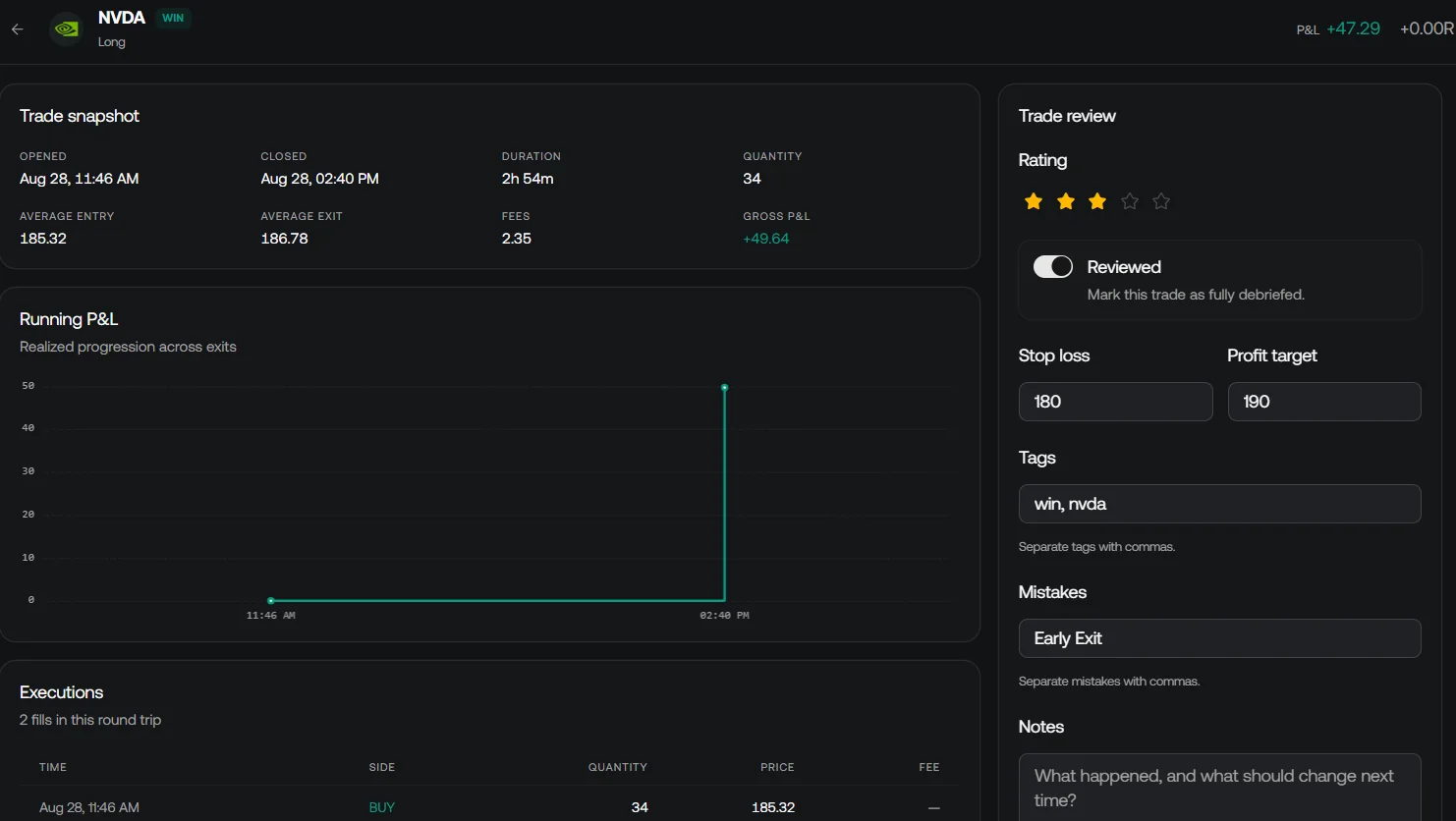
Fills carry the trade date. Because the tax year of a securities sale is the trade date, and because the Journal records the exact time of each fill from broker sync, an import or a click on the chart, the December-to-January boundary is visible per trade rather than per statement. A trade's detail view shows when the round trip was opened and closed and its duration, which is the same information that decides both the tax year and the holding period.
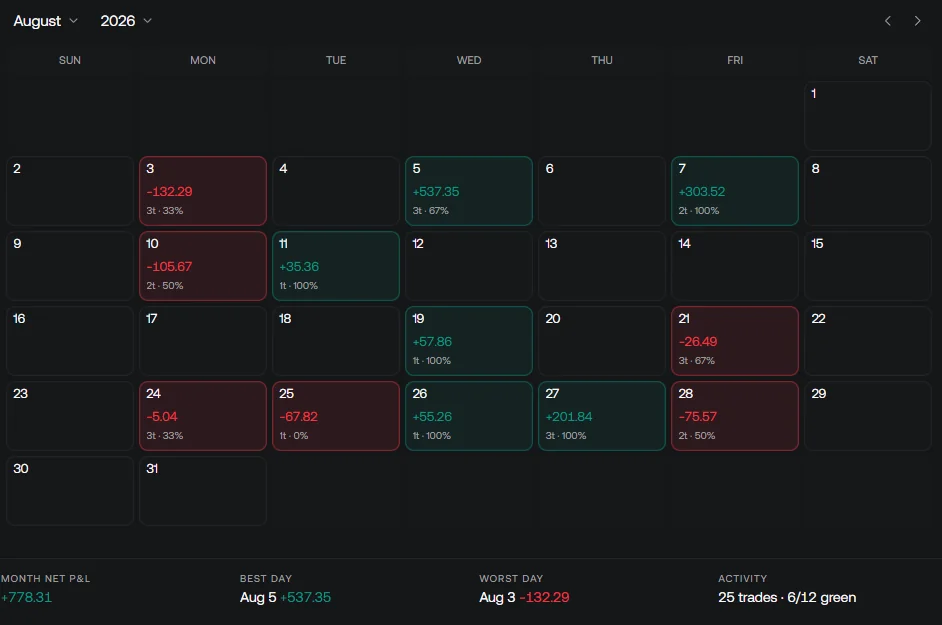
Cut the year off on the calendar. The Journal calendar shows realized results by trading day and the dashboard totals any range, including Year, YTD or a custom window. Setting the range to the tax year produces the realized figure that should agree, before fees and any adjustments, with the sum of the broker's Form 1099-B; setting it to the last week of December shows which fills fall on either side of the year end.
The video below shows how favorite tools are arranged and reached through the wheel in Quant Charts.
Keep the subscription date. If a charting subscription is a deductible business expense for a trader on Schedule C, the payment date and the period it covers are what the 12-month rule looks at. The invoice, not the Journal, is the record for that, but the Journal's date ranges make it easy to show the business was active through the period the subscription covered.
Backtests have no tax year. When you describe a rule to Quant, our coding agent, inspect the Pine Script under Code and click Run, the Backtest Summary's net profit, trade count, win rate, max drawdown and profit factor describe hypothetical trades on historical candles. No income is received, constructively or otherwise, and nothing is reported. Only fills executed with a broker belong in the Journal account you reconcile at year end.
FAQs
What is the difference between the cash and accrual methods?
Under the cash method you report income in the year it is actually or constructively received and deduct expenses in the year paid. Under the accrual method you report income when the right to it is fixed and the amount is determinable, and deduct expenses when the liability is fixed and economic performance has occurred, regardless of payment.
Which method do individual investors use?
Almost always the cash method. IRS Publication 538 restricts the cash method for certain corporations, partnerships and tax shelters through a gross receipts test, but those restrictions apply to entities, not to the size of an individual's portfolio.
If I sell stock on December 31 but it settles in January, which year is it?
The December year. Publication 550 states that securities traded on an established market are reported in the year of the trade date, not the settlement date, and gives exactly this example. The holding period also ends on the trade date.
Can I defer a dividend by not withdrawing it?
No. Under the constructive receipt rules in Publications 538 and 550, income credited to your account and available to you is taxable in that year whether or not you withdraw it, and you cannot postpone taking possession of a payment to move it into the next year.
How do I change accounting methods?
By requesting IRS approval on Form 3115, Application for Change in Accounting Method. A change from cash to accrual or the reverse requires approval; correcting a math or posting error does not, because it is not a change in method.
How does Quant Charts help with year-end timing?
The Journal records each fill with its execution time, shows each trade's open and close dates, and totals realized results by day and by any date range, so fills near the year end can be placed on the correct side of the trade date rule and reconciled with Form 1099-B. Quant Charts does not keep tax books, and backtests create no income.
References
LuxAlgo Resources
- Journal overview, Trades and Dashboard (LuxAlgo Docs)
- Making strategies with Quant and Reading a strategy backtest (LuxAlgo Docs)
- US Income Tax for Traders: An Essential Guide and Essential Tax Forms: A Guide for Investors (LuxAlgo Blog)
External Resources
- Publication 538, Accounting Periods and Methods (IRS)
- Publication 550, Investment Income and Expenses (IRS)
- Topic No. 403, Interest Received and Topic No. 404, Dividends (IRS)
- About Form 3115, Application for Change in Accounting Method and Instructions for Form 3115 (IRS)
- About Form 8949 and About Form 1099-B (IRS)
Read next