Certificates of Deposit Explained: A Safe Investment

A certificate of deposit, or CD, is a bank deposit that you agree to leave in place for a fixed term in exchange for a stated interest rate. Investor.gov describes CDs as among the safest savings options because a CD bought through a federally insured bank is covered by deposit insurance up to $250,000. In return for that safety you give up two things: access to the money before maturity without a penalty, and any return above the rate you locked in. This guide explains how CDs are defined and disclosed under federal rules, how deposit insurance applies to them, what happens at maturity, how the main variations differ, how the interest is taxed, and where a CD's yield fits into the way Quant Charts users judge a trading strategy.
What a CD Is
In federal consumer rules a CD is a time account. Regulation DD, the Truth in Savings rule administered by the Consumer Financial Protection Bureau, defines a time account as one with a maturity of at least seven days in which the consumer generally has no right to withdraw for six days after opening unless the deposit carries an early withdrawal penalty of at least seven days' interest. That definition is what separates a CD from a savings account: the bank can rely on the money for the term, and it pays for that reliability with a rate that is usually higher than the same bank's savings rate.
Credit unions offer the equivalent product as a share certificate. The mechanics are the same, but the insurance comes from the National Credit Union Administration rather than the FDIC.
How the Rate Works
Regulation DD requires banks to quote both an interest rate and an annual percentage yield, using those terms. The APY is defined as the total interest paid over a 365-day period given the interest rate and how often interest compounds, so two CDs with the same interest rate but different compounding frequencies show different APYs. When comparing offers, compare APYs.
The same rule lists what the bank must disclose before the account is opened. For a CD the list includes:
- the interest rate and APY, and for a fixed-rate account how long the rate stays in effect;
- how often interest is compounded and credited;
- any minimum balance to open the account or to earn the stated APY;
- fees and the conditions under which they apply;
- the maturity date;
- a statement that an early withdrawal penalty will or may apply, how it is calculated and when it is assessed;
- whether the account renews automatically at maturity and, if so, whether there is a grace period and how long it lasts.
Because these items are required, the disclosure document is the place to settle every question about a CD. The SEC's investor alert on high-yield CDs makes the same point in plainer language: read the disclosure statement, ask to see the maturity date in writing, and confirm how and how often interest is paid.
Deposit Insurance
The FDIC lists time deposits such as CDs among the products its insurance covers, alongside checking, savings and money market deposit accounts. The standard coverage is $250,000 per depositor, per ownership category, at each insured bank. The Deposit Insurance Fund that pays claims is backed by the full faith and credit of the United States and is funded by premiums banks pay plus interest on the fund's Treasury holdings.
Three details matter for CD buyers:
- The limit is per bank, not per CD. Investor.gov notes that the $250,000 covers all accounts in your name at the same bank. Several CDs at one bank in the same ownership category are added together.
- Ownership categories are separate. The FDIC insures single accounts, joint accounts, certain retirement accounts and trust accounts as separate categories, each with its own limit. In a joint account each co-owner's share is insured to $250,000. The FDIC's Electronic Deposit Insurance Estimator calculates coverage for a specific mix of accounts.
- Insurance follows the deposit, not the seller. A CD sold by a brokerage is insured only if the underlying deposit sits at an insured bank in your name. The FDIC's BankFind tool confirms whether an institution is insured.
The NCUA's Share Insurance Fund gives credit union members the same $250,000 protection, also backed by the full faith and credit of the United States, and the NCUA states that it covers principal and posted dividends on share certificates up to the limit.
Maturity, Renewal and Early Withdrawal
A CD ends in one of three ways: you take the money at maturity, it renews into a new CD, or you break it early.
Notice before maturity. For a CD with a term longer than one month that renews automatically, Regulation DD requires the bank to send the maturity notice at least 30 calendar days before maturity, or at least 20 days before the end of a grace period that is at least five days long. For terms over one year the notice must include the full disclosures for the new account and the maturity date of the existing one. If the new rate is not yet known, the bank must say when it will be set and give a number to call.
Grace period. The grace period is the window after maturity during which you can withdraw or move the money without penalty before the CD rolls into a new term at whatever rate then applies. Its length is one of the required disclosures, and a missed grace period is the most common way savers end up in a CD they did not choose.
Early withdrawal. The penalty is set by the bank and disclosed at opening, usually as a number of days or months of interest. It can exceed the interest earned so far, in which case it comes out of principal. Regulation DD also requires banks to state, where interest can be withdrawn before maturity, that the APY assumes interest stays on deposit and that withdrawing it reduces earnings.
Types of CDs
Banks package the basic time deposit in several ways. The table describes the structures without quoting rates, because rates change continuously and the right comparison is always the APY in the current disclosure.
| Type | What differs | What to check |
|---|---|---|
| Standard fixed-rate CD | One rate for the whole term; penalty for early withdrawal | APY, compounding, penalty formula, renewal terms |
| No-penalty CD | Allows withdrawal after a short initial period without penalty, usually at a lower rate | When withdrawals become allowed; whether partial withdrawals are permitted |
| Jumbo CD | Higher minimum deposit, sometimes a higher rate | Whether the balance exceeds the insurance limit in that ownership category |
| Variable-rate or step-rate CD | Rate changes on a schedule or tracks an index | How and when the rate is determined and any cap; Regulation DD requires these to be disclosed |
| Callable CD | The bank may end the CD early after a set call period; you cannot | The difference between the call period and the maturity date |
| Brokered CD | Bought through a brokerage or deposit broker; may be sold before maturity on a secondary market instead of redeemed | The issuing bank, insurance in your name, and the risk of receiving less than principal if sold early |
The SEC's alert singles out two traps. A CD described as "one-year non-callable" is not a one-year CD: the phrase means the bank cannot call it in the first year, and the maturity may be many years away. And brokered CDs are more complex than bank CDs. If you need the money early you may lose some principal, and because deposit brokers are not licensed or examined by any state or federal agency, the alert advises checking the background of the broker and the issuing bank before buying.
How CD Interest Is Taxed
CD interest is ordinary income for federal purposes and, unlike Treasury interest, is also taxable by states and localities that tax income. IRS Publication 550 sets out the timing. Interest paid at intervals of one year or less is included in income when you receive it or could receive it without a substantial penalty, and the same applies to a CD of one year or less that pays everything at maturity. If interest is deferred for more than one year, the original issue discount rules apply and a portion is reported each year even though it has not been paid. If you withdraw early, you report the full interest credited and deduct the penalty separately as an adjustment to income.
CDs held inside an IRA follow the account's tax rules instead, and the FDIC insures such retirement deposits as their own ownership category.
CDs Alongside Bills and Savings
The SEC groups CDs with savings deposits, Treasury bills and money market funds as cash equivalents, and names inflation as the principal risk of holding them: a fixed rate can fall behind rising prices. Within that group the trade-offs are practical.
| Feature | CD | Treasury bill | Savings account |
|---|---|---|---|
| Rate | Fixed for the term | Fixed by the auction discount | Variable at the bank's discretion |
| Access before maturity | Penalty, or a secondary sale for brokered CDs | Sale in the secondary market at the current price | On demand |
| Protection | FDIC or NCUA insurance to $250,000 per category per institution | Full faith and credit of the United States, no limit | FDIC or NCUA insurance |
| State and local tax on interest | Yes | No | Yes |
Laddering

A ladder splits the money across CDs maturing at intervals, for example one, two, three and four years. When the shortest matures you either spend it or reinvest at the long end. The point is not to predict rates but to avoid committing everything at one rate on one day, and to have a rung maturing regularly so the early withdrawal penalty rarely has to be paid. Keep each rung's balance, added to other deposits at the same bank in the same ownership category, within the insurance limit.
Where Quant Charts Fits
Quant Charts does not sell or hold CDs, and it does not chart them; a CD is a bank contract, not a traded instrument. What a CD rate gives a trader is a number: the return available with insurance and no market risk. Every trading result should be judged against it. Three places in the platform and the Library make that comparison explicit.
Enter the CD yield as the risk-free rate. The Library's Sharpe ratio entry defines the ratio as the average return in excess of the risk-free rate divided by the volatility of those excess returns. The Sharpe Ratio indicator has a Risk-Free Rate input for exactly this figure, prorated per period and subtracted before the average is taken, and its dashboard ranks the chart symbol against comparison symbols computed the same way. A strategy that does not clear the insured rate after volatility is counted has not earned its risk.
Test the strategy against cash. The Benchmark Comparison Discipline indicator runs a simple signal against the alternatives it must beat: buy-and-hold, an exposure-matched benchmark, random-timing twins and cash. Its Risk-Free Rate setting compounds the cash alternative and sets the Sharpe excess, so a CD's APY can stand in for the cash leg. The indicator's own guidance is that Sharpe against Sharpe decides the verdict, not raw return.
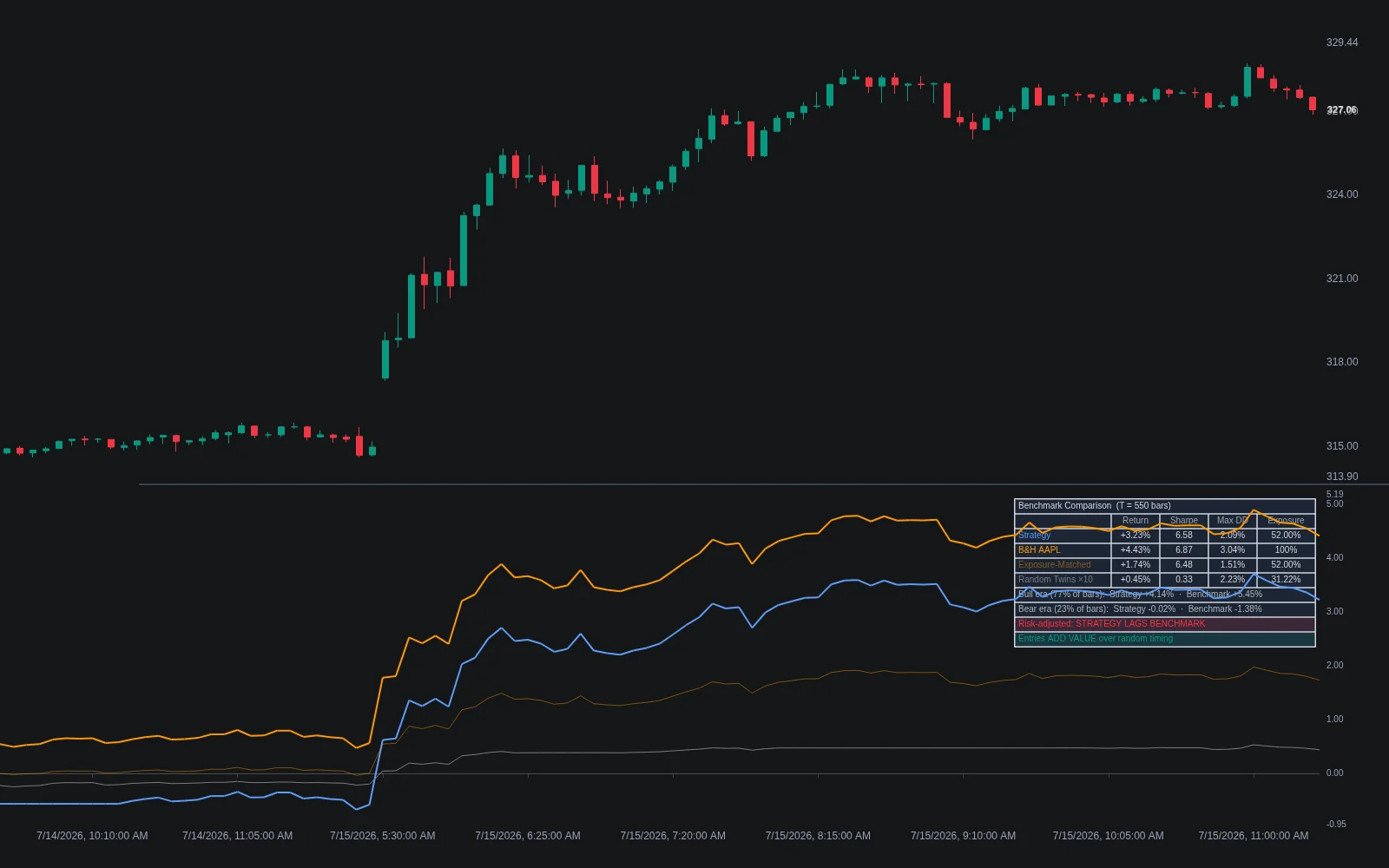
The video below shows how an indicator such as this one is added to a chart in Quant Charts.
Backtest with the hurdle in mind. Describe a rule to Quant, our coding agent, in plain language, for example buying an index fund when it closes above its 50-day moving average and moving to cash when it closes below. Quant writes the Pine Script; open Code to inspect it, then click Run. The Backtest Summary reports net profit, trade count, win rate, max drawdown and profit factor. Set commission and slippage in the strategy's Properties, then translate net profit into an annual percentage over the test period and put it next to the CD APY. The Library's drawdown statistics entry explains how to read the drawdown that the CD never has.
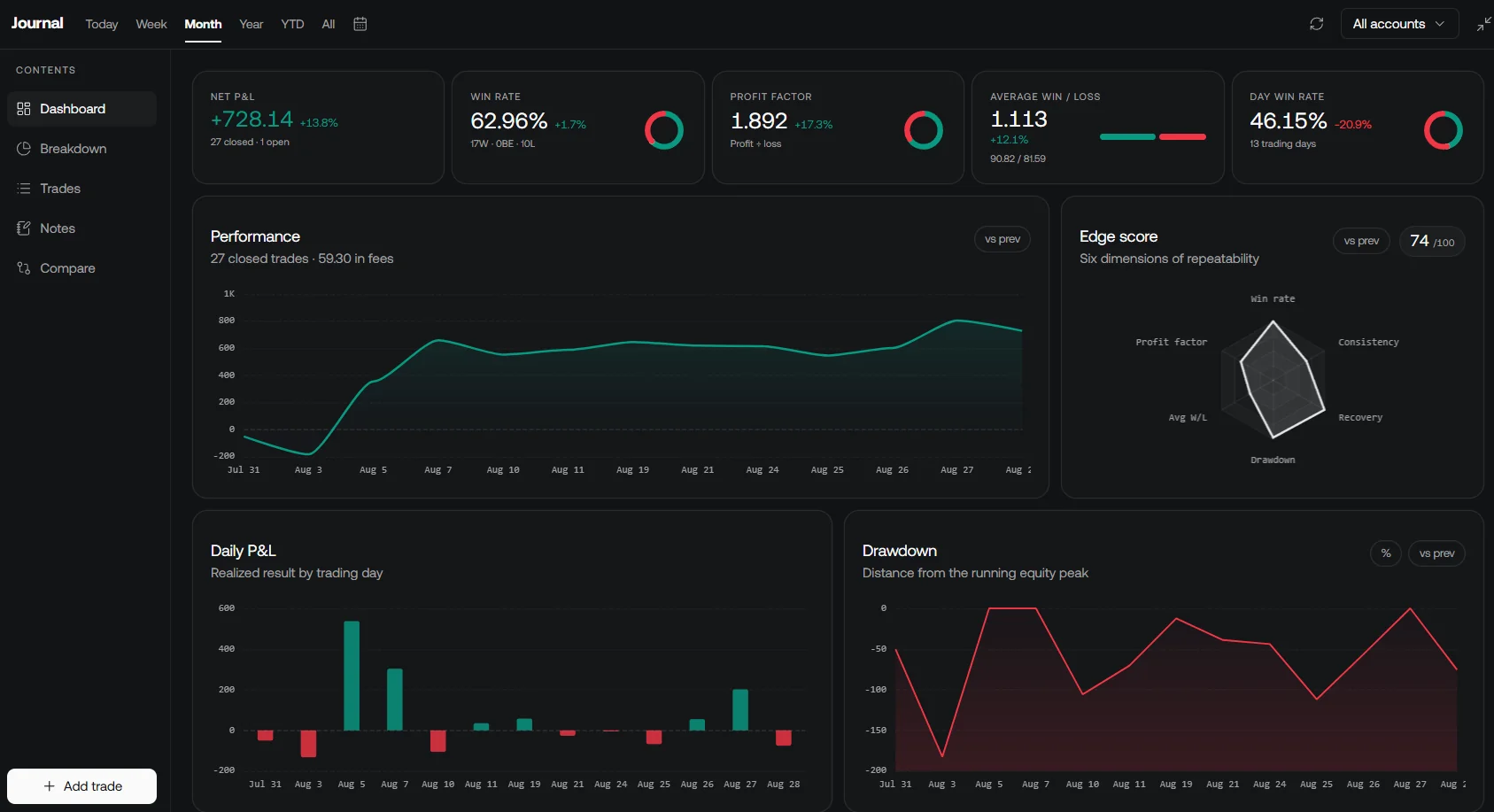
Keep the record honest. The Journal in Quant Charts holds manual accounts with a starting balance you set. Recording every trade there gives a realized return to set against the CD rate, rather than a remembered one.
FAQs
What is a certificate of deposit?
A bank or credit union deposit held for a fixed term at a stated rate. Federal rules classify it as a time account with a maturity of at least seven days, and the bank must disclose the rate, APY, compounding, maturity date, early withdrawal penalty and renewal terms before you open it.
Are CDs insured?
Yes, at insured institutions. The FDIC covers CDs at banks and the NCUA covers share certificates at credit unions, each up to $250,000 per depositor, per ownership category, per institution. The limit applies to all your deposits at that institution in that category combined, not to each CD.
What happens if I withdraw early?
The bank charges the early withdrawal penalty disclosed at opening, usually a set number of days or months of interest, which can exceed the interest earned and reduce principal. For tax purposes you report the full interest credited and deduct the penalty separately.
What happens when a CD matures?
For automatically renewing CDs longer than one month, the bank must send notice at least 30 days before maturity or 20 days before the end of a grace period of at least five days. During the grace period you can withdraw without penalty; otherwise the CD renews at the rate then offered.
What is a brokered CD?
A CD bought through a brokerage or deposit broker rather than directly from a bank. It may be sold before maturity on a secondary market instead of redeemed, which can return less than principal, and the SEC advises checking the background of the broker and the issuing bank because deposit brokers are not licensed by any agency.
How does a CD rate relate to Quant Charts?
Quant Charts does not sell or chart CDs. A CD's APY is the insured return a strategy must beat, so it belongs in the Risk-Free Rate input of the Sharpe Ratio and Benchmark Comparison Discipline indicators and next to the net profit that Quant's Backtest Summary reports.
References
LuxAlgo Resources
- Sharpe Ratio and Drawdown Statistics concepts (LuxAlgo Library)
- Sharpe Ratio and Benchmark Comparison Discipline indicators (LuxAlgo Library)
- Making strategies with Quant and Reading a strategy backtest (LuxAlgo Docs)
- Journal (LuxAlgo Docs)
External Resources
- 12 CFR 1030.2 Definitions, 1030.4 Account disclosures and 1030.5 Subsequent disclosures, Regulation DD (Cornell Legal Information Institute)
- Understanding Deposit Insurance and Are My Deposit Accounts Insured by the FDIC? (FDIC)
- Electronic Deposit Insurance Estimator and BankFind Suite (FDIC)
- Share Insurance Coverage (National Credit Union Administration)
- Certificates of Deposit (CDs) (Investor.gov)
- High-Yield CDs: Protect Your Money by Checking the Fine Print (U.S. Securities and Exchange Commission)
- Publication 550, Investment Income and Expenses (Internal Revenue Service)
Read next