Congress Stock Trading Rules and Key Data Sources
Congressional stock disclosures are public records of reported transactions, not a live feed of lawmakers’ portfolios. The STOCK Act requires qualifying securities transactions above $1,000 to be reported within a deadline that can be earlier than 45 days. Understanding the filing, its timing, and its limitations is essential before drawing conclusions about either investment performance or ethics.
This guide explains the disclosure rules, where to find original records, how to evaluate trading patterns, and how to use LuxAlgo charts and Quant for a clearly defined research question. Legal guidance and the legislative record were checked September 8, 2026; dated proposals and interviews are identified separately.
- Start with the filing: check the asset, owner, transaction type, amount range, and any amendment.
- Keep dates separate: the transaction, filing, public availability, and your own discovery may occur on different days.
- Question performance claims: estimated returns from incomplete disclosures are not verified brokerage results.
- Use charts for market context: price and volume cannot identify a lawmaker’s orders or establish insider trading.
Stock-Trading Laws for Congress
What the STOCK Act Requires
The Stop Trading on Congressional Knowledge Act of 2012 affirmed that members and congressional employees are subject to insider-trading prohibitions and owe a duty concerning material, nonpublic information obtained through their official roles. It also added periodic transaction reporting to the broader financial-disclosure framework. Filing a trade does not make unlawful trading lawful, and a late filing alone does not prove insider trading.
For House members, officers, and covered employees, the House Ethics Committee states that qualifying transactions over $1,000 must be disclosed by the earlier of 30 days after becoming aware of the transaction or 45 days after it occurred. The Senate guidance specifies 30 days after written notification, with the same 45-day outside limit. These are calendar-day deadlines, not a universal permission to wait 45 days.
Deadline example: suppose a qualifying transaction occurs August 3 and the House filer becomes aware that day. Thirty days later is September 2; 45 days later is September 17. The earlier date controls. If awareness occurs August 25, the September 17 outside limit still arrives first. These illustrations assume no special factual complication; filers should use their chamber’s guidance for their own obligations.
Reportable activity generally includes covered transactions by the member, spouse, and dependent children, subject to exceptions. Annual-report obligations and PTR obligations are not identical: candidates and some staff categories have different requirements. A third-party investment manager does not automatically remove reporting duties.
Annual Financial Disclosures Under EIGA
Annual reports generally cover the previous calendar year and are due May 15, with authorized extensions available. The House’s 2026 instruction guide for calendar-year 2025 reports explains report-specific rules. The following is a reading guide, not an exhaustive filing checklist.
| Category | What to look for |
|---|---|
| Earned income | The filer’s reportable non-federal income of $200 or more per source; family-income rules differ. |
| Investment assets | Generally, value above $1,000 at year-end or income above $200 during the year; exclusions apply. |
| Transactions | Reportable purchases, sales, and exchanges above $1,000; the amount is transaction value, not profit. |
| Liabilities | Generally, obligations above $10,000, with rules that depend on the debt and filer. |
| Gifts and travel | Use the reporting year’s thresholds and exclusions; permission to accept a gift or trip is a separate issue. |
| Other interests | Outside positions, employment arrangements, and continuing private-employer benefits where required. |
Do not reuse the old $335 gift threshold as a current rule. For example, Senate gift guidance for calendar year 2026 identifies a $525 aggregate reporting threshold for gifts from a non-relative source, subject to the applicable exclusions. That does not authorize accepting otherwise prohibited gifts.
The House’s disclosure requirements also cover relevant outside positions and agreements, including deferred compensation and future employment. New-filer and candidate reports can require identification of sources that paid more than $5,000 for services during the applicable period. Read the specific schedule rather than assuming every report contains the same information.
Why a PTR Feed Is Not a Complete Portfolio
The Senate explains that publicly traded mutual funds and ETFs generally qualify as Excepted Investment Funds. Qualifying fund transactions are reported on the next annual or termination report rather than a PTR. Individually owned securities in a separately managed account generally remain reportable. Consequently, an empty PTR search does not establish that someone owns no investments.
Ethics and Past Cases
A financial conflict can arise when an official’s responsibilities overlap with personal investments. A committee assignment, confidential briefing, or pending contract may justify careful scrutiny. Establishing wrongdoing requires evidence about the applicable duty, information, conduct, and outcome—not simply a trade followed by a favorable price move.
Keep Allegations and Outcomes Separate
Richard Burr’s 2020 stock sales drew investigations. Burr denied using private information; the Justice Department closed its criminal investigation without charges in 2021. In January 2023, Burr said the SEC had also concluded its investigation without action. Associated Press reported those outcomes. The episode illustrates why an account of scrutiny must include the subsequent disposition.
A different example is former Representative Christopher Collins. In its January 2020 sentencing announcement, the Justice Department described a scheme involving confidential clinical-trial information he received as an Innate Immunotherapeutics director and passed to his son. Collins received a 26-month sentence for the scheme and false statements. The Justice Department’s clemency record lists his presidential pardon on December 22, 2020. Corporate-board information and congressional information should not be conflated.
When reviewing other controversies, check the original transaction and ownership, the timing of the relevant public announcement, the official’s response, and any enforcement result. An estimated amount band is not an exact trade size, and a spouse’s transaction should not be described as personally executed by the member without evidence.
Watch: Congressional Stock Trading Under Scrutiny
This Amanpour and Company interview originally aired May 22, 2023. Reporter Rebecca Ballhaus discusses conflicts and accountability with Hari Sreenivasan. It provides historical context for the debate; its legislative discussion is not a statement of today’s bill status.
Where to Track Congress Trades
| Source | Useful for | Check before relying on it |
|---|---|---|
| House Clerk financial disclosures | Original House reports and amendments | Select the correct filer, year, and report type. |
| Senate public disclosure search | Original Senate records | Use the public search portal; eFD filing accounts serve filers. |
| LuxAlgo Congress Tracker | A readable table of disclosures with transaction dates, filing dates, amount ranges, and source links | Open the original filing and check the dataset’s freshness. |
| InsiderFinance Congress tracker | An alternative interface for browsing reported transactions | Confirm field definitions, source links, update timing, and current access terms. |
The Senate’s March 2026 instructions say reports become publicly available within 30 calendar days of filing. Its online collection includes member reports filed since 2012, retained until six years after membership ends; candidate reports remain online for one year after candidacy ends. Coverage and retention differ by record type. Follow the portals’ use conditions, including restrictions on commercial uses and solicitation; public access does not mean unrestricted use.
Aggregators can make a newly available filing easier to discover. They cannot turn a transaction that was private for weeks into a contemporaneous public signal. Compare the actual filing and publication history rather than taking “real time” in a product description to mean immediate reporting of every trade.
LuxAlgo Congress Tracker and Open-Source Market Trackers
LuxAlgo’s Congress Tracker is a starting point for browsing the public record. Its amount ranges preserve the disclosed bands rather than presenting a midpoint as an exact investment. Use the original-source link to confirm a row, especially if the asset name, date, or transaction type looks unusual.
For a reproducible research workflow, Market Trackers provides open-source infrastructure and published datasets. The project documents provenance such as source URL, retrieval time, and parser information. Its pipeline ships no market prices and computes no investment scores, so a return study needs separately sourced, appropriately licensed price data and an explicit methodology.
Market Trackers and the hosted Congress Tracker are distinct from the chart interface. Use the project’s documentation to understand the data model and the hosted tracker to inspect available records. Neither a normalized row nor an AI explanation substitutes for checking the government record when the interpretation matters.
Fields to Verify Before Drawing a Conclusion
- Identity and ownership: resolve similar names, chamber, member, spouse, dependent, or joint ownership.
- Asset: confirm the security, ticker, share class, and whether it is stock, an option, a fund, or another instrument.
- Action: distinguish a purchase, full or partial sale, exchange, option exercise, and amendment.
- Amount: retain the reported range. If you estimate with a midpoint, label that assumption and test alternatives.
- Dates: record transaction date, filing date, first verified public availability, and when your system obtained the record.
- Version: retain the source and amendment history so an amended entry is not counted as a second independent trade.
Trading-Pattern Analysis Without Hindsight
Sector Preferences and Activity Totals
To compare sectors, define the period and universe first: which chamber, which filers, which assets, and whether dates refer to trading or disclosure. Apply a consistent sector classification, and preserve unmapped securities rather than silently excluding them. Party-level summaries also need the membership classification applicable to the observation period.
Transaction counts and dollar estimates answer different questions. Ten small purchases can outnumber one large sale without representing a larger cash commitment. Adding minimum and maximum reported values produces a range for disclosed activity, not precise market trading volume or portfolio exposure. Options premiums and stock transaction amounts are not interchangeable measures of economic exposure.
A 2022-versus-2021 comparison, for example, should use comparable coverage and an explicit cutoff for late reports and amendments. A decrease in published rows may reflect missing data or changed coverage rather than a genuine reduction in trading. Show the calculation and limitations alongside any sector or party chart.
Why “Congress Beat the S&P 500” Needs a Methodology
A return estimate needs entry and exit prices, position weights, cash balances, dividends, corporate actions, and treatment of positions still open. Disclosures rarely provide everything needed to reconstruct an actual account. Equal-weighting each reported purchase answers a different question from estimating dollars invested using amount-band midpoints.
Compare identical dates and appropriate benchmarks, include losing and delisted securities, and separate stock-price changes from dividend-inclusive returns. A ranking built from selected winners cannot establish that lawmakers as a group outperform by a fixed annual percentage. Nor does estimated outperformance establish access to inside information.
Timing example: imagine a purchase at a market price of $100 on August 3 that first becomes publicly observable to your research system on September 2, when the price is $110. If it later reaches $115, the trade-date price change is 15%, but the public-information entry’s price change is about 4.55%, before costs. The first number was not achievable merely by following the later disclosure. These are hypothetical prices, not a lawmaker’s returns.
Investigate the Market Context in LuxAlgo
After checking a filing, add its supported symbol to a LuxAlgo watchlist and inspect the chart around the date the information became usable. The advanced watchlist also provides financial and news views for context. Earnings, sector moves, or macroeconomic news may explain a price change independently of the filing.
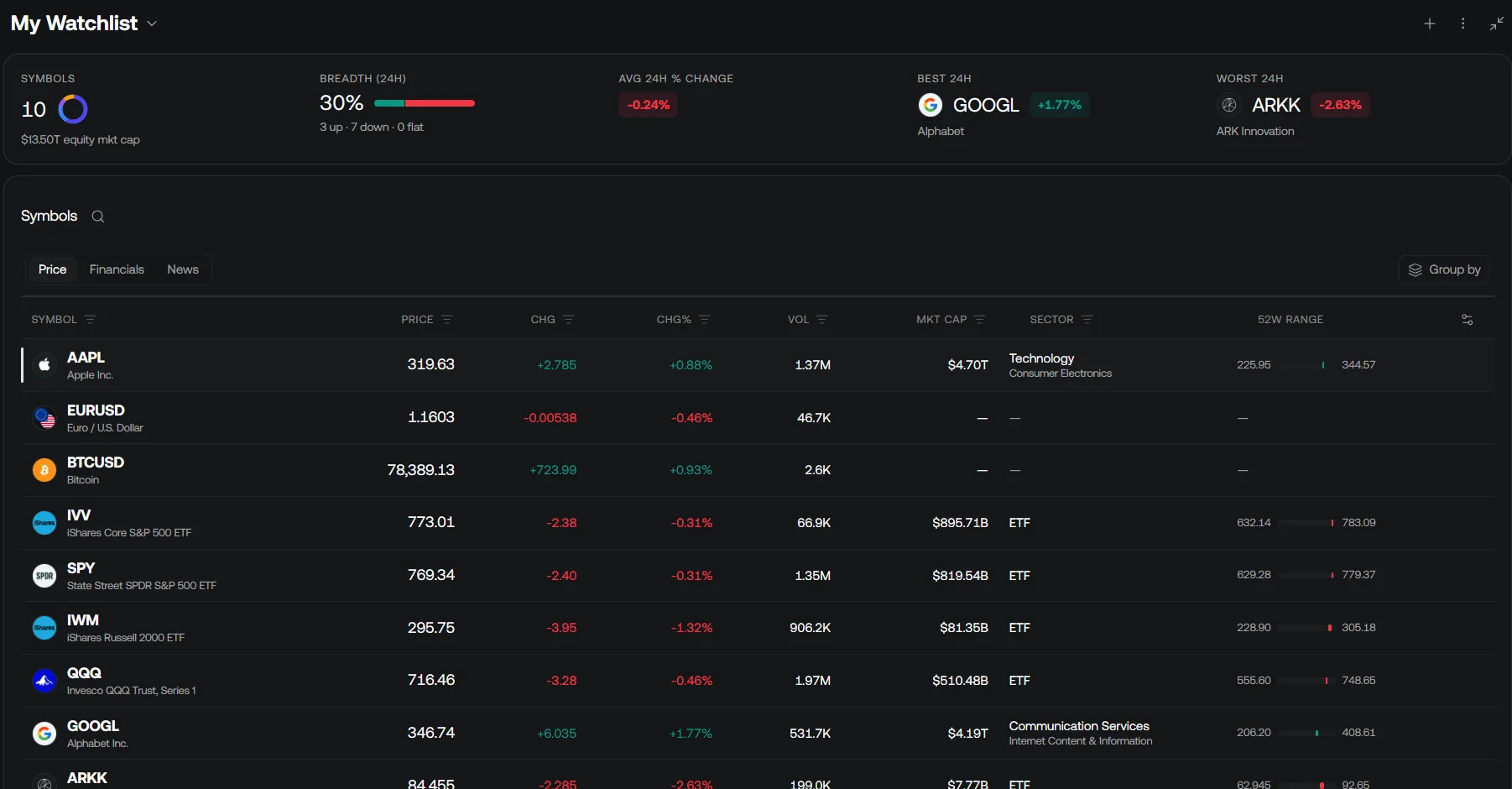
Use multi-chart layouts to inspect the stock and an appropriate market or sector reference over the same dates. Check the feed and session. LuxAlgo’s data documentation explains that U.S. equity data comes from EDGX, not consolidated all-venue volume.
Volume Profile can describe where trading activity occurred by price; volume delta can describe differences in classified buying and selling activity. Neither reveals the identity of a lawmaker’s orders, distinguishes informed trading from speculation, or proves that a filing caused market-wide accumulation. Use these tools to form questions, not to assign motives.
Build a Defined Disclosure Study with Quant
Quant, our coding agent, can help turn explicit research instructions into a strategy. First prepare and validate the event information you intend to supply. Do not assume a chart strategy automatically retrieves congressional filings, reconstructs historical publication times, or handles an entire portfolio across many symbols.
For a small educational test, choose one supported stock and manually verified event timestamps. Specify that an entry can occur only after information was publicly available and obtainable by the chosen workflow; use the next session if precise intraday availability is unknown. Define the holding period, exit timing, position size, duplicate-event handling, and commission and slippage assumptions before testing.
Review the generated code, then run it while signed in. Check entries and exits in the strategy viewer’s Trades Log against the event list. Evaluate drawdown, trade count, net results, and a comparable baseline. Reserve later observations for a test that was not used to select the rules.
A simulated two-day reporting window is a policy counterfactual. It can explore how a shorter delay might change a defined model, but it must not be presented as a historical strategy using information that readers actually had two days after the trade. Generating code faster does not solve missing data or establish a profitable edge.
Proposals to Change Congressional Trading Rules
Separate a bill’s introduction, committee action, passage in one chamber, and enactment. The official H.R. 7008 record identifies a version placed on the Senate calendar on August 6, 2026. The bill-status record checked September 8 still lists that action and no enacted law. It is a proposal, not an existing blanket ban.
That Stop Insider Trading Act version would generally prohibit members, spouses, and dependent children from purchasing covered investments and require public notice 7–14 calendar days before sales. It includes exclusions for specified funds, small-business interests, and qualifying trusts, plus other exceptions. It does not simply require disposal of every existing holding.
Its enforcement formula would combine the greater of $2,000 or 10% of a violating transaction with specified realized gains, and require disposal of prohibited purchases. Those proposed consequences should not be confused with current late-disclosure penalties. Other proposals can differ on family coverage, divestment, trusts, enforcement, and which offices are covered; identify the exact bill and version before comparing them.
A qualified blind trust also has formal requirements. It is not merely an ordinary brokerage account with an adviser. Questions about who chooses the trustee, what holdings are known at the start, and which communications are permitted matter when assessing whether an arrangement addresses a conflict.
FAQs
What happens if members of Congress don’t follow the STOCK Act’s disclosure rules?
A required report filed more than 30 days after its due date can trigger a $200 late-filing penalty, with waiver rules. Knowing or willful failures and false statements can have separate civil, disciplinary, or criminal consequences. A late report is not automatically an insider-trading offense.
What changes do proposed reform bills suggest to address ethical concerns about congressional stock trading?
Proposals may restrict purchases, require advance notice of sales or divestment, regulate trusts, and change penalties. Family and officeholder coverage varies. Check the exact bill, version, and legislative status: a proposal or House-passed bill is not automatically federal law.
Why do many Americans support banning stock trading by members of Congress and their families?
Supporters want to reduce conflicts between public duties and household finances, limit opportunities to misuse confidential information, and strengthen trust. The percentage supporting a ban depends on the poll’s date, sample, and wording; no single undated figure describes public opinion reliably.
For the penalty distinction, see the Senate disclosure instructions, page 7. The legislative example above is linked to its official text and status.
Use the Record as a Research Starting Point
Start with an original disclosure, preserve its uncertainty, and investigate what was known when. The LuxAlgo Congress Tracker helps locate reported activity; LuxAlgo charts help inspect market context; Quant can help build a reviewable test from validated inputs. Those tools support analysis without converting a delayed filing into proof of wrongdoing or a guaranteed trading signal.
References
- House Ethics Committee: financial disclosure and PTR deadlines
- House 2026 instruction guide for calendar-year 2025 reports
- Senate financial disclosure guidance and FAQs
- Senate March 2026 financial disclosure instructions
- STOCK Act of 2012: enacted text
- H.R. 7008: Senate-calendar version and status
- LuxAlgo Market Trackers: sources, provenance, and data limits
Read next