Crypto Tax: Key Trading Considerations

For United States federal tax purposes, cryptocurrency is property. That single classification, set out in IRS Notice 2014-21 and repeated on the IRS digital assets page, explains almost everything else about crypto taxes: selling a coin for dollars is a sale of property, swapping one coin for another is an exchange of property, and receiving coins for work, mining or staking is income measured in dollars on the day you receive them. This guide follows the IRS's own digital asset guidance and its frequently asked questions through what counts as a taxable event, how gain and income are calculated, how to identify which units you sold, what brokers now report on Form 1099-DA, and where the figures go on your return. It closes with how Quant Charts users keep the trade record those figures depend on. It covers federal rules only and is not tax advice.
What the IRS Means by a Digital Asset
The IRS defines a digital asset as any digital representation of value recorded on a cryptographically secured, distributed ledger or similar technology. Convertible virtual currencies such as Bitcoin, stablecoins and non-fungible tokens all fall within it. Because a digital asset is property rather than currency, the general tax principles that apply to property transactions apply to it, and the IRS directs taxpayers to Publication 544 for gains and losses and Publication 551 for basis.
Every federal income tax return now carries a digital asset question that must be answered yes or no. The IRS page explains the split. You answer no if you only held digital assets, bought them with dollars without selling, or moved them between wallets or accounts you own. You answer yes if you received digital assets as payment, as a reward or award, from mining, staking or similar activities, or from an airdrop following a hard fork, or if you sold, exchanged or otherwise disposed of a digital asset for another digital asset, for dollars, or for goods or services. Paying a transaction fee in a digital asset also counts as a disposal.
Taxable and Non-Taxable Events
The table summarizes the IRS frequently asked questions on virtual currency transactions.
| Event | Tax result | IRS FAQ |
|---|---|---|
| Buying crypto with dollars and holding it | Not taxable; establishes basis | Q5, digital assets page |
| Selling crypto for dollars | Capital gain or loss | Q4, Q7 |
| Exchanging one crypto for another | Capital gain or loss on the crypto given up; new basis in the crypto received | Q16 to Q18 |
| Paying for goods or services with crypto | Capital gain or loss equal to the value received minus adjusted basis | Q14, Q15 |
| Receiving crypto for services | Ordinary income at fair market value when received; self-employment tax if an independent contractor | Q9 to Q13 |
| Mining rewards | Ordinary income at fair market value on receipt | Notice 2014-21 |
| Staking rewards | Ordinary income when you gain dominion and control | Rev. Rul. 2023-14 |
| Airdrop after a hard fork | Ordinary income at fair market value when recorded and controllable; no income if you received nothing | Q22 to Q25 |
| Transfer between your own wallets | Not taxable, even if an exchange issues a form | Q38 |
Computing Gain or Loss
The FAQ sets out the arithmetic in three answers. Your basis in crypto bought with dollars is what you spent to acquire it, including fees, commissions and other acquisition costs, all measured in dollars. Your gain or loss on a sale is the difference between the amount you received and your adjusted basis, reported in dollars. When you exchange crypto for other property, including another crypto, the gain or loss is the fair market value of what you received minus the adjusted basis of what you gave up, and the property you received takes a basis equal to that fair market value.
The holding period decides the rate. Under the FAQ it begins on the day after you acquired the crypto and ends on the day you sell or exchange it. Held one year or less, the gain or loss is short-term and taxed as ordinary income; held more than one year, it is long-term and may qualify for the lower capital gains rates that IRS Tax Topic 409 lists by taxable income. The same topic's loss rules apply: losses offset gains, and a limited amount of any excess offsets other income each year with the remainder carried forward. Because the holding period is counted per unit, a trader who buys in several lots and sells part of the position needs to know which lots were sold.
Which Units Did You Sell?
The FAQ allows you to choose which units are deemed sold if you can specifically identify them. Specific identification means documenting the unit's unique digital identifier, such as its private key, public key and address, or keeping records for all units of that crypto held in a single account, wallet or address that show four things: the date and time each unit was acquired, its basis and fair market value when acquired, the date and time it was sold or exchanged, and its fair market value and the proceeds when disposed of. If you do not identify specific units, the FAQ deems them sold in chronological order, first in, first out.
The choice matters in a rising market. Selling the oldest units first realizes the largest gains and the longest holding periods; identifying high-basis units realizes less gain now and leaves more embedded gain for later. Either way the records described above must exist at the time of the sale, and broker reporting on Form 1099-DA now applies its own identification rules per account, which is another reason to keep the ledger current.
Income Events: Services, Mining, Staking and Airdrops
Crypto received as payment for services is ordinary income equal to its fair market value in dollars when received, which for an on-chain transaction is the time it is recorded on the ledger. If the services were performed as an independent contractor, the FAQ treats the value as self-employment income subject to self-employment tax; if paid as wages, it is subject to withholding and reported on Form W-2. Notice 2014-21 applies the same rule to mining: the fair market value of mined coins on the date of receipt is gross income, and mining carried on as a trade or business is self-employment income. Revenue Ruling 2023-14 extends the analysis to staking on a proof-of-stake network: rewards are included in gross income in the year the taxpayer gains dominion and control over them, meaning the ability to sell, exchange or transfer them.
Hard forks are handled in Revenue Ruling 2019-24 and FAQ questions 22 to 25. A fork alone, with no new coins received, produces no income. If the fork is followed by an airdrop and you receive new coins, you have ordinary income equal to their fair market value when recorded and controllable, and that amount becomes your basis. In every one of these cases the coins received are later sold as property, so the income event sets the basis for a second, capital event when you dispose of them.
Broker Reporting: Form 1099-DA
Brokers that effect digital asset sales for customers must report them on Form 1099-DA, Digital Asset Proceeds From Broker Transactions. The IRS instructions describe the phases: for sales effected after 2025, gross proceeds are reported for all digital assets, and basis is reported for digital assets that are covered securities, with optional basis reporting for noncovered securities and simplified reporting for qualifying stablecoins and specified non-fungible tokens. The form carries a code and name for the asset, number of units, dates acquired and disposed of, proceeds, cost or other basis where known, any wash sale loss disallowed, whether basis was reported to the IRS, federal tax withheld, and the checkbox code to use on Form 8949.
Two consequences follow. Crypto trades now reach the IRS through the same matching process as stock trades, so the figures you report on Form 8949 need to reconcile with the broker's. And because a broker only knows the basis of units acquired in the same account, coins moved in from a wallet or another platform will often show no basis, leaving you to supply it from your own records with an adjustment on Form 8949.
Where It Goes on the Return
- Sales and exchanges. FAQ question 43 directs capital transactions to Form 8949, Sales and Other Dispositions of Capital Assets, with the totals summarized on Schedule D. Each disposal is a row with description, dates, proceeds, basis and any adjustment.
- Ordinary income. FAQ question 44 directs income from services, mining, staking and airdrops to Form 1040 or Schedule 1, Additional Income and Adjustments to Income, or to the self-employment schedules where the activity is a trade or business.
- The question. The digital asset question on page one of Form 1040 must be answered even when no other line is affected.
- No form, still reportable. FAQ question 42 states that income, gain or loss from every taxable transaction must be reported for the year it occurred regardless of the amount and whether or not a payee statement or information return was received.
Records the IRS Expects
FAQ question 46 states that taxpayers must keep records sufficient to establish the positions taken on their returns, and gives as examples records of receipts, sales, exchanges and other dispositions together with the fair market value of the crypto at each event. Combined with the specific identification rules, the practical list is: date and time of each acquisition and disposal, quantity, the dollar value at that moment, fees paid and the currency they were paid in, the counterparty platform or wallet, and for transfers between your own wallets, evidence that both sides belong to you. Exchanges close, export formats change and blockchains do not record dollar prices, so the record has to be kept as you go rather than reconstructed at filing time.
Where Quant Charts Fits
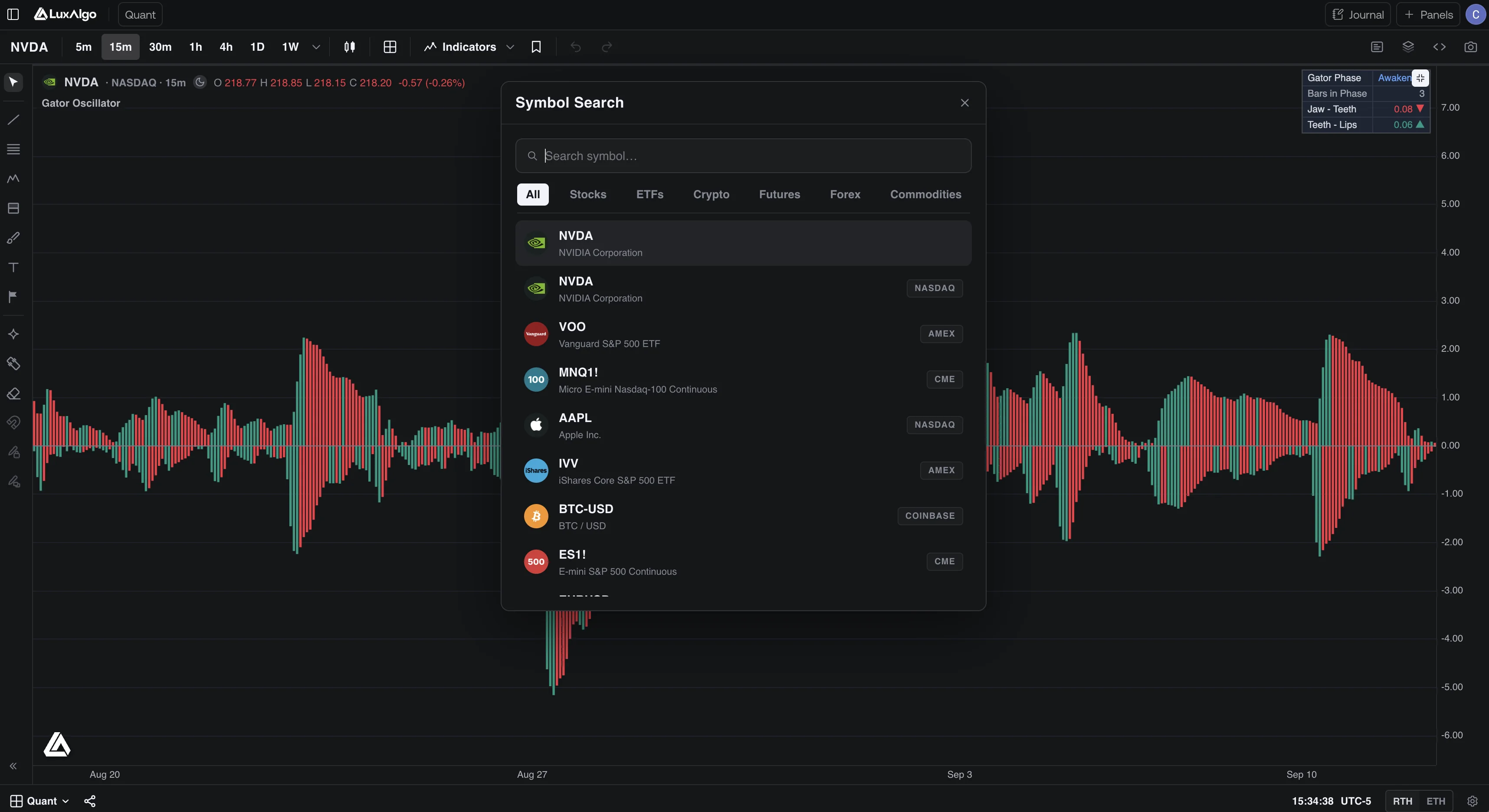
Quant Charts does not compute taxes, produce Form 8949 or hold digital assets; no LuxAlgo tool places orders or moves coins. What it provides is the chart and the record for the trades you make elsewhere. Crypto data is included on every plan, sourced from Binance spot and perpetuals, Binance.US, Coinbase and Hyperliquid, with pre-aggregated order-flow footprints available on those venues. Open Symbol Search from the top bar and use the Crypto tab, or pin a venue with the provider prefix, for example typing the Binance prefix before the pair to chart Binance spot specifically. Charting the venue you actually traded on matters for records, because the dollar price at the moment of a fill can differ between exchanges.
Log each fill with its dollar value and timestamp. The Journal in Quant Charts stores fills, not summaries. While the Journal is open, the drawing toolbar gains a Journal Trade tool: one click on the chart captures the time and price of that bar and opens the Add trade dialog prefilled with the symbol, so a crypto fill can be recorded at the exact price and time the IRS records require. Quantity, side, fee and execution time complete the entry, and the Journal rebuilds the round trip from the fills. Manual and import accounts also accept exports from supported brokers and journals.
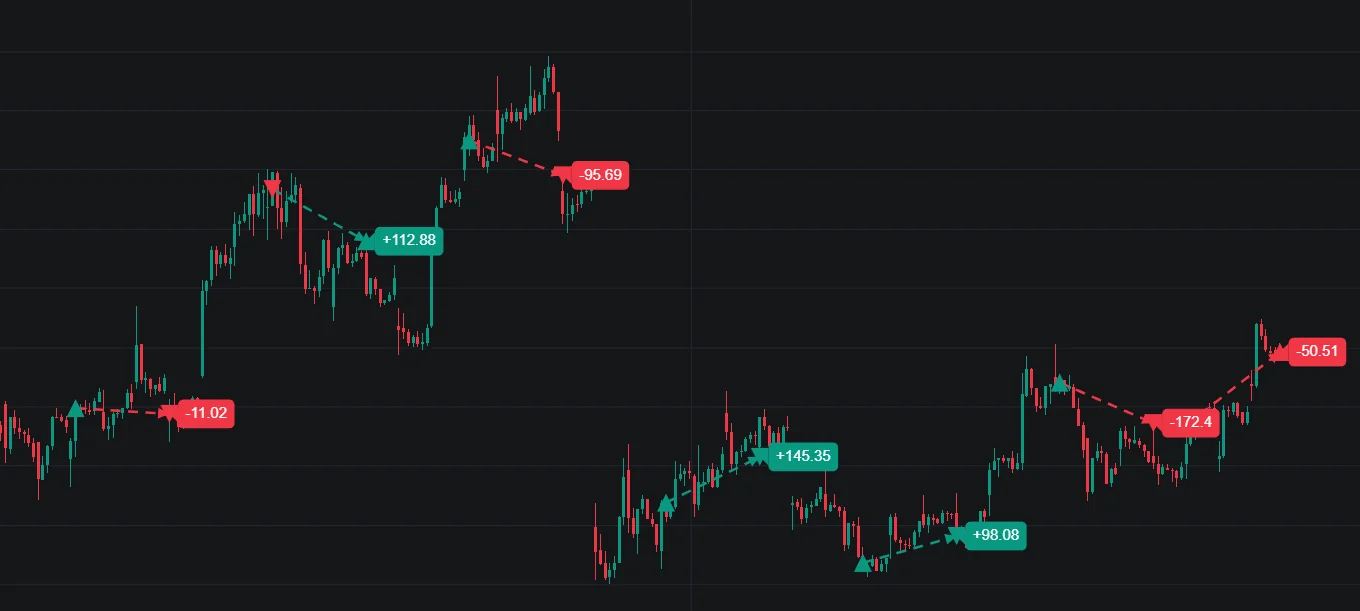
Watch the holding period. A trade's detail view shows when it was opened and closed and its duration, and the Journal's Breakdown page groups net results by hold time. Since the one-year line separates ordinary rates from long-term rates, and the IRS counts from the day after acquisition, seeing a position's age on the chart before closing it is cheaper than discovering it on Form 1099-DA the following spring.
The video below shows how indicators are added to a chart in Quant Charts.
Backtests are not transactions. When you describe a rule to Quant, our coding agent, in plain language, inspect the Pine Script under Code and click Run, the Backtest Summary's net profit, trade count, win rate, max drawdown and profit factor describe hypothetical trades on historical candles. Nothing is bought, sold or exchanged, so no digital asset transaction occurs and nothing is reported. Only fills executed on an exchange belong in the Journal account you reconcile against Form 1099-DA.
FAQs
How does the IRS classify cryptocurrency?
As property, not currency. Notice 2014-21 and the IRS digital assets page apply general property tax principles, so sales and exchanges produce capital gains or losses and coins received for services, mining or staking are ordinary income at their dollar value when received.
Is swapping one cryptocurrency for another taxable?
Yes. IRS FAQ question 16 treats an exchange of crypto held as a capital asset for another crypto as a disposal: you recognize gain or loss equal to the fair market value received minus your adjusted basis, and the new coin's basis is that fair market value.
Is moving crypto between my own wallets taxable?
No. FAQ question 38 states that a transfer between wallets, addresses or accounts you own is not a taxable event, even if an exchange issues an information return for it. Paying the network fee in crypto, however, is a small disposal of the coins used for the fee.
How are staking and mining rewards taxed?
As ordinary income at fair market value in dollars. Notice 2014-21 includes mined coins in gross income on the date of receipt, and Revenue Ruling 2023-14 includes staking rewards when the taxpayer gains dominion and control. That value becomes the basis for the later sale of the coins.
What is Form 1099-DA?
The information return brokers use to report customers' digital asset sales, with gross proceeds for sales effected after 2025 and basis for covered securities. It lists the asset, units, dates, proceeds, basis where known, disallowed wash sale loss and the Form 8949 checkbox code, and the IRS matches it against your return.
Does Quant Charts calculate crypto taxes?
No. Quant Charts charts crypto from Binance, Binance.US, Coinbase and Hyperliquid on every plan and its Journal records fills with price, time, quantity and fees, which supports the records the IRS requires. Quant backtests are hypothetical and create no transactions. Tax computation belongs with your preparer or tax software.
References
LuxAlgo Resources
- Quant Charts market data and venues (LuxAlgo Docs)
- Journal overview, Trades and Breakdown (LuxAlgo Docs)
- Making strategies with Quant and Reading a strategy backtest (LuxAlgo Docs)
- Essential Tax Forms: A Guide for Investors (LuxAlgo Blog)
External Resources
- Digital assets and Frequently asked questions on virtual currency transactions (IRS)
- Notice 2014-21, Revenue Ruling 2019-24 and Revenue Ruling 2023-14 (IRS)
- About Form 1099-DA and Instructions for Form 1099-DA (IRS)
- About Form 8949 and About Schedule D (IRS)
- Topic No. 409, Capital Gains and Losses, Publication 544, Sales and Other Dispositions of Assets and Publication 551, Basis of Assets (IRS)
Read next