Cryptocurrency Explained: Understand Digital Assets
Cryptocurrency is a digital asset whose transfers and ownership are governed by a network’s rules and cryptographic signatures. Bitcoin and Ethereum are prominent examples, but coins, stablecoins, and application tokens serve different purposes and carry different risks. A token’s availability online does not make it safe, decentralized, or valuable.
This guide explains the technology, the main asset categories, custody choices, and practical research steps. For market analysis, LuxAlgo combines charting and AI tools: use Quant Charts to inspect a specific market and Quant, our coding agent, to develop research logic. Understanding a chart is one part of evaluating a digital asset; it does not replace checking the asset’s design, custody, or liquidity.
Cryptocurrency Basics Explained
A cryptocurrency balance is recorded by the relevant network or, when assets are held through a custodian, reflected in that provider’s account records. Sending an asset onchain requires a valid transaction. Trading inside an exchange can instead change its internal balances without an immediate blockchain transfer.
| Question | Traditional money and payment systems | Cryptocurrency systems |
|---|---|---|
| Who controls it? | Central banks issue base money; banks and payment providers operate account and payment services. | Control depends on the protocol, validators or miners, developers, governance, and any token issuer. |
| How quickly does it settle? | Varies by payment rail, institution, currency, and destination. | Varies by network, fees, congestion, confirmations, and provider policies. |
| What protects the user? | Account controls and applicable legal or institutional protections. | Network rules and key security, plus any protections actually offered by the service used. |
| Can a mistake be reversed? | Disputes or recalls may be possible, depending on the payment method. | An onchain transfer generally has no central chargeback mechanism. |
The important comparison is the specific service and transaction, not a blanket claim that conventional payments take days while cryptocurrency is instant. A notification, a block confirmation, finality, and an exchange credit are different events.
Core Technology
Understanding Blockchain
A blockchain links batches of transactions or state updates into an ordered history. Nodes check proposed changes against shared rules. Cryptographic links make changes to earlier history detectable, while the consensus mechanism determines which valid history the network accepts. See Bitcoin’s explanation of transactions and mining.
“Tamper-resistant” is more useful than “tamper-proof.” Networks can experience competing blocks, reorganizations, software failures, or attacks. Security depends on the particular protocol and its participants. A public ledger also cannot prove that an offchain claim, such as ownership of a physical asset, is true merely because someone records it.
A conventional database can also have replication, access controls, and audit logs. The distinctive question is how participants establish agreement and who has authority to change records. Public blockchains allow broad verification; permissioned systems can restrict participation and access.
Security Through Decentralization
Distributing validation can reduce dependence on a single operator. It does not remove every concentration of power: mining pools, large validators, software providers, token administrators, and custodians may still matter. Nor does a resilient network guarantee that an exchange, bridge, or wallet application will remain available.
Public-chain activity is not automatically anonymous. Addresses and transfers can be visible, and identities may become associated with them. Bitcoin’s user guidance explains both this privacy limitation and the responsibility that comes with controlling your own keys.
Mining and Verification
Bitcoin uses proof-of-work. Miners compete to find a valid block hash, and network nodes independently check the rules; miners do not have permission to invent valid balances. Bitcoin targets an average block interval of roughly ten minutes, but an individual block can arrive sooner or later. Difficulty adjusts to changes in mining activity rather than guaranteeing a fixed wait for every payment.
Ethereum uses proof-of-stake, not mining. Validators stake ETH, propose blocks, and attest to the chain; specified misconduct can trigger penalties. Its current consensus documentation describes 12-second slots and epochs of 32 slots. A slot is an opportunity to propose a block, not a promise that every transaction finalizes in 12 seconds. Read the Ethereum proof-of-stake documentation for the distinction between inclusion and finality.
Main Cryptocurrency Categories
Bitcoin: The Original Cryptocurrency
Bitcoin is used for transfers and is held by some investors as a store-of-value asset. That use does not make its market price stable. Under its current issuance rules, supply is capped at 21 million BTC, and one BTC contains 100 million satoshis. The Bitcoin FAQ explains divisibility and declining issuance. A supply cap or a halving does not guarantee a price increase; demand and market conditions still matter.
Ethereum and Smart Contracts
Ethereum supports applications through smart contracts: programs executed according to network rules. ETH is its native asset, used for transaction fees and staking. Tokens created by applications on Ethereum are not the same asset as ETH, and a useful application does not automatically make its token a good investment.
ETH has no Bitcoin-style fixed supply cap. New issuance and fee burning affect its outstanding supply, which can rise or fall depending on network conditions. Describing supply simply as “unlimited” misses those mechanics. Ethereum’s Ether guide explains the roles of issuance, gas fees, and burning.
Other Coins and Tokens
| Category | Examples or purpose | What to investigate |
|---|---|---|
| Native network assets | BTC, ETH, and assets associated with networks such as Solana, Cardano, BNB Chain, or Avalanche. | Consensus, issuance, network usage, operational history, and governance. |
| Stablecoins | Tokens such as USDT and USDC aim to track a reference currency. | Reserve structure, redemption eligibility, issuer controls, liquidity, and deviations from the peg. |
| Application and governance tokens | Tokens used for access, incentives, or voting in a protocol. | Actual token rights, supply unlocks, concentration, and whether usage creates demand for the token. |
| Tokenized claims and NFTs | Tokens that identify an item or represent a claimed right to an asset. | What rights are enforceable, who maintains the underlying asset, and how transfers or redemption work. |
These categories overlap. A name, ticker, or low unit price is not enough to identify an asset: check the network and, for a token, its contract address. Market capitalization is typically price multiplied by circulating supply; it is not the amount of cash available for holders to withdraw. For example, 100 million circulating tokens priced at $2 imply a $200 million market capitalization, even if trading liquidity is much smaller.
Stablecoins aim to maintain a peg; the name is not a guarantee. Fiat-backed models depend on an issuer and reserves, while other designs use different collateral or algorithms. Ethereum’s stablecoin overview distinguishes these mechanisms. Review the actual issuer’s terms before assuming that every holder can redeem directly at par. Lending a stablecoin adds risks beyond simply holding it.
Using and Storing Cryptocurrencies
Wallet Types and Security
A wallet helps manage keys and sign transactions; the assets themselves are recorded on the network. A private key authorizes signing, rather than acting like a bank PIN that a help desk can reset. A receiving address is derived according to the network’s rules and should not be confused with the secret key.
Two separate choices are often mixed together: hot versus cold describes exposure of keys, while custodial versus self-custodial describes who controls them. A hardware wallet can reduce online key exposure, but it cannot make a malicious transaction safe if you approve it.
| Choice | Practical advantage | Responsibility or risk |
|---|---|---|
| Hot wallet | Convenient interaction with applications and transfers. | Online devices and software may be compromised. |
| Cold or hardware-based key storage | Can keep signing keys isolated from an internet-connected computer. | Device authenticity, backups, and transaction review still matter. |
| Custodial account | Provider handles key management and may offer account recovery. | You depend on its security, solvency, withdrawal policies, and legal arrangements. |
| Self-custody | You control authorization without relying on a custodian to sign. | Losing all valid recovery methods can permanently remove access. |
Buying and Trading
Compare the product before comparing fees. A spot purchase, a derivative, and a fund share are different exposures. Some services allow onchain withdrawals; others do not. Check asset availability, the trading pair, spread, fees, supported networks, custody arrangements, withdrawal limits, and your location’s eligibility requirements.
Centralized exchanges, brokers, payment apps, and peer-to-peer services have different operational models. Do not assume every exchange has the same verification process, every payment app has higher fees, or every broker provides direct ownership. A decentralized exchange also introduces its own smart-contract, liquidity, and transaction-execution risks.
For a hypothetical spot purchase, spending $100 at $50,000 per BTC buys 0.002 BTC before fees. At $40,000 per BTC, that amount is worth $80: a 20% decline. A recovery from $40,000 to $50,000 requires a 25% increase. Leverage, financing, and liquidation rules can make the outcome substantially different from holding the spot asset.
Safety Guidelines
- Keep recovery phrases and private keys private. Do not put them into support chats, unfamiliar websites, or cloud-synced screenshots.
- Verify the recipient, asset, network, and amount before signing. Where appropriate, a small test transfer can expose an address or network mismatch before a larger transfer.
- Review contract permissions and spending limits. A hardware wallet does not prevent a loss caused by an approval you deliberately sign.
- Protect custodial accounts with unique credentials and strong multi-factor authentication where supported. Account authentication does not protect a separately exposed recovery phrase.
- Obtain wallet software and hardware through verified channels, maintain secure backups, and understand recovery before relying on the wallet.
These practices follow the concerns described in Ethereum’s security and scam-prevention guidance. No wallet category deserves an unconditional “high security” label. Security depends on how it is configured and used, and permanent loss cannot be summarized reliably by a single undated percentage of all coins.
Research Cryptocurrency Markets with LuxAlgo
Begin with LuxAlgo’s crypto market overview to inspect assets and price history. A public market-page snapshot is an introduction to research, not a trade recommendation or a guaranteed executable quote.
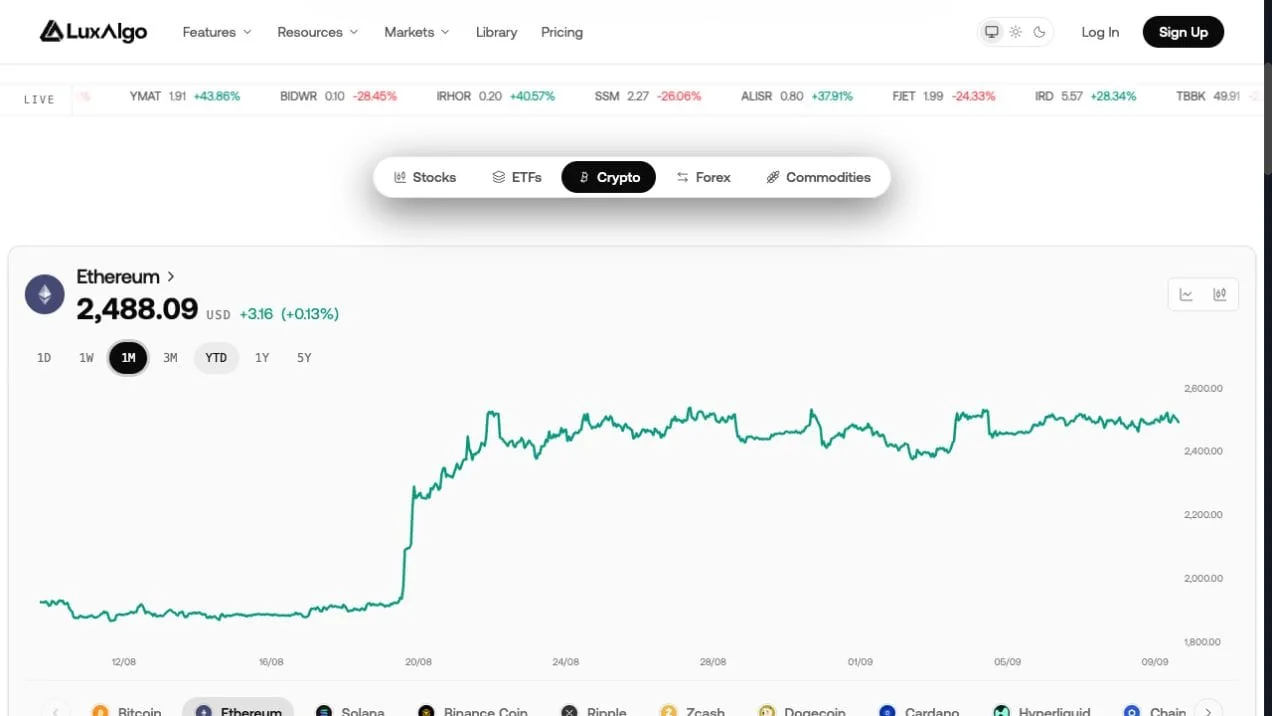
In Quant Charts, identify the exact exchange, base asset, quote asset, and instrument type. BTC/USD and BTC/USDT have different quote assets; spot and perpetual-futures prices are not interchangeable. The market-data documentation explains feed coverage. Crypto data is associated with the exchange shown for the symbol, so one chart’s volume should not be described as the entire crypto market’s volume.
To investigate an idea, give Quant, our coding agent, a precise specification. For example, request a study that calculates completed daily percentage returns and the largest close-to-close decline over a chosen lookback. Specify the symbol, exchange, interval, and treatment of missing bars; then compare selected outputs with the underlying chart.
For a strategy, define entries, exits, sizing, and realistic costs separately. Follow the Making Strategies guide: inspect the generated code and run it manually. Evaluate unseen history and different market conditions. A backtest of liquid Bitcoin prices does not establish an edge in a thinly traded token, and charting or AI output cannot certify custody safety or an issuer’s reserves.
Looking Ahead
Market Growth and Challenges
Evaluate developments through measurable questions instead of expired price forecasts. Are transactions and users increasing? Are fees sustainable? Is liquidity concentrated on one venue? How much supply can unlock? Does a service’s growth benefit the token holder, or only its operators? Adoption and token returns are different outcomes.
Exchange-traded products can provide another route to exposure, but they do not remove underlying price risk. Regulation, tax treatment, and access vary by jurisdiction and product. Check the relevant authority and provider’s current documentation rather than relying on a global count of countries that “accept crypto.”
Shifts in Banking and Finance
Payments, custody, and tokenized assets are distinct uses of digital-asset technology. Assess who holds the assets, how recipients redeem them, and what legal claim a token actually provides. A fast network message does not necessarily complete bank settlement, currency conversion, or a customer withdrawal.
Payment channels and other scaling designs can move some activity away from a base chain. Their usefulness depends on liquidity, routing, availability, and the security model. Avoid comparing a theoretical peak transaction count with a payment network’s measured throughput as though they were equivalent.
Emerging Applications
- DeFi: trading and lending applications can automate financial rules, but introduce contract, collateral, oracle, and liquidation risks.
- Tokenization: a token may represent a claim on an external asset; enforceability and custody still need independent verification.
- Identity and credentials: verifiable records may help establish claims without making every piece of personal data public. Privacy design matters.
- AI-related projects: assess what the system actually does and whether a token is necessary. An AI label is not evidence of adoption or investment value.
- Scaling networks: examine which security assumptions, bridges, and operators the design adds rather than treating all layer-2 systems as identical.
Summary
Understanding a digital asset requires three separate checks: how its network works, what ownership or token rights mean, and how you would hold or trade it. Bitcoin, ETH, stablecoins, and application tokens differ on each dimension. Use LuxAlgo’s charting and AI tools to make market research explicit and repeatable, while evaluating custody, liquidity, and project claims on their own evidence.
Frequently Asked Questions
Is every cryptocurrency decentralized?
No. Control depends on the network, its participants, governance, and any token issuer or custodian. A public blockchain does not eliminate every centralized dependency.
Are cryptocurrency transactions instant?
Not necessarily. Network inclusion, finality, and a provider crediting your account are different events. Fees, congestion, and service policies affect the wait.
Does a wallet store coins inside the device?
The network records the assets. A wallet manages keys and helps authorize transactions; losing all recovery methods can remove access to self-custodied assets.
Are stablecoins risk-free?
No. They aim to track a reference value, but the mechanism, issuer, reserves, redemption rules, and market liquidity matter. Lending or using them in applications adds further risks.
Does Ethereum still use mining?
No. Ethereum uses proof-of-stake. Its documented 12-second slots describe block-proposal timing, not guaranteed transaction finality.
How can LuxAlgo help with crypto research?
Use Quant Charts to inspect a specific exchange and instrument, and Quant to develop explicit studies or strategies. Inspect the code and run it manually; market analysis does not verify custody or issuer safety.
References
LuxAlgo Resources
- LuxAlgo Crypto Markets
- LuxAlgo Quant
- Quant Charts Data and Market Coverage
- Making Strategies with Quant
External Resources
Read next