Earnings Reports and Stop-Loss Adjustments
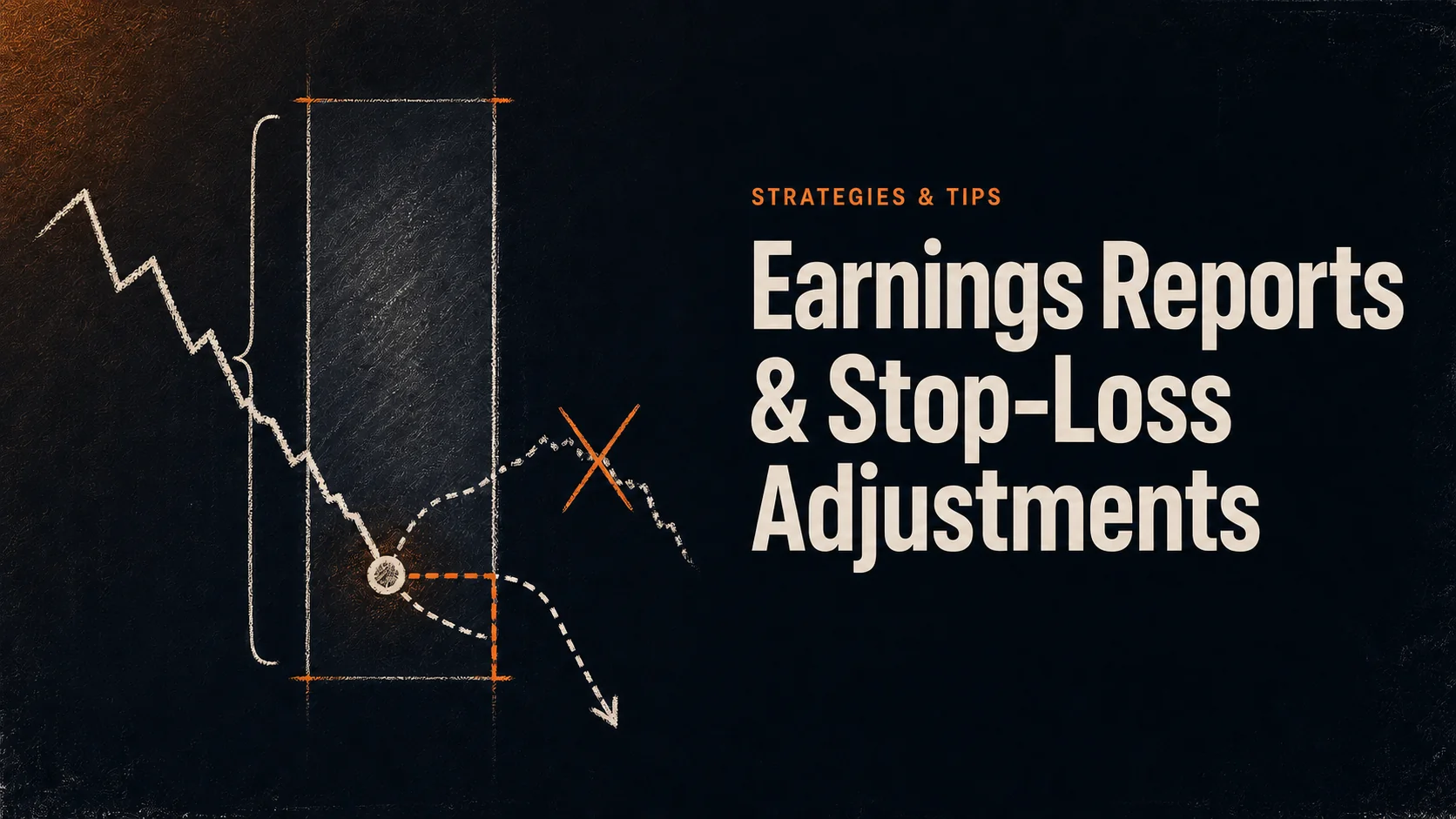
Before holding a stock through earnings, decide how much event exposure you are willing to retain. A stop-loss order does not guarantee an exit at its trigger price, and widening or removing it does not make an overnight gap less costly.
Use LuxAlgo’s native charts and Quant to research clearly defined stop rules. Combine that work with the company’s confirmed release timing and your broker’s order rules. The aim is a plan that accounts for gaps, position size, and execution—not a prediction of the earnings reaction.
Why Earnings Can Challenge Stop-Loss Orders
Revenue, earnings, guidance, and management commentary can change expectations quickly. A stock can fall after an earnings beat or rise after a miss because the market considers more than one headline number. The initial move can also reverse as additional information arrives.
There is no fixed sequence of buildup, consolidation, and continuation that every report follows. Release timing matters: news outside regular trading hours can leave the next session opening far from the previous close. Higher reported volume also does not guarantee a narrow spread or enough liquidity at your intended price.
The SEC’s stop-order bulletin explains the execution distinction. A stop-market order becomes a market order when triggered and can fill at a different price. A stop-limit order controls the acceptable price but may remain unfilled. Confirm which sessions and trigger conditions your broker supports.
A Gap Can Exceed the Planned Loss
Suppose you own 100 shares bought at $100 with a stop at $95. The planned loss to that level is $500 before costs. If the next executable price after earnings is $85 and the order fills there, the loss is $1,500 before costs. The $95 trigger did not create a guaranteed $500 maximum loss.
A tighter trigger does not remove that gap risk. A wider trigger gives the position more room before activation, but increases the intended loss per share. Evaluate the exposure you retain, not only where a line appears on the chart.
Compare the Available Adjustments
| Approach | What it changes | Important tradeoff |
|---|---|---|
| Reduce or close exposure before the release | Reduces the amount exposed to the event | Also reduces participation in a favorable move; execution and costs still matter |
| Keep a defined stop | Maintains a specified exit trigger | Does not guarantee the fill price or availability outside supported sessions |
| Widen the stop | Increases the distance to the trigger | Raises planned loss per share and does not eliminate gaps |
| Use a protective put | Adds an option hedge for matching stock exposure | Requires premium, suitable contract terms, and expiry management |
Removing a stop leaves the position exposed and replaces the standing instruction with a discretionary decision. A mental stop depends on monitoring, connectivity, available liquidity, and your ability to act. Treat removing an order as a change in the risk plan, not a routine way to avoid an unfavorable fill.
Recalculate Size When the Distance Changes
Before entry, keeping a planned monetary allowance constant while doubling the stop distance requires roughly halving quantity, before costs. For example, 1,000 shares with a $5 distance and 500 shares with a $10 distance both represent $5,000 between entry and stop. Neither is a guaranteed loss cap.
For an existing position, include any realized result and costs from reducing it, then evaluate the remaining exposure at current prices. Do not ignore those effects by recalculating only from the original entry. The CME position-sizing lesson explains the relationship between quantity, stop distance, and risk allowance.
Use ATR as Context, Not an Earnings Forecast
ATR describes recent realized price movement. It does not estimate every possible earnings gap, and a calm pre-release period can produce an ATR that understates the next event’s move. See TradingView’s ATR documentation for the calculation.
If you use an ATR stop, specify whether ATR is captured at entry or recalculated later. A long stop calculated as entry minus current ATR times a multiplier can move lower when volatility rises. A one-way trailing rule needs an explicit constraint preventing that widening.
Do not assume that widening stops for 24–48 hours and tightening afterward is always appropriate. Define the conditions for any change, such as a completed session or a specific price structure, and test them. The original thesis may also be invalidated by the report, regardless of the technical stop.
Protective Puts and Other Options Trades
A protective put combines a long stock position with a matching long put. The strike and expiry define the protection, while the premium adds cost. For a hypothetical stock bought at $100 with a $95 put costing $3 per share, the combined expiration loss below the strike is $8 per share before other costs, assuming matching coverage.
The protection ends when the option expires or is closed. Check contract size, exercise procedures, and expiry timing. A put’s changing market value before expiry also depends on time and implied volatility.
A long straddle or strangle is a different trade that buys options to seek a sufficiently large move. It is not automatically a hedge for an existing stock position. Premiums, time decay, and a decline in implied volatility can offset a price move. Do not substitute a volatility trade for a defined stock hedge without analyzing the combined payoff.
Research the Plan With LuxAlgo
Start by confirming the announcement date and time from the company’s investor-relations materials. For historical research, distinguish release time from the date of the following trading session. Avoid using information that became available only after the simulated decision.
In Quant, define the entry and exit rules and use the Code, Review, and Run workflow. If the test depends on earnings events, verify that the required historical event data and timestamps are available to the implementation; do not assume every script has an automatic earnings filter.
- Specify execution assumptions. Include commissions, slippage, session coverage, and order timing. A bar-based result may not reproduce every after-hours fill.
- Inspect individual events. Check gaps, stop triggers, and the first available simulated fill, including losing examples.
- Compare rules fairly. Keep the event sample, entries, and cost assumptions consistent when comparing exposure reduction or stop distances.
- Reserve unseen data. Evaluate a period not used to select the settings and report sample limitations.
Library indicators and available order-flow displays can add context, but cumulative delta does not prove who traded or guarantee that a reversal is coming. Data coverage varies by symbol and feed. Native strategy research is also separate from live broker execution and options-hedge modeling.
After the Announcement
Review the actual report, guidance, and price response against the original plan. Reassess exposure and open orders after any partial fills or manual changes. Falling volatility alone does not prove that the market has settled or that a previous stop level is appropriate again.
Use LuxAlgo Journal to review supported trading records and notes. Record the release timing, intended order, actual fill, costs, and reason for any adjustment. That makes it easier to distinguish a strategy issue from an execution issue.
Video: Take-Profit and Stop-Loss Research
Prof. Dr. Alp Ustundag’s video discusses a research approach to daily take-profit and stop-loss settings. It is general strategy context, not an earnings-gap protection method or a demonstration of LuxAlgo’s current native platform.
FAQs
How can traders adjust stop-loss levels during earnings season to manage risk while staying positioned for potential gains?
Decide the event exposure before the release, review broker order behavior, and calculate the effect of any stop-distance change on quantity and planned loss. Reducing exposure can reduce event risk. Tightening or widening a trigger does not guarantee an exit price through a gap.
How can LuxAlgo help improve stop-loss strategies during volatile periods like earnings reports?
Native charts support price analysis, and Quant can help implement and test clearly defined strategy rules. Verify the required event data, inspect simulated fills, and review results after costs. Indicators and backtests do not automatically place broker stops or guarantee protection.
Why are traditional stop-loss strategies less reliable during earnings season, and what can traders do instead?
Earnings can produce gaps and rapid moves that make fills differ from trigger prices. Review exposure, order types, and supported sessions. A matching protective put offers a different form of protection with premium and expiry costs; a straddle or strangle is not automatically a stock hedge.
Read next