Forex Trading Essentials: A Beginner’s Guide to Currency Markets
Forex trading means buying one currency while selling another. The foreign exchange market connects banks, companies, investment funds, central banks, and individual traders. It supports international payments, hedging, funding, and speculation; those activities should not be confused with a beginner’s leveraged trading account.
The BIS 2025 Triennial Survey release reported average OTC foreign exchange turnover of approximately $9.6 trillion per day in April 2025, up from $7.5 trillion in April 2022. That total includes spot, forwards, swaps, and options—not just retail spot forex. The survey measured a particular month, rather than a fixed daily amount for every market condition.
This guide covers currency quotes, pips, order types, trading sessions, analysis, and risk. LuxAlgo’s charting and AI platform can help you research an idea with Quant Charts and Quant, our coding agent. Brokerage, account eligibility, and live execution remain separate decisions.
Key Takeaways
- Currency quotes express the value of a base currency in a quote currency.
- Spreads, commissions, financing, and currency conversion can all affect results.
- A large global market does not guarantee tight spreads or easy exits for every pair.
- Leverage changes required margin, not the amount lost on a given position’s price move.
- Use practice accounts and explicit trading rules before considering live exposure.
Currency Pairs and Price Basics
Reading Currency Pairs
In EUR/USD, EUR is the base currency and USD is the quote currency. A price of 1.3600 means one euro is worth $1.36. Buying the pair creates exposure that benefits when the euro strengthens relative to the dollar; selling the pair reverses that exposure.
The bid is the price at which you can sell the base currency, and the ask is the price at which you can buy it. A quote written as 1.3600/05 means a bid of 1.3600 and an ask of 1.3605: a five-pip spread. Buying at the ask and immediately selling at an unchanged bid would lose $5 on 10,000 euros before other charges.
The spread is a trading cost, but it is not necessarily the broker’s only fee or entirely a broker markup. Compare commissions, overnight financing or rollover, account-currency conversions, and any other applicable charges.
Major, Minor, and Exotic Pairs
| Category | Typical meaning | Examples | What to check |
|---|---|---|---|
| Majors | Heavily traded pairs involving USD | EUR/USD, USD/JPY | Often competitive spreads, but news and quiet periods can widen them. |
| Minors or crosses | Commonly traded currencies paired without USD | EUR/GBP, GBP/JPY | Liquidity and volatility depend on the currencies and session. |
| Exotics | A major currency paired with a less actively traded currency; labels vary by broker | USD/TRY; USD/SGD may also receive this label | Check financing, spread, dealing hours, and available size individually. |
The BIS release put the U.S. dollar on one side of 89.2% of trades in April 2025, the euro at 28.9%, and the yen at 16.8%. Currency shares add to 200%, since every FX transaction involves two currencies. These wholesale-market figures do not describe the likelihood of success in a retail account.
Lots, Pips, and Leverage
A standard forex lot conventionally represents 100,000 units of the base currency; a mini lot is 10,000 and a micro lot is 1,000. Some brokers allow orders in individual units. Confirm the contract size and minimum order increment for the actual product.
A pip is a conventional price unit, not necessarily the smallest quote increment. For many pairs it is 0.0001, so EUR/USD moving from 1.3600 to 1.3601 is one pip. For yen-quoted pairs it is commonly 0.01. A broker may quote fractional pips. For 10,000 EUR/USD units, a one-pip move equals $1; for USD/JPY, pip value is first expressed in yen and must be converted if the account uses dollars.
Leverage lets you support a larger exposure with a smaller margin deposit. For example, 10,000 euros at EUR/USD 1.1000 represent $11,000 of exposure. At a hypothetical 30:1 leverage ratio, initial margin is about $366.67. A 100-pip adverse move still costs $100 on that position before fees. It is not limited to a percentage of the margin deposit. Actual margin rules and account protections vary by jurisdiction, broker, and product.
Forex Trading Mechanics
How a Retail Forex Trade Is Executed
Forex is largely an over-the-counter market, rather than a single exchange with one universal order book. A retail OTC order is governed by your dealer’s agreement and execution policy. The CFTC’s retail forex advisory explains that the dealer is the customer’s counterparty. Currency futures traded on a regulated exchange are a different product.
A dealer may internalize exposure, hedge it with other firms, or use a mixture of approaches. Terms such as dealing desk, ECN, or STP do not by themselves prove a particular execution quality or eliminate conflicts. It is inaccurate to assume every retail order is sent directly through an ECN to a large bank.
In practice, select the pair and size, choose an order type, review margin and costs, and check the actual fill after submission. Depending on the dealing model, an instant-execution request may be requoted or rejected; a market-execution order can fill at a different price from the one displayed when you clicked.
Order Types in Forex
| Order | Purpose | Important limitation |
|---|---|---|
| Market | Request an immediate entry or exit at available prices | Prioritizes execution, not a guaranteed price; slippage and rejection are possible. |
| Limit | Buy at a specified price or lower, or sell at it or higher | Controls the acceptable execution price, but may never fill. |
| Stop entry | Trigger a buy above or a sell below the current market | A triggered stop-market order can slip; a stop-limit may remain unfilled. |
| Stop loss | Request an exit after an adverse price threshold | An ordinary stop does not guarantee the exit price or maximum loss. |
| Trailing stop | Move the exit threshold as price moves favorably | Can trigger in normal fluctuations; broker/server requirements vary. |
A plotted trailing-stop indicator is an analytical study, not automatically an order at your broker. Check whether triggers use bid, ask, or another price, and whether a feature remains active when the trading application is closed. Those details can explain why an order behaves differently from a chart impression.
Trading Sessions and Times
Forex is generally available around the clock during the trading week, with weekend closures and broker-specific maintenance or holiday schedules. Activity passes through the Sydney and Tokyo regions, then Europe and London, then North America and New York. Pair-specific liquidity matters more than assigning one fixed volatility label to an entire session.
London and New York overlap for part of the day, often making that period relevant for USD and European-currency pairs. The UTC hours shift with daylight-saving changes, and countries do not all change clocks on the same date. Confirm the trading date and your broker’s hours rather than relying on a permanent UTC table.
Basic Trading Methods
Fundamental, Technical, and Sentiment Analysis
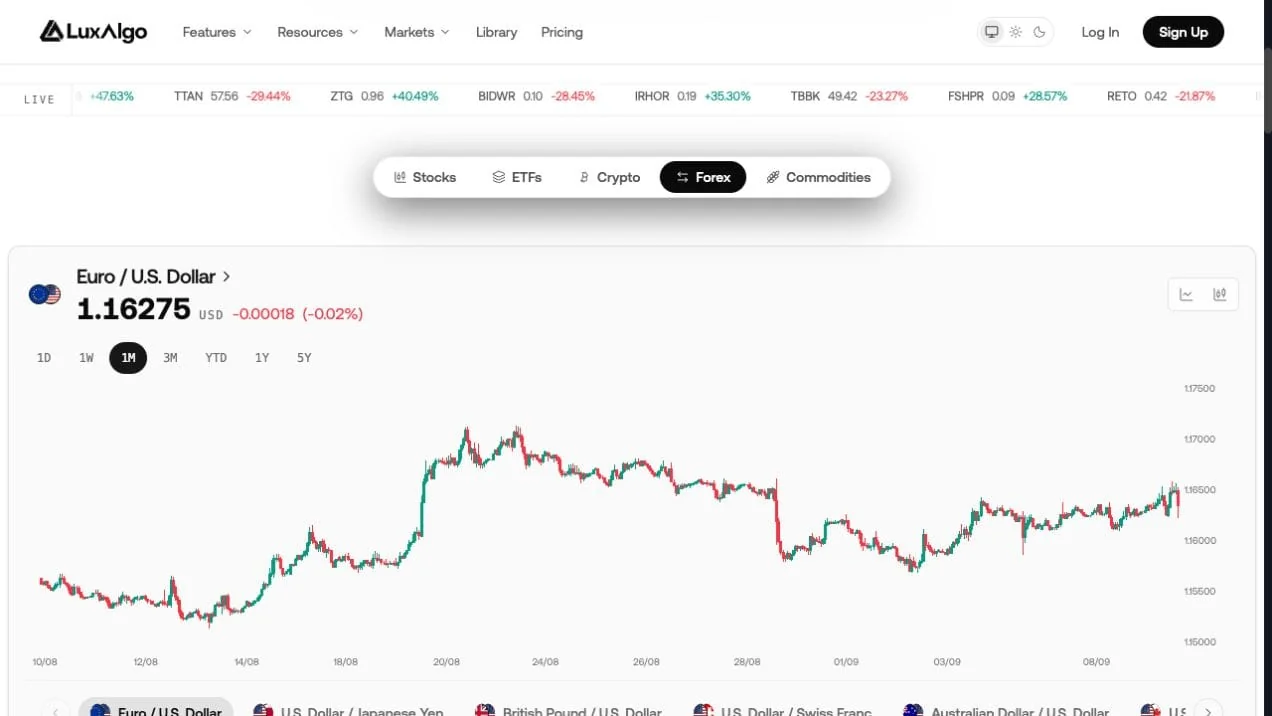
Fundamental analysis considers central-bank policy, inflation, employment, growth, and other economic developments. Compare releases with market expectations: a strong economic number need not strengthen a currency if traders expected an even stronger result. LuxAlgo’s forex market page and economic calendar can help organize that research.
Technical analysis uses price patterns, trend measures, and indicators to define possible setups and invalidation levels. Sentiment analysis considers positioning and expectations. None provides certainty, and a broker’s positioning sample or tick volume is not a complete picture of global forex activity.
A Breakout Example with Explicit Assumptions
Suppose a hypothetical EUR/USD short enters at 1.1772 after a predefined support break and closes at 1.1700. The difference is 0.0072, or 72 pips. At 10,000 units, that is $72 before costs, assuming these are actual executable entry and exit prices. If they are only chart levels, the spread and fill assumptions must be added. This is an arithmetic example, not a verified historical trade.
Define what “break” means before testing: a completed candle below the level, an intrabar touch, or a close followed by a retest are different rules. Also define the stop, target, session, maximum holding time, and what cancels the setup. Studying one or two clearly specified methods makes it easier to understand what the evidence does and does not support.
Position Size, Stops, and Costs
Choose a risk budget before calculating size. A fixed 2% rule is not suitable for every trader, and several positions can share the same underlying currency exposure. For example, long EUR/USD and long GBP/USD both contain short-dollar exposure.
With a hypothetical $5,000 USD account, a 1% total loss budget is $50. Reserve $5 for estimated costs, leaving $45 for price risk. On EUR/USD with a 30-pip stop, 15,000 units have a $1.50 pip value and $45 of planned price risk. Round down to the broker’s supported increment and verify the margin requirement separately. If an exit slips to 50 pips, the price loss becomes $75 before costs.
A target twice the planned stop distance gives a nominal 2:1 reward-to-risk relationship. It does not establish positive expectancy: the win rate, actual average win and loss, costs, and gaps still matter. Limit aggregate exposure and set a stopping rule for the day rather than increasing leverage to recover losses.
Starting Forex Trading
Selecting a Forex Broker
Verify the exact legal entity serving your country, its permissions, disciplinary history, client-money terms, withdrawal rules, and full cost schedule. In the United States, the CFTC registration-check guidance directs users to NFA records for relevant derivatives intermediaries. The SEC is not the general regulator for retail OTC forex dealers. Other countries have their own applicable regulators and rules.
Registration does not guarantee that funds are safe, that a provider cannot fail, or that trading will be profitable. A familiar brand name can operate through different entities with different protections. Compare the actual agreement and execution policy instead of choosing a dealing-desk, ECN, or STP label as a shortcut.
Use a demo account to learn order entry, sizing, and the platform’s reports. Virtual trading avoids real-money losses during practice, but it may not reproduce live liquidity, fills, financing, or emotional pressure. Treat demo results as practice evidence.
Choosing Charting and Trading Software
LuxAlgo provides a native charting and AI research workflow. Quant Charts lets you examine supported markets and indicators, while Quant helps develop custom studies and strategies. This is useful when your next task is understanding or testing an idea; it does not replace the broker agreement or execute a live forex order.
MetaTrader 4 supports forex analysis and trading through a broker. MetaTrader 5 is a multi-asset platform, with available instruments determined by the broker. TradingView’s trading interface connects to supported brokers; TradingView itself does not process the trades.
When comparing software, check the exact data feed, chart tools, mobile access, account security, order types, broker compatibility, and reliability under the conditions you intend to trade. A chart price is not necessarily your executable bid or ask.
Build a Forex Research Workflow with Quant
- Set the market context. Open the currency pair in Quant Charts, select a consistent timeframe, and note scheduled releases. The data documentation lists forex among paid-plan markets. Forex has candle data; footprint-dependent tools are not supported there.
- Write a specific hypothesis. Ask Quant, our coding agent, to build the completed-bar breakout rule you have defined, with explicit exits and sizing. Specify how levels are calculated without using future bars.
- Inspect and run. Follow Making Strategies with Quant: review the generated code, then run it manually. Verify the simulated trades against the chart.
- Model the product honestly. Account for spread, commission, slippage, and financing. If the test cannot model a cost or execution feature, record that limitation instead of treating the result as equivalent to a live account.
- Evaluate new data. Keep a period outside rule development for evaluation, compare against a simple baseline, and log results before changing the rules.
Create a Trading Plan
Choose scalping, day trading, or swing trading according to your available time and ability to monitor risk. Write down the instruments, sessions, entry and exit conditions, size limits, daily stopping rule, and review schedule. Use measurable process goals—such as following the plan and recording every trade—rather than treating a daily profit target as something the market must provide.
Conclusion
Start with the quote convention, the executable spread, the contract size, and the loss you can incur at your planned exit—and beyond it if the market gaps. Then use economic context and a clearly defined setup to guide research. LuxAlgo’s forex market tools, Quant Charts, and Quant can support that process, while broker selection and live risk remain decisions that require separate checks.
Frequently Asked Questions
What is forex trading?
Forex trading exchanges one currency for another. A currency pair expresses the base currency’s value in the quote currency.
Is a pip the smallest forex price movement?
Not necessarily. A pip is commonly 0.0001 for many pairs and 0.01 for yen-quoted pairs, while a broker may quote fractional pips. Check the instrument specification.
How much is one pip on EUR/USD?
At 10,000 base-currency units, a 0.0001 move is $1. At 100,000 units it is $10, before costs. Other quote and account currencies can require conversion.
Does leverage limit a forex trade’s loss to its margin?
No. Margin is collateral for the exposure. Losses depend on size and price movement, and account terms determine liquidation and any additional liability.
Do stop-loss orders guarantee the planned exit price?
Ordinary stop orders do not. Gaps, slippage, and execution conditions can increase the loss; a stop-limit may not execute at all.
Can LuxAlgo help beginners research forex strategies?
Yes. Use Quant Charts for supported forex candle data and Quant to develop explicit rules. Inspect the code and run it manually, evaluate costs and unseen history, and arrange any live execution separately with an appropriate broker.
References
LuxAlgo Resources
- Forex Markets and Economic Calendar
- LuxAlgo Quant
- Quant Charts Data and Market Coverage
- Making Strategies with Quant
External Resources
Read next