High-Yield Savings: Maximize Returns

A high-yield savings account is an ordinary insured savings deposit that pays a rate well above what the largest branch banks offer on the same product. It keeps the two features that make a savings account useful, deposit insurance and access on demand, and adds a return that is worth comparing with Treasury bills and certificates of deposit. This guide explains what a savings deposit is under federal rules, how to read the annual percentage yield and the disclosures a bank must give you, how deposit insurance applies, what can change after you open the account, how compounding is calculated, how the interest is taxed, and how a savings yield serves as the cash hurdle for judging a trading strategy in Quant Charts. It quotes no rates, because rates change monthly and the right comparison is always the APY in the current disclosure.
What a Savings Deposit Is
The Federal Reserve's Regulation D defines a savings deposit as an account that is not payable on a specified date and on which the bank may reserve the right to require seven days' written notice of withdrawal, a right that in practice is almost never exercised. The definition covers passbook and statement savings accounts, money market deposit accounts and regular share accounts at credit unions. Since a 2020 amendment the definition also states that the depositor may make transfers and withdrawals "regardless of the number of such transfers and withdrawals," which removed the old federal limit of six convenient transfers per month. Banks may still impose their own limits and fees, so the account agreement, not the regulation, now decides how often you can move money out.
"High-yield" is a marketing term, not a regulatory category. The accounts that carry it are usually offered by online banks or online divisions of larger banks, whose lower branch costs are passed on as a higher variable rate. Legally they are the same savings deposits as any other, with the same insurance and the same disclosure rules.
Reading the APY and the Disclosures
Regulation DD, the Truth in Savings rule, requires a bank to state both the interest rate and the annual percentage yield, using those terms. The APY is the total interest paid over a 365-day period given the rate and the compounding frequency, so it already reflects how often interest is added to the balance. Two accounts with the same interest rate but different compounding show different APYs, and the APY is the number to compare.
Before the account is opened the bank must disclose, among other items:
- the interest rate and APY, and for a variable-rate account the fact that both may change, how the rate is determined, how often it may change and any limit on the size of a change;
- how often interest is compounded and credited, and whether accrued interest is forfeited if the account is closed before crediting;
- any minimum balance required to open the account, to avoid a fee or to earn the stated APY, and how the balance is measured;
- the amount of each fee and the conditions under which it is charged;
- any limits on the number or dollar amount of withdrawals or deposits.
Every periodic statement must then show the APY actually earned during the period, the dollar amount of interest, and each fee debited, itemized by type. That statement line is the check on whether the advertised yield is the yield you are receiving.
What an Advertisement Must Say
The same regulation governs the advertisements that draw savers to these accounts. A rate of return in an advertisement must be stated as an annual percentage yield, and no other rate may appear except the interest rate, shown no more prominently than the APY. If the APY is stated, the advertisement must also say, where applicable, that the rate may change after opening, the period for which the APY is offered or the date it is accurate as of, the minimum balance needed to earn it (for tiered accounts, the minimum for each tier next to its APY), any larger minimum opening deposit, and that fees could reduce earnings. An account may not be called "free" if any maintenance or activity fee may be imposed. When a headline rate turns out to require a minimum balance, a linked checking account or a limited promotional period, those conditions should be in the advertisement itself.
Deposit Insurance
The FDIC lists savings accounts and money market deposit accounts among the products its insurance covers. The standard coverage is $250,000 per depositor, per ownership category, at each insured bank, and the Deposit Insurance Fund is backed by the full faith and credit of the United States. Single accounts, joint accounts, certain retirement accounts and trust accounts are separate categories with separate limits, and in a joint account each co-owner's share is insured up to the limit. The FDIC's Electronic Deposit Insurance Estimator calculates coverage for a specific set of accounts, and its BankFind tool confirms that an institution is insured. Credit union savings are covered on the same terms by the National Credit Union Administration's Share Insurance Fund.
Two situations deserve care. Some high-yield accounts are offered by financial technology companies that hold customer money at partner banks; the deposit is insured only if it is actually held at an insured bank and the records identify you as the owner, so confirm which bank holds the funds. And an account that sweeps balances into a money market mutual fund or other investment is not a deposit and is not insured, however it is labelled.
What Can Change After You Open the Account
The defining feature of a savings account, and the reason its yield can exceed a CD's at times and fall below it at others, is that the rate is variable at the bank's discretion. Regulation DD requires 30 days' advance notice of any change in a disclosed term that may reduce the APY or otherwise harm the depositor, but it exempts rate changes on variable-rate accounts from that notice. In practice the rate follows the level of short-term interest rates set by Federal Reserve policy: when policy rates fall, savings rates follow within weeks, and the FDIC publishes monthly national average rates for savings and other deposit products that show the trend. A saver who wants a rate locked for a period needs a CD or a Treasury bill instead.
How Compounding Adds Up
Interest on a savings account is usually calculated daily on the balance and credited monthly. Once credited, it earns interest itself. The APY captures that effect for one year; over longer periods the arithmetic is the same as the compound annual growth rate the LuxAlgo Library describes in its CAGR entry: the ending balance equals the starting balance multiplied by one plus the annual rate, raised to the power of the number of years. As a purely hypothetical illustration, a balance left untouched at a constant 4% APY grows by about 4% in the first year and by about 21.7% over five years rather than 20%, because each year's interest is earned on a larger balance. The actual rate on a savings account will not stay constant, which is exactly why the comparison with a fixed-rate CD is not settled by today's APY alone.
Investor.gov's compound interest calculator lets you run the same arithmetic with regular contributions, and its Save and Invest roadmap places an emergency fund in a savings account as the step that comes before investing.
How the Interest Is Taxed
Savings interest is ordinary income. IRS Publication 550 explains that a bank reports interest of $10 or more on Form 1099-INT and that the interest is taxable in the year it is credited to the account, whether or not you withdraw it. Unlike Treasury interest, it is also subject to state and local income tax where those apply. Interest earned inside an IRA follows the account's rules instead.
Savings Accounts Beside CDs and Treasury Bills
| Feature | High-yield savings | Certificate of deposit | Treasury bill |
|---|---|---|---|
| Rate | Variable at the bank's discretion | Fixed for the term | Fixed by the auction discount |
| Access | On demand, subject to the bank's own transfer limits | Penalty before maturity | Sale in the secondary market at the current price |
| Protection | FDIC or NCUA insurance to $250,000 per category per institution | FDIC or NCUA insurance | Full faith and credit of the United States, no limit |
| State and local tax | Yes | Yes | No |
| Best suited to | Emergency funds and money needed within months | Money with a known date | Larger balances above insurance limits |
Many savers hold all three: a savings account for the emergency fund, a CD ladder for dated goals, and bills for balances that would exceed insurance limits at any one bank.
Where Quant Charts Fits
Quant Charts does not open savings accounts, hold cash or chart deposit rates; a savings account is a bank contract, not a traded instrument. What the account's APY provides a trader is the same thing a CD rate provides: the return available with insurance and no market risk, which every trading result has to clear before it has earned anything. Three parts of the platform and the Library use that number directly.
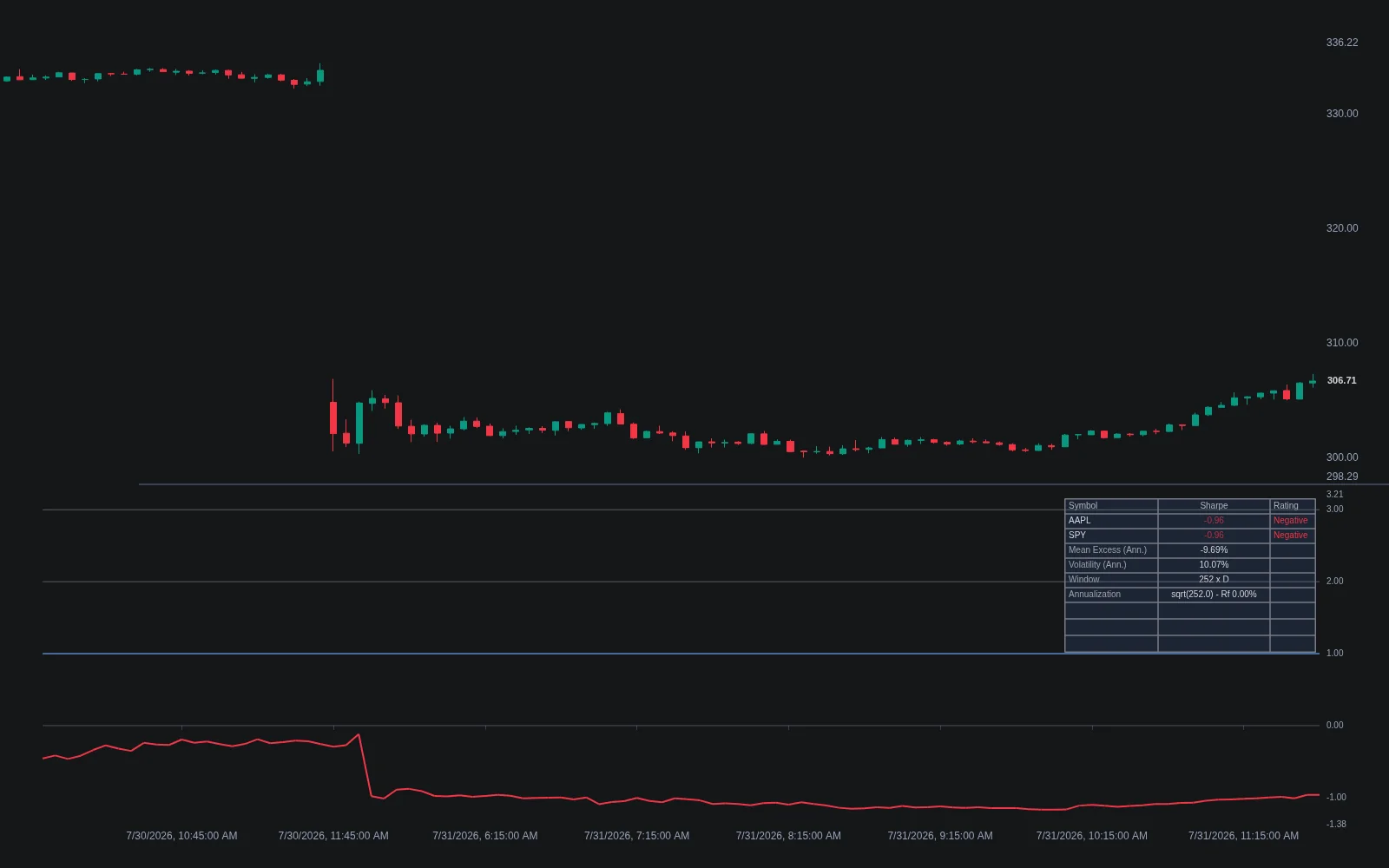
Enter the savings APY as the risk-free rate. The Library's Sharpe ratio entry defines the ratio as the average return in excess of the risk-free rate divided by the volatility of those excess returns. The Sharpe Ratio indicator has a Risk-Free Rate input that is prorated per period and subtracted before averaging, and its dashboard ranks the chart symbol against comparison symbols computed the same way. Because a savings rate is variable, update the input when the rate changes.
Annualize the backtest before comparing. Describe a rule to Quant, our coding agent, in plain language, for example buying a stock when it closes above its 20-day high and selling when it closes below its 10-day low. Quant writes the Pine Script; open Code to inspect it, then click Run. The Backtest Summary reports net profit, trade count, win rate, max drawdown and profit factor. Set commission and slippage in the strategy's Properties, then convert net profit over the test period into a compound annual growth rate as the CAGR entry describes, so that a three-year backtest and a savings APY are stated on the same yearly basis. The Library's drawdown statistics entry covers the figure the savings account never shows: how far the strategy fell from its peak on the way.
The video below shows how favorite tools are arranged and reached through the wheel in Quant Charts.
Keep the cash sleeve in the record. The Journal in Quant Charts holds manual accounts with a starting balance you set. Recording trades there produces a realized return for the trading capital, which can then be set against what the same money would have earned untouched in the savings account over the same months.
FAQs
What is a high-yield savings account?
A federally insured savings deposit that pays a variable rate well above the rates of the largest branch banks, usually offered by online banks. Legally it is the same savings deposit as any other, subject to the same Truth in Savings disclosure rules and the same FDIC or NCUA insurance.
What does APY mean?
Annual percentage yield is the total interest paid over a 365-day period given the interest rate and the compounding frequency, calculated under Regulation DD. It is the figure banks must use when advertising a rate and the figure to compare between accounts.
Can the bank change the rate?
Yes. Savings rates are variable at the bank's discretion, and Regulation DD exempts rate changes on variable-rate accounts from the 30-day advance notice that applies to other adverse changes. Rates generally follow short-term policy rates set by the Federal Reserve.
Is there still a six-withdrawal limit?
Not in federal regulation. Regulation D was amended in 2020 so that savings deposits may allow transfers regardless of their number. Banks may still set their own limits and fees, which must be disclosed in the account terms.
Are high-yield savings accounts insured?
At insured banks and credit unions, yes, up to $250,000 per depositor, per ownership category, per institution. Confirm the holding bank when the account is offered through a financial technology company, and note that balances swept into an investment fund are not deposits.
How does a savings rate relate to Quant Charts?
Quant Charts does not hold cash or chart deposit rates. The savings APY is the insured return a strategy must beat, so it belongs in the Risk-Free Rate input of the Sharpe Ratio indicator and beside the annualized net profit from Quant's Backtest Summary.
References
LuxAlgo Resources
- CAGR, Sharpe Ratio and Drawdown Statistics concepts (LuxAlgo Library)
- Sharpe Ratio indicator (LuxAlgo Library)
- Making strategies with Quant and Reading a strategy backtest (LuxAlgo Docs)
- Journal (LuxAlgo Docs)
External Resources
- 12 CFR 204.2 Definitions, Regulation D (Cornell Legal Information Institute)
- 12 CFR 1030.4 Account disclosures, 1030.5 Subsequent disclosures, 1030.6 Periodic statement disclosures and 1030.8 Advertising, Regulation DD (Cornell Legal Information Institute)
- Understanding Deposit Insurance and Are My Deposit Accounts Insured by the FDIC? (FDIC)
- National Rates and Rate Caps, Electronic Deposit Insurance Estimator and BankFind Suite (FDIC)
- Share Insurance Coverage (National Credit Union Administration)
- Save and Invest and Compound Interest Calculator (Investor.gov)
- Publication 550, Investment Income and Expenses (Internal Revenue Service)
Read next