How Delta Hedging Automation Works

Delta hedging automation repeatedly estimates an options position’s directional exposure, calculates an offsetting hedge, and checks what actually executed. It can make that process more consistent, but it cannot keep a portfolio perfectly neutral through every price move, data delay, or market disruption.
The essential loop is measure exposure → decide whether to adjust → submit an order → reconcile the result. A reliable design needs current option data, correct contract specifications, an execution connection, and controls for failures. A chart signal by itself does not supply all of those components.
- Calculate exposure in consistent units, including contract multipliers and long/short signs.
- Choose a target and tolerance instead of assuming every small delta change needs a trade.
- Include existing hedge positions and outstanding orders in the adjustment decision.
- Measure costs, residual risk, and operational errors alongside hedge accuracy.
- Keep options delta separate from orderflow volume delta.
Key Concepts in Delta Hedging
Understanding Delta and Delta-Neutrality
The Options Industry Council defines delta as an estimate of the option premium’s sensitivity to a small underlying-price change, holding other pricing inputs constant. For ordinary purchased stock options, calls have positive delta and puts negative delta. Selling an option reverses the position’s exposure.
A per-share call delta of 0.50 suggests roughly a $0.50 premium change for a $1 stock move under that local approximation. It does not mean every option contract changes by just $0.50, nor does it guarantee the actual premium change.
For stock options with a verified 100-share multiplier, calculate share-equivalent exposure as signed contract quantity × 100 × per-share delta. Add the existing stock position, with long shares positive and short shares negative. Adjusted contracts and other products may use different specifications; confirm those before calculating.
| Position | Option delta per share | Share-equivalent exposure | Initial stock offset |
|---|---|---|---|
| Long 10 calls | +0.50 | +500 | Short 500 shares |
| Short 10 calls | +0.50 | −500 | Buy 500 shares |
| Long 10 puts | −0.40 | −400 | Buy 400 shares |
| Short 10 puts | −0.40 | +400 | Short 400 shares |
These are arithmetic examples with no existing stock hedge, not recommendations to open the positions. Neutrality means the combined first-order sensitivity is near the chosen target at that moment. It does not mean the portfolio cannot lose money.
Why Delta Changes
Moneyness, time remaining, implied volatility, interest rates, dividends, and model assumptions affect the estimate. At-the-money delta is often near +0.50 for calls or −0.50 for puts, but those are not exact universal values. Near expiration, small moves around a strike can sharply change exposure.
Gamma measures how delta changes with the underlying price. Long ordinary options have positive gamma and short options negative gamma; stock has no option gamma. Higher gamma can make yesterday’s or even a recent hedge insufficient more quickly.
Do not hard-code a universal rule that volatility always moves delta in one direction or matters less than price. The effect depends on the contract, moneyness, maturity, and model. Recalculate using coherent inputs rather than inferring a hedge from a generic volatility indicator.
What Delta Hedging Leaves Unhedged
Options remain exposed to curvature from gamma, changes in implied volatility through vega, time decay through theta, and other valuation inputs. Liquidity, financing, stock borrow, exercise, assignment, and settlement can also change the economics or required position.
A market maker may earn a spread, but inventory risk and adverse price movement can exceed that revenue. A short-options position may receive time-decay benefits while facing adverse gamma and volatility exposure. Delta neutrality is a risk-management objective, not an independent source of guaranteed profit.
How Delta Hedging Automation Works
1. Validate Data and Calculate Exposure
The system needs the current positions, option identifiers, expiration, strike, exercise style, multiplier, underlying quotes, and either reliable Greek estimates or sufficient inputs to calculate them. Record timestamps and units. A stale option quote combined with a current stock price can produce a misleading hedge.
OIC’s pricing-model guide explains the inputs behind theoretical values and why American-style exercise can require a different model, such as a binomial approach. Black–Scholes-style models, trees, and simulation methods have different assumptions and computational requirements. None guarantees an executable market price.
Calculate exposure separately for each underlying and account before considering portfolio offsets. Five hundred share-equivalents of one company do not cancel five hundred of another. Index, futures, cross-currency, and proxy hedges need appropriate contract-value conversions and introduce additional basis or currency risk.
2. Define the Desired Hedge and Adjustment
For a zero-delta target using stock, the desired stock holding is the negative of the option share-equivalent exposure. The proposed stock order is desired stock holding minus current stock holding, adjusted for executable lot sizes and orders already in progress.
The target need not always be exactly zero. A policy may allow a tolerance around zero or another explicitly approved exposure target. That tolerance should be stated in share-equivalents, dollars of sensitivity, or another defined unit—not an ambiguous “delta of 5.”
Worked Example: Rebalance 10 Long Calls
Start with the original example of 10 long calls, each with delta 0.50 and a 100-share multiplier. Option exposure is +500 share-equivalents, offset by an existing short position of 500 shares.
| Stage | Option exposure | Stock holding | Net delta | Action |
|---|---|---|---|---|
| Initially hedged | +500 | −500 | 0 | Monitor |
| Call delta rises to 0.60 | +600 | −500 | +100 | Desired adjustment: sell 100 shares |
| Only 60 shares execute | +600 | −560 | +40 | Reconcile the remaining 40-share order |
| All 100 shares execute | +600 | −600 | 0 | Recalculate from current inputs |
When delta rises from 0.50 to 0.60, the hedge needs 100 additional short shares, not another 600-share sale. The table holds the new option delta constant only to isolate the arithmetic. Real exposure can change while the order is working.
If the stock is $100 and residual delta is +40 share-equivalents, a small 1% price rise—$1—implies approximately +$40 of first-order portfolio change before other effects. Dollar delta is $100 × 40 = $4,000; multiplying that by 1% gives the same $40 estimate. Neither figure is a maximum-loss estimate.
3. Submit Through an Appropriate Execution Connection
Execution may use a broker API or institutional infrastructure, depending on the account and system. An automated calculation does not imply direct exchange access. Check permissions, buying power, borrow availability, order type, session, symbol mapping, and size limits before submission.
A broker’s attached hedge order is also not necessarily a continuously rebalancing portfolio service. For example, IBKR documents an attached delta hedge order with specific parent-order behavior. Read the exact order semantics rather than inferring perpetual neutrality from its name.
4. Reconcile Executions and Repeat
Use acknowledged executions and broker positions to update the hedge. An accepted order is not the same as an executed order. When only part of the quantity trades, track the executed amount, working remainder, and any cancellation or rejection.
In the example, if 60 of the 100 shares have sold and 40 remain working, sending a fresh 40-share sale without reconciling the first order can over-hedge the position. After an uncertain response, check the original order identifier before retrying. Recalculate exposure after fills, position changes, and relevant market-data updates.
Logs should connect the input snapshot, computed target, intended adjustment, risk decision, order identifier, and resulting position. On a data outage or position mismatch, stop creating new adjustments and follow a predefined recovery procedure. Stopping software does not close existing exposure or cancel every broker order.
Choosing Rebalancing Frequency
More frequent hedging can reduce some intervals of residual directional exposure while increasing spread costs, fees, turnover, and market impact. Less frequent hedging accepts larger deviations. The trade-off depends on gamma, liquidity, position size, costs, and the underlying’s behavior.
- Scheduled checks: reassess at a defined interval, with explicit handling for data gaps and market sessions.
- Exposure thresholds: act when the absolute difference from target exceeds a defined limit.
- Market-event triggers: recalculate after a sufficiently large price move, a new option fill, or another specified event.
- Hybrid policies: combine regular checks with exposure limits and emergency procedures.
A tolerance of ±50 share-equivalents is an illustrative policy, not a recommended setting. With residual exposure +40, that policy would wait; at +100, it could trigger an adjustment. Define whether the adjustment returns to zero or to an inner threshold. Different trigger and reset levels can reduce repeated tiny trades near the boundary.
Volatility-aware policies can be tested, but “trade more often when volatility rises” is not automatically optimal when spreads widen or liquidity disappears. Historical optimization estimates a trade-off under its assumptions; it does not discover a permanently ideal schedule.
Advanced Delta Hedging Techniques
Dynamic Versus Static Hedging
Dynamic hedging updates positions as exposure changes. Holding an initial stock offset without adjustment is simpler, but its delta neutrality usually drifts. Static replication with a carefully constructed set of instruments is a broader concept and should not be confused with leaving one initial stock hedge untouched.
| Approach | Benefit to evaluate | Limitation |
|---|---|---|
| Frequent dynamic adjustments | Can respond sooner to changing exposure. | More trading costs and operational demands; no protection against every jump. |
| Threshold-based adjustments | Can avoid trading for small changes. | Allows residual exposure inside the band and during execution. |
| Initial stock offset held unchanged | Fewer adjustment orders. | Does not maintain neutrality as option delta changes. |
Gamma’s sign matters. A long-gamma position generally calls for selling more underlying after a rise and buying after a decline to restore delta. A short-gamma position generally requires the opposite. The eventual result also depends on time decay, volatility changes, financing, and the prices of the hedge trades. Do not describe all between-hedge movement as a guaranteed gamma loss.
Control Execution Costs Without Assuming Fills
Limit orders can control the worst acceptable execution price but may remain unexecuted. Market orders prioritize execution without guaranteeing price. The Investor.gov order guide describes these distinctions.
Net compatible exposures before trading, account for rounding, and avoid duplicate orders. Test size limits, minimum adjustment quantities, and delays between orders against the risk of remaining off target. Passive execution can save spread costs in some circumstances and increase unhedged exposure in others.
For a simple cost comparison, 20 adjustments averaging 50 shares create 1,000 shares of turnover. At an assumed $0.02 per share in combined execution costs, that is $20 before any additional charges. Forty otherwise identical adjustments cost $40. Assess whether the extra reduction in residual exposure justifies the additional cost.
Where LuxAlgo Fits in the Workflow
Use Charts for Underlying-Market Context
LuxAlgo charts can support examination of the underlying market, while the Library supplies indicators and research concepts. Choose the correct symbol, interval, and data source before drawing conclusions about price or volume conditions.
Options delta and volume delta are different measurements. Options delta estimates price sensitivity. Orderflow volume delta compares buying and selling volume classifications. Volume Delta Candles, Delta Flow Profile, and similar tools do not calculate an options portfolio’s share-equivalent hedge. ICT Immediate Rebalance is likewise a chart concept, not an options rebalancing engine.
Use Quant to Make Research Assumptions Explicit
Quant, our coding agent, helps develop and examine strategy code. Use it to express an underlying-market rule or an explicitly simplified hedge simulation, and follow the documented review-and-run workflow.
A useful research request is: “Explain the required inputs for a threshold-based hedge. Separate observed data from assumptions, include existing stock positions and working orders, and show how residual exposure and turnover would be measured.” Do not ask a stock-price chart alone to validate an entire options portfolio.
A credible historical options-hedging test also needs synchronized option prices or valuation inputs, changing Greeks, contract specifications, exercise and settlement handling, and the execution costs of every leg. If those are unavailable in the chosen environment, label the model as an illustration and use suitable options research infrastructure for full validation. A saved chart strategy does not automatically monitor broker Greeks or activate a live hedge.
Use Trade Relay as a Separate Execution Component
Trade Relay is LuxAlgo’s free, self-hosted open-source tool for routing configured webhook instructions through risk controls to supported broker connections. Its documented workflow includes a simulator, paper trading, order records, and a persistent kill switch. Support varies by connection and execution mode; a watch-only account cannot execute.
A custom hedging system would still need to calculate options exposure, choose adjustments, and reconcile the portfolio. A webhook router is not a Greeks engine. Verify the selected broker, instrument, order type, and mode rather than assuming every connected account supports the required hedge.
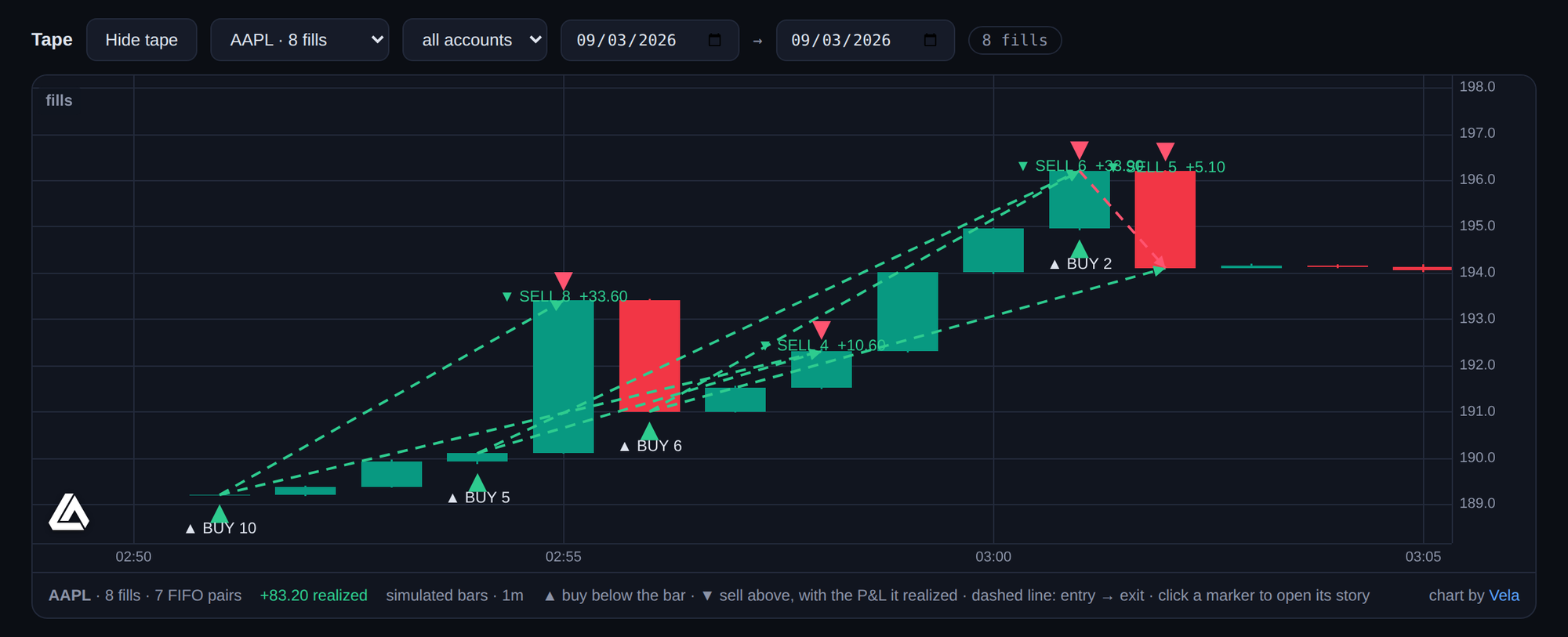
Start with simulation, then paper testing and independent broker readback before considering live use. Keep ongoing supervision and recovery procedures. Automation changes the work from repeatedly entering orders to maintaining a data, risk, and execution process.
What to Validate Before Relying on Automation
- Calculation: independently check long and short calls and puts, multipliers, existing stock, and target units.
- Data: test stale quotes, missing Greeks, mismatched timestamps, and changing contract specifications.
- Execution: test incomplete execution, rejections, duplicate messages, uncertain responses, and canceled orders that later receive updates.
- Lifecycle: handle exercise, assignment, expiration, settlement, and stock borrow changes.
- Performance: compare net outcomes, turnover, costs, peak residual delta, time away from target, and scenario losses.
- Recovery: verify what happens on restart, connection loss, a breached limit, or a manual intervention.
Evaluate both the unhedged position and alternative hedge policies under consistent assumptions. A strategy with delta closer to zero may still have worse total results after costs. Stress tests should include price gaps and simultaneous volatility changes, not only small continuous stock moves.
Delta Hedging in Algorithmic Options Trading
This Stock and Options Playbook explainer introduces the calculation-and-adjustment idea. Use the contract-size examples and operational distinctions above when assessing how a real system would implement it.
Conclusion and Key Takeaways
Automated delta hedging is a repeated measurement, execution, and reconciliation process. It can help enforce a defined policy, but it does not eliminate model risk, gaps, costs, or the other sensitivities of an options portfolio.
Use LuxAlgo for relevant market research and coding assistance, and assess Trade Relay separately where its supported execution workflow fits. The next step is a verified small simulation with explicit inputs and failure cases—not an assumption that a chart signal has made the portfolio neutral.
FAQs
What are the benefits of using automation for delta hedging compared to manual methods?
Automation can calculate exposure and apply predefined adjustment rules consistently across positions. Its benefits depend on accurate data, correct contract handling, reliable execution, and reconciliation. It does not eliminate human oversight, execution errors, costs, or residual risk.
What challenges do traders face when choosing rebalancing frequency in delta hedging, and how can automation help?
Frequent adjustments can reduce some residual exposure while increasing turnover and costs. Infrequent adjustments allow more drift. Automation can enforce scheduled, threshold-based, or hybrid policies, but the trade-off must be tested using realistic costs, changing Greeks, and market disruptions.
How can traders use platforms like LuxAlgo to automate delta hedging effectively, especially during market volatility?
LuxAlgo charts and Quant can support market research and clearly specified simulations. Full options hedging additionally requires current options data, contract specifications, a suitable valuation process, and broker-position reconciliation. Trade Relay can route configured instructions through supported connections, but it does not supply the options delta calculation.
References
Read next