How to Avoid Panic and Revenge Trading After a Loss

After a trading loss, your first job is to prevent an emotional decision from adding unplanned risk. Check any remaining positions and orders, pause new entries, and follow a written recovery routine. You do not need to win the money back today.
Panic trading and revenge trading can look different. Panic may lead to an unplanned exit or an inability to evaluate a valid setup. Revenge trading usually involves chasing recovery through larger size, repeated entries, or relaxed rules. Exiting because your planned stop was reached is not panic; re-entering because a separately defined setup occurs is not automatically revenge. The reason and process matter.
LuxAlgo charts, Quant, and the Journal can help you make rules explicit and review what happened. They cannot remove emotions, prevent every impulsive order, or make an unprofitable strategy profitable. Use them to support a process you can follow and measure.
Steps to Take After a Trading Loss
- Check the actual account state. Confirm the loss, fees, remaining exposure, and working orders at your broker. Do not assume a stop filled exactly as intended.
- Pause new risk. Avoid a fresh entry or a size increase while your immediate objective is to recover the loss.
- Apply the session rule. If your daily loss or rule-violation limit has been reached, end new trading for the session. Manage existing exposure according to the plan.
- Record the event. Save the setup, planned risk, actual fills, emotion rating, and any deviation.
- Review before deciding to resume. A break alone is not permission to trade again. Require an independently valid setup and available risk capacity.
A useful question is: Would I take this next trade, at this size, if the previous loss had never happened? If the answer is no, step away from the entry screen.
How to Spot Your Emotional Trading Triggers
Notice the Urge Before the Order
A loss can feel more urgent than an equivalent gain feels rewarding, but there is no fixed “twice as painful” ratio that describes every trader or situation. Likewise, assigning a universal percentage of trading success to psychology obscures the role of strategy quality, costs, execution, and risk.
Watch for specific changes in your own behavior: repeatedly checking the same chart, opening an order ticket without a setup, raising size, moving a stop farther away, or thinking “just one more trade.” Physical tension or a racing heartbeat can be cues to pause, but they do not diagnose a condition or tell you whether the market will reverse.
| Trigger | Possible warning sign | Prewritten response |
|---|---|---|
| Unexpected loss or poor fill | Anger and a larger next order | Check execution details, then pause new entries. |
| Several losses | Switching to unfamiliar setups | Apply the session limit and schedule a review. |
| Missed opportunity | Chasing after the entry condition has expired | Record a missed setup; wait for a new valid one. |
| Giving back profits | Trying to return to the day's peak P&L | Use the planned risk limit rather than the peak as a target. |
| Winning streak | Skipping checks or increasing leverage | Keep the normal sizing and entry rules. |
Track Emotions Alongside Decisions
Record your state before an entry where possible, then add a short note after the exit. A personal 1–10 rating can help compare your own sessions, provided you define it consistently. For example, 1 might mean settled and able to follow the checklist, while 10 means a strong urge to act without checking. It is a self-observation scale, not a clinical measure or a universal trading cutoff.
| Journal field | What to record |
|---|---|
| Time and context | Session, instrument, news, fatigue, and previous trades |
| Plan | Setup, intended entry, invalidation, size, and planned dollar risk |
| Actual execution | Fills, fees, exit reason, and any order problem |
| Emotional state | Before/after rating, the thought you noticed, and physical cues |
| Process | Which rules were followed or broken, including profitable violations |
| Next action | Continue observation, end the session, or investigate a specific issue |
Keep the note factual. “I entered twice the planned size because I wanted to recover $200” is more useful than “I am terrible at trading.” Also record the times you felt frustrated and still followed the plan. Those examples show which safeguards you can actually use.
Find Patterns Without Jumping to Conclusions
Review whether violations cluster after losses, during a particular session, or when you are tired. Separate the pattern from its explanation: three losing afternoon trades do not prove that afternoons are unsuitable or that fatigue caused the losses.
Compare similar setups and include every trade in the chosen period. Track rule adherence separately from profit. If 16 of 20 trades followed the plan, adherence was 80%; that number can improve even during a losing week. A rule-breaking winner still belongs in the violation group.
Methods to Manage Emotions While Trading
Use a Short Pause and Comfortable Breathing
First make sure any open exposure is handled under your risk plan. Then step away from the order controls, relax your shoulders and hands, and notice your breathing. The NHS breathing guide recommends gentle, regular breathing without forcing it, optionally counting as you breathe in and out, and practicing for at least five minutes.
This is a stress-management practice, not a treatment for trading losses or evidence that the next trade is safe. If focusing on breathing feels uncomfortable, stop and choose another quiet activity. You can take a short walk, get water, or look away from market updates. The goal is to create time between the urge and the action.
Label the emotion in neutral language: “I am frustrated about the loss” or “I feel pressure to finish green.” Acknowledge it without turning it into an order instruction. A scheduled screen break may help you notice these changes before they accumulate.
Replace Recovery Demands with Testable Questions
Challenge the thought that is driving the next action. “I must make it back now” can become “The previous loss does not improve this setup.” “My strategy is broken” can become “Was this an expected losing trade, a rule violation, or an execution problem?” Balanced language leaves room for investigation without denying the financial loss.
Reframing should not excuse a weak strategy. A loss may reveal a mistake, but it can also be ordinary variation. Conversely, repeated losses deserve review even when you followed the plan. Emotional discipline and a positive trading expectancy are separate requirements.
Rehearse the Response, Not a Winning Outcome
Before a session, imagine a realistic difficult sequence: an entry fills, the trade loses, and you follow the stop and pause rule. Practice the exact next steps you want to take. Visualizing only a successful trade can encourage outcome fixation rather than preparation.
Use reminders tied to actions, such as “I can skip a trade” or “I will check size before submitting.” Affirmations do not reprogram your reactions or guarantee control. They are prompts; their value depends on whether your behavior changes.
If reflection or gratitude journaling helps you, note one decision you handled well and one adjustment to practice. Avoid demanding that every setback produce an immediate positive lesson. It is acceptable to finish the session without another trade.
Create and Follow a Clear Trading Plan
Write Rules You Can Check
Specify the markets, sessions, entry conditions, order types, size calculation, exit conditions, and events you avoid. Include a maximum planned session loss, a response to rule violations, and a restart condition. Choose those limits before trading rather than negotiating them after a loss.
“Wait for three confirmations” is not enough. If your setup uses a moving average, RSI, or support, define the exact calculation and timing. Several indicators derived from the same prices are not necessarily independent evidence. Keep the rule simple enough to explain and review.
A percentage risk rule is also only a starting calculation. Two percent of a $50,000 account is $1,000 of planned risk, not a guaranteed maximum loss and not a recommendation for every account. Gaps, leverage, correlated positions, and costs can make that exposure unsuitable.
Worked example: a hypothetical $20,000 account has a $100 planned trade-risk budget. With a $2 entry-to-stop distance, that permits 50 shares before costs. Doubling to 100 shares after a loss doubles the same planned price risk to $200. It does not improve the setup or increase its probability of success.
Understand What Exit Orders Can and Cannot Do
Preplanned exits reduce the number of decisions you need to make under pressure. However, an order is not a guaranteed loss cap. The SEC explains that a stop becomes a market order when triggered; the fill can be worse than the stop price. A limit order controls price but may not execute.
Confirm whether your broker supports the intended order relationship, what happens outside regular hours, and whether an exit remains active after only part of an order executes. A take-profit limit is not guaranteed to fill simply because price briefly touches the level. Trailing-stop behavior depends on the actual broker order; a trailing line on a chart is not an order.
Do not widen a stop solely to avoid accepting a loss. If your strategy permits changes, write the conditions in advance and account for the resulting exposure. A software or data problem may require a different response from an ordinary losing trade.
Use Session Limits and Scheduled Reviews
Suppose your hypothetical plan ends new entries at a $300 session loss. You have lost $220, and the next normal setup requires $100 of planned risk. Taking it would put the planned total at $320, above the limit. Skip it unless a smaller position is already allowed by your sizing rules; do not invent a special exception to chase recovery. Existing exposure and potential slippage also need consideration.
A planned session limit is a decision rule, not a promise that actual losses cannot exceed it. Define whether your calculation includes fees, unrealized losses, and open-position risk. Check that definition consistently at the broker.
Review behavior after the session, performance at a scheduled interval, and strategy changes in a separate research period. A calendar week alone is not enough statistical evidence. Consider the number and variety of trades, costs, and market conditions. Staying committed to a process does not mean continuing indefinitely with a failing strategy.
Use LuxAlgo to Make the Review Concrete
Start with the Journal
Open Journal in the LuxAlgo workspace header. The Journal supports manual records, statement imports, and supported broker connections. Confirm that the fills and fees are current before interpreting results; broker accounts refresh daily or through Refresh. Your journal belongs to your account and is not included when you share a workspace.
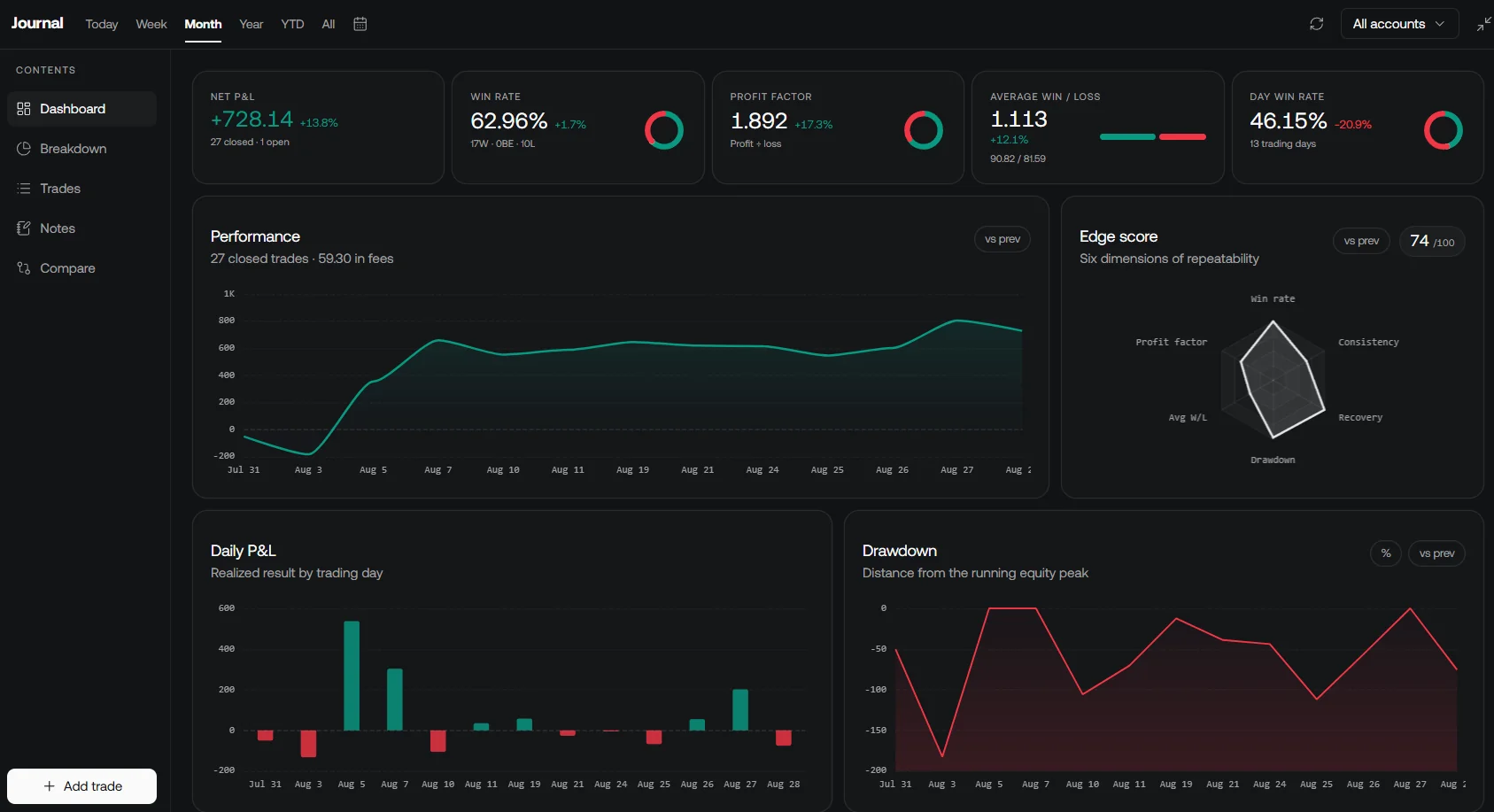
Use day notes for the session plan and recovery routine, and per-trade notes for specific decisions. Keep your emotion-rating definitions in the note so they remain consistent. A daily note can record what happened even if you deliberately took no further trades.
Tag trades consistently—for example, by setup and whether you followed the plan. The Breakdown view groups results by dimensions including time of day, size, and saved tags. Use these views to identify questions for review, not to diagnose emotions or infer a reliable pattern from a few trades.
Keep the Chart Setup Stable
Use LuxAlgo charts to review the actual price context and keep the same indicators and settings during the session. Constantly adding indicators after a loss can become another form of searching for reassurance. More confirmations do not guarantee better decisions.
Separate a chart signal, an alert notification, and a broker order. Native chart analysis does not enforce your personal daily loss limit. TradingView toolkits and the separate strategy-alert workflow should not be described as automatic notifications from every saved Quant strategy.
Research Changes with Quant Outside the Recovery Window
Quant, our coding agent, can help turn a proposed rule into a testable strategy. Define entries, exits, sizing, and simulated order timing; review the generated code before running it. Follow the strategy workflow and set realistic costs in the backtest properties.
Inspect individual trades in the Trades Log. Compare a proposed change with the unchanged rule over the same data, then evaluate later data that was not used to select the change. Changing parameters until the most recent loss disappears is hindsight fitting, not evidence of an improvement.
Do this during a planned research period, not as a way to justify an immediate recovery trade. A simulated result does not reproduce the emotional pressure, liquidity, or execution of live trading.
Video: Emotional Control in Trading
Patrick Bailouni’s discussion offers additional coaching ideas for recognizing emotions and building a routine. Evaluate the suggestions against your own recorded behavior; mindset advice does not establish that a trading strategy has an advantage.
When Pausing Is Not Enough
If you repeatedly cannot stop, borrow to recover losses, conceal trading, or put essential expenses at risk, step back from live trading and speak with a qualified professional or a trusted person. The NHS guide to gambling-related harm identifies chasing losses and financial harm as reasons to seek support. This is not a diagnosis; persistent loss-chasing deserves more help than another indicator or backtest.
FAQs
How can I use a trading journal to stay disciplined and manage emotions after a loss?
Record the plan, actual fills, emotional state, and any rule violation. Review process separately from profit, including profitable trades that broke your rules. Choose one concrete change to practice rather than rewriting the entire strategy after every loss.
What mindfulness techniques can help traders stay calm and focused during volatile markets?
A short break, comfortable breathing, and naming the emotion may help create a pause before acting. They are stress-management practices, not guarantees of better trades. Resume only when your trading rules and risk capacity allow it.
How can LuxAlgo tools help me stay disciplined and avoid emotional trading after a loss?
Use the Journal for fills, notes, and review; charts for consistent analysis; and Quant for testing explicit changes during a separate research period. These tools support a routine but do not prevent impulsive broker orders or guarantee profitability.
Read next