How to Build Confidence in Trading Decisions

Build confidence in trading decisions by making your process specific, testable and reviewable. Define the setup, decide what would invalidate it, size the exposure before entry and record whether you followed the plan. Confidence should reflect the evidence you have—not how strongly you feel about the next trade.
A good decision can lose money, and a rule-breaking trade can make money. Neither result alone establishes whether a strategy has an edge. Use preparation, realistic testing and a trading journal to distinguish execution problems from weaknesses in the strategy itself.
The Importance of Confidence in Trading
Useful confidence means being able to act on a defined plan while accepting uncertainty. It also includes the willingness to skip a setup, reduce exposure or stop testing a strategy when its assumptions fail. Hesitation can be a reasonable response to missing information; decisiveness is not automatically evidence of good judgment.
CME Group’s trading psychology lesson emphasizes independent judgment and critical self-assessment. Apply that combination by documenting your reasoning before seeing the outcome and remaining willing to revise your conclusions when evidence changes.
| Situation | Useful response | Overconfidence warning |
|---|---|---|
| A setup meets the plan | Check risk and execution conditions before acting. | Increase size because the trade feels certain. |
| A planned trade loses | Compare execution with the rules and review the broader sample. | Double the next position to recover the loss. |
| A trade breaks the rules but wins | Record the deviation separately from the profit. | Treat the win as proof that the rules are unnecessary. |
| Evidence is incomplete | Define the missing condition or choose no trade. | Add indicators until one supports the desired position. |
Build a Repeatable Preparation Routine
Choose one market, session and setup to study first. Write the conditions precisely enough that another person could tell whether a historical trade qualified. A moving average, RSI reading or support level can be part of that definition, but an indicator alone does not specify an entire trading strategy.
- Entry: State the trigger, timeframe and whether it requires a completed bar.
- Invalidation and exit: Define the stop, profit-taking or other exit conditions, including how open positions are handled at session end.
- Exposure: Set position size from the planned risk, instrument value and available capital. Account for other open positions.
- Execution: Check spreads, liquidity, order types and scheduled events relevant to the market.
- No-trade conditions: Specify when missing data, an unavailable setup or a risk limit prevents a new entry.
For illustration, a stock entry at $50 with a planned stop at $49 has $1 of price risk per share. A $50 price-risk budget implies 50 shares before fees and slippage. That is an arithmetic example, not a suitable risk recommendation. Gaps and poor fills can make the realized loss larger; a stop order does not guarantee the exit price.
Test the Rules with Quant Before Trusting the Results
On LuxAlgo’s native charting platform, Quant, our coding agent, can turn a precise description into a strategy for historical testing. Describe entries, exits and risk rules; review the generated script in Code, then Run it on the intended symbol and timeframe. Use Inputs for exposed parameters and Properties for simulation settings such as capital, order size, commission and slippage. See the strategy creation guide.
Inspect individual trades as well as the summary. Confirm that signals use information available at the time, fills reflect your intended timing and costs are plausible. Reserve data that did not guide your rule choices for a separate evaluation. Repeatedly changing rules to improve that reserved period makes it part of development; it is no longer an independent check.
Historical profitability is a research result, not a guarantee. Record the strategy version, date range, market, timeframe and assumptions so you can explain what changed between tests. Practice observing the rules on new data before treating a backtest as evidence that you can execute them consistently.
Use a Journal to Separate Process from Outcome
In LuxAlgo, open Journal beside Panels to record and review trades. You can use a manual account, import supported records or connect an available broker integration. The Journal belongs to your account rather than a particular workspace, and includes trade review, notes and tags. See the Journal guide for the supported workflow.
Record the setup and strategy version, planned entry and exit, actual fills and costs, your reason for acting, and any deviation. A short note such as “entered before the bar closed because I feared missing the move” is more useful than labeling yourself an undisciplined trader. Also record valid setups you skipped when assessing hesitation; a fills-only log cannot show missed opportunities.
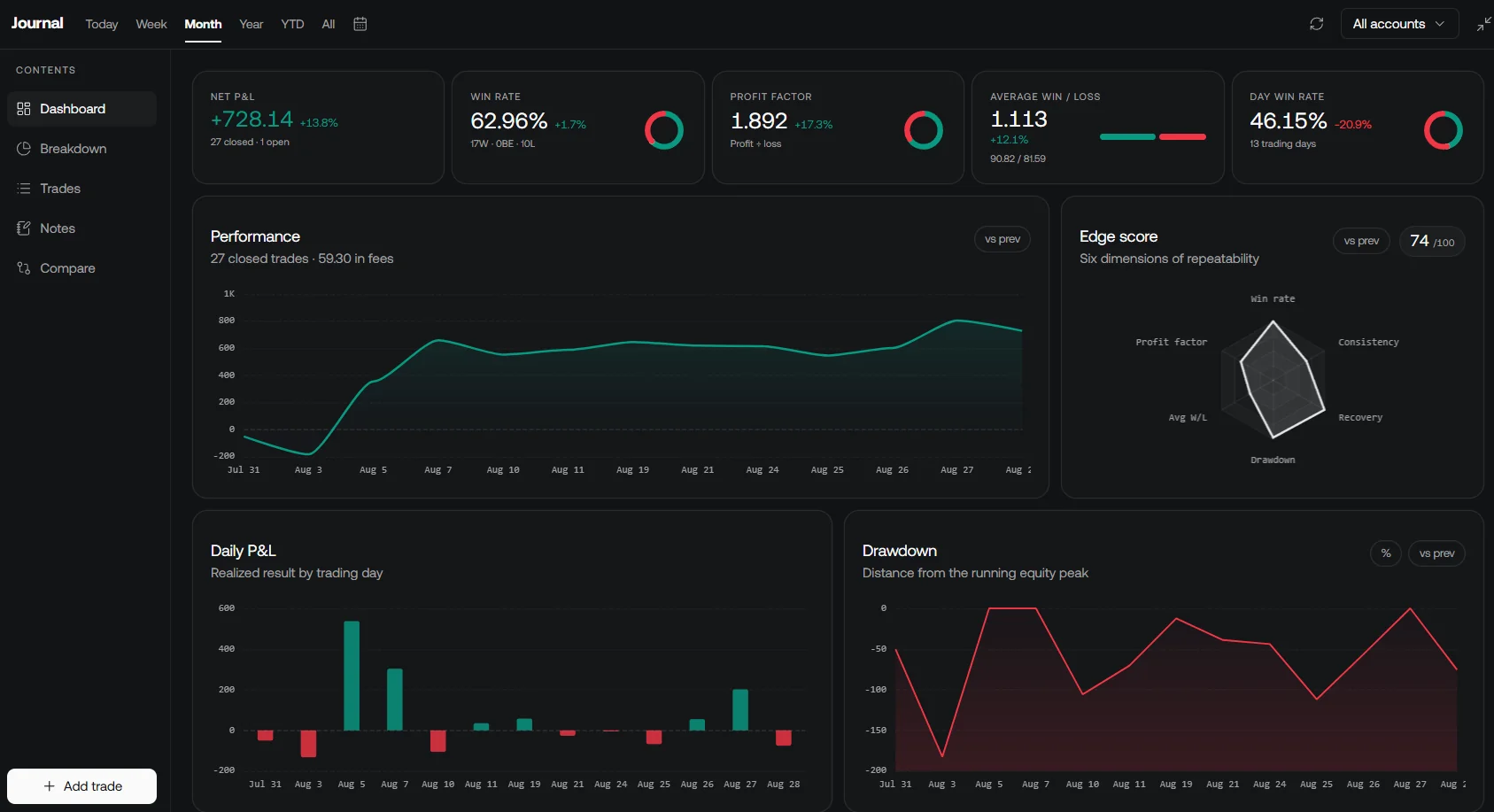
Suppose you review 20 recorded decisions and followed the checklist on 16. That is 80% adherence within this small illustrative sample. It measures your recorded process, not an 80% chance of winning. Review profit and loss after costs separately, and keep the sample definition consistent so the comparison is meaningful.
Handle Doubt Without Forcing a Trade
When doubt appears, identify its cause. An unclear entry rule calls for clarification. Unexpected slippage calls for an execution review. A losing streak calls for comparison with the strategy’s risk assumptions and recent conditions. None of these is automatically a mindset failure.
- Before the session: Review the checklist and decide what would cause you to pause new entries.
- During the session: If you feel pressured to chase or recover a loss, step away long enough to reassess against the written plan. Manage existing exposure according to its risk rules.
- After the session: Log deviations and choose one specific process issue to work on.
- At a scheduled review: Evaluate patterns across trades rather than rewriting the strategy after every outcome.
Pausing new entries does not close an existing position. Keep those decisions explicit. Breathing exercises or a short break may help you regain focus, but they cannot repair an unprofitable strategy or remove market risk.
Learn with Others Without Borrowing Their Conviction
A trading community can help you question assumptions and improve how you describe a setup. Ask others to review the rules, data and costs rather than endorse a prediction. A screenshot of a winning trade omits losing trades, exposure and selection decisions, so it is weak evidence for copying a strategy.
Build confidence through a cycle you can repeat: prepare the rules, test their assumptions, observe execution and review the record. Use LuxAlgo charts, Quant and Journal to make that work easier to inspect. The objective is to make better-supported decisions while remaining willing to say “the evidence is not strong enough yet.”
Read next