How Wins and Losses Shape Trading Psychology

Wins and losses can change how a trader feels about the next decision. A winning streak may encourage larger bets or looser entry criteria; a losing streak may lead to hesitation, chasing or an urgent attempt to recover. The useful response is to identify what changed in the decision process and check it against a written plan.
Emotional awareness matters, but it cannot turn a weak strategy into a profitable one. LuxAlgo’s AI trading and charting platform supports a more reviewable process: native charts for market context, Quant for testing explicit rules, and the Journal for comparing actual trades with the plan. These tools provide evidence to inspect, not a guarantee of objectivity or self-control.
Effects of Wins and Losses on Trading Psychology
How Wins Can Change the Next Trade
A profit can reinforce a useful behavior, but it can also reward a poor decision by chance. If an unplanned entry happens to win, repeating it without testing may turn an isolated outcome into an unsupported rule. Watch for increases in size, extra trades or skipped checks after a successful session.
Review profitable trades with the same questions you ask about losses: did the setup qualify, was size appropriate, and did the exit follow the plan? A good result does not explain why it occurred. Separate the contribution of the rule, execution and favorable market movement.
How Losses Can Change the Next Trade
After a loss, warning signs include entering mainly to get back to break-even, moving an exit because accepting the loss feels uncomfortable, or avoiding the next qualifying setup without a stated reason. These are behaviors to record rather than proof that every losing session reflects poor psychology.
A strategy can experience losses despite correct execution. It can also lose because its rules are weak, market conditions changed, costs were underestimated or fills differed from assumptions. Investigate those explanations before concluding that more confidence or discipline is the answer.
Recognize Biases through Observable Behavior
| Pattern | Possible trading behavior | Question for the review |
|---|---|---|
| Overconfidence | Increasing exposure after a short winning streak. | Did evidence or the risk rule justify the increase? |
| Loss aversion | Avoiding a planned exit because realizing the loss feels especially unpleasant. | Did the trading hypothesis change, or only the willingness to accept the result? |
| Sunk-cost reasoning | Keeping a trade because of the time or money already committed. | Would the current evidence justify this exposure if the past commitment were removed? |
| Outcome bias | Calling every winner a good decision and every loser a mistake. | Was the decision reasonable using information available at the time? |
The SEC’s investor-behavior bulletin describes the disposition effect: a tendency to retain losing investments too long and sell winning ones too early. That is a pattern to investigate across decisions, not a diagnosis from a single sale. A planned profit-taking exit or a justified long-term holding decision needs to be evaluated in its own context.
Keep Win Rate and Risk in Perspective
Several wins do not establish an edge, and several losses do not by themselves disprove one. Review average wins, average losses, costs, drawdown and sample size alongside win rate. A planned risk-to-reward target is different from the outcomes the strategy actually realizes.
For a worked explanation, see the connection between win rate and risk/reward. Use a consistent sizing method rather than assuming the same number of shares or contracts always means the same risk. Changes in exit distance and instrument value can change the loss exposure.
Strategies for Emotional Balance in Trading
Learn from Losses without Rewriting the Plan after Each One
Start by reconstructing the trade: what was known at entry, what rule applied, what size was used and why the exit occurred. Record the facts before writing an explanation. Hindsight can make a losing setup appear obviously flawed even when the decision was consistent with the available information.
| What happened? | What it may indicate | Next check |
|---|---|---|
| A planned loss with expected execution | A normal outcome within the strategy’s distribution. | Record it and compare the broader sample. |
| A loss after an unplanned entry or size change | A rule-compliance issue. | Identify the trigger and a specific prevention step. |
| A loss larger than the model expected | Execution, liquidity, data or modeling differences. | Inspect fills and assumptions rather than only the chart signal. |
| Repeated poor results despite following the rules | A possible strategy or market-condition problem. | Review costs, the baseline and validation evidence. |
Do not force every loss into a lesson about mindset. Sometimes the appropriate finding is that the trade followed the plan and lost. Sometimes the plan itself needs investigation. Keep proposed changes separate until they have been evaluated.
Set Goals You Can Actually Evaluate
A daily profit target can create pressure to trade when no setup qualifies. Pair outcome monitoring with goals about preparation, execution and learning. Those goals make the process easier to review while retaining an honest assessment of net results.
- Preparation: identify the setup, invalidation and risk assumptions before entry.
- Execution: record whether the entry, size and exit followed the written rule.
- Learning: investigate one clearly stated question rather than changing several variables at once.
- Risk: define the conditions for reducing exposure or pausing new trades, and review any breaches.
Specify what happens to existing positions during a pause. Stepping away from new decisions should not mean leaving open risk unmanaged. A stop trigger is not a guaranteed fill; the SEC’s stop-order bulletin explains execution differences and the non-execution risk of stop-limit orders.
Use a Short Reset Routine
After an unusually emotional trade, pause before making another discretionary decision. Note the event, the impulse it created and whether the next trade independently meets the plan. A brief break or a simple breathing exercise may help some people refocus, but neither establishes an edge or a universally effective trading routine.
Choose a routine that fits the strategy and workload. There is no evidence here for a required 10–15-minute meditation session or a fixed recovery time. If fatigue or distraction repeatedly causes missed checks, simplify the workload and reassess whether the planned session is practical.
Use LuxAlgo to Separate Process from Outcome
Reconstruct the Setup on Native Charts
Open the relevant market and interval on LuxAlgo’s native charts. Review the information available when the decision was made. Mark the planned entry, exit and invalidation, and note whether the actual trade differed.
Keep the chart focused on studies that answer a defined question. More indicators do not necessarily provide independent confirmation or remove bias. A chart makes the setup visible; it cannot prove why you acted or whether the next trade will succeed.
Record Actual Decisions in the Journal
The native Journal helps review recorded trading activity. Keep the actual fills and costs alongside notes about the setup, decision and rule compliance. Record winning trades, losing trades and relevant skipped opportunities so the review is not limited to memorable outcomes.
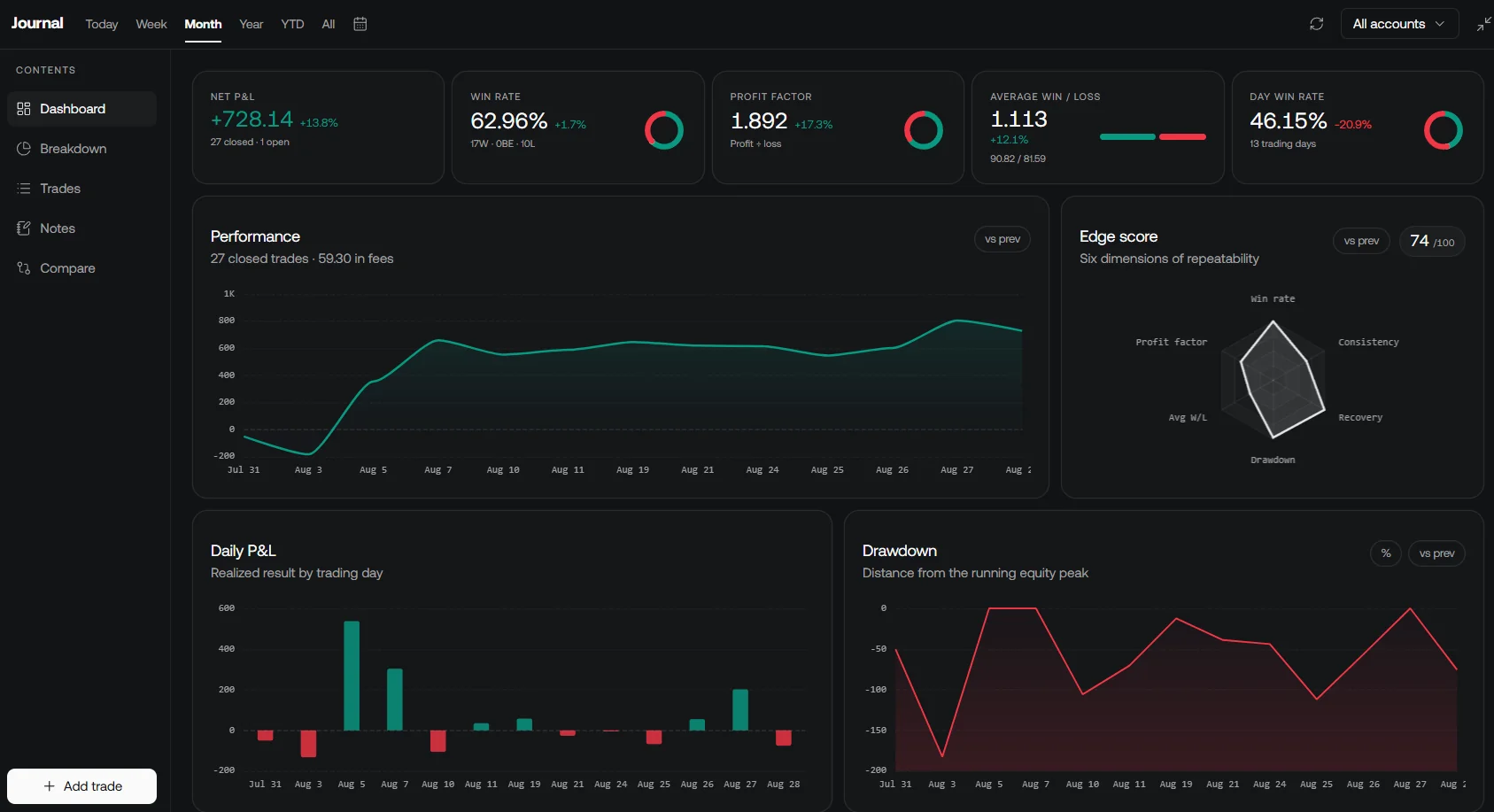
Journal accounts support manual records, supported file imports and broker connections where available for the account. Check duplicates, timezones, missing fills and costs before using the analytics to explain performance.
A useful note separates observation from interpretation: “Entered two bars after the planned trigger at twice the planned size” is an observation; “I was trying to recover the previous loss” records your explanation. Review repeated patterns rather than treating one note as proof of a general cause.
Test Proposed Rule Changes with Quant
Quant, LuxAlgo’s coding agent, can help turn a defined entry, exit and sizing rule into a strategy. Use it to investigate a specific hypothesis raised by the journal, such as whether a stated exit rule changes average outcomes. A backtest does not replay every discretionary choice you made.
Review Code, run the script and inspect its trades. Use Quant’s strategy controls to check sizing and execution-cost assumptions. Compare the proposed change with the baseline over the same period, then test on data not used to choose the change.
Compiling successfully does not establish correct trading logic, and historical performance does not guarantee future results. Native chart alerts require separate setup; a saved Quant strategy does not automatically monitor all watchlist symbols or execute broker orders.
Build a Review Routine That Survives Winning and Losing Streaks
Keep the Review Schedule Consistent
Choose review intervals that fit the strategy’s trade frequency. Check the same questions after wins and losses: rule compliance, execution differences, costs, exposure and the evidence for the setup. Frequent trading may warrant frequent operational checks, while judging a strategy’s quality generally requires a larger sample.
Keep versions of the rules and a reason for each change. Avoid selecting new parameters solely because they would have avoided the latest loss. If results deteriorate despite correct execution, investigate the strategy rather than treating persistence as a virtue by itself.
Use Community Feedback without Outsourcing Judgment
Trading communities can offer alternative interpretations and help identify unclear assumptions. Share the entry rule, risk limits, sample and failed examples as well as successful charts. Ask what evidence would contradict the idea.
Group enthusiasm, a confident speaker or a series of profitable screenshots does not validate a setup. Evaluate suggestions within your own research and risk constraints. Social feedback is most useful when it improves the questions you ask, rather than creating pressure to copy a trade.
Define Progress More Carefully
Progress can mean fewer unplanned entries, more complete records or more consistent execution. These improvements are useful even when a particular trade loses. They should still be paired with a review of whether the strategy’s net outcomes justify the risk taken.
Wins and losses are feedback to examine, not verdicts on personal ability. Use native charts to reconstruct the setup, the Journal to review actual decisions and Quant to test explicit rule changes. Keep emotional awareness and strategy evaluation working together, with neither used as an excuse to avoid the other.
Read next