ICT Silver Bullet Setup & Trading Methods

The ICT Silver Bullet is an intraday setup defined by the clock. The trader watches three fixed one-hour windows, anchored to New York time, and looks for exactly one trade shape inside each: a run on resting liquidity, a fast move the other way that leaves a fair value gap, and an entry in that gap aimed at the opposing pool of orders. It comes from the Inner Circle Trader (ICT) teaching of Michael J. Huddleston and is among the most rigid of the time-based ICT models, which is its main virtue: the setup either forms inside the window or the session's answer is no trade. This guide sets out the windows, the anatomy of the setup and its component concepts as the LuxAlgo Library documents them, the entry, stop and target conventions, what the evidence does and does not support, and how to mark, study and journal the setup in Quant Charts.
The Three Windows
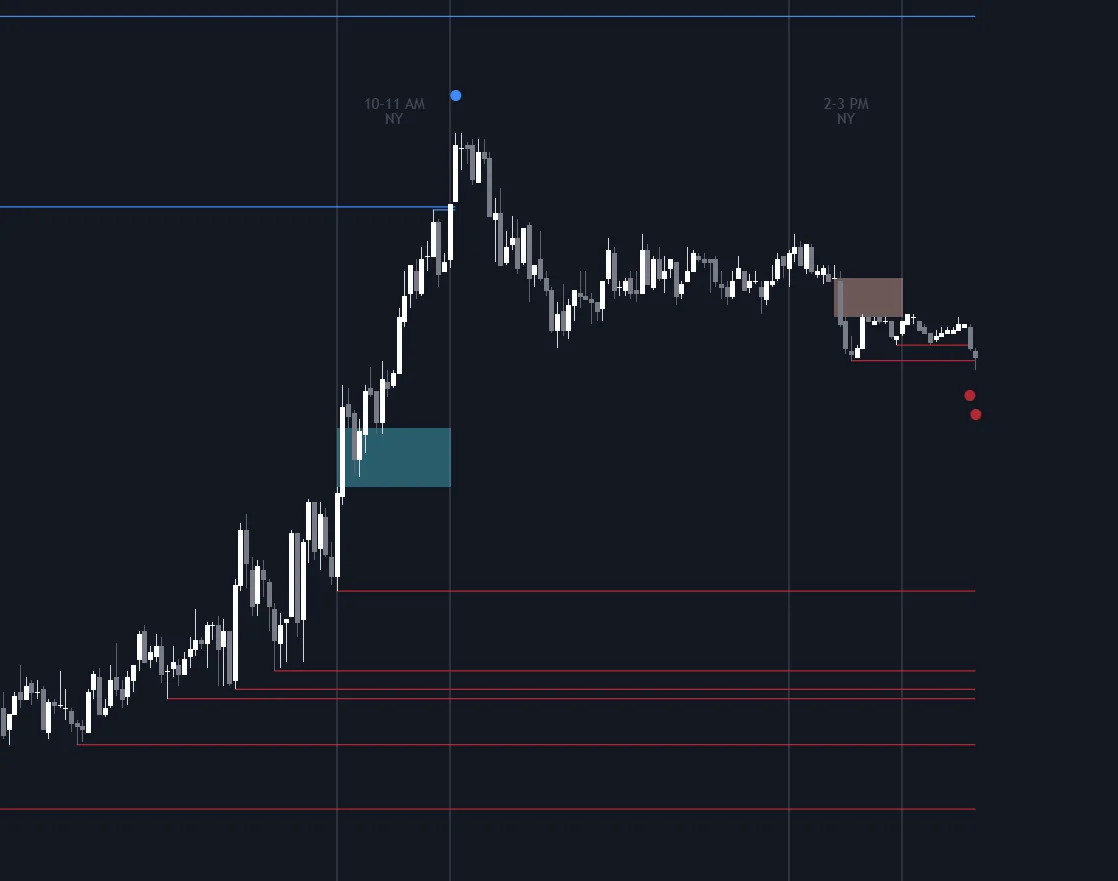
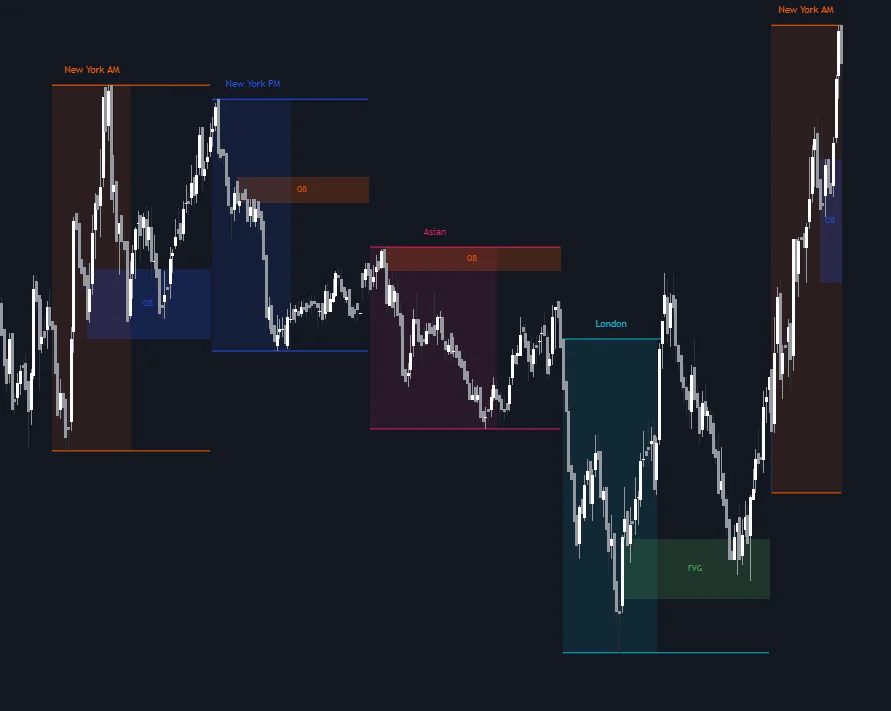
The Library's Silver Bullet entry lists three windows, all in New York time, sitting inside the broader ICT killzones. Because the windows are anchored to New York, traders elsewhere must convert them carefully: daylight-saving changes move them relative to other regions twice a year.
| Window | New York time | Session context |
|---|---|---|
| London | 3:00 to 4:00 am | Inside the London open killzone, which often sets the high or low of the day |
| New York AM | 10:00 to 11:00 am | After the US equity open; often resolves the morning's manipulation into its expansion |
| New York PM | 2:00 to 3:00 pm | Afternoon repositioning ahead of the close |
The premise is the one behind every time-based ICT model: participation clusters around session opens and overlaps, so a pattern that prints inside a busy window is more likely to be engaging genuine order flow than the same pattern in the dead hours between sessions. The Library's Trading Sessions entry adds the caveat that session boundaries are conventions, not rules, and that everything about them describes statistical tendencies with plenty of exceptions.
Anatomy of the Setup
The Library describes a fixed sequence. Before the window opens, the trader maps the draw: untapped highs or lows, session liquidity resting beyond recent extremes, or an unfilled imbalance that could attract price. Inside the window, the model waits for the manipulation, a sweep through one of those pools or a clear structure shift, followed by displacement the other way that leaves a fresh fair value gap. The entry is placed in the gap, the stop beyond the manipulation swing, and the target at the opposing pool. The sequence compresses the ICT accumulation-manipulation-distribution template, also called the Power of Three, into sixty minutes.
- Map the draw on both sides before the window: session highs and lows, equal highs or lows, prior-day extremes and unfilled gaps.
- Wait for the manipulation inside the hour: a run through one mapped pool that fails to hold, or a structure shift that sets the direction.
- Require displacement away from the swept level: a run of large-bodied candles closing in the new direction that leaves an imbalance behind.
- Enter in the gap created inside the window, rather than chasing the move that made it.
- Stop beyond the manipulation swing, target the opposing pool. If no valid gap forms before the window closes, there is no trade.
Fair Value Gaps
A fair value gap (FVG) is a three-candle imbalance. In the bullish case the middle candle moves so fast that the first candle's high and the third candle's low never overlap; the untraded span between them is the gap, and the Library reads it as a footprint of displacement that the market may later revisit. To identify one, find a wide-range middle candle, compare the first candle's high with the third candle's low, draw the zone across the span and mark its midpoint, which ICT calls the consequent encroachment. Raw three-candle gaps print constantly, so most tools require a minimum size or confluence with structure before a gap makes the chart.
The Library's FVG Behavior Rules entry supplies the grading the Silver Bullet depends on. Gaps are classified by origin, with those formed inside a displacement leg ranked above incidental ones, and by order, with the first gap presented after an anchor such as the New York open ranked highest. A gap is respected when price trades into it and continues in the original direction, and disrespected when price closes through the far side. A fill that reaches only the midpoint still counts as respect. A disrespected gap is often relabelled an inversion FVG and watched from the other side: a failed bullish gap becomes resistance, a failed bearish gap becomes support.
Liquidity Pools and the Judas Swing
The manipulation leg of the setup is a liquidity sweep: a run through a level where resting orders cluster, followed by a failure to hold beyond it. The Library's identification is a two-part check. First the run: price trades through a prior swing high or low, equal highs or lows, or a session extreme, often quickly and often on a wick. Then the failure: price closes back inside the prior range. A close that holds beyond the level with continuation is a breakout, not a sweep.
- Buy-side liquidity (BSL) is the pool of resting buy orders above a visible high: the protective stops of short sellers plus the stop-entries of breakout buyers. Old highs, equal highs and prior session or weekly extremes are the classic locations.
- Sell-side liquidity (SSL) is the mirror below prior lows: the stops of longs plus the entries of breakout sellers.
- Session liquidity is the pool that builds at the high and low of each completed session. A later session frequently runs an earlier one's extreme, London probing the Asian range or New York running London's high or low, and the Library notes that neither outcome is owed: some session extremes simply break and trend.
When the sweep happens early in a session it is the ICT Judas swing: a false push shortly after the open that runs resting stops before the day's real move develops the other way. The Library is careful to describe all of this as inference from the chart rather than visible order data, and its honest read of the setup stops at what can be seen: an obvious level was run, the run failed, and a fast repricing followed.
Confirming the Shift
Two structure concepts qualify the reversal leg. Displacement is the fast, one-sided move itself: large bodies, small wicks, consecutive closes in one direction, imbalances left unfilled. There is no fixed threshold; it is judged relative to the surrounding tape, and reasonable traders disagree at the margin. A change of character (CHoCH) is the first structural break against the prevailing trend, and many traders use it interchangeably with the market structure shift (MSS) that ICT vocabulary attaches to a counter-trend break delivered with displacement right after a sweep. The Library warns that a lone CHoCH is failure-prone, since deep pullbacks in healthy trends routinely break a minor swing and resume, which is why the model stacks context around it: a sweep before it, displacement through it, and a gap entry after it. A break of structure, by contrast, is a with-trend break and confirms continuation rather than reversal.
Entry, Stop and Target
The entry is a limit order inside the fair value gap that displacement created within the window, positioned in the gap rather than chasing the move. The stop goes beyond the swing that formed the manipulation, or beyond the far edge of the entry gap in tighter variants; the Library's liquidity sweep entry explains why the reversal thesis is invalidated if price trades back through the swept extreme, so the exit belongs beyond the sweep's wick where the invalidation is unambiguous. The target is the opposing liquidity pool identified before the window, with partial exits at intermediate structure common. Because the windows are fixed, many practitioners also cap the trade in time, closing what has not resolved by session landmarks rather than carrying the idea all day.
The LuxAlgo Library's ICT Silver Bullet indicator adds a Minimum Trade Framework, 40 ticks on futures and indices and 15 pips on forex pairs, as a gauge of whether a window's range offered enough room for the setup to be worth taking. It measures expectations rather than dictating entries and exits.
What the Evidence Supports
The Library's assessment is blunt: no audited public statistics exist for the model, and claimed win rates circulating online should be treated as marketing until shown otherwise. What can be said honestly is that the windows coincide with genuinely busy times of day, and that a one-window, one-setup structure caps overtrading and produces a clean, reviewable sample of decisions. Every window either offered a valid entry or it did not, which makes the edge question answerable from your own journal faster than with most discretionary models. The teaching centres on liquid index futures and major forex pairs, markets whose day is organised around the London and New York sessions; instruments without a meaningful New York cadence fit the model poorly.
Where Quant Charts Fits
The indicators are native. The LuxAlgo Library is built into the Quant Charts Indicators picker as its own section. Click Indicators, go to LuxAlgo Library and add ICT Silver Bullet, ICT Killzones Toolkit or Liquidity Sweeps the same way you add RSI, with no import or script paste. Every Library indicator can be customised on the spot with Quant, our coding agent, by describing the change in plain language. On the Free plan you can add five indicators per chart plus one Quant script; paid plans are unlimited.
Set the clock first. The windows are quoted in New York time, so set the chart's time zone to New York from the Symbol tab of chart settings or by right-clicking the time axis, otherwise the shaded windows land on the wrong candles. Symbol coverage follows the plan: US equities from Cboe EDGX, including ETFs, and crypto are on every plan, while forex, commodities and CME futures, the markets the Silver Bullet teaching centres on, are on paid plans.
The video below shows how an indicator is added from the picker in Quant Charts.
Test the rule set. Describe a time-boxed version of the setup to Quant in plain language: a sweep of the prior session extreme inside one of the three windows, displacement back through the level, an entry at the gap midpoint, a stop beyond the sweep and a target at the opposing session extreme. Quant writes the Pine Script; open Code to inspect it, then click Run. The Backtest Summary reports net profit, trade count, win rate, max drawdown and profit factor, with commission and slippage set in the strategy's Properties. Run it on the exact symbol and timeframe you intend to trade, because results from another market do not transfer, and treat a small trade count as noise rather than evidence.
Journal the windows. Every plan includes the Journal, which turns broker fills or imported trades into round trips and reports win rate, profit factor and drawdown over any range, with a breakdown by hold time, day, time of day, symbol and side. The breakdown by time of day is the Silver Bullet's natural audit: it shows whether the three windows actually produced the results and whether trades taken outside them dragged on the account.
What the platform does not do. No LuxAlgo tool places orders, and no indicator can know whether a given run through a level is a sweep until the failure is printed. The tools mark the windows, detect the gaps and keep the record; the read of the draw and the context remains the trader's.
FAQs
What are the ICT Silver Bullet times?
Three one-hour windows anchored to New York time: 3 to 4 am during London, 10 to 11 am in the New York morning and 2 to 3 pm in the New York afternoon. Traders in other regions must convert around daylight-saving changes, which shift the windows relative to other zones twice a year.
Does the setup appear every day?
No. The window is fixed but the setup is not guaranteed. Some sessions produce no fair value gap inside the hour, no clear draw to target, or a gap that forms against the higher-timeframe context. Standing aside when nothing valid forms is part of the model, not a failure of it.
How is a fair value gap identified?
Find a wide-range middle candle and compare the first candle's high with the third candle's low. If they do not overlap, the span between them is the gap. Mark its midpoint, and filter for size or confluence with structure, since raw three-candle gaps print constantly.
How do I tell a liquidity sweep from a breakout?
By what happens after the level breaks. A sweep trades through a prior high, low or session extreme and then closes back inside the prior range. A close that holds beyond the level with continuation is a breakout. Confirmation comes from displacement away from the swept level or a change of character on a lower timeframe.
Is there evidence the Silver Bullet has an edge?
The LuxAlgo Library states that no audited public statistics exist and that claimed win rates circulating online should be treated as marketing until shown otherwise. The defensible value is structural: a time-boxed, one-shot rule set limits overtrading and produces a clean sample to review in your own journal.
How do I mark the windows in Quant Charts?
Set the chart's time zone to New York, then open Indicators, go to the LuxAlgo Library section and add ICT Silver Bullet or ICT Killzones Toolkit. The windows shade automatically, gaps inside them are detected, and Quant can adjust the study or turn the rules into a backtest from a plain-language description.
References
LuxAlgo Resources
- Silver Bullet, Killzones, Trading Sessions and Accumulation-manipulation-distribution concepts (LuxAlgo Library)
- Fair Value Gap, FVG Behavior Rules and Inversion FVG concepts (LuxAlgo Library)
- Liquidity Sweep, Buy-side Liquidity, Sell-side Liquidity, Session Liquidity and Judas Swing concepts (LuxAlgo Library)
- Displacement, Change of Character, Break of Structure and Smart Money Concepts concepts (LuxAlgo Library)
- ICT Silver Bullet, ICT Killzones Toolkit and Liquidity Sweeps indicators (LuxAlgo Library)
- Indicators, Charts overview, Data, Making strategies with Quant and Journal Breakdown (LuxAlgo Docs)
External Resources
- The Silver Bullet, killzones and Judas swing vocabulary originates in the Inner Circle Trader teaching of Michael J. Huddleston, published through free video content in the 2010s and 2020s; the definitions above follow the LuxAlgo Library's documented conventions rather than any single video.
This article is educational and is not trading advice. The Silver Bullet is a discretionary model with no audited performance record; test any rule set on your own data and journal before risking capital.
Read next