Inside Bar Breakouts Tight Risk Big Reward
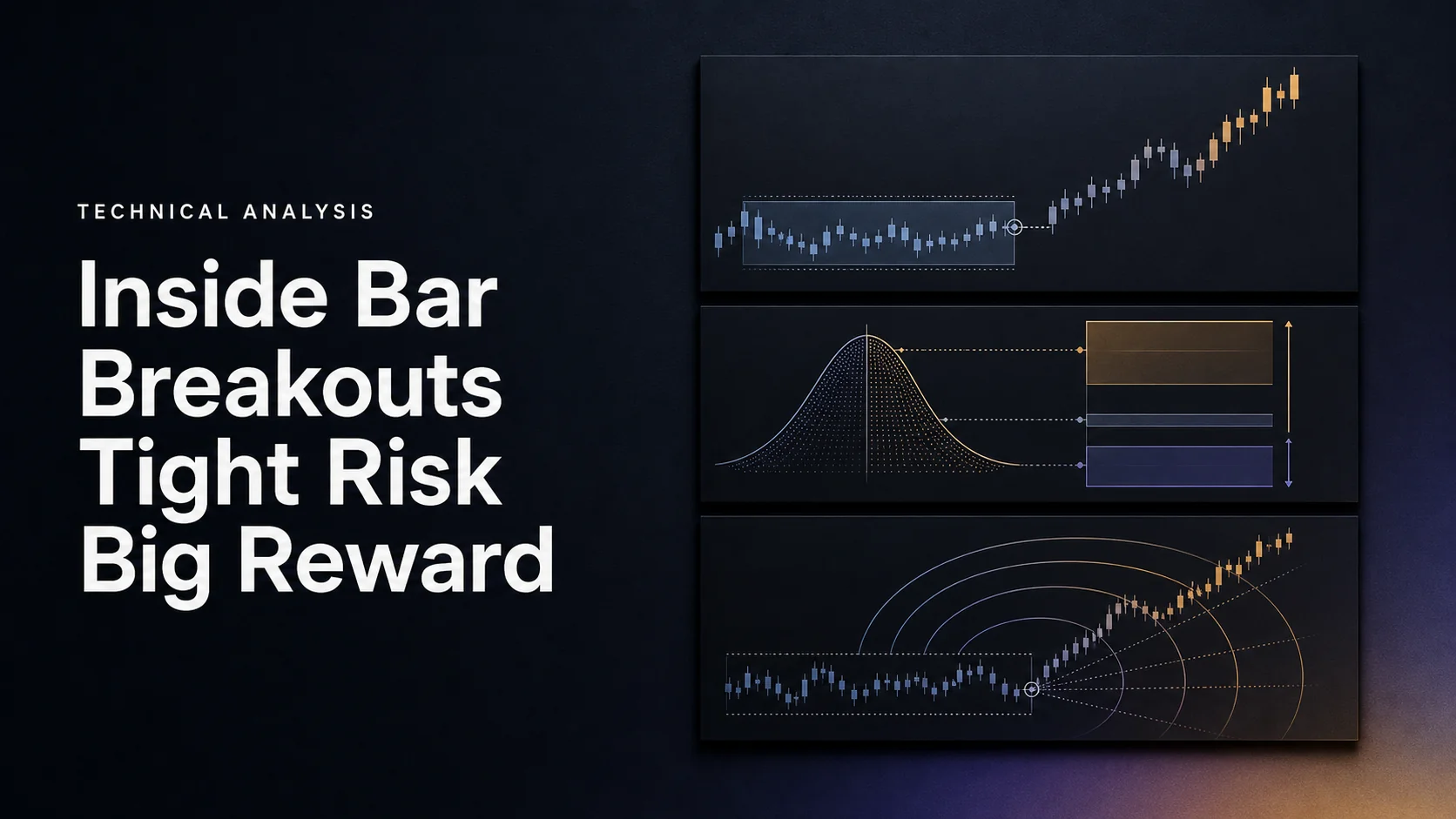
An inside bar gives you a clearly defined range to study, not a guaranteed low-risk trade. Whether the stop is tight depends on the range you use, the entry fill, and the exit rule. A large mother bar can create a wide stop even when the inside bar is small.
Use LuxAlgo’s native charts to identify the formation and Quant to build and test explicit breakout rules. Keep the pattern definition, order timing, sizing, and exit behavior consistent across the test.
What Is an Inside Bar?
For the strict definition used here, the completed inside bar has a high below the previous bar’s high and a low above the previous bar’s low. The previous bar is the mother bar. Compare the full high-low ranges, including wicks, rather than only the candle bodies.
Some implementations allow an equal high or low. That is a different recognition rule and should be recorded. If several bars remain inside one mother bar, specify whether you keep the original boundary or adopt a new one.
The formation indicates range contraction relative to the mother bar. It does not establish the direction or size of the next move. TradingView’s inside-bar overview discusses variations and the tradeoff between stop-entry and close-confirmed approaches.
Choose the Breakout Boundary
This guide’s example trades the mother-bar range. A strategy entering above or below the inside bar itself uses different levels and should be tested separately.
| Decision | Rule to define | Why it matters |
|---|---|---|
| Long entry | Break above the mother-bar high, with a specified buffer | The buffer affects both entry timing and risk distance |
| Short entry | Break below the mother-bar low, with a specified buffer | Short execution and contract value need their own assumptions |
| Confirmation | Intrabar trigger or completed-bar close | A resting price stop does not automatically wait for a close |
| Expiration | Cancel after a defined number of bars or invalidation event | An old setup should not remain active unintentionally |
If placing orders on both sides, define how the unused order is canceled after an entry. A bar that crosses both boundaries can produce ambiguous historical results without enough intrabar information. Do not assume the favorable side triggered first.
Evaluate Context Without Assuming Certainty
A trend filter, nearby price level, or prior breakout can provide context. Each is an additional rule to test. Specify its lookback and when the information becomes available; a swing level confirmed by later candles cannot be used earlier without introducing lookahead.
Daily charts are one possible starting point, not universally the best timeframe. Intraday and daily strategies have different trade counts, costs, session exposure, and holding periods. A higher timeframe does not remove news or overnight gap risk.
Volume and momentum conditions can change trade selection, but agreement among indicators does not guarantee continuation. Compare the base setup with the filtered version using the same data and execution assumptions.
Stop Placement and Position Size
One testable rule places a long stop below the mother-bar low or a short stop above its high. A stop near the inside bar or mother-bar midpoint is a different exit strategy. Do not choose the tighter level solely to create a more attractive reward-to-risk ratio.
Calculate quantity from the planned monetary loss allowance and estimated loss per unit, including costs. For contracts, include tick or pip value and currency conversion. The CME position-sizing lesson explains why stop distance and quantity must be considered together.
Actual losses can exceed the plan. The SEC’s stop-order bulletin explains that a trigger price is not a guaranteed execution price. A stop-limit order adds price control but can remain unfilled.
A Hypothetical Mother-Bar Breakout
Suppose a stock’s mother bar has a high of $100 and low of $98. The next completed bar has a high of $99.50 and low of $98.50, satisfying the strict inside-bar definition.
- Planned long entry: $100.10.
- Initial stop: $97.90.
- Distance: $2.20 per share.
- Hypothetical target: $104.50, giving $4.40 of planned reward per share.
That is a 1:2 risk-to-reward ratio before costs. A $220 planned allowance permits 100 shares before costs. With a $0.10 per-share cost and execution allowance, 95 shares use $218.50. Neither the target nor the stop fill is guaranteed.
If the entry fills at $100.50 instead, the distance to the same stop is $2.60 and the reward to the same target is $4. The planned reward-to-risk ratio falls to approximately 1.54. This shows why actual entry quality matters more than the pattern’s reputation for large rewards.
For a separate hypothetical short EUR/USD trade, an entry at 1.0780, stop at 1.0820, and target at 1.0680 gives 40 pips of risk and 100 pips of reward: 2.5 times the planned risk, before costs. These are illustrative levels, not a claimed historical trade.
Manage Failed Breakouts as Separate Decisions
A break beyond the range followed by a return inside can be defined as a failed breakout. Specify whether that requires a touch or a completed close, and which boundary matters. A pin bar or reversal does not prove that institutions deliberately hunted stops.
Closing a failed trade and opening a reversal trade are separate actions. A countertrade needs its own entry, stop, quantity, and evidence. Include the realized loss from the first trade when reviewing the sequence, and do not increase size merely to recover it.
A re-entry rule can also be tested, but define the maximum attempts and setup expiration. Otherwise repeated small losses may be hidden by focusing only on the eventual successful breakout.
Build the Inside-Bar Strategy With LuxAlgo Quant
In Quant, describe the strict or inclusive pattern rule, mother-bar anchor, direction filter, entry buffer, expiration, exit, and sizing method. Use the Code, Review, and Run workflow to inspect the implementation. A successful run does not establish that the trading logic is correct.
- Review inputs and properties: include capital, order size, commissions, and slippage.
- Inspect individual trades: check when the inside bar completes and which boundary triggers the order.
- Check difficult cases: include gaps, nested inside bars, and bars touching both entry and exit levels.
- Compare variations consistently: keep the sample and costs unchanged when testing a different stop or trend filter.
- Reserve unseen data: evaluate the selected settings outside the tuning period and examine nearby parameter values.
Do not assume that the pretested strategy database automatically tests arbitrary inside-bar rules. Native Quant research and live broker order handling are separate workflows. Use LuxAlgo Journal to review supported trading records and notes against the original plan.
Market-Structure Tools on LuxAlgo
The Library’s market-structure tools label Break of Structure and Change of Character on a Quant Chart, with internal and swing structure settings. These can provide context around an inside-bar setup.
Do not assume those labels detect the exact inside-bar rule, calculate your intended position size, or guarantee a breakout. Validate any added condition separately and distinguish a chart alert from a broker order.
Video: Inside-Bar Breakout Strategy
Master The Market explains an inside-bar trading approach. Compare its boundary and execution choices with the specific rules you intend to test.
FAQs
How does the inside-bar breakout strategy help manage risk while offering high reward potential?
The pattern supplies visible boundaries for defining an entry and invalidation rule. Risk depends on the chosen stop distance, quantity, costs, and fills. A small inside bar does not guarantee a tight mother-bar stop or a large realized reward.
What mistakes should traders avoid when using the inside-bar breakout strategy?
Avoid changing the pattern definition after seeing results, confusing a resting stop with close confirmation, ignoring gaps and same-bar ambiguity, and increasing size to recover a failed breakout. Test filters rather than assuming they improve every setup.
How do LuxAlgo's market-structure tools improve trading strategies for inside-bar breakouts?
They provide market-structure context through internal and swing structure labels on a Quant Chart. They should not be assumed to detect your exact inside-bar rule or place broker orders. Use Quant to implement and test clearly defined strategy logic.
Read next