Java for Finance: Essential Coding Insights
Java runs a large share of the systems that sit between a trading idea and a filled order: order management, risk checks, market data distribution, clearing and settlement, and at some venues the matching engine itself. It earned that position not by being the fastest language but by being fast enough, safe by default and maintainable by large teams for decades, with a runtime whose just-in-time compiler, garbage collectors and concurrency library have been tuned against exactly these workloads. This guide covers what a developer needs to write Java that behaves correctly with money and time, chooses data structures that match market data, uses concurrency without races, keeps the garbage collector out of the latency budget, and tests like a firm whose bugs cost real capital. It closes with where Quant Charts fits, which is before the Java: Quant, our coding agent, writes and backtests the strategy in Pine Script so that the engineering effort is spent on rules that already survived a test.
Key points:
- Java's strength is the whole platform, not raw speed: the JIT, a choice of garbage collectors, java.util.concurrent, virtual threads, and mature build and test tooling.
- Never put money in a double. BigDecimal for ledgers and prices at rest, long integers in tick units on hot paths, java.time for timestamps and System.nanoTime for latency.
- Data structures follow access patterns. TreeMap for a price-ordered book, primitive arrays for series, PriorityQueue for time priority; LinkedList and Vector almost never.
- Latency is a garbage-collection problem first. Allocate at start-up, choose ZGC or Shenandoah for low pauses, warm the JIT, and measure with JMH.
Where Java Sits in the Finance Stack
| Component | Why Java fits | Typical alternatives |
|---|---|---|
| Order management and routing | Reliability, concurrency, FIX connectivity via QuickFIX/J, large-team maintainability | C#, C++ |
| Risk and pre-trade checks | Strong typing and exceptions make invariants explicit; fast enough after JIT warm-up | C++ where nanoseconds matter |
| Market data distribution | High-throughput messaging: Aeron, Chronicle Queue, Kafka for non-latency paths | C++ feed handlers at the edge |
| Matching engines | Proven at scale; LMAX open-sourced the Disruptor pattern from its exchange | C++, Rust |
| Backtesting and research services | ta4j for indicators and strategies; JVM services integrate with data platforms | Python for exploratory research |
| Reporting and analytics | Kafka and Flink for streams; Apache POI and JFreeChart for spreadsheets and charts | Python, BI tools |
The pattern is that Java owns the middle of the stack: everything that must be correct, concurrent and maintained for years, but not the last few microseconds before the wire. Our C and C++ techniques guide covers that edge, and the language comparison places Java among the alternatives.
What the Platform Gives You
The HotSpot JIT compiles hot methods to machine code after observing them run, so steady-state Java performance is close to compiled code for most workloads, with the caveat that the first seconds after start-up are slower and a trading service must be warmed up before the open. Garbage collection is configurable: G1 is the default and balances throughput and pause time, while ZGC, generational since JDK 21, and Shenandoah target pauses in the sub-millisecond range for latency-sensitive services. Virtual threads, standardised in JDK 21, make it cheap to run tens of thousands of blocking I/O tasks, which suits broker API integrations and data collection, though they are not the tool for a CPU-bound hot path. Around the runtime sit Maven or Gradle for builds, JUnit 5 for tests and JMH for benchmarks, all mature and well documented.
Represent Money and Time Exactly
A double cannot represent most decimal prices exactly, so ledgers built on doubles drift by a cent here and there until reconciliation fails. Java's answer is BigDecimal, which carries an explicit scale and rounding mode; use it for anything that is stored, reported or reconciled. On a hot path where BigDecimal's allocation cost matters, represent prices as long integers in tick units and quantities as long integers in lots, converting at the boundaries. For time, java.time provides Instant for wall-clock timestamps and System.nanoTime provides a monotonic clock for measuring latency; never subtract two wall-clock times to measure a duration, because the wall clock can jump.
import java.math.BigDecimal;
import java.math.RoundingMode;
import java.util.Currency;

/** Money for ledgers and reports: exact decimal, explicit scale, explicit rounding. */
public record Money(BigDecimal amount, Currency currency) {

    public Money {
        int scale = currency.getDefaultFractionDigits();
        amount = amount.setScale(scale, RoundingMode.HALF_EVEN);   // banker's rounding
    }

    public Money plus(Money other) {
        requireSameCurrency(other);
        return new Money(amount.add(other.amount), currency);
    }

    public Money times(BigDecimal factor) {
        return new Money(amount.multiply(factor), currency);
    }

    private void requireSameCurrency(Money other) {
        if (!currency.equals(other.currency)) {
            throw new IllegalArgumentException("currency mismatch: " + currency + " vs " + other.currency);
        }
    }
}

// Hot path: integers in tick units, no allocation.
final class Ticks {
    static long toTicks(double price, double tickSize) { return Math.round(price / tickSize); }
    static double toPrice(long ticks, double tickSize) { return ticks * tickSize; }
}
Data Structures That Match Market Data
The wrong container is the most common performance mistake in Java trading code, and the advice that circulates is often backwards. A LinkedList is almost never the right choice: its nodes are scattered in memory, every traversal misses the cache, and its supposed advantage for insertions disappears because you first have to find the position. Vector is a synchronised relic. The right choices follow the access pattern.
| Need | Use | Why |
|---|---|---|
| Price series, indicator buffers | Primitive arrays (double[], long[]) or a ring buffer over them | Contiguous, no boxing, cache-friendly; ArrayList of Double boxes every value |
| Order book by price level | TreeMap with the price as key and a FIFO queue of orders as value | Sorted by price, log-time insert and best-bid lookup, iteration in price order |
| Symbol lookup | HashMap, or an array indexed by an integer instrument id | Constant time; the array avoids hashing entirely when ids are dense |
| Time-priority scheduling | PriorityQueue keyed on timestamp | Log-time insert and poll of the earliest item |
| Sharing between threads | ConcurrentHashMap for maps; a single-writer ring buffer for streams | Lock-free reads; the ring buffer avoids contention altogether |
| Large primitive collections | Agrona or Eclipse Collections primitive maps and lists | Avoid boxing and the garbage it creates |
Boxing is the hidden cost. Every Double in an ArrayList is a separate object on the heap, allocated when created and collected later; a million-bar series as a double array is eight megabytes of contiguous memory, while the same series as boxed Doubles is several times larger and scattered. The distinction rarely matters in a report and always matters in a loop that runs on every tick.
A Backtest Loop in Plain Java
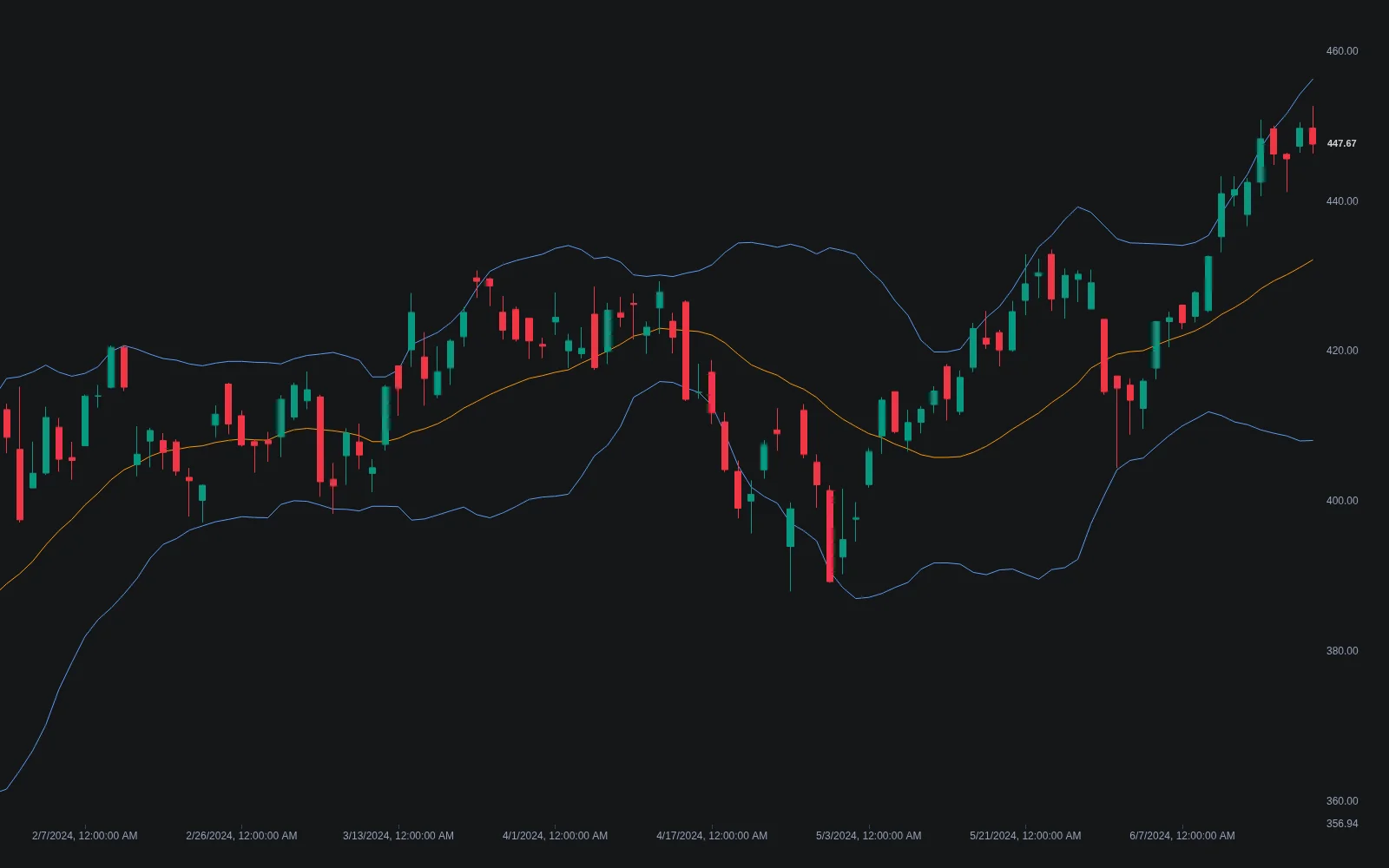
The example below runs a moving average crossover over closing prices held in tick units, fills each signal at the next bar's open, and charges a commission. It allocates nothing inside the loop, which is the habit to build before any discussion of garbage collectors.
public final class CrossoverBacktest {

    public record Result(long trades, double finalEquity, double maxDrawdown) {}

    /** open and close are in tick units; fast and slow are SMA lengths; commission is a fraction per fill. */
    public static Result run(long[] open, long[] close, int fast, int slow, double commission) {
        double cash = 1.0;              // start with one unit of capital
        double qty = 0.0;               // position in instrument units
        long trades = 0;
        double peak = 1.0, maxDd = 0.0;
        int pending = 0;                // +1 buy, -1 sell, decided on bar i, filled on bar i + 1

        for (int i = 0; i < close.length; i++) {
            // 1. Fill the order queued on the previous bar at this bar's open.
            if (pending == 1) { qty = cash * (1 - commission) / open[i]; cash = 0.0; }
            else if (pending == -1) { cash = qty * open[i] * (1 - commission); qty = 0.0; trades++; }
            pending = 0;

            // 2. Mark equity and drawdown on every bar.
            double equity = cash + qty * close[i];
            if (equity > peak) peak = equity;
            double dd = equity / peak - 1.0;
            if (dd < maxDd) maxDd = dd;

            // 3. Decide on this bar's close; the fill happens next bar.
            if (i < slow) continue;
            double fastNow = sma(close, i, fast), slowNow = sma(close, i, slow);
            double fastPrev = sma(close, i - 1, fast), slowPrev = sma(close, i - 1, slow);
            if (qty == 0.0 && fastPrev <= slowPrev && fastNow > slowNow) pending = 1;
            else if (qty > 0.0 && fastPrev >= slowPrev && fastNow < slowNow) pending = -1;
        }
        double finalEquity = cash + qty * close[close.length - 1];
        return new Result(trades, finalEquity, maxDd);
    }

    private static double sma(long[] series, int end, int length) {
        long sum = 0;
        for (int k = end - length + 1; k <= end; k++) sum += series[k];
        return (double) sum / length;
    }
}
The recomputed averages are deliberate for clarity; a production version keeps running sums. What must not change is the structure: decide on the close, fill on the next open, pay for every fill, and mark drawdown on every bar. The ta4j library provides the same machinery, indicators, rules and a backtesting engine, with a larger vocabulary, and is the sensible choice once the strategy has more than one rule.
Concurrency Without Races
Java's concurrency library is one of the best reasons to use the language, and the discipline that goes with it is simple: share as little mutable state as possible, and make ownership of what remains explicit. The pattern trading systems converge on is the single-writer principle: each piece of state is mutated by exactly one thread, and other threads communicate with it through queues. LMAX's Disruptor is the canonical Java implementation, a pre-allocated ring buffer with sequence barriers that avoids locks and garbage; Aeron and Agrona from the same lineage cover messaging and allocation-free data structures, and Chronicle Queue persists the same stream to disk with microsecond latency. For everything that is not on the hot path, java.util.concurrent provides ConcurrentHashMap, executors and completable futures, and virtual threads make blocking broker calls cheap to run in parallel.
Two rules prevent most production incidents. Never block the thread that processes market data on I/O; hand the work to a queue. And never use synchronized on a hot path when a single-writer design would remove the need for a lock; a lock that is contended once a second is invisible, and one that is contended a million times a second defines your latency.
Garbage Collection, Warm-Up and Measurement
The JVM's garbage collector is what separates Java's latency profile from C++'s, and managing it is the core skill of low-latency Java. The first lever is allocation: an object that is never created is never collected, so hot paths pre-allocate buffers, reuse message objects and avoid boxing, exactly as the backtest loop above does. The second is collector choice: G1 is a sound default for services measured in milliseconds; ZGC and Shenandoah keep pauses small for services measured in microseconds, at some cost in throughput and memory. The third is warm-up: the JIT needs to see the hot path run before it compiles it, so a trading service replays recorded data through its own logic before the market opens. Commercial runtimes such as Azul Platform Prime offer alternative JIT and GC implementations aimed at the same problem.
Measure all of it. JMH is the standard harness for Java microbenchmarks and handles the pitfalls, dead-code elimination, warm-up, statistics, that make hand-rolled timing loops lie. In production, record System.nanoTime around the hot path and report percentiles, not averages; our latency standards guide explains why the 99th percentile is the number that matters.
import org.openjdk.jmh.annotations.*;
import java.util.concurrent.TimeUnit;

@State(Scope.Thread)
@BenchmarkMode(Mode.SampleTime)                 // reports a latency distribution, not just a mean
@OutputTimeUnit(TimeUnit.NANOSECONDS)
@Warmup(iterations = 5)
@Measurement(iterations = 10)
public class SmaBenchmark {
    long[] closes = new long[10_000];

    @Setup
    public void setUp() { for (int i = 0; i < closes.length; i++) closes[i] = 10_000 + (i % 97); }

    @Benchmark
    public double sma20() {
        long sum = 0;
        for (int k = closes.length - 20; k < closes.length; k++) sum += closes[k];
        return sum / 20.0;
    }
}
Libraries Worth Knowing
| Library | Role | Notes |
|---|---|---|
| ta4j | Technical indicators, trading rules, backtesting | Open source; the quickest route to a tested strategy in Java |
| QuickFIX/J | FIX protocol engine | Order routing to brokers and venues that speak FIX |
| LMAX Disruptor | Lock-free inter-thread messaging | Pre-allocated ring buffer; the reference single-writer design |
| Aeron and Agrona | Low-latency messaging; allocation-free collections | Used in exchange and gateway infrastructure |
| Chronicle Queue | Persisted low-latency messaging | Journals every message for replay and audit |
| JMH | Microbenchmarks | OpenJDK's harness; the only trustworthy way to time small methods |
| JUnit 5 | Unit and integration tests | Pair with recorded-data replay tests |
| Kafka and Flink | Streaming and stream processing | Analytics, surveillance and reporting paths; not the tick-to-trade path |
| Apache POI and JFreeChart | Spreadsheets and charts | Reporting to the rest of the firm |
Testing Like the Bugs Cost Money
Unit tests with JUnit 5 cover the arithmetic: rounding of Money, indicator values against known references, order book behaviour at the edges. The test that catches the expensive bugs is deterministic replay: record a session of market data and the orders the system produced, replay the data through the current build, and fail if the orders differ. Run the suite in CI on every change, run JMH on the hot path when performance-relevant code changes, and treat a new garbage-collection pause distribution as a regression even when the tests are green.
Where Quant Charts Fits
The Java in this article is infrastructure: it runs a rule reliably, quickly and for years. Whether the rule deserves that infrastructure is a different question, and Quant Charts answers it first. Describe the strategy to Quant, a Bollinger Band mean reversion, a moving average crossover with a volatility filter, whatever the Java service is meant to run, and Quant writes it in Pine Script and plots it on the active chart. Open Code to read the logic, click Run, and the Backtest Summary reports net profit, trade count, win rate, maximum drawdown and profit factor with the commission and slippage set in the strategy properties. A rule that fails there has saved a sprint of Java; a rule that passes arrives with a precise specification. The Making Strategies with Quant guide shows the workflow, and the Library's Bollinger Bands is one of the indicators available in a click.
For teams that already run JVM services, PineTS, LuxAlgo's open-source runtime for Pine Script®, runs the same Pine logic in a scripting runtime alongside those services. The LuxAlgo platform does not place orders for you at a broker or venue; that is the job of the order management code this article describes.
Conclusion
Java earns its place in finance by being the language of systems that must be right, concurrent and maintained for a long time. Writing it well for markets comes down to a handful of habits: exact types for money and monotonic clocks for time, containers chosen for the access pattern rather than by reputation, a single writer for every piece of mutable state, allocation kept off the hot path so the garbage collector has nothing to collect, and JMH and percentiles instead of guesses. Around those habits sit excellent libraries, ta4j for strategies, the Disruptor family for messaging, QuickFIX/J for connectivity, and the platform's own tooling. Prove the rule on Quant Charts, where Quant writes the Pine Script and the Backtest Summary judges it, then build the Java for the rules that survive.
Key Takeaways
- Platform over speed. JIT, selectable GC, java.util.concurrent, virtual threads and tooling are why Java owns the middle of the stack.
- Exact money, monotonic time. BigDecimal at rest, long ticks on the hot path, java.time for wall clock, System.nanoTime for latency.
- Containers by access pattern. Primitive arrays, TreeMap books, PriorityQueue; avoid LinkedList, Vector and boxing.
- Single writer, no garbage. Disruptor-style queues, pre-allocation, ZGC or Shenandoah, JIT warm-up, JMH.
- Prototype on Quant Charts. Quant writes the Pine Script, Code shows it, Run backtests it; engineer only what passes.
FAQs
Why is Java so widely used in finance?
Because it combines a fast JIT-compiled runtime with memory safety, a strong type system, an excellent concurrency library and tooling that large teams can maintain for decades. It is fast enough for order management, risk, market data distribution and even matching engines, and its weaknesses, garbage-collection pauses and JIT warm-up, are manageable with known techniques.
Should I use double or BigDecimal for prices in Java?
BigDecimal for anything stored, reported or reconciled, with an explicit scale and rounding mode, because doubles cannot represent most decimal prices exactly. On hot paths where BigDecimal's allocations are too costly, use long integers in tick units and convert only at the boundaries. Never use double for a ledger.
Which Java data structure suits an order book?
A TreeMap keyed by price level with a FIFO queue of orders at each level gives sorted iteration, logarithmic insertion and immediate access to the best bid or offer. LinkedList is a poor choice despite common advice, because its scattered nodes defeat the CPU cache and finding an insertion point is linear anyway. Use primitive arrays for price series to avoid boxing.
How do I reduce garbage-collection pauses in a Java trading system?
Allocate as little as possible on the hot path: pre-allocate buffers, reuse message objects, avoid boxed types and streams in tight loops. Choose a low-pause collector such as ZGC or Shenandoah for latency-sensitive services, warm the JIT by replaying data before the market opens, and measure pause distributions as part of testing. Commercial JVMs such as Azul Platform Prime target the same problem.
What is the single-writer principle?
Each piece of mutable state is modified by exactly one thread, and other threads communicate with it through queues rather than locks. It removes contention and most race conditions. The LMAX Disruptor is the canonical Java implementation, a pre-allocated ring buffer with sequence barriers; Aeron, Agrona and Chronicle Queue extend the same idea to messaging and persistence.
How does Quant Charts relate to Java trading systems?
Quant Charts is where the strategy is proven before the Java is written. Describe the rule to Quant and it writes the strategy in Pine Script, which you can read in Code and run with Run; the Backtest Summary shows whether it survives commission and slippage. Rules that pass become the specification for the Java implementation. The LuxAlgo platform does not place orders for you, so execution remains your own code, for example through our open-source Trade Relay and Broker SDK.
References
LuxAlgo Resources
- Quant Charts
- LuxAlgo Quant
- Making Strategies with Quant
- PineTS Documentation
- Bollinger Bands Indicator
- C/C++ in Finance: Code Techniques Explained
- C# in Finance: A Trading Code Guide
- Best Programming Languages for Algorithmic Trading
- Latency Standards in Trading Systems
- How to Build a Backtesting Engine in Python
External Resources
Read next