Learning from the Best: Algo Trading Competitions
Algorithmic trading competitions are structured contests in which participants submit forecasting models or trading strategies that are scored on market data they have not seen, under fixed rules about risk, capital and timing. They range from data-science challenges run by quantitative funds, through simulated trading platforms and university case competitions, to paid evaluations run by proprietary trading firms. Done well, they teach the discipline that matters most in systematic trading: building something that works on data you did not tune it on, inside risk limits you did not choose. Done badly, they teach how to overfit a leaderboard. This guide covers the main formats and the notable competitions in each, how scoring and rules actually work, what the experience does and does not transfer to live trading, and how to prepare a strategy for one on Quant Charts, where Quant, our coding agent, writes the rule, and the Backtest Summary and the Library's cost tools test it the way a judge would.
Key points:
- Out-of-sample scoring is the point. Every serious competition judges entries on data the entrant could not see, which is the standard live trading applies too.
- Rules are risk management. Fixed virtual capital, drawdown limits and minimum activity are the same constraints a fund or a prop firm imposes; learn to design within them.
- Leaderboards reward the wrong thing if you let them. Public scores invite overfitting; the final ranking on hidden data is where the lesson is.
- Prepare like a judge would score. Costs charged, walk-forward tested, edge stress-tested against friction, then paper traded.
The Five Formats
| Format | What you submit | How it is judged | Who it suits |
|---|---|---|---|
| Data-science forecasting challenges | A model that predicts a target (return, volatility, closing move) from a provided dataset | A statistical score on hidden test data, often including market data that arrives after the deadline | Programmers and data scientists; no trading account or execution logic needed |
| Simulated strategy platforms | A full strategy in the platform's framework, run on its historical and live data | Out-of-sample performance and risk metrics over a live evaluation period | Quantitative developers who want a complete research-to-evaluation loop |
| University case competitions | Algorithms and manual decisions for designed cases: market making, options, time-series, auctions | Case-by-case profit and loss under simulated markets, usually in teams | Students; often a recruiting channel for trading firms |
| Paper-trading contests | Discretionary or automated trades in a virtual account on a broker or charting platform | Account return over a fixed window, sometimes with drawdown rules | Retail traders testing execution and discipline without capital at risk |
| Prop-firm evaluations | Trades in a funded-account challenge with profit targets and loss limits, for a fee | Pass or fail against the firm's exact rules, then a funded account with profit split | Traders seeking capital; the paid cousin of a competition |
Notable Competitions by Format
| Competition | Organiser | Format and task |
|---|---|---|
| Jane Street Market Prediction (2020) and Real-Time Market Data Forecasting (2024) | Jane Street on Kaggle | Forecasting from anonymised real-world market features; the 2024 edition scored on data arriving after the deadline |
| Optiver Realized Volatility Prediction (2021) and Trading at the Close (2023) | Optiver on Kaggle | Predict short-horizon realised volatility from order-book data; predict US stocks' closing-auction moves |
| Two Sigma: Using News to Predict Stock Movements (2018) | Two Sigma on Kaggle | Combine news analytics with market data to predict stock performance |
| Numerai tournament | Numerai | Ongoing predictions on obfuscated financial data feeding a hedge fund; participants stake the fund's token on their models |
| International Quant Championship | WorldQuant | Team-based alpha construction on the BRAIN research platform, progressing through regional rounds to a global final |
| IMC Prosperity | IMC Trading | Multi-round algorithmic and manual trading challenge for university students worldwide; its fourth edition drew more than eighteen thousand teams |
| Rotman International Trading Competition | Rotman School of Management, University of Toronto | University teams trade designed cases in a simulated market |
| UChicago Trading Competition | University of Chicago | Algorithmic cases covering market making, options trading and time-series analysis |
| Quantiacs contests | Quantiacs | Recurring futures and crypto strategy contests built and backtested in its Python platform |
The Kaggle challenges are the most accessible entry point for programmers, because they need nothing but a notebook and the provided data, and the Python libraries covered elsewhere on this blog. The university competitions are recruiting events as much as contests. The strategy platforms and prop-firm evaluations are the closest to live trading, because they impose account rules and evaluate over time rather than on a single test set.
How Scoring and Rules Work
Forecasting challenges score a statistic: a correlation or utility measure between predictions and realised outcomes on a hidden test set, with a public leaderboard on part of the data and a private one, revealed at the end, on the rest. Strategy and account-based competitions score performance metrics over an evaluation window, and constrain the account while they do it. The specific numbers differ by contest and change between editions, so read the current rules rather than any summary, but the structure is consistent.
| Element | Typical form | What it teaches |
|---|---|---|
| Virtual capital | A fixed starting balance identical for all entrants | Position sizing relative to capital, not to conviction |
| Return measure | Net profit or return over the window, sometimes risk-adjusted with the Sharpe ratio | Volatility of returns matters as much as their level |
| Drawdown limits | Maximum peak-to-trough and sometimes daily loss caps that disqualify on breach | Survival first; see the Library's drawdown statistics |
| Activity requirements | Minimum trades or trading days; limits on concentration or leverage | A strategy has to actually trade, and diversify, to be judged |
| Hidden evaluation | Private test set, or a live period after submissions close | Only out-of-sample results count, the same standard as live trading |
| Eligibility | Age, residence, student status or a platform subscription | Read the rules before building |
What Competitions Teach
- Out-of-sample discipline. The private leaderboard or live period is an enforced in-sample and out-of-sample split. Entrants who tuned to the public score routinely drop when the hidden results appear, the "shake-up" that finance competitions are known for, and that drop is the single most valuable lesson on offer.
- Multiple-testing humility. Trying hundreds of models and submitting the best public score is the competition version of curve fitting. The Library's model overfitting and train and validation discipline entries cover the defences: hold out data touched once, and expect out-of-sample performance to be worse than in-sample.
- Risk rules as design constraints. A drawdown cap forces sizing and stop logic to be designed in from the start rather than bolted on, which is how funds and prop firms operate.
- Engineering habits. Reproducible code, version control, a data pipeline that does not leak the future, and a submission that runs unattended.
- Exposure to how firms think. The tasks quantitative funds pose in public, volatility forecasting, closing-auction prediction, news-based signals, show which problems they consider worth solving.
What They Do Not Teach
Competitions rarely charge realistic costs, and a forecasting score says nothing about whether the signal survives spread, slippage and impact when traded; the Library's cost-model realism entry is the corrective. Evaluation windows are short, so a winning entry may simply have fitted the regime that prevailed during them. Fixed rules encourage strategies that maximise the score rather than strategies that would be sensible with real capital, such as taking maximum permitted risk late in a contest when behind. And the winner's curse applies: among thousands of entrants, the top of any leaderboard contains luck as well as skill. Treat a good result as evidence the process is sound, not as proof the strategy is ready to trade, and see our guide to backtesting traps for the failure modes that carry over.
Prop-Firm Challenges: The Paid Cousin
A proprietary-firm evaluation is a competition with an entry fee and a prize of capital: trade a demo account to a profit target without breaching daily and overall loss limits, and the firm funds an account and shares profits. The rules are the interesting part, because they are stricter and more specific than most contests and decide the pass rate more than the trader's edge does. LuxAlgo's prop-firm pass-rate simulator runs Monte Carlo simulations of each major firm's exact challenge rules and compares firms, fees and offers, so the odds of a given strategy passing can be estimated before paying. Our guides to the best prop firms for algorithmic trading and retail prop firms versus hedge funds cover the landscape.
Preparing a Strategy on Quant Charts
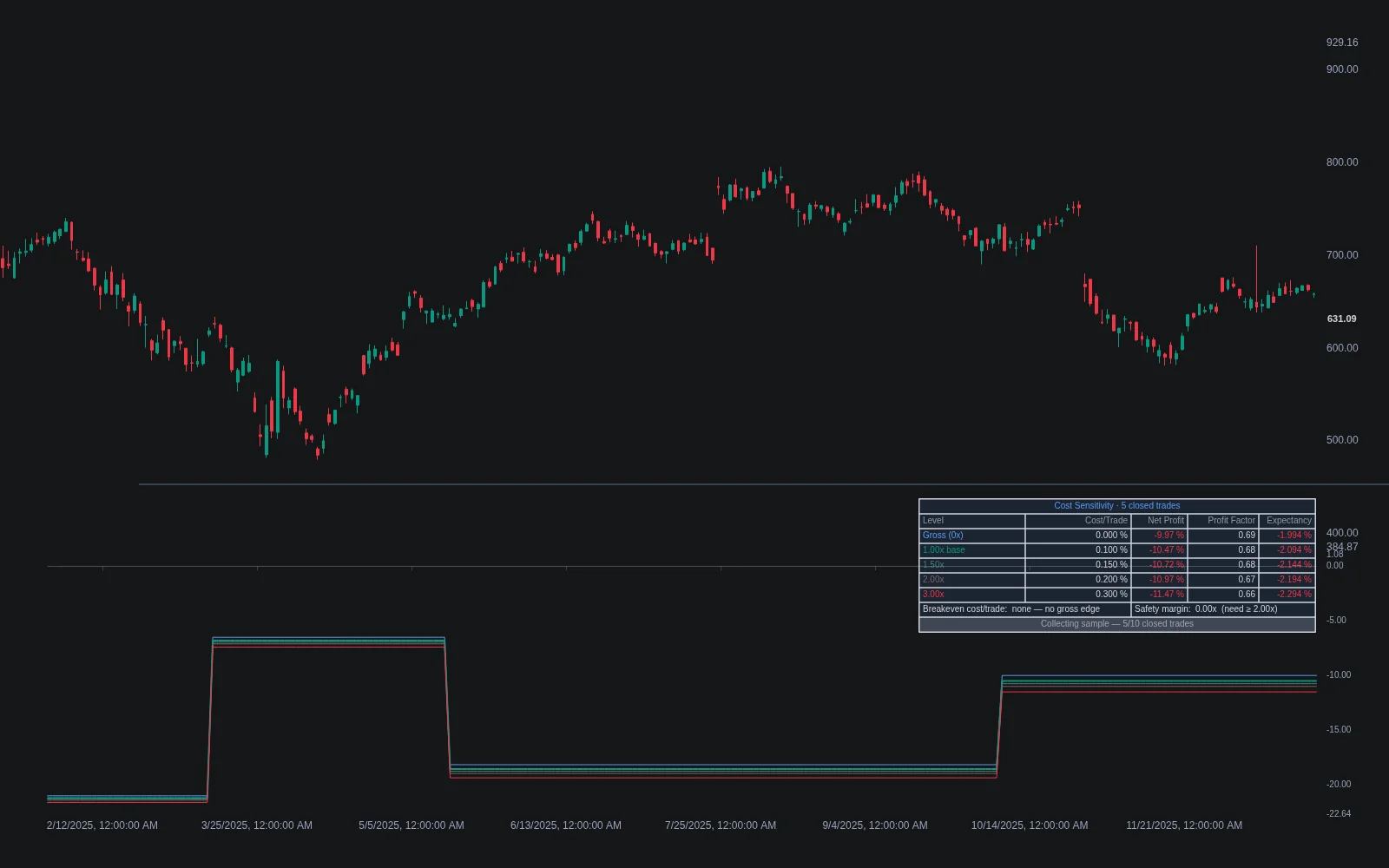
Whatever the contest, the preparation is the same process a judge's scoring rewards, and Quant Charts runs it without a research stack. Describe the rule to Quant, enter on a twenty-bar breakout only when realised volatility is below its median, exit on the opposite Donchian band, risk one percent per trade, and Quant writes it in Pine Script on the active chart. Open Code to read the logic, click Run, and the Backtest Summary reports net profit, trade count, win rate, maximum drawdown and profit factor with commission and slippage set in the strategy properties, so the drawdown figure a competition would disqualify on is visible before entering. Add the Library's Cost Sensitivity indicator to see how far costs can rise before the edge dies, and the Execution Cost Modeling indicator to estimate what those costs realistically are. Then test the rule on a period it was not designed on, ideally as a walk-forward analysis, and paper trade it while logging fills in the Journal, which accepts manual entries and paints them on the chart. The Making Strategies with Quant guide shows the steps; our guides to walk-forward testing, backtesting metrics and paper trading go deeper on each stage.
One boundary. The LuxAlgo platform does not place orders for you or submit entries to a competition; Quant Charts is where rules are written and tested, and the contest platform or broker is where they run.
Conclusion
Algorithmic trading competitions are worth entering for what they enforce rather than what they pay: scoring on unseen data, design within risk rules, and the discomfort of watching a public-leaderboard score fall on the private one. Choose the format that matches your goal, a Kaggle challenge for modelling skill, a university case for recruiting, a platform contest or prop-firm evaluation for something closer to live trading, read the current rules before building, and prepare the way a judge scores: costs charged, edge stress-tested, walk-forward validated, paper traded. Quant Charts runs that preparation end to end, with Quant writing the rule and the Backtest Summary and cost tools judging it.
Key Takeaways
- Five formats. Forecasting challenges, strategy platforms, university cases, paper-trading contests and prop-firm evaluations judge different things.
- Hidden data decides. Public leaderboards invite overfitting; the private score or live period is the result that matters.
- Rules teach risk. Fixed capital, drawdown caps and activity requirements are the constraints funds and prop firms use.
- Costs are the missing test. Most contests ignore friction; check it yourself with Cost Sensitivity and Execution Cost Modeling before believing a result.
- Prepare on Quant Charts. Quant writes the rule, the Backtest Summary reports it with costs, walk-forward and paper trading finish the job; no LuxAlgo tool places orders.
FAQs
What is an algorithmic trading competition?
A contest in which entrants submit a forecasting model or a trading strategy that is scored on market data they have not seen, under fixed rules about capital, risk and timing. Formats include data-science challenges run by quantitative funds, simulated strategy platforms, university case competitions, paper-trading contests and fee-based proprietary-firm evaluations.
Which trading competitions are worth entering?
It depends on the goal. Kaggle challenges from firms such as Jane Street, Optiver and Two Sigma build modelling skill with nothing but a notebook. University competitions such as IMC Prosperity, the Rotman International Trading Competition and the UChicago Trading Competition double as recruiting events. Strategy platforms such as Quantiacs and WorldQuant BRAIN, and prop-firm evaluations, are closest to live trading.
How are trading competitions scored?
Forecasting challenges score a statistic such as correlation or a utility measure on a hidden test set, with a public leaderboard on part of the data and a private one revealed at the end. Account-based contests score return, often risk-adjusted, over an evaluation window while enforcing a fixed virtual balance, drawdown limits and activity requirements. Specific thresholds vary by contest and edition.
Do trading competitions prepare you for live trading?
Partly. They enforce out-of-sample evaluation, risk rules and engineering discipline, which all transfer. They rarely charge realistic costs, use short evaluation windows, reward score-maximising behaviour that would be reckless with real capital, and contain a large element of luck at the top of any leaderboard. Treat a good result as evidence of a sound process, not a tradable strategy.
How is a prop-firm challenge different from a competition?
A prop-firm evaluation charges an entry fee and pays in capital: hit a profit target on a demo account without breaching daily and overall loss limits, and the firm funds an account with a profit split. The rules decide the pass rate more than the trader's edge does, which is why LuxAlgo's prop-firm pass-rate simulator models each firm's exact rules before you pay.
How can Quant Charts help me prepare for a competition?
Describe the strategy to Quant and it writes the Pine Script on the active chart; open Code to read it, click Run, and the Backtest Summary reports net profit, trade count, win rate, maximum drawdown and profit factor with commission and slippage. The Library's Cost Sensitivity and Execution Cost Modeling indicators test whether the edge survives friction, walk-forward analysis tests it out of sample, and the Journal logs paper-trading fills. No LuxAlgo tool places orders or submits entries.
References
LuxAlgo Resources
- Quant Charts
- LuxAlgo Quant
- Making Strategies with Quant
- Journal Documentation
- Prop Firm Pass Rate Simulator and Comparison
- Cost Sensitivity Indicator
- Execution Cost Modeling Indicator
- Sharpe Ratio Concept
- Drawdown Statistics Concept
- In-Sample and Out-of-Sample Split Concept
- Walk-Forward Analysis Concept
- Model Overfitting Concept
- Train and Validation Discipline Concept
- Cost-Model Realism Concept
- Paper Trading: How Simulators Prepare You for Live Markets
- Best Prop Firms for Algorithmic Trading in 2025
- Retail Prop Firms vs Hedge Funds: Which Path to Choose
- Walk-Forward Testing vs Backtesting
- Top 7 Metrics for Backtesting Results
- Backtesting Traps: Common Errors to Avoid
- Python for Algorithmic Trading: Essential Libraries
External Resources
- Kaggle — Jane Street Real-Time Market Data Forecasting
- Kaggle — Jane Street Market Prediction
- Kaggle — Optiver Realized Volatility Prediction
- Kaggle — Optiver Trading at the Close
- Kaggle — Two Sigma: Using News to Predict Stock Movements
- Wikipedia — Numerai
- WorldQuant — International Quant Championship
- IMC — Prosperity Trading Challenge
- Rotman International Trading Competition
- UChicago Trading Competition
- Quantiacs
- Wikipedia — Kaggle
- Wikipedia — Paper Trading
Read next