Margin Account 101: Key Concepts

A margin account is a brokerage account in which the firm lends you money to buy securities, using the securities in the account as collateral. That loan raises your buying power, and it raises the amount you can lose. This guide explains the account type, the rules that govern it, how a margin call happens, what changed in FINRA's 2026 intraday-margin framework, and how to plan the size and risk of a leveraged trade in Quant Charts before any money is borrowed.
Cash Account vs Margin Account
A cash account requires full payment for every purchase. You cannot borrow from the broker, and equity trades generally settle the next business day (T+1). A margin account lets you deposit part of the purchase price and borrow the rest, and it is the only account type in which you can sell short. Many options strategies also require one.
| Feature | Cash account | Margin account |
|---|---|---|
| Funding | Your cash only | Your cash plus a broker loan secured by your securities |
| Short selling | Not available | Available |
| Interest | None | Charged on the borrowed balance at the firm's rate |
| Largest possible loss | The amount invested | Can exceed the amount deposited |
| Maintenance requirement | None | Minimum equity must be held at all times |
| Forced sales | No | Yes, if equity falls below the requirement |
Cash accounts carry their own rules. Buying and selling a security before paying for it is "free-riding," a Regulation T violation, and selling a position bought with unsettled proceeds is a good-faith violation. Both can lead to account restrictions.
The Rules: Regulation T and FINRA Rule 4210
Two layers of rules govern margin lending in the United States. Federal Reserve Board Regulation T sets the initial margin on new purchases. FINRA Rule 4210 sets the minimum equity you must keep afterwards, and brokerage firms may impose stricter "house" requirements on top of both.
| Requirement | Rule | What it means |
|---|---|---|
| Initial margin | Regulation T | Firms may lend up to 50% of the purchase price of an eligible stock on a new purchase. You deposit the other 50%. |
| Minimum equity | FINRA Rule 4210(b) | At least $2,000 of equity before you can trade on margin. You may hold a margin account with less, but you cannot use leverage. |
| Maintenance margin | FINRA Rule 4210(c) | Equity must stay at or above 25% of the current market value of long margin securities. |
| Short positions | FINRA Rule 4210(c) | $5 per share or 30% of market value, whichever is greater; for stocks under $5, $2.50 per share or 100%. |
| House requirements | Firm policy | Firms may require more than the rules, for the whole account or for specific volatile stocks, and may raise them without advance notice. |
Not every security is marginable. Firms can restrict stocks that do not trade on a national exchange or that swing widely from day to day, requiring full payment for them. Under Regulation T you have one payment period, currently three business days from the trade date, to meet the initial requirement on a new purchase. The firm may shorten that window.
Worked Example: Equity, Loan and Margin Excess
FINRA's own illustration shows how the numbers move. On Day 1 you buy $100,000 of margin stock, deposit the required 50%, and borrow $50,000. Your equity is $50,000. The equity above the 25% maintenance requirement, $25,000 here, is your "margin excess."
| Day 1 | Day 2 | |
|---|---|---|
| Market value of securities | $100,000 | $60,000 |
| Margin loan | $50,000 | $50,000 |
| Your equity | $50,000 | $10,000 |
| Required equity at 25% | $25,000 | $15,000 |
| Result | $25,000 margin excess | $5,000 maintenance call |
On Day 2 the securities lose $40,000 of value. The loan does not shrink, so equity falls to $10,000 against a $15,000 requirement, and the firm can issue a $5,000 maintenance call. If the call is not met by the firm's deadline, it may sell $20,000 of securities ($5,000 divided by 25%) to restore the required equity. The loss on a $50,000 deposit is $40,000, twice what the same decline would have cost in a cash account holding $50,000 of the stock.
A useful planning figure is the amount your holdings can fall before a call: margin excess divided by (1 minus the maintenance percentage). The higher the house requirement, the smaller that cushion.
Margin Calls and Forced Liquidation
FINRA describes three ways a call can be triggered:
- New trades create a deficit. You buy on margin without enough excess to cover your share of the purchase, and the initial requirement is not met within the payment period.
- Account value falls. Equity drops below the FINRA or house maintenance requirement as prices decline.
- The firm raises house requirements. A call can arrive with no trade and no loss, for example when a holding becomes highly volatile, is delisted or enters bankruptcy.
The consequences are spelled out by both the SEC and FINRA. The firm can sell securities in your account without contacting you first, decides which securities to sell, may sell before any deadline it mentioned, and is not required to grant an extension. You remain responsible for any shortfall left after the sale. A stop-loss order does not prevent a call, because a gap through the stop or a house-requirement increase can create the deficit before the order fills.
Interest and the Cost of Carry
Margin is a loan, and interest accrues daily on the borrowed balance at the firm's published rate. Rates differ between firms and usually vary with the size of the loan, so check the broker's margin rate schedule rather than a generic figure. The longer a leveraged position is held, the more the position must return simply to cover the interest, which is why margin suits defined-duration trades better than open-ended holdings. Interest is also added to the debit balance, so an unattended loan slowly erodes equity even when prices are flat.
The 2026 Intraday-Margin Framework
For years, accounts flagged as "pattern day traders" faced a $25,000 minimum equity requirement and trade-count restrictions. FINRA has replaced those provisions with intraday margin requirements, effective June 4, 2026, with a transition period for firms through October 20, 2027. Under the new framework:
- There is no $25,000 minimum and no pattern-day-trader designation based on counting trades.
- The 25% maintenance requirement applies throughout the trading day, not only at the close.
- Positions that exceed the equity in the account create an "intraday margin deficit" that must be satisfied promptly by depositing funds or reducing positions.
- Repeatedly failing to satisfy deficits can restrict the account for up to 90 days.
- The $2,000 minimum equity to use leverage is unchanged.
Firms may monitor accounts in real time and reject orders that would create a deficit, compute intraday requirements at the end of the day and issue calls, or combine the two. Because some firms will run the old rules during the transition, confirm which framework your broker applies before planning an active strategy around it.
Where Quant Charts Fits
LuxAlgo does not lend money, hold accounts or place orders, so nothing on the platform replaces the broker's margin figures. What Quant Charts does is the planning that should happen before leverage is used: sizing a position from the loss at the stop rather than from available buying power, testing a rule with realistic costs and leverage settings, and reviewing the results afterwards.
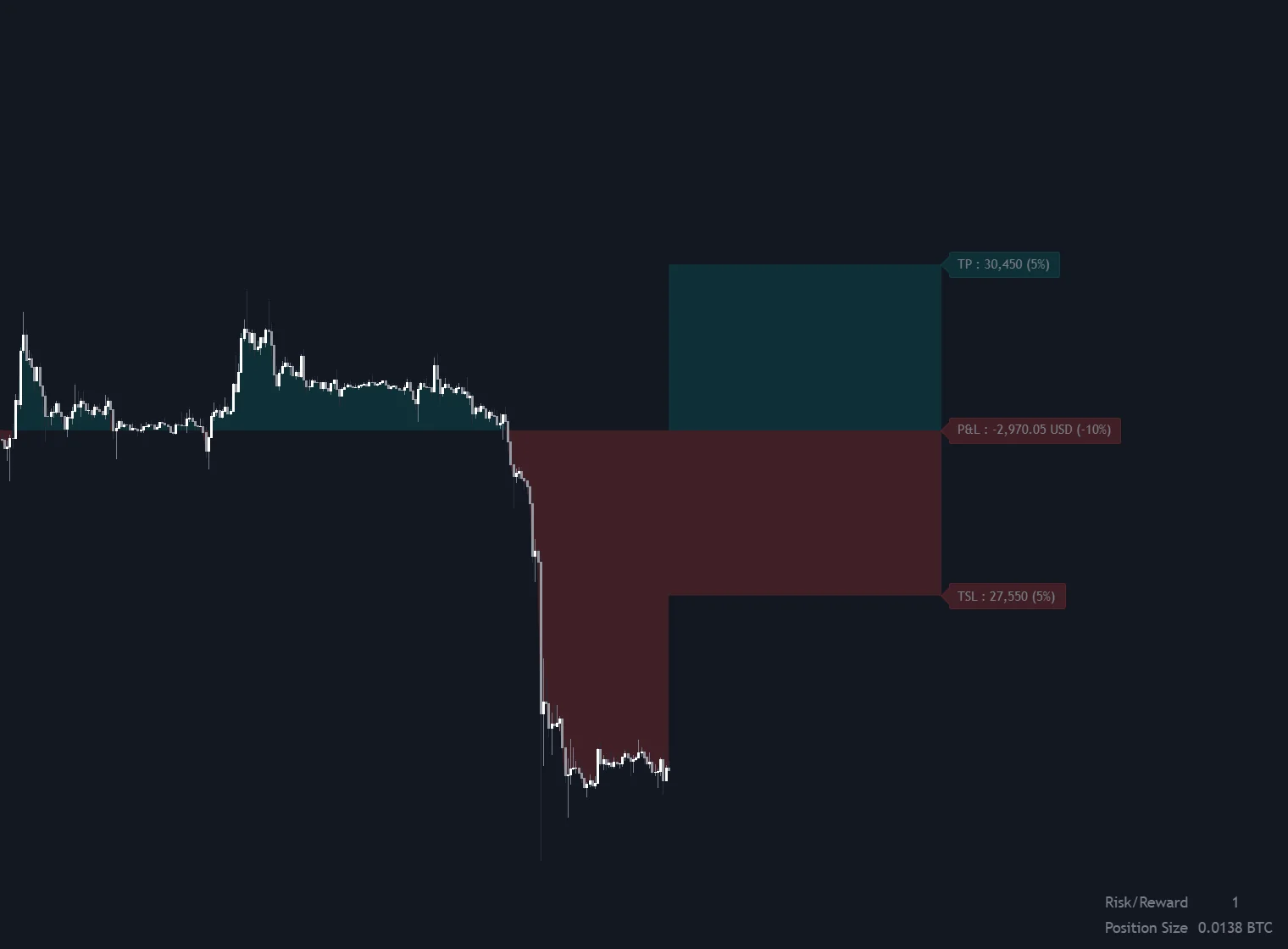
Size from risk, not from buying power. The Library's sizing bases entry separates two questions that margin blurs together: how much exposure you hold (a notional cap, such as position value as a multiple of equity) and how much you lose if the stop is hit (a risk cap). Margin raises the first; it does nothing to protect the second. The fixed fractional rule works backwards from a chosen fraction of equity and the stop distance to a share count, and the Risk Management Tool indicator performs that arithmetic on the chart, plotting the stop and target and showing the position's profit and loss as it develops.
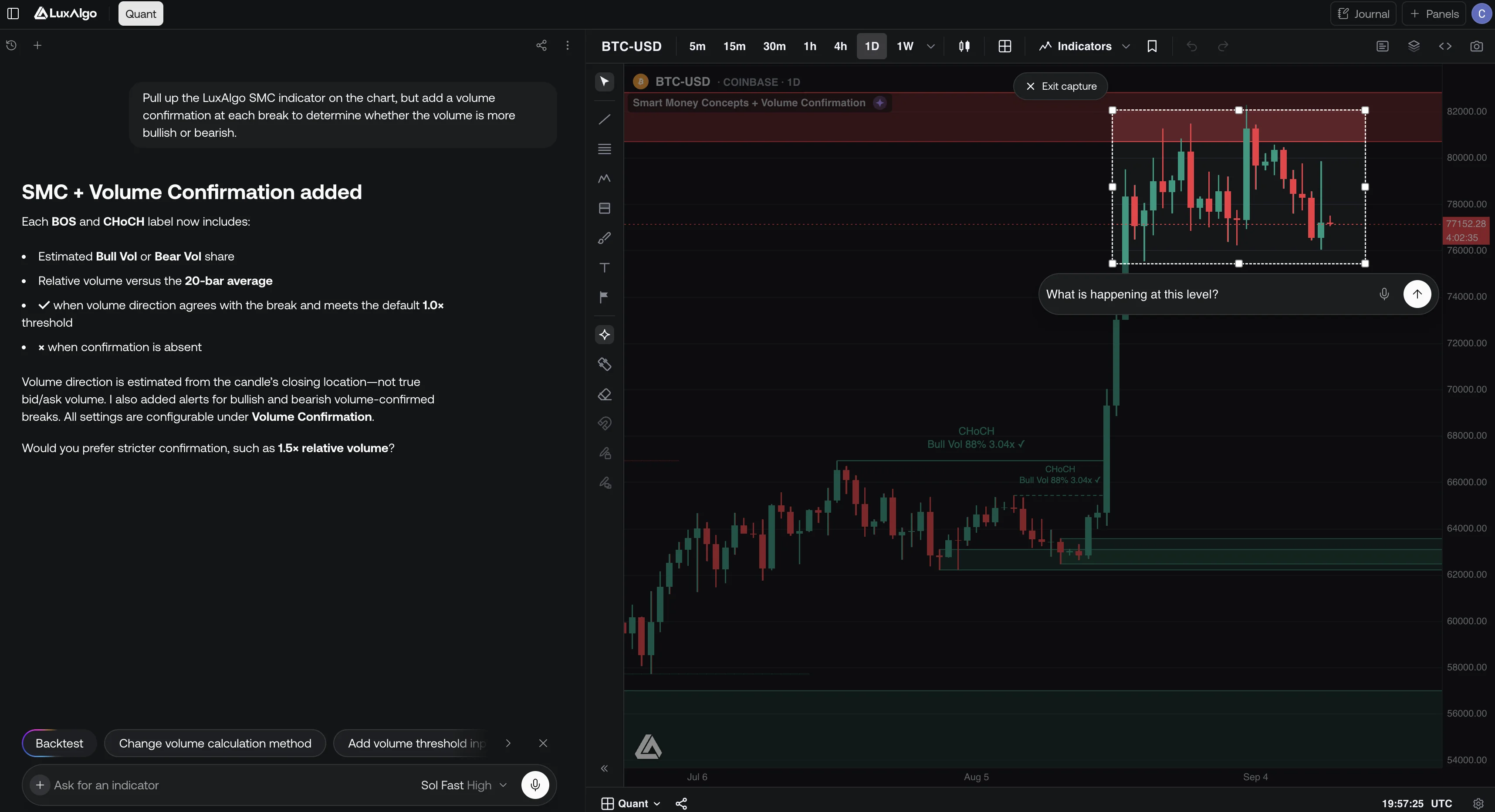
Test the rule with leverage and costs switched on. Describe a rule to Quant, our coding agent, in plain language, for example a long entry when price closes above a 20-day high with a stop under the prior swing low. Quant writes the Pine Script; open Code to inspect it, then click Run. The Backtest Summary reports net profit, trade count, win rate, max drawdown and profit factor. In the strategy's Properties, set commission and slippage to realistic values and use the margin setting to model the leverage the rule assumes. The max drawdown that results is the figure to compare against the maintenance cushion from the worked example above. A simulated drawdown deeper than the cushion means the rule would have produced a margin call, whatever its profit factor says.
Read results in R and drawdown terms. The R-multiple framework expresses every outcome as a multiple of the risk taken at entry, which makes a leveraged and an unleveraged version of the same rule directly comparable. Risk of ruin shows why oversizing matters: the probability of an account-ending losing streak falls sharply as risk per trade is cut and rises toward certainty when it is not. The Drawdown Statistics indicator profiles depth, duration and recovery of an equity series, and its threshold alert mirrors the shape of a maintenance limit.
Set account-level circuit breakers. Loss-control rules, such as a daily loss limit or a consecutive-loss breaker, cap the damage of a losing sequence rather than a single trade. On a margin account they double as a way to stop adding exposure before the broker's requirement forces the decision.
The video below shows how indicators such as the Risk Management Tool are added to a Quant Charts layout.
After the trade, log fills in the Quant Charts Journal and review the drawdown and daily P&L alongside the broker's margin statements. The Journal records your trades; it does not read the broker's live maintenance calculation.
Where Each Tool Stops
- The broker lends, sets house requirements, calculates equity and margin excess, issues calls and liquidates. Only the broker's figures determine whether you are in compliance.
- Quant Charts charts exchange-listed US equities, ETFs and crypto, with forex, commodities and CME futures on paid plans. It runs Quant strategies with simulated margin, commission and slippage. It does not place orders or monitor a live account.
- The Library explains sizing, R-multiples, risk of ruin and drawdown, and provides indicators that implement them on the chart.
- The Journal stores your own fills and computes P&L, drawdown and an Edge Score from them.
Conclusion
A margin account converts the broker into a lender and your portfolio into collateral. Regulation T caps the initial loan at half the purchase price, FINRA Rule 4210 requires at least $2,000 of equity to borrow and 25% maintenance thereafter, and firms may demand more at any time. Since June 2026 the maintenance test applies throughout the trading day, and the old $25,000 day-trading threshold is being phased out. The risks are concrete: losses larger than the deposit, forced sales without notice and interest that accrues whether or not the trade works. Sizing from the loss at the stop, testing rules with costs and leverage switched on, and comparing simulated drawdown with the maintenance cushion are the parts of the process you control.
Key Takeaways
- Initial margin: up to 50% of a new purchase may be borrowed under Regulation T.
- Minimum equity of $2,000 to use leverage; 25% maintenance under FINRA Rule 4210; house requirements can be higher and can change without notice.
- A margin call can come from a new trade, a price decline or a house-requirement increase, and the firm may liquidate without contacting you.
- FINRA's intraday-margin framework replaced pattern-day-trader rules from June 4, 2026, with firm transitions allowed through October 20, 2027.
- Quant Charts, the Library and the Journal support sizing, testing and review; they do not lend, monitor or trade the account.
FAQs
What is a margin account?
A brokerage account in which the firm lends you cash to buy securities, using the securities in the account as collateral. It increases purchasing power and exposes you to larger losses than a cash account, and it is required for short selling.
How much do I need to trade on margin?
FINRA Rule 4210 requires equity of at least $2,000 before you can use leverage. Regulation T then lets the firm lend up to 50% of a new purchase, and your equity must stay at or above 25% of the value of long margin securities. Firms may set higher minimums.
What triggers a margin call?
A new purchase that is not fully met within the payment period, a decline in account value below the maintenance requirement, or an increase in the firm's house requirement. The firm can sell securities to cover the deficit without notifying you first.
Does the $25,000 pattern-day-trader rule still apply?
FINRA replaced the pattern-day-trader provisions with intraday margin requirements effective June 4, 2026. Firms may continue to apply the old rules during a transition period that runs through October 20, 2027, so check which framework your broker uses.
Can I lose more than I deposit?
Yes. The loan does not fall when prices fall, so a decline in the securities is borne entirely by your equity, and you are responsible for any shortfall remaining after a forced sale.
Does Quant Charts monitor my margin account?
No. Quant Charts does not connect to a broker's margin engine or place orders. It helps you size positions from risk, backtest rules with simulated margin, commission and slippage through Quant, and review logged trades in the Journal. Broker statements remain the source of your margin figures.
References
LuxAlgo Resources
- Sizing Bases and Fixed Fractional (LuxAlgo Library)
- R-multiple Framework, Risk of Ruin and Loss-control Rules (LuxAlgo Library)
- Risk Management Tool, Drawdown Statistics and Fibonacci Trailing Stop indicators
- Making strategies with Quant and Reading a strategy backtest (LuxAlgo Docs)
- Quant Charts Journal (LuxAlgo Docs)
External Resources
- FINRA Rule 4210: Margin Requirements
- FINRA: Brokerage Accounts (Margin Accounts section)
- FINRA: Know What Triggers a Margin Call
- FINRA: Understanding the New Intraday Margin Requirements
- FINRA: Frequent Intraday Trading
- SEC Investor.gov: Types of Brokerage Accounts
- SEC Investor.gov Glossary: Margin Call
- 12 CFR Part 220: Regulation T, Credit by Brokers and Dealers (Cornell LII)
Read next