Margin Call: What Traders Need to Know

A margin call is a demand to bring a margin account back into compliance with its required funding or equity level. Falling investment values, new trades or a higher broker requirement can create the shortfall. A broker can also liquidate securities without first contacting you, so waiting for a notification is not a dependable risk plan.
The examples below focus on a simple US stock margin account holding long, margin-eligible shares with a cash loan. Short positions, options, portfolio margin, futures and other jurisdictions use different calculations. Your broker’s current account requirements and agreement determine what applies to you.
Initial Margin, Maintenance Margin and Equity
FINRA’s margin-call guidance explains that Regulation T generally allows an initial loan of up to 50% of an eligible stock purchase. This is an initial funding rule for a new position; it is not a promise that every security qualifies or that a broker will lend the maximum.
For long margin-eligible stocks, FINRA’s general maintenance minimum is 25% of current market value. A firm can impose a higher house requirement, such as 30% or 40%, and can increase it without advance written notice. Do not apply the 25% figure indiscriminately to options, short stock or every asset in a mixed account.
| Concept | Meaning in this example | At a $20,000 purchase |
|---|---|---|
| Market value | Current value of the shares | Initially $20,000 |
| Margin debit | Cash borrowed from the broker | Initially $10,000 |
| Account equity | Market value minus the loan, with no other assets or obligations | Initially $10,000 |
| Initial equity percentage | Your contribution divided by purchase value | 50% |
| Maintenance requirement | Assumed house percentage of current share value | 30%, or $6,000 at the initial value |
With $20,000 of shares financed by $10,000 of equity, the initial exposure is twice the equity. That does not mean leverage stays at 2:1. If the shares fall while the loan stays unchanged, equity shrinks faster than the position value and the exposure-to-equity multiple rises.
Three Common Margin-Call Triggers
- New activity creates a deficit: a purchase or other transaction exceeds the funding or equity available under the applicable rules.
- The portfolio loses value: equity falls below the current maintenance requirement.
- The broker raises its requirement: the account can become deficient even if prices and positions have not changed.
Interest charged to a margin loan and other account obligations also affect the actual balance. Cash withdrawals and changes in collateral eligibility can reduce the cushion. Check the account’s full calculation rather than treating one position’s unrealized profit or loss as the whole account.
Worked Example: $20,000 Falls to $14,000
Assume the account contains only long stock, the margin loan remains $10,000, the maintenance rate stays at 30%, and interest and transaction costs are ignored. At a $14,000 market value, equity is $14,000 − $10,000 = $4,000. The equity percentage is $4,000 ÷ $14,000 = approximately 28.57%.
| Item | Calculation | Result |
|---|---|---|
| Current equity | $14,000 − $10,000 | $4,000 |
| Equity percentage | $4,000 ÷ $14,000 × 100 | Approximately 28.57% |
| Required equity | 30% × $14,000 | $4,200 |
| Maintenance shortfall | $4,200 − $4,000 | $200 |
The original $10,000 equity has lost $6,000, or 60%, while the shares have fallen 30%. This is how borrowing magnifies losses on your own capital. The shortfall calculation uses current market value, not the original $20,000 purchase value.
Calculate the Threshold Price Carefully
For this single long-stock position with a fixed loan and fixed maintenance percentage, the threshold occurs when market value minus the loan equals the maintenance percentage times market value. Rearranging gives:
Threshold position value = loan ÷ (1 − maintenance rate). With a $10,000 loan and 30% maintenance, the threshold is $10,000 ÷ 0.70 = approximately $14,285.71. Below that value, the account is deficient under these assumptions.
If the position was initially bought at a per-share price P₀ with an initial equity fraction i, the equivalent formula is threshold share price = P₀ × (1 − i) ÷ (1 − m), where m is the maintenance fraction. At a $100 purchase price, 50% initial equity and 30% maintenance, the threshold is approximately $71.43 per share.
This formula is a simplified boundary, not a guaranteed broker liquidation price. It assumes the share quantity, loan and maintenance rate do not change. Accrued interest, other holdings, options, short positions, concentration charges and broker-specific calculations can change the result.
A Cash Deposit and a Stock Sale Are Not Equivalent
In the $14,000 example, adding $200 of cash and applying it to the loan reduces the debit to $9,800. Equity becomes $4,200 against the unchanged $14,000 stock value, meeting the assumed 30% requirement exactly. Further price moves or costs can immediately create another deficit.
Selling $200 of stock is different. If the proceeds repay the loan, stock value becomes $13,800 and the loan becomes $9,800. Equity is still $4,000, while the 30% requirement is $4,140. The account remains $140 short.
Under the same fixed-price, single-rate assumptions, required sales equal the shortfall divided by the maintenance rate: $200 ÷ 0.30 = approximately $666.67. After that sale and loan repayment, market value is about $13,333.33, the debit about $9,333.33 and equity still $4,000—30% of the remaining stock value.
FINRA also distinguishes depositing eligible securities from depositing cash. Collateral transferred into the account brings its own margin requirement. For example, a $6,000 shortfall met with stock subject to a 40% requirement needs $10,000 of that stock: $6,000 ÷ (1 − 0.40). These illustrations are not instructions to send a particular amount; obtain the broker’s current calculation for your account.
Do You Get Time to Respond?
Do not assume you have two to five days before securities can be sold. FINRA states that a firm need not issue a maintenance call before liquidating positions and need not let you choose what it sells. It may sell enough to pay off the margin loan rather than only the minimum needed to cover the deficiency.
Different call types have different rules. FINRA describes a Regulation T initial-payment period that is currently three business days from the trade date, while firms can require earlier payment or more initial margin. That is not a general grace period protecting every maintenance deficit from liquidation.
If a call appears, promptly verify its type, amount, accepted remedies and any stated deadline with the broker. Ask how pending deposits and orders are treated. A promised transfer, an alert or an unanswered support message should not be assumed to prevent a sale.
The 2026 Intraday-Margin Transition
FINRA’s new intraday-margin framework became effective June 4, 2026, with a permitted broker transition period through October 20, 2027. A firm may still use the prior day-trading requirements during that transition. Confirm which framework your broker has implemented.
After migration, the new framework replaces the pattern-day-trader designation and its $25,000 minimum with requirements tied to intraday exposure. Firms can monitor in real time, calculate intraday requirements at the end of the day or combine approaches. This does not remove maintenance requirements or your responsibility to fund positions, and it does not guarantee advance notice before liquidation.
Trading With Margin: Video
The retained Markus Heitkoetter video premiered March 19, 2022, and discusses margin benefits, risks and calls. Its account examples are historical education and predate the 2026 intraday-margin changes. Use current broker and regulatory guidance for the rules governing your account.
Monitor the Broker’s Margin Figures
Your broker’s account display is the operational source for current equity, margin requirements and available excess. Check projected requirements before submitting an order and understand how they can change overnight or when positions expire. Third-party chart alerts or a personal balance tracker do not establish that your brokerage account is compliant.
For a specific example, Interactive Brokers’ TWS documentation describes yellow as a 10% cushion above the margin requirement, orange as a depleted cushion with limited time for margin-reducing trades, and red as approaching liquidation. These are TWS definitions, not universal thresholds. IBKR explicitly warns that rapid deterioration can lead to liquidation without a yellow warning.
A price alert from a charting platform monitors its configured market condition. A margin warning depends on the broker’s account-wide calculation, including positions, obligations and house rules. Treat these as separate tools, even when both help you pay attention to risk.
Reduce Exposure Before a Deficit Appears
| Practice | What it can help with | Important limitation |
|---|---|---|
| Use less borrowed exposure | Reduce sensitivity of equity to adverse price moves | It cannot remove market risk |
| Maintain additional margin excess | Provide room for price moves or higher requirements | No fixed cushion guarantees safety |
| Plan exits and order types | Make execution decisions before stress rises | Stops do not guarantee the exit price |
| Review correlated holdings | Identify concentration hidden across several positions | Diversification can weaken during a broad sell-off |
| Check account conditions regularly | Spot requirement changes and shrinking excess | Alerts can fail or arrive after rapid moves |
A generic “risk 1–2% per trade” rule is not a margin-compliance calculation. A planned stop loss, collateral requirement and total leveraged exposure are different quantities. Several positions can also lose together. Stress-test the whole account with adverse prices and higher house requirements instead of assuming small individual stop distances are enough.
Investor.gov explains the stock-order tradeoffs: market orders do not guarantee a price, limit orders may not fill, and a stop order becomes a market order after its trigger. Gaps and fast markets can produce a loss larger than the planned stop-based estimate.
Forced sales can alter the portfolio, consume flexibility and leave a balance owed. They do not merely delay a strategy until its predicted rebound. Avoid assuming a later recovery would have occurred or that depositing more money is always the appropriate response. Reassess the exposure and your capacity to bear further loss.
Use LuxAlgo to Prepare and Review the Trading Plan
LuxAlgo’s native charts can support price analysis and scenario review before a trade. Keep the broker’s actual margin calculation alongside that research. A chart setup, indicator or simulated strategy does not monitor or satisfy the live account’s maintenance requirement.
For a supported chart-strategy hypothesis, ask Quant, our coding agent to help express the rules. Inspect the generated code and run it manually. Then review the test settings, costs and individual trades. A candle-based simulation is not evidence that a broker would finance the same positions or liquidate them at the simulated exit price.
After execution, use LuxAlgo’s native trade journal to review recorded trades and your decision process. Save the broker’s margin figures, loan balance and any liquidation messages separately. Imported trade records are not a real-time broker margin engine.
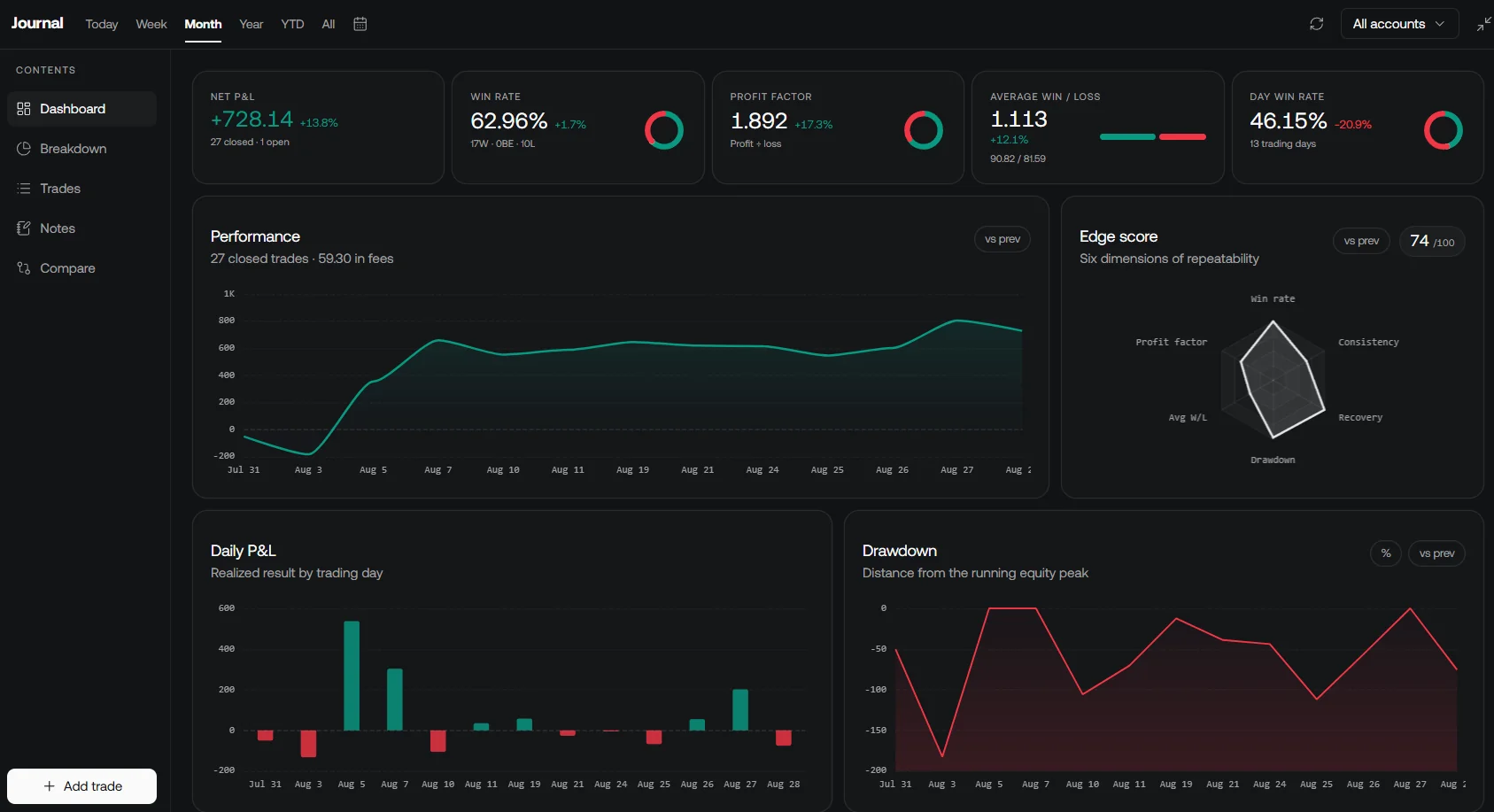
The workspace demonstration below shows how to organize chart research and related work. Use it to keep scenarios and review notes together; continue monitoring the live account through the broker.
Keep the Response Plan Practical
- Before using margin: read the agreement and identify the current initial, maintenance and house requirements.
- Before a new order: inspect projected margin and the effect of adverse prices across the account.
- When excess shrinks: review exposure and available funding before waiting for a formal call.
- If a deficit occurs: verify the current broker calculation and accepted remedies promptly, without assuming a guaranteed extension.
- Afterward: record the cause, actual executions, costs and changes needed to the trading process.
Stress can encourage rushed decisions. A written response plan and manageable exposure can help make those decisions more deliberate. Trading communities can offer perspective, but they cannot determine your broker’s current requirements or promise protection from liquidation.
Frequently Asked Questions
Can a margin call happen without a market loss?
Yes. New trading activity or a higher broker house requirement can create a deficit even when existing prices have not fallen.
Must a broker notify me before liquidating?
No. FINRA explains that a broker need not issue a maintenance call before selling securities and need not let you choose which assets it sells.
Is selling $200 of stock enough for a $200 margin shortfall?
Not necessarily. In a simple long-stock account where sale proceeds repay the loan, equity initially stays unchanged while the maintenance requirement falls. At a fixed 30% rate, a $200 shortfall requires approximately $666.67 of sales, ignoring costs and price changes.
Does a stop-loss order guarantee protection from a margin call?
No. A stock stop becomes a market order when triggered, and the exit price can differ from the stop price. Other positions or higher requirements can also create a deficit.
Does LuxAlgo’s trade journal monitor my live broker margin?
No. It supports review of recorded trades. Use your broker’s current account information for margin requirements, available excess and liquidation risk.
Read next