Market Depth: Impact of Thin vs. Thick
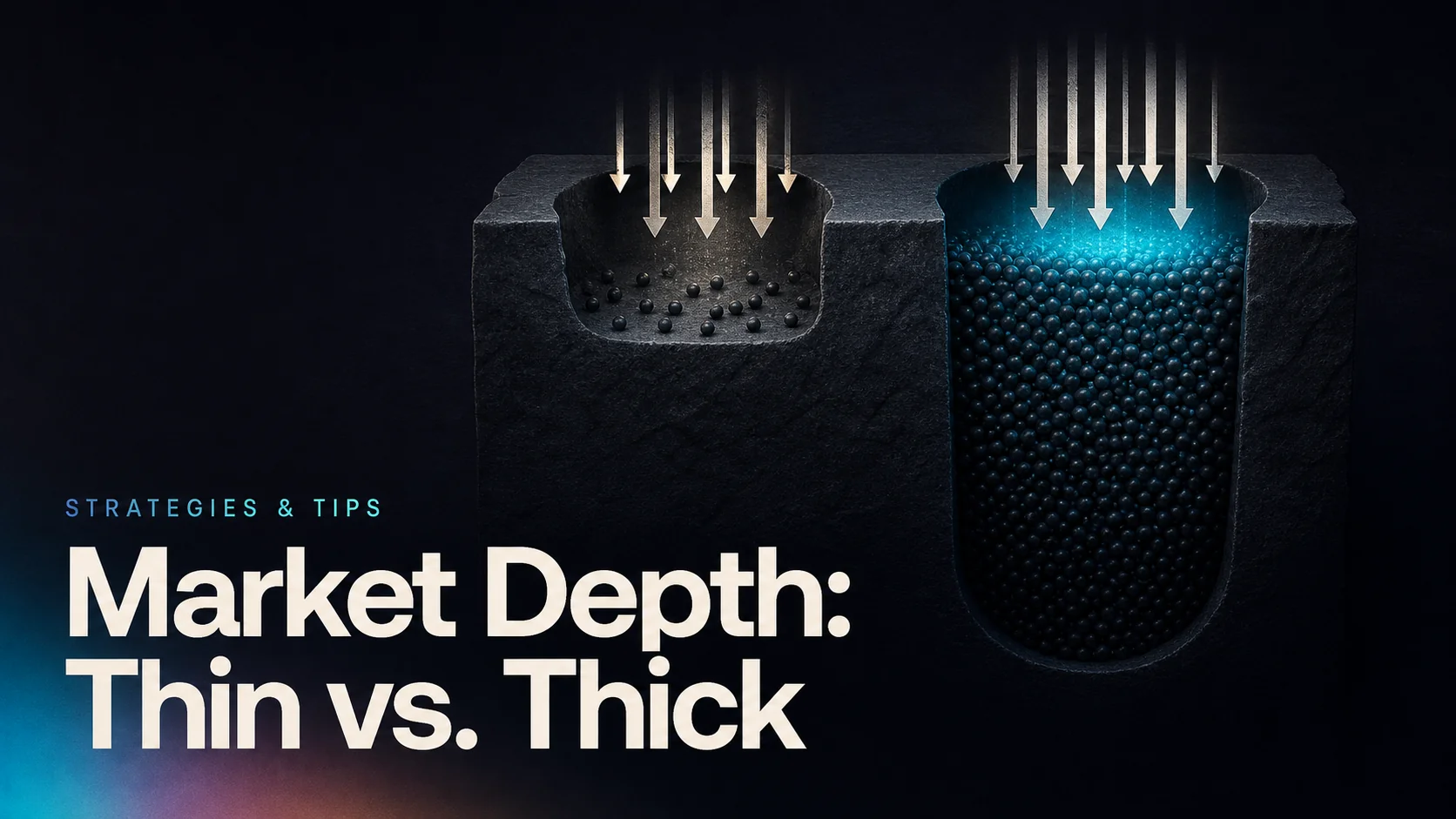
Market depth describes the quantity available to buy or sell at different prices. A thin order book offers relatively little displayed size near the current price; a thick book offers more. The distinction matters because an order can consume the best available quotes and continue into less favorable prices.
Depth is only one part of liquidity. Spreads, replenishment, order size, and access to trading venues also affect execution. A heavily traded market can briefly become thin, and a thick snapshot does not guarantee stable prices. Use LuxAlgo’s native charts and Quant, our coding agent, to research market behavior while checking actual resting orders through a suitable depth feed.
Thin vs. thick markets at a glance
| Aspect | Thin book | Thick book |
|---|---|---|
| Displayed depth | Less size near the current price, relative to your order | More size near the current price, relative to your order |
| Potential price impact | An aggressive order may consume several levels | More size may be absorbed near the best quote |
| Spread | May be wide, but can also be narrow | Often competitive; depth and spread remain separate measurements |
| Execution | Can be immediate at worse prices, or incomplete under a price limit | More displayed capacity does not guarantee a passive order fills |
| Risk | Greater sensitivity to disappearing quotes and order size | Still exposed to news, repricing, and rapid liquidity withdrawal |
Always specify the instrument, venue, side of the book, time, and price range. A book might be deep on the bid side but thin on the ask side. It can also be deep ten ticks away while offering little at the best price.
Depth, volume, and liquidity are different
Depth is available displayed quantity at particular prices. Volume records completed trading over an interval. Spread is the difference between the best ask and best bid. Resilience describes how liquidity replenishes after trading or a disturbance.
These measures interact, but one cannot substitute for all the others. A high-volume session can include shallow books and rapid quote replacement. Conversely, a large displayed order may cancel before you reach it. Hidden or reserve quantities also mean that a displayed book is not a complete map of all potential liquidity.
CME Group’s discussion of liquidity measurement explains why book depth alone can give an incomplete picture: rapid replenishment can support trading even when the quantity visible at an instant is lower. Compare actual execution quality and the cost of trading your intended size alongside the snapshot.
A worked example: same spread, different depth
Consider two hypothetical books with a best bid of $99.99 and a best ask of $100.00. Both show a one-cent spread. You want to buy 500 shares immediately.
| Ask price | Thick book: shares offered | Thin book: shares offered |
|---|---|---|
| $100.00 | 500 | 100 |
| $100.10 | Not needed for this example | 100 |
| $100.30 | Not needed for this example | 300 |
Assume these offers remain available, your route can access them, and no other orders intervene. In the thick book, all 500 shares execute at $100.00. In the thin book, the order buys 100 at $100.00, 100 at $100.10, and 300 at $100.30.
Thin-book cost: $10,000 + $10,010 + $30,090 = $50,100
Average execution price: $50,100 ÷ 500 = $100.20
Cost above the initial ask: $100, or 20 basis points of the $50,000 reference value, before fees.
This is a frozen-book illustration, not a forecast of real fills. Quotes can change, replenish, or disappear during submission. It nevertheless shows why a narrow spread alone does not establish that a larger order is inexpensive to execute.
A buy limit of $100.00 would prevent executions above that price. In this snapshot, only 100 shares are available at the limit in the thin book. The remaining quantity might rest, cancel, or otherwise follow the order’s instructions. Price control does not guarantee completion.
Trading in thin markets
Price movement and execution
When little quantity is available near the market, a relatively small aggressive order can move through several price levels. A thin market is therefore not necessarily slow: an order may execute quickly, but at an unfavorable average price. A passive order faces a different problem—there may be insufficient opposing interest to execute it.
Conditions can change around announcements, session transitions, and disruptions. Check the actual market instead of treating a calendar month or a participant count as a reliable liquidity rule.
Position size, order type, and timing
- Compare size with available quantity. Evaluate both the immediate entry and how you would exit if liquidity worsened.
- Choose the tradeoff deliberately. A marketable order prioritizes immediate execution at available prices; a limit order constrains price but may remain unexecuted.
- Consider smaller orders carefully. Splitting an order can reduce its immediate footprint, but introduces timing risk and may reveal repeated trading interest. It does not guarantee a lower total cost.
- Allow for uncertainty. Displayed quantity is not reserved for you, and the visible snapshot may already be stale when your order arrives.
The SEC’s order-type guide explains the distinction between controlling execution price and obtaining execution. Check your broker’s supported instructions, session restrictions, and handling of unexecuted quantities.
Stop placement and risk
Do not automatically widen a stop because the book is thin. A wider planned stop increases the loss per unit and normally requires a smaller position to keep the same planned cash risk. Market gaps and execution costs can still make the realized loss larger.
For example, a $100 planned risk budget with a $0.50 entry-to-stop distance allows 200 shares before costs. Increasing the distance to $1.00 reduces that calculation to 100 shares. Neither calculation guarantees a $100 maximum loss: a triggered stop-market order can execute beyond its trigger, while a stop-limit order can remain unfilled.
Trading in thick markets
More displayed size near the best quotes can reduce the mechanical cost of executing a given order. That is useful for strategies whose expected return is small relative to spread and slippage. However, “thick” is relative: a book that comfortably handles 100 shares may be inadequate for 100,000.
A resting limit order also competes under the venue’s matching rules. Quantity ahead of it can delay execution even when the overall book looks deep. News or a sudden imbalance can cause a previously thick book to reprice quickly.
Compare depth at consistent distances from the best price, and inspect how quickly it returns after trades. CME’s liquidity-tool methodology combines book depth, spreads, and cost-to-trade measures rather than treating trading volume as the only indicator.
Using LuxAlgo to study traded activity
Start with the intended symbol and session in LuxAlgo’s native charts. Executed-volume tools can help you examine where trading occurred and how price responded. They answer a different question from how much resting quantity is available now.
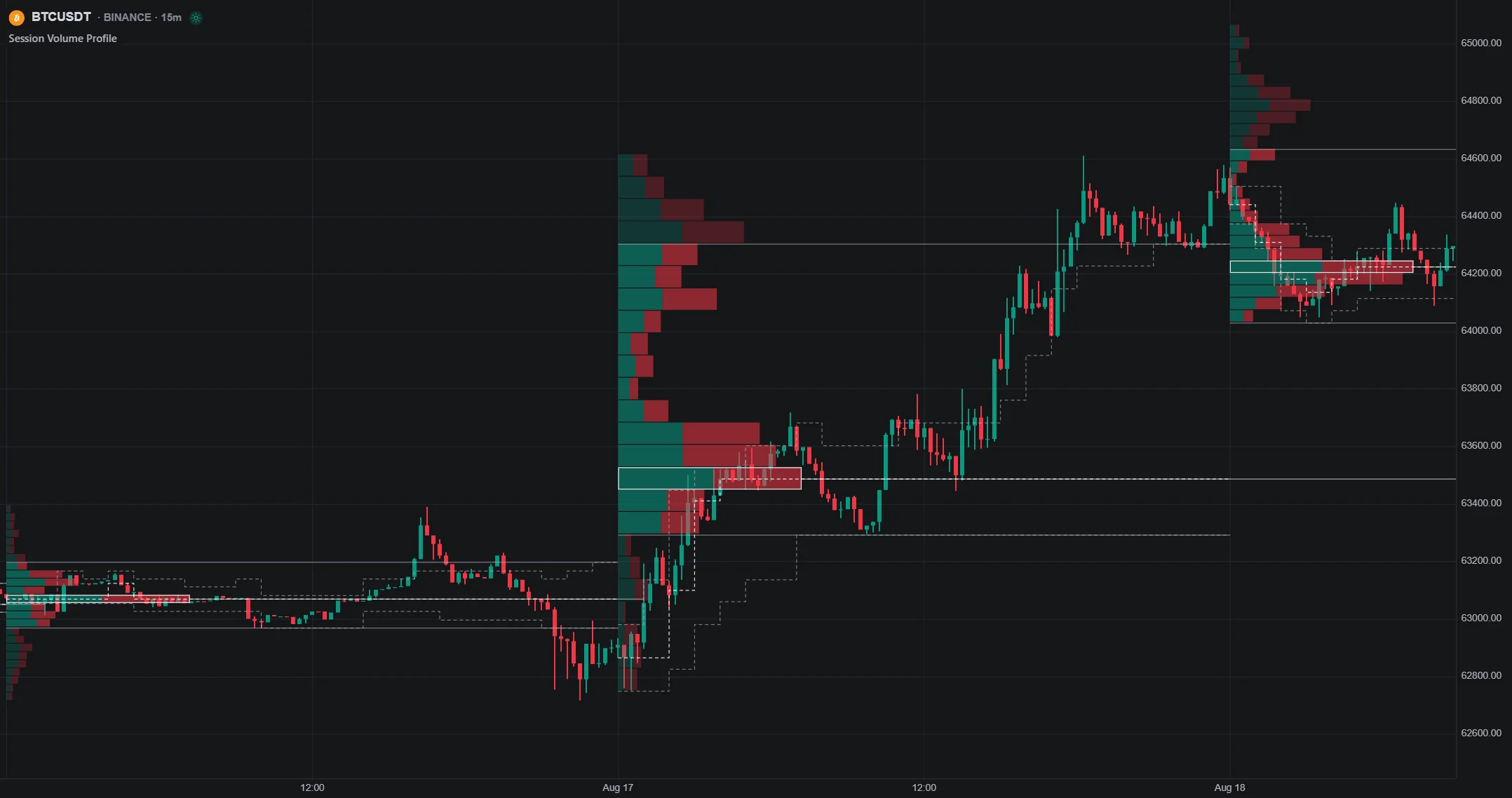
Consult the data documentation before making comparisons. Native footprint data is preaggregated executed volume at price, not a live order book or Time & Sales tape. Supported US equity order-flow data reflects Cboe EDGX activity rather than consolidated volume across every US venue; cryptocurrency data depends on the selected exchange.
If you need actual depth, use an appropriate broker or exchange depth feed and understand its coverage. The name “DOM,” a ladder-shaped display, or a volume-based indicator does not by itself prove that the underlying data contains resting limit orders. Inspect the tool’s inputs and methodology.
Test strategy sensitivity with Quant
Ask Quant to build a strategy using explicit entries, exits, and risk rules, then review the code before running it. Keep the symbol, timeframe, and session consistent when comparing variations.
Use backtest properties to test realistic and more adverse commission and slippage assumptions. Inspect individual trades and save the settings with each run. A strategy that loses its apparent advantage under modestly worse costs deserves closer investigation.
A candle-based historical simulation does not reconstruct order-book queues, quote cancellations, or hidden liquidity. Cost sensitivity is useful research, but it is not evidence that a particular order size would have filled in a thin book.
Video: liquidity and volatility
This educational video provides additional context on liquidity and price movement. Treat the relationship as conditional: neither high volume nor a thick snapshot guarantees low volatility.
A practical pre-trade depth review
- Confirm the instrument, venue, session, and whether your feed shows resting orders or completed trades.
- Measure the spread and available size on the side your order would consume.
- Estimate the prices required for your intended quantity, allowing for quotes changing before execution.
- Choose order instructions with an explicit price-versus-completion tradeoff.
- Size the position around a plausible exit and adverse execution, not only the best entry quote.
- Compare actual fills with the arrival market and review how the book behaved afterward.
Thin and thick markets describe execution conditions, not guaranteed opportunities or suitability categories. The useful question is whether the available liquidity, costs, and uncertainty fit the particular trade you intend to make.
Read next