Municipal Bonds Tax: Tips for Investors

Municipal bonds are the one mainstream security whose interest is usually left out of federal taxable income, which is why their yields are quoted lower than comparable Treasuries and corporates. The exemption is real but conditional, and most of the tax surprises in this market come from the conditions: bonds that were never exempt, bonds bought below par, bonds sold before maturity, and interest that counts for the alternative minimum tax. This guide sets out the rules as the IRS publishes them, explains how the amounts arrive on your tax forms, shows how to compare a tax-exempt yield with a taxable one, and describes where Quant Charts fits for an investor whose bond holdings sit alongside a trading account. It is educational and is not tax advice.
What a Municipal Bond Is
Investor.gov describes municipal bonds as debt securities issued by states, cities, counties and other governmental entities to fund day-to-day obligations and capital projects such as schools, highways and sewer systems. The buyer lends money in exchange for regular interest, usually semi-annual, and repayment of principal at maturity. The two common types differ in what backs them. General obligation bonds are backed by the issuer's full faith and credit and its power to tax residents. Revenue bonds are backed by a specific revenue source such as tolls or lease fees, and some are non-recourse, so if the revenue dries up the bondholder has no claim on anything else.
A third category matters for tax. Municipal issuers sometimes issue bonds on behalf of private entities such as non-profit colleges or hospitals. The Municipal Securities Rulemaking Board calls these private activity bonds and describes the issuer as a conduit that does not guarantee payment; the private borrower does. As the next sections show, that structure also changes how the interest is taxed.
The Federal Exemption and Its Conditions
IRS Publication 550 states the core rule: interest on an obligation issued by a state or local government generally is not taxable. Interest on a bond used to finance government operations is not taxable if the bond is issued by a state, the District of Columbia, a U.S. territory or one of their political subdivisions, which can include port authorities, toll road commissions, utility service authorities and community redevelopment agencies. The publication adds that the issuer should be able to tell you whether the interest is taxable and should provide a periodic or year-end statement showing the tax treatment.
Two conditions are worth knowing. A bond issued after June 30, 1983 generally must be in registered form for its interest to be exempt. And the exemption covers interest only: Publication 550 cautions that even when interest is not taxed, you may have to report a capital gain or loss when you sell the bond. The exemption also does not remove the interest from your return. If you must file, you are required to show tax-exempt interest you received; the IRS describes this as an information reporting requirement that does not make the interest taxable.
What Stays Taxable
The MSRB's investor guide is direct that not all municipal bonds are tax-exempt, and Publication 550 lists the main exceptions.
- Private activity bonds. Publication 550 states that interest on private activity bonds, other than certain tribal manufacturing bonds, is taxable for purposes of the alternative minimum tax. In practice the interest is excluded from regular taxable income but is a preference item under the AMT. Your broker reports it separately in box 9 of Form 1099-INT, and Form 6251 picks it up. IRS Topic 556 explains that the AMT applies only when the tentative minimum tax exceeds the regular tax.
- Federally guaranteed bonds. Interest on federally guaranteed state or local obligations issued after 1983 is generally taxable, with a list of agency exceptions in the publication.
- Arbitrage bonds. Interest is taxable where any part of the proceeds is expected to be used to buy higher-yielding investments.
- Mortgage revenue bonds. Interest on state or local home-mortgage bonds issued after April 24, 1979 is taxable unless the bonds are qualified mortgage bonds or qualified veterans' mortgage bonds.
- Tax credit bonds. Build America Bonds and similar issues pay the holder an income tax credit, claimed on Form 8912, in place of or in addition to interest.
- Taxable municipals. The MSRB notes that issuers sometimes issue taxable bonds when the purpose of the financing does not qualify for the exemption. The name is not a guide: the CUSIP and the official statement are.
State and Local Treatment
The federal exemption says nothing about state tax. The MSRB's general statement is that for interest to be free from state and local taxes, the buyer generally must be a resident of the state where the bond was issued, although there are exceptions, and Investor.gov phrases it the same way. Rules vary by state, so the only reliable source is the tax authority where you file. Publication 550 adds a federal detail for itemizers: state and local income taxes paid on interest that is exempt from federal income tax are deductible as taxes, subject to the overall limit on the deduction for state and local taxes.
Buying Below Par: Market Discount and OID
The largest tax trap in this market is a bond bought on the secondary market for less than its redemption value. Publication 550 is explicit that market discount on a tax-exempt bond is not tax exempt. Market discount arises when a bond's value falls after issue, usually because interest rates rose. If you bought the bond after April 30, 1993, you can elect to accrue the discount over your holding period and include it in income currently as taxable interest. If you do not, any gain attributable to market discount is taxed as ordinary income when you dispose of the bond. Bonds bought before May 1, 1993 produce capital gain instead.
The de minimis test decides whether a small discount counts at all. Publication 550 says to treat market discount as zero if it is less than one-fourth of 1 percent of the stated redemption price multiplied by the number of full years to maturity after you acquire the bond. A bond with ten full years to run and a $1,000 redemption price therefore has a $25 threshold; buy it at $980 and the discount is ignored, buy it at $960 and the full $40 is market discount. Accrued market discount is figured either ratably, in equal daily installments to maturity, or under the constant yield method if you elect it.
Original issue discount is different. Publication 550 states that OID on tax-exempt state or local bonds is treated as tax-exempt interest, so a zero-coupon municipal bond bought at issue accrues exempt interest rather than a taxable gain. The accrued OID increases your basis for bonds issued after September 3, 1982 and acquired after March 1, 1984.
| Situation | Federal treatment per Publication 550 | Where it appears |
|---|---|---|
| Coupon interest on a qualifying municipal bond | Excluded from taxable income; reported for information | Form 1099-INT box 8; Form 1040 line 2a |
| Interest on a private activity bond | Excluded from regular tax; AMT preference item | Form 1099-INT box 9; Form 6251 |
| Original issue discount on a tax-exempt bond | Treated as tax-exempt interest | Form 1099-OID box 11; Form 1040 line 2a |
| Market discount above the de minimis threshold | Ordinary income, currently by election or on disposition | Form 1099-INT box 10 if elected; otherwise Form 8949 |
| Sale above adjusted basis | Capital gain, short or long term by holding period | Form 1099-B; Form 8949 and Schedule D |
| Sale below adjusted basis | Deductible capital loss | Form 8949 and Schedule D |
| Exempt-interest dividends from a municipal bond fund | Excluded from taxable income; private activity portion subject to AMT | Form 1099-DIV boxes 12 and 13 |
Selling Before Maturity
Publication 550's chapter on sales confirms that gain on a tax-exempt state or local bond is taxable and that a loss is deductible as a capital loss. Gain from market discount is ordinary income for bonds bought after April 30, 1993, as above; gain beyond that is capital gain, long term if the bond was held more than a year. Basis is adjusted for accrued OID and for any market discount you elected to include. The same rules apply to a bond called by the issuer before maturity, which Investor.gov flags as call risk: many municipal bonds are callable, and issuers tend to call when rates have fallen.
The Forms and Where the Numbers Go
IRS Topic 403 explains that if you received $10 or more of interest or tax-exempt interest, you should receive Form 1099-INT or Form 1099-OID, often inside a composite broker statement, and that you must report all taxable and tax-exempt interest even if no form arrives. Publication 550's reporting instructions total the tax-exempt figures from 1099-INT box 8, 1099-OID box 11 and 1099-DIV box 12 and place them on Form 1040 line 2a. Box 9 of the 1099-INT and box 13 of the 1099-DIV show the portion subject to the AMT; those amounts are already inside boxes 8 and 12 and are not added again. The instructions for Form 1099-INT add that box 13 reports amortized bond premium on a tax-exempt bond and box 14 the CUSIP of the bond, which lets you tie each figure to a specific holding.
Municipal Bond Funds
A mutual fund or ETF that holds municipal bonds passes the exemption through as exempt-interest dividends, reported in box 12 of Form 1099-DIV and included on line 2a. Publication 550 notes that exempt-interest dividends paid from specified private activity bonds may be subject to the AMT and are shown in box 13. Capital gain distributions from the fund and gains on selling fund shares are taxable in the ordinary way. State treatment depends on where the fund's bonds were issued and on your state's rules, which the fund reports each year.
Comparing a Tax-Exempt Yield With a Taxable One
Because the exemption is what buyers are paying for, Investor.gov and the MSRB both note that tax-exempt municipal yields are usually lower than taxable yields on securities of similar maturity and credit quality. The comparison is a tax-equivalent yield: divide the municipal yield by one minus your marginal federal rate, adding the state rate where the bond is also state-exempt. A bond yielding 3 percent to an investor with a 32 percent marginal rate is equivalent to a taxable yield of about 4.41 percent. Those are illustrative numbers, not current rates. The comparison changes with your bracket, with whether the AMT applies to you, and with whether the bond trades at a discount that will produce ordinary income.
Risks the Exemption Does Not Remove
Investor.gov lists the risks that apply regardless of tax status. Call risk: the issuer may repay early when rates fall. Credit risk: the issuer may be unable to pay, and a high credit rating is not a prediction that a bond cannot default. Interest rate risk: a fixed-coupon bond loses market value when rates rise, which is exactly how market discount is created for the next buyer. The MSRB adds reinvestment risk and notes that high-yield municipal bonds may be risky. The official statement, financial disclosures, ratings and trade history for any municipal bond are available free on the MSRB's EMMA system, which the SEC designated as the official repository for municipal disclosures.
Where Quant Charts Fits
Municipal bonds themselves are not on the platform. Quant Charts carries US equities and ETFs from Cboe EDGX and crypto on every plan, and adds forex, commodities and CME futures as candles on paid plans. Individual municipal bonds trade over the counter and are researched on EMMA, not charted here. What the platform does offer is the context around them.
Treasury yields are the reference curve. The Library's yield curve entry explains how yields across maturities are read and why the 2s10s and 3m10y spreads matter, and the real yields entry explains the inflation-adjusted rate that sets the hurdle for every other asset. A municipal yield only makes sense against the Treasury of the same maturity, and the tax-equivalent calculation above is how the two are put on the same footing.
Municipal bond ETFs sit on the watchlist. Because ETFs listed on US exchanges are included on every plan, an exchange-traded municipal bond fund can be added to a watchlist through Symbol Search, charted, and compared with a Treasury ETF in a multi-chart layout. The Price tab of the Advanced view shows price, change, volume and the 52-week range for the list. Fund-level financial fields are not reported for ETFs, so yield and holdings still come from the fund's own documents.
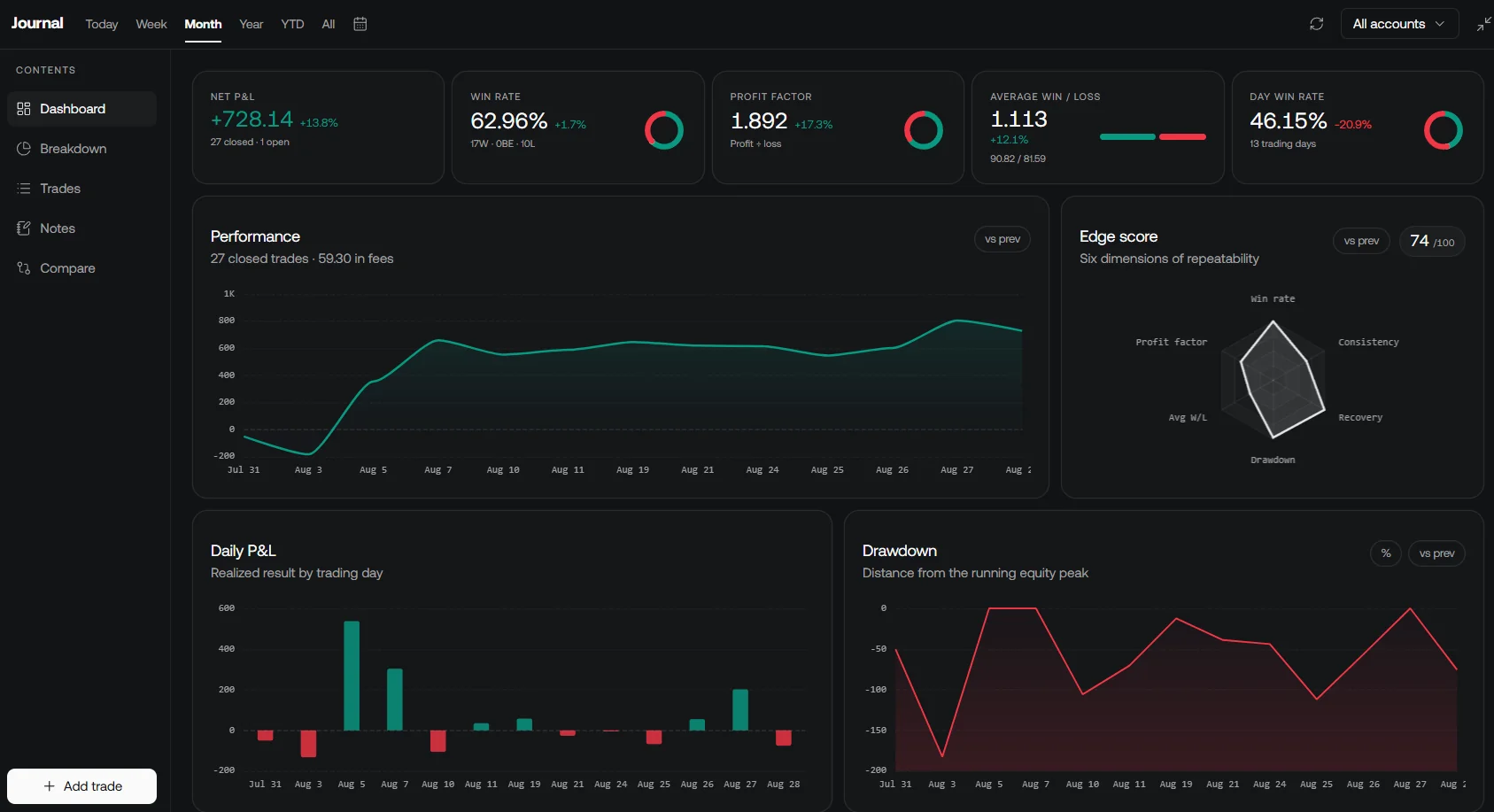
The Journal keeps the dates that decide the tax. Every plan includes the Journal, which supports broker sync, CSV and other file imports, and manual accounts with a starting balance you set. Whether market discount applies, whether a gain is long term and which year interest belongs to all depend on acquisition date, price and disposal date, and a manual Journal account is a convenient place to keep those alongside the trading record. The Journal does not compute tax; it preserves the facts the forms are built from.
The video below shows how indicators are added to a chart in Quant Charts.
Quant tests the equity side of the allocation. An investor holding municipals for income often runs a rules-based equity strategy with the rest of the capital. Describe the rule to Quant, our coding agent, in plain language; Quant writes the Pine Script, and you open Code to inspect it, then click Run. The Backtest Summary reports net profit, trade count, win rate, max drawdown and profit factor, with commission and slippage set in the strategy's Properties. That after-cost result, converted to an annual figure, is what the tax-equivalent municipal yield should be compared against. No LuxAlgo tool places orders or buys bonds.
FAQs
Is all municipal bond interest tax-free?
No. Publication 550 exempts interest on qualifying state and local government bonds, but interest on private activity bonds is taxable for the AMT, and federally guaranteed, arbitrage and certain mortgage revenue bonds are taxable. Issuers also sell explicitly taxable municipal bonds.
Do I have to report tax-exempt interest?
Yes, as information. Publication 550 and Topic 403 require tax-exempt interest to be shown on your return, on Form 1040 line 2a, even though it is not taxed. Your broker reports it in box 8 of Form 1099-INT.
Is municipal bond interest exempt from state tax?
Generally only for residents of the issuing state, according to the MSRB and Investor.gov, with exceptions that vary by state. Your state tax authority is the source for its own rule.
What happens if I buy a municipal bond below par?
Market discount on a tax-exempt bond is not exempt. If it exceeds the de minimis threshold of one-fourth of 1 percent of redemption price per full year to maturity, it is ordinary income, either accrued currently by election or recognized when you dispose of the bond.
How do private activity bonds affect the alternative minimum tax?
Their interest is a preference item. It appears in box 9 of Form 1099-INT, or box 13 of Form 1099-DIV for fund dividends, and flows to Form 6251. It matters only if your tentative minimum tax exceeds your regular tax.
Can I chart municipal bonds in Quant Charts?
Individual municipal bonds are not on the platform. Exchange-traded municipal bond funds can be watched and charted as US ETFs on every plan, Treasury yields provide the reference curve, and the Journal can hold manual records of bond lots and their dates.
References
LuxAlgo Resources
- Yield Curve and Real Yields reference entries (LuxAlgo Library)
- Data and Watchlist (LuxAlgo Docs)
- Journal and Journal accounts (LuxAlgo Docs)
- Making strategies with Quant (LuxAlgo Docs)
External Resources
- Publication 550, Investment Income and Expenses (IRS)
- Topic no. 403, Interest received and Topic no. 556, Alternative minimum tax (IRS)
- Instructions for Forms 1099-INT and 1099-OID (IRS)
- Instructions for Form 6251 (IRS)
- Municipal Bonds (Investor.gov)
- Municipal Bond Basics (MSRB) and EMMA (MSRB)
This article is educational and is not tax, legal or investment advice. Tax rules change; confirm current treatment with the IRS publications above or a qualified tax professional.
Read next