Optimizing Portfolios Under Basel III Constraints

Basel III is a set of banking rules, not a trading strategy. It was agreed by the Basel Committee on Banking Supervision after the 2007 to 2009 financial crisis, and it sets minimum standards for how much capital internationally active banks must hold, how much liquid funding they must keep on hand, and how much total leverage they may run. Individual traders are not bound by any of it. The framework is still worth understanding, because it is the most carefully argued public answer to a question every trader faces: how much cushion does a portfolio need to survive a bad period without being forced to stop? This guide explains what Basel III actually requires, using the Basel Committee's own standards and the Federal Reserve's implementation, and then translates each rule into the personal risk controls documented in the LuxAlgo Library, with notes on where the Journal, watchlist and Quant tools in Quant Charts support that work.
What Basel III Is and Who It Binds
The Bank for International Settlements describes Basel III as an internationally agreed set of measures developed in response to the financial crisis, designed to strengthen the regulation, supervision and risk management of banks. The standards are minimum requirements that apply to internationally active banks, and member jurisdictions are free to impose stricter rules. The original 2010 to 2011 framework focused on raising the quality and quantity of capital, building buffers that can be drawn down in stress, and containing leverage; the finalisation agreed in December 2017 revised how risk-weighted assets are calculated, added an output floor, and refined the leverage ratio, with the last transitional arrangements running to 2028.
In the United States the Federal Reserve implemented the framework through a final rule approved in July 2013. For the largest bank holding companies, those with $100 billion or more in total consolidated assets, the Fed sets a firm-specific common equity requirement each year that combines the Basel minimum with the results of its supervisory stress test. Those two documents, the BIS standards and the Fed's annual requirements, are the primary sources for the figures in this article.
The Capital Stack
Capital rules are stated as a percentage of risk-weighted assets, or RWA. Each exposure a bank holds is multiplied by a risk weight, so a government bond adds far less to RWA than an unsecured loan of the same size, and the capital ratios are measured against that weighted total rather than the raw balance sheet. The Basel Committee's summary of the reforms sets out the core layers:
| Layer | Level | What it does |
|---|---|---|
| Minimum Common Equity Tier 1 (CET1) | 4.5% of RWA after deductions | The highest-quality capital, mainly common shares and retained earnings, that absorbs losses first. |
| Capital conservation buffer | 2.5% of RWA in common equity | Raises the common equity standard to 7%. A bank that dips into the buffer faces constraints on dividends and other discretionary distributions. |
| Countercyclical buffer | Set by national authorities, up to 2.5% | Built up when credit growth is judged excessive so that it can be released in a downturn. |
| G-SIB surcharge | Additional common equity for global systemically important banks | Higher loss absorbency for the institutions whose failure would do the most damage. |
| Output floor | Phased in from 50% to 72.5% | Caps how far a bank's internal models may reduce RWA below the standardised approach. |
The Federal Reserve's version for large US banks is easier to read as a single number. Each firm's total CET1 requirement is the sum of the 4.5% minimum, a stress capital buffer of at least 2.5% that is derived from the supervisory stress test, and, where applicable, a G-SIB surcharge of at least 1.0%. The stress capital buffer replaced the quantitative part of the older Comprehensive Capital Analysis and Review in 2020, so the buffer a bank must carry now depends directly on how much capital it would lose in the Fed's hypothetical recession.
Two design choices matter for the translation that follows. First, the buffers are meant to be used: the Committee's own text says banks are expected to draw on them in stress, with the penalty being restricted payouts rather than closure. Second, the requirement is defined against a risk measure, not against the size of the book, which is exactly the distinction between risking a fixed percentage of equity per trade and simply capping position size.
Liquidity Rules: LCR and NSFR
Capital protects against losses. Liquidity rules protect against running out of cash while still solvent, which is how many institutions actually failed in 2008. Basel III added two standards.
- Liquidity Coverage Ratio (LCR). The January 2013 standard requires a bank to hold a stock of unencumbered high-quality liquid assets that can be converted to cash easily and immediately in private markets, sufficient to meet its net cash outflows over a 30 calendar day stress scenario. The ratio must be at least 100% in normal times, and the Committee explicitly expects banks to spend the pool and fall below 100% during an actual stress. The full requirement applied from 1 January 2019 after a phase-in through 80% and 90%.
- Net Stable Funding Ratio (NSFR). The October 2014 standard requires banks to maintain a stable funding profile relative to their on- and off-balance-sheet activities, so that a disruption to regular funding sources does not erode liquidity to the point of failure. It became a minimum standard, at 100%, from 1 January 2018, and it is the long-horizon complement to the 30-day LCR.
The LCR's definition of high-quality liquid assets is narrow on purpose: central bank reserves and the highest-grade sovereign debt sit at the top, with haircuts and caps on anything less liquid. The point is that an asset only counts as a liquidity buffer if it can be sold quickly, in size, without moving the price against you, in a market that is itself under stress.
The Leverage Ratio and Stress Tests
Risk weights can be gamed, and internal models can be optimistic, so Basel III added a backstop that ignores risk weighting entirely. The leverage ratio is Tier 1 capital divided by total on- and off-balance-sheet exposures, including derivatives and securities financing, and the January 2014 framework set the minimum at 3%. Global systemically important banks face a higher requirement. Whatever the risk models say, a bank cannot hold more than roughly 33 times its Tier 1 capital in gross exposure.
The Federal Reserve's stress test supplies the forward-looking piece. Each year the Fed projects every large bank's capital ratios through at least two hypothetical scenarios, including a severe recession, publishes the bank-level results, and requires the firms to run and disclose their own company-run tests. The stress capital buffer described above is the output of this exercise, so a bank whose portfolio would lose more in the scenario is required to hold more capital in the present.
Translating the Rules Into a Personal Risk Framework
None of the ratios above apply to a retail or proprietary trading account, and there is no reason to compute a CET1 ratio for a brokerage portfolio. What transfers is the structure: a loss-absorbing cushion defined against risk, a liquidity reserve sized to a stress horizon, a gross exposure cap that does not trust the risk model, and a periodic test of what a bad scenario would do. The LuxAlgo Library documents an individual-scale equivalent for each.
Capital buffer to heat cap
The closest analogue to a capital ratio is the Library's Max Heat rule. Heat is the sum, across every open position, of the loss that would be taken if each stop were hit from the current price, divided by account equity, and the rule refuses new positions or forces size reductions whenever adding them would push that total past a ceiling. The Library notes that ceilings in the 4 to 12 percent range are common, with lower values for correlated books, and that the honest way to choose the number is to decide what drawdown you could tolerate from one simultaneous stop-out and work backwards. That is the same logic as a conservation buffer: define the loss the account must be able to absorb and keep that much room at all times.
Underneath the heat cap sits per-trade sizing. Fixed fractional sizing risks a constant fraction of current equity on every trade, with size back-solved from the stop distance; the Library's example is a $50,000 account risking 1 percent, or $500, which with a stop $2 away is 250 shares. Because the fraction applies to current equity, dollar risk shrinks through a drawdown, which is the individual trader's version of a buffer that is drawn down gradually rather than all at once.
Liquidity to a cash reserve
The LCR asks how long the institution could keep meeting obligations if funding disappeared. For an individual account the equivalent questions are whether margin calls, living expenses or a funded-account drawdown limit could force liquidation at a bad moment, and whether the instruments held could be sold quickly without a large price concession. The practical translation is a cash or cash-equivalent reserve that is never used as margin, and a preference for liquid instruments in the part of the portfolio that might need to be closed under stress. The Library's Portfolio-aware Sizing entry adds the correlation dimension: positions that move together behave as one larger position, so a book that looks diversified by symbol count may have very little genuine liquidity when everything sells off at once.
Leverage ratio to a gross exposure cap
The leverage ratio exists because risk weights can understate danger. The individual equivalent is a hard limit on gross notional exposure relative to equity that applies regardless of how tight the stops are or how low the measured volatility has been. Volatility-scaled sizing has a known failure mode, which the Library describes plainly: when volatility jumps faster than the lookback updates, the position sized for yesterday's range takes today's larger one. A gross cap is the blunt backstop for that case, in the same way the 3% leverage floor backstops a bank's models.
Stress test to a drawdown review
The Fed's stress test asks what a specific adverse scenario would do to capital. The trader's version uses the Library's Drawdown Statistics and Risk of Ruin. Drawdown statistics profile the declines of an equity curve from its running peak: maximum depth, average depth, duration until the peak is regained, and the recovery factor of net profit divided by maximum drawdown. The Library's caveat is the important part: a backtest's maximum drawdown is a single realisation, and the live worst case is usually worse because the historical window has not yet contained the strategy's true tail. Risk of ruin turns win rate, payoff, risk per trade and a ruin barrier into a probability of touching that barrier, and the Library stresses how nonlinear it is: halving risk per trade typically collapses ruin probability by orders of magnitude. Defining ruin as a practical drawdown threshold, such as the level at which a funded account would be closed, rather than as zero, gives the more relevant number.
The bank rule that has no direct market equivalent, restricted payouts when a buffer is breached, maps onto the Library's Loss-control Rules: daily loss limits stated in R, consecutive-loss breakers, cooldowns and a restart protocol decided in advance. The entry's point about enforcement applies to both banks and traders: a limit that can be overridden in the moment is not a limit.
Basel III Rules and Their Individual Equivalents
| Basel III rule | What it controls for a bank | Individual-scale equivalent |
|---|---|---|
| CET1 minimum plus conservation buffer | Loss-absorbing capital against risk-weighted assets | Max heat ceiling on total open risk, fixed-fractional sizing per trade |
| Stress capital buffer | Extra capital sized to a hypothetical recession | Ruin probability and drawdown review used to set risk per trade |
| Liquidity Coverage Ratio | 30-day stock of high-quality liquid assets | Cash reserve never pledged as margin, liquid instruments in the tradable book |
| Net Stable Funding Ratio | Stable funding over a longer horizon | Trading capital that is not needed for expenses or debt service |
| Leverage ratio | 3% Tier 1 capital against gross exposure | Hard cap on gross notional relative to equity, independent of volatility estimates |
| Payout restrictions in the buffer | Retained earnings rebuild capital | Loss-control rules: daily loss limit, breakers, cooldown, restart protocol |
Limitations of the Analogy
- Different problem. Basel III protects depositors and the financial system from bank failure. A trader's risk framework protects one account. The bank rules say nothing about expectancy or whether a strategy should be traded at all.
- Different scale of data. Banks calibrate risk weights on decades of default and loss data across millions of exposures. An individual's drawdown history is one path, which is why the Library recommends resampling trade sequences rather than trusting the single observed maximum.
- Gaps and liquidity. Heat caps and ruin estimates bound stop-based loss. Gaps, halts and slippage can push realised losses past any computed figure, the same reason the LCR haircuts anything less than the most liquid assets.
- Not investment advice. Regulatory minimums are floors set for institutions with very different balance sheets. Nothing here is a recommendation of a particular allocation, leverage level or product.
Where Quant Charts Fits
Quant Charts, the LuxAlgo charting and AI platform, does not compute regulatory ratios and does not place orders. What it does provide is the record-keeping and testing surface that a personal version of these rules needs.
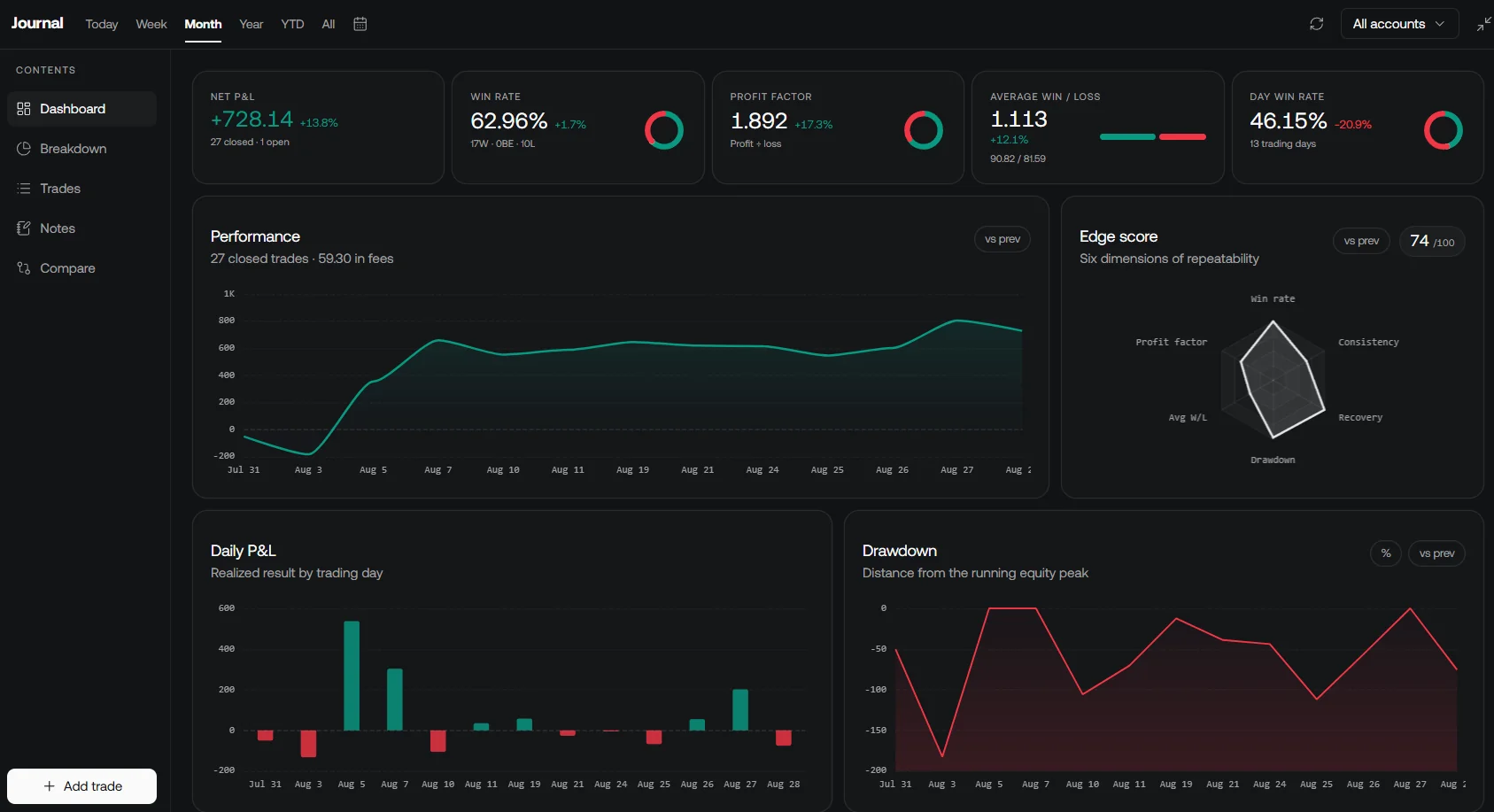
- Journal. Available on every plan, the Journal builds trades from broker sync, file imports or manual accounts with a starting balance, groups fills into round trips, and reports across selectable date ranges. Its Breakdown views by hold time, day, time, symbol and side are the raw material for a drawdown review, and the equity curve on the dashboard is the series that max drawdown, duration and recovery factor are computed from.
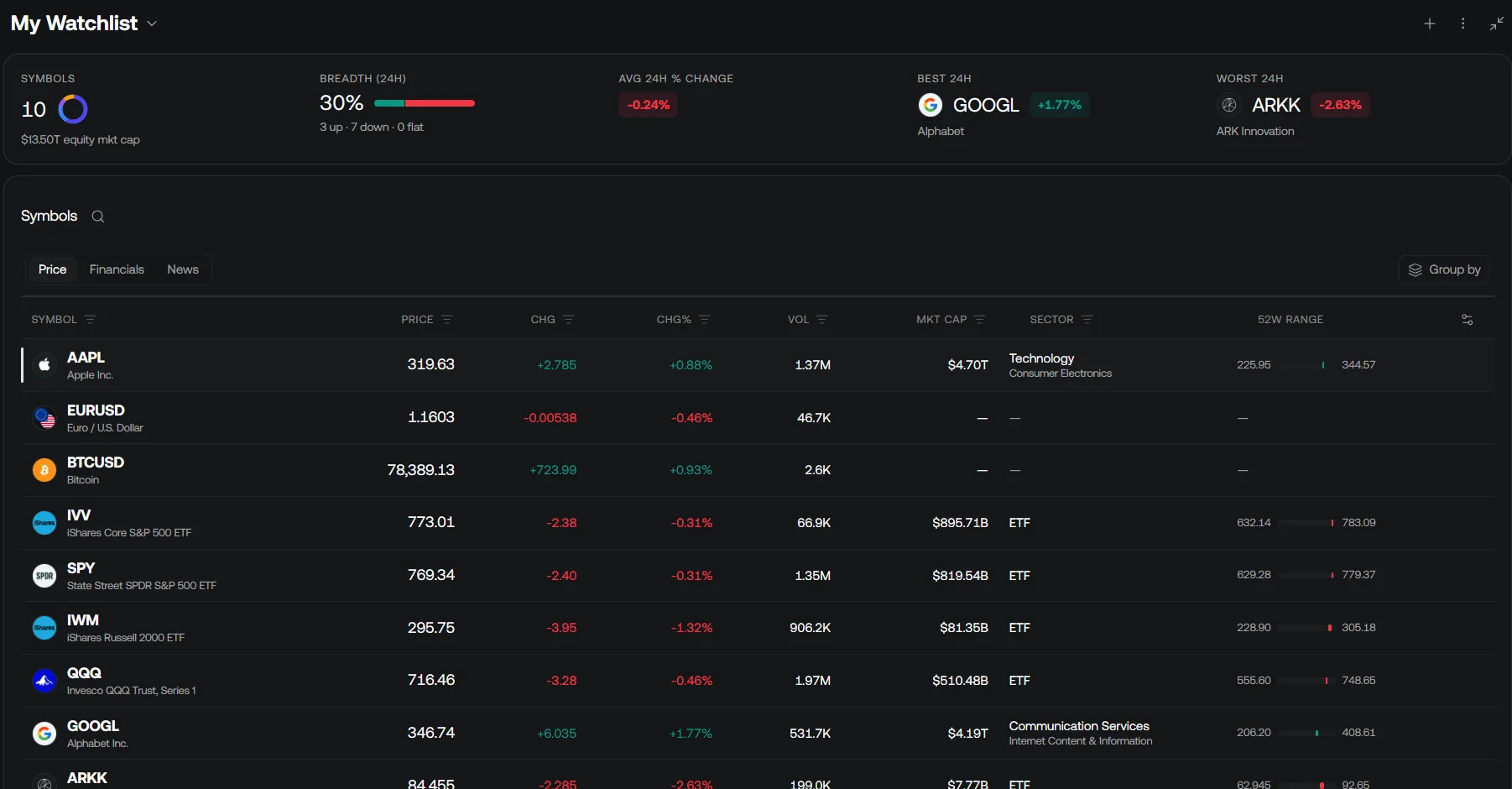
- Watchlist. The Advanced view's Price, Financials and News tabs, Group by, Sections and Allocation breakdown make concentration visible. Financial data covers stocks, and ETFs are bucketed separately in the allocation view.
- Quant. Quant, our coding agent, writes Pine Script from a plain-language description. Describe a rule such as sizing each entry at a fixed fraction of equity with a stop at a volatility multiple and skipping entries when open risk would exceed a heat ceiling, inspect the Code tab, and click Run. The Backtest Summary reports net profit, trade count, win rate, max drawdown and profit factor, and commission and slippage are set in the strategy Properties so the drawdown figure reflects costs.
- Data. Quant Charts data covers Cboe EDGX US equities, including ETFs, and crypto on every plan; paid plans add forex, commodities and CME futures.
Conclusion
Basel III binds banks, not traders, and the specific ratios do not transfer. Its architecture does. A cushion defined against risk rather than size, a liquidity reserve sized to a stress horizon, a gross exposure backstop that distrusts the risk model, a forward-looking test of a bad scenario, and automatic restrictions when the cushion is breached are exactly the components the Library documents as max heat, fixed-fractional sizing, portfolio-aware sizing, drawdown statistics, risk of ruin and loss-control rules. The bank version is enforced by supervisors. The individual version has to be enforced in advance, in writing, by the trader, which is the harder part.
FAQs
Does Basel III apply to retail traders?
No. Basel III sets minimum standards for internationally active banks, implemented by national regulators such as the Federal Reserve. Individual and proprietary trading accounts are not subject to its capital, liquidity or leverage ratios.
What is the CET1 requirement under Basel III?
The minimum Common Equity Tier 1 ratio is 4.5% of risk-weighted assets, and the 2.5% capital conservation buffer raises the common equity standard to 7%. Large US banks also carry a stress capital buffer of at least 2.5% and, for G-SIBs, a surcharge of at least 1.0%.
What does the Liquidity Coverage Ratio require?
Banks must hold unencumbered high-quality liquid assets sufficient to cover net cash outflows over a 30 calendar day stress scenario, at a minimum of 100% in normal times, with the pool expected to be used during an actual stress.
What is the Basel III leverage ratio?
Tier 1 capital divided by total on- and off-balance-sheet exposures, with a 3% minimum. It ignores risk weights and acts as a backstop to the risk-based capital requirements. Global systemically important banks face a higher requirement.
What is the individual equivalent of a capital buffer?
A max heat ceiling: the total loss across all open positions if every stop were hit, kept below a fixed percentage of equity, combined with fixed-fractional sizing so that risk per trade shrinks as the account draws down.
Does Quant Charts calculate Basel III ratios or manage risk automatically?
No. Quant Charts does not compute regulatory ratios and does not place orders. The Journal records trades and drawdowns, the watchlist shows allocation, and Quant lets you backtest a rule that includes sizing and heat limits before you apply it yourself.
References
LuxAlgo Resources
- Max Heat
- Fixed Fractional
- Portfolio-aware Sizing
- Drawdown Statistics
- Risk of Ruin
- Loss-control Rules
- Quant Charts docs: Journal Breakdown
- Quant Charts docs: Watchlist Advanced view
- Quant Charts docs: Quant strategies
External Resources
- BIS: Basel III: international regulatory framework for banks
- BIS: Basel III summary table of the reforms (PDF)
- BIS: Basel III transitional arrangements 2017 to 2028 (PDF)
- BIS: Basel III: The Liquidity Coverage Ratio and liquidity risk monitoring tools
- BIS: Basel III: The Net Stable Funding Ratio
- BIS: Basel III leverage ratio framework and disclosure requirements
- Federal Reserve: Basel Regulatory Framework
- Federal Reserve: Large Bank Capital Requirements
- Federal Reserve: Stress Tests
This article is for educational purposes only and is not financial, legal or regulatory advice. Basel III requirements apply to banks; individual traders should size risk according to their own circumstances.
Read next