Our Philosophy of Selling Technical Indicators (And What to Avoid)
A technical indicator should be sold on the usefulness of its tools, documentation and support—not on a promise that buying it will make someone profitable. That is the central idea behind our philosophy of selling trading software. A subscription price, a persuasive chart or a large following does not establish a trading edge.
LuxAlgo offers paid software as well as free contributions, so this is our perspective as a vendor, not an independent review of the industry. This refreshed edition builds on the original 2023 essay signed by founder Sean Mackey, while updating the product context and the criteria readers can use to evaluate a vendor.
The question is not simply whether selling indicators is good or bad. It is whether a business explains what the product does, demonstrates it honestly, supports its users and sets expectations that match the evidence. Those standards should apply to LuxAlgo too.
Four Things That Make a Good Vendor
Our four principles are contribution, honest marketing, realistic branding and original work. For scripts offered on TradingView, its Vendor Requirements provide platform-specific rules in addition to those principles. Meeting publication requirements is not a certification of future profitability.
1. Contribute Work People Can Inspect
We believe vendors should contribute useful public work alongside their paid products. Readable code, explanations and examples let other developers study an approach, ask questions and identify limitations. Contributions can also help users learn enough to make more informed decisions about commercial tools.
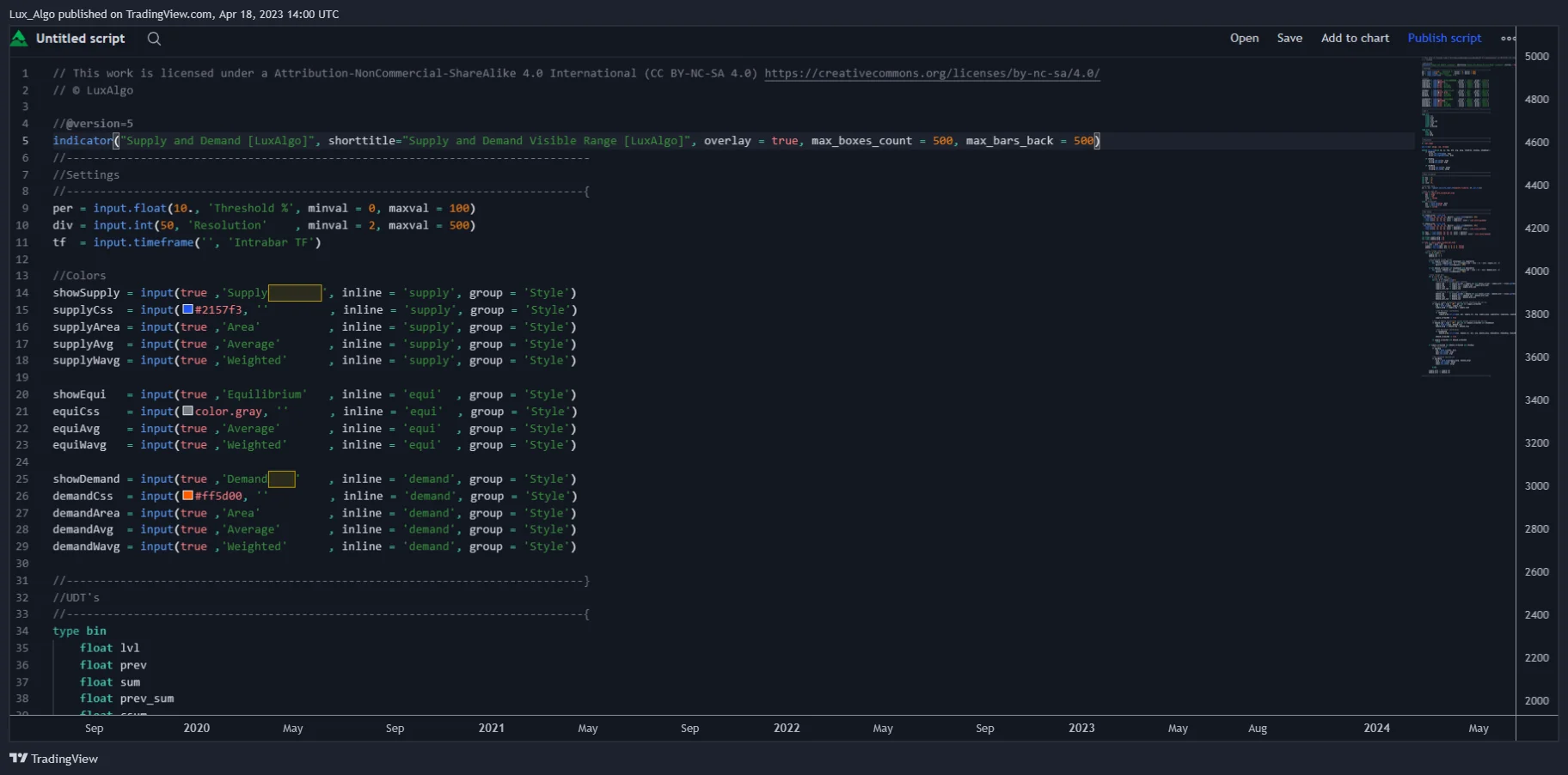
A visible implementation offers more to evaluate than a screenshot alone, but it still needs review. Check when outputs become available, whether past signals can change and how missing data or unusual inputs are handled. Read the license as well: access to source code does not automatically permit every form of reuse or commercial redistribution.
Open contributions are a practice we value, not a shortcut for judging everyone else. A closed-source product is not automatically fraudulent, and publishing free scripts does not prove that a vendor’s paid work is correct. Documentation, reproducible behavior, support and clearly stated limitations remain relevant evidence.
2. Market the Tool Without Promising the Outcome
It is reasonable to demonstrate a useful interface, explain a feature or show an indicator on an example chart. It becomes misleading when that demonstration is presented as dependable income, a guaranteed return or proof that a customer will achieve the same result.
The original essay used a pizza advertisement as an analogy: appetizing photography can show the product, but it does not justify claiming that eating it will produce a six-pack. Likewise, an attractive chart can demonstrate an indicator’s display. It cannot establish what a trader will earn by using it.
Examples such as “turn $1,000 into $100,000” or “quit your job with this indicator” replace a software explanation with an outcome promise. Luxury cars, cash and lifestyle footage do not supply missing trading records. Evaluate the claim and its evidence rather than inferring competence from the presentation.
| Claim or presentation | What it leaves unanswered | More useful evidence |
|---|---|---|
| An indicator has an 89% win rate | Which entries, exits, costs, dates and instruments define a trade? | A fully specified strategy, complete results and clear testing limitations |
| A screenshot shows several perfect turns | When were the signals available, and what examples were omitted? | Dated behavior, confirmation timing and unsuccessful cases |
| A backtest grows dramatically | Were settings selected on the same data, and are fills realistic? | Declared assumptions, costs, drawdowns and a later evaluation period |
| A creator displays an expensive lifestyle | How does that demonstrate the software’s behavior? | Product documentation and verifiable functionality |
| A proprietary formula is described as a secret edge | What can the user actually evaluate? | A clear feature description, limitations and support expectations |
A win rate can be reported for a defined test, with its assumptions and limits. It is not an inherent property of a chart overlay independently of entry and exit rules. Nor does a high percentage of winning trades imply a profitable result: 80 gains of $1 and 20 losses of $5 total a $20 loss before costs, despite an 80% winning-trade percentage. This is an arithmetic illustration, not a strategy forecast.
Good explanations distinguish historical examples, simulated results and actual trading records. They describe costs, drawdowns, unsuccessful periods and the risk that results will change. A disclaimer should reinforce accurate claims; it cannot make an unsupported headline accurate.
3. Set Realistic Expectations in Branding and Service
Names and messages built around guaranteed gains encourage users to expect more than analytical software can deliver. We prefer descriptions that identify the task: organizing charts, measuring a condition, exploring a hypothesis or reviewing results. Those functions can be useful without implying that the software removes uncertainty.
Customers also need practical clarity before paying. Explain what is included, which platform it runs on, what data or account requirements apply, how recurring billing works and where to get help. A responsive support process and clear documentation are part of the product’s value.
Cancellation and refund terms should be easy to find and followed as written. The original essay favored generous refunds; that remains a service principle rather than proof that refunds always work better than trials. Trials, free versions and refund policies serve different purposes. Compare the actual terms, eligibility and deadlines rather than assuming any particular purchase is refundable.
4. Create Original, Useful Products
A vendor should explain what its product adds: a distinctive method, a better research workflow, well-integrated controls, useful customization or a clearer way to inspect information. Calling a formula “proprietary” is not an explanation of its value.
Original work also requires respecting other developers. Familiar mathematical ideas can appear in many tools, but copying someone’s code or impersonating their branding is a different matter. For paid TradingView scripts, the current vendor rules generally require explicit permission and attribution when reusing another author’s code, with specified public-domain exceptions. Check both the applicable license and the platform rules.
Users should be able to understand why a tool exists and whether its distinct features help their own process. More settings, more colors or more signals are not automatically better design.
What Makes a Vendor Worth Avoiding?
The strongest warning signs are behaviors: unsupported guarantees, misrepresented results, hidden conditions, copied work or explanations that evade basic questions. The same standards apply whether a product is paid, free or part of a larger membership.
- Results without a method: performance numbers with no defined trade rules, dates, costs or complete record.
- Misleading historical displays: signals plotted at earlier turns without explaining when they were confirmed, or nonstandard chart prices presented as executable fills.
- Pressure instead of explanation: urgency and lifestyle claims used to discourage questions about functionality or terms.
- Unclear access and billing: customers cannot determine what they are purchasing, which platform they need or how to stop renewal.
- Missing limitations: demonstrations suggest that a tool works in every market condition, with no discussion of failures or uncertainty.
It is unnecessary to speculate about a vendor’s motives to evaluate these practices. Someone may misunderstand a tool, explain it poorly or deliberately overstate it; the customer still needs accurate information. A large audience, polished branding or an active community does not substitute for that information.
How Vendors Can Benefit the Community
A business can fund documentation, development, support and educational work over time. Its audience can bring more people into scripting and technical analysis, while public feedback exposes questions that individual developers might miss. These are potential contributions, not automatic consequences of selling a subscription.
The original essay described LuxAlgo’s growth through TradingView and channels such as YouTube, Instagram and TikTok. The useful point is the relationship between outreach and education, not a historical follower count presented as current proof of quality. Community size is a measure of reach; the quality of explanations and responses is a separate question.
We want community activity to help people understand and question tools. Explaining why an indicator changes, showing an unsuccessful example and acknowledging a limitation can be more valuable than repeatedly highlighting an attractive outcome. User feedback should improve the product and its documentation, not merely produce testimonials.
Do Paid Indicators Work Better Than Free Indicators?
Price alone cannot answer that question. A paid indicator does not come with a proven profitability advantage, and a free indicator is not necessarily less capable. Equally, it would be too broad to claim that no paid implementation could ever produce different or better results under any defined test. The comparison needs a specific task and evidence.
| Meaning of better | What to compare | What the comparison cannot prove |
|---|---|---|
| More useful to you | Whether the controls, explanations and workflow solve your actual task | That every other trader will find the same value |
| Easier to maintain | Updates, documentation, support and compatibility | That a subscription guarantees continued development forever |
| Different historical results | The same data, complete trade rules, costs and evaluation dates | That selected past results will persist |
| Less work to configure | Presets, integrated tools and clear settings | That preset conditions remove the need for judgment |
| Worth the total cost | Required subscriptions, data access and time spent learning | That a higher price signals greater trading accuracy |
Paid toolkits can combine features, presets and customization in a convenient package. A subscription can support continued updates and assistance. Those are possible reasons to pay, provided they matter to the user and are actually delivered. They are different claims from promising better returns.
Comparisons are particularly vulnerable to overfitting. If a developer tries many combinations and publishes only the best-looking one, the chosen result can reflect the selection process. Keep development and later evaluation periods separate, preserve unsuccessful tests and compare alternatives under the same assumptions. Changing the instrument or date range until one tool looks superior does not establish a general ranking.
What This Means for LuxAlgo Today
LuxAlgo’s current offering extends beyond the TradingView indicators discussed in the original essay. Start with the native platform when evaluating the current charting and strategy-research workflow. Treat its value as the ability to organize analysis, express rules and inspect results—not as a promise that the platform will make trading decisions successful.
For a supported strategy-research question, ask Quant, our coding agent to express the rules. Inspect the generated code and run it manually. Use the strategy settings and individual trades to examine assumptions, costs and behavior rather than relying only on a summary result.
Check native data coverage and available history before comparing results. The source, symbol, interval and execution assumptions can affect what a test says. A charting feature and a strategy backtest are different capabilities; neither is a guarantee of real trading outcomes.
Readers should be able to tell which product and environment a tutorial or feature description refers to before making a purchase decision.
An Industry That Predates Social-Media Marketing
Commercial technical-analysis tools existed before today’s indicator brands and social-media promotions. In his MESA Software account, John Ehlers describes adapting maximum-entropy methods to market analysis, first for his own use and then as a vendor; he also dates the R-MESA program to 1992. That history supports the broader point without attributing modern website distribution to the early development of those tools.
The original essay also recognized Mark Jurik’s work and the role of platform communities in distributing indicators. The lasting question is how those distribution models support useful development while giving customers clear expectations. We should not infer the quality of a product from whether it is an independent brand, a platform add-on or part of a membership.
TradingView’s current model includes public publications with author-controlled access and Paid Spaces through its Creator Program. Approved authors can offer script bundles with recurring payments handled on TradingView, so direct platform monetization is part of the current landscape.
There is also a terminology distinction. A publicly listed script can keep its source closed and restrict use to authorized users; that is not the same as a privately published script. Current TradingView vendor rules prohibit selling access to private publications and permit only the public restricted-access and Paid Space types. Authors must check the current requirements rather than rely on older descriptions.
A healthier industry depends on honest explanations, clear access models, original work and responsible support. Platform moderation can help establish standards, but neither moderation nor popularity relieves a vendor of the responsibility to describe its own product accurately.
The Standard We Want to Be Held To
Our position is that vendors should earn trust through useful tools, transparent explanations and service. Customers should be able to understand the purpose and limits of a product, evaluate its fit and decide that it is not for them without being told that success depends on buying it.
The original essay’s goal was to make this industry more understandable for traders and for aspiring vendors. That remains worthwhile. Technical indicators and research software can support a process, but uncertainty, execution and the consequences of trading remain with the person using them.
Acknowledgments from the Original Essay
The original 2023 essay was signed by Sean Mackey, founder of LuxAlgo. It thanked Alex Pierrefeu (@alexgrover) for his work and technical discussions at LuxAlgo; John Ehlers and Mark Jurik for their contributions to technical-analysis tools; and @ChrisMoody for conversations about the industry’s history.
It also acknowledged LuxAlgo users from the early community onward, the wider Pine Script community, the PineCoders team and TradingView. Those contributions and the feedback of users helped shape the discussion. Acknowledgment is appreciation, not a claim that these people or organizations endorse every statement in this refreshed edition.
Frequently Asked Questions
Does paying for an indicator prove it will be more profitable?
No. Price does not establish a trading edge. Any performance comparison needs defined rules, data, costs and evaluation periods, with clear limits on what historical results show.
Is a closed-source indicator automatically a bad product?
No. Inspectable contributions are valuable, but closed source alone does not prove poor quality or misconduct. Evaluate documentation, behavior, limitations, terms and support.
Can an indicator have a meaningful win-rate claim?
Only in the context of a defined trading method and test. Entries, exits, costs, sample selection and losses matter; the percentage of winners alone does not establish profitability.
What can justify paying for trading software?
Useful functionality, convenient workflows, customization, documentation, maintenance and support can justify a price when they meet the user’s needs. They do not guarantee returns.
How should I evaluate LuxAlgo’s current native workflow?
Define the task, check data and feature coverage, inspect code generated by Quant, run it manually and review the resulting trades and assumptions. Keep that evaluation separate from a promise of trading profits.
Read next