Pattern Day Trader: Compliance Tips

Start by asking your broker which day-trading margin rules apply to your account. As of September 2026, firms can be operating under different requirements. FINRA’s new intraday-margin standards took effect June 4, 2026, with a permitted transition through October 20, 2027. A universal “four trades and $25,000” checklist is no longer sufficient.
FINRA Regulatory Notice 26-10 explains the change. Once a firm migrates, the new framework replaces the pattern day trader designation and its $25,000 minimum with intraday-margin requirements. During the transition, a firm may continue using the legacy rules. Broker requirements can also be stricter than regulatory minimums.
Check Your Broker’s Applicable Framework
| Compliance question | Legacy PDT framework | New intraday-margin framework |
|---|---|---|
| What is monitored? | Day-trade classification, minimum equity and day-trading buying power | Whether account equity meets applicable margin requirements throughout the trading day |
| Does the four-in-five count apply? | Generally four or more day trades in five business days, exceeding 6% of total trades in that period; other designation provisions also matter | The new framework removes the PDT trade-count designation |
| Is $25,000 universally required? | A designated pattern day trader must meet the legacy $25,000 minimum | No PDT-specific $25,000 minimum; other equity and margin requirements remain |
| What should I confirm? | Designation, broker counting method, equity and buying power | Migration date, house requirements, monitoring method and deficit-resolution process |
Ask for the answer in writing or save the broker’s current account notice. Check the account type and product as well as the firm’s transition date. The absence of a PDT counter on a screen does not prove that a particular trade is permitted.
If Your Broker Has Moved to Intraday Margin
FINRA’s investor guide to intraday margin states that leveraged trading generally requires at least $2,000 in account equity, and firms may require more. Below that amount, a margin account may trade available cash without leverage subject to the firm’s requirements. Removing the PDT-specific minimum does not remove margin controls.
For long margin-eligible equity securities, FINRA describes a minimum maintenance requirement of 25% of current market value throughout the day, with firms able to impose higher requirements. Do not apply that percentage to every options position, short sale or other product: the applicable calculation depends on what the account holds.
A broker can monitor in real time and prevent trades that would create a deficit, calculate intraday deficits at the end of the day, or combine approaches. Therefore, an accepted order or an apparently adequate closing balance is not proof that the account met its requirements at every relevant point during the day.
- Confirm the house margin requirement before increasing a position, especially in concentrated or volatile securities.
- Ask how withdrawals, deposits, unsettled activity and other positions affect the equity and margin figures the broker uses.
- Keep a record of intraday margin notices and respond promptly through the broker’s stated process.
- Do not treat the removal of the PDT count as permission to trade without position limits or sufficient capital.
An intraday-margin deficit must be satisfied as promptly as possible. Under the new rule, a customer who makes a practice of failing to satisfy deficits promptly can face restrictions when a deficit remains unmet at the close of the fifth business day. The rule provides a 90-calendar-day restriction after that fifth day, or until the deficit is satisfied. This is not an automatic 90-day freeze whenever equity falls below $25,000, and the fifth day is not a recommended waiting period.
If Your Broker Still Uses the Legacy PDT Rules
The historical requirements are described in FINRA Regulatory Notice 24-13. Under that framework, a day trade generally means buying and selling, or selling and buying, the same security in a margin account on the same day. The pattern definition generally involves four or more day trades within five business days, unless those day trades are 6% or less of the account’s total trades during that period.
A firm can also apply the pattern designation when it knows or reasonably believes that the customer will engage in pattern day trading. Three trades are therefore not an unconditional safe allowance. A designated account must satisfy the $25,000 minimum before continuing to day trade and maintain the required equity; checking only at the market open is insufficient.
Count Executed Round Trips Carefully
Use the broker’s confirmed day-trade count and rolling five-business-day window. Multiple orders, partial fills, scaling into or out of a position and multi-leg options can complicate counting. Do not assume that every order is a separate day trade, or that combining orders makes an otherwise counted round trip disappear.
Record the security, account, execution date, opening and closing transactions, and the broker’s resulting count. Reconcile differences before the next trade. A spreadsheet or journal supports that review, but the broker’s interpretation and account controls determine what it permits.
Distinguish Equity Shortfalls from Buying-Power Calls
The minimum-equity requirement and a day-trading buying-power violation are different issues. Under the legacy rules, exceeding day-trading buying power can generate a special maintenance margin call and reduced buying power. If that call is not met within five business days, trading can be restricted to cash available for 90 days or until the call is met. Ask the broker which restriction applies rather than assuming every balance decline has the same consequence.
Deposits used to meet the legacy minimum-equity or day-trading maintenance requirement must remain for the required holding period—at least two business days following the close of business on the deposit day. Confirm when funds qualify and when restrictions are removed; initiating a transfer does not itself confirm that the account can resume trading.
Legacy PDT Rule Explained: Video
This Charles Schwab video was uploaded November 3, 2023 and explains the legacy PDT framework. It predates the 2026 intraday-margin changes. Use it for historical context if your broker still applies the old rules; it does not establish Schwab’s current migration status or your account’s present requirements.
Position Sizing and Order Controls
Choose position size from a defined loss scenario and available capital, then separately verify margin and buying power. A fixed dollar amount or percentage of equity can make sizing consistent, but neither ensures compliance. Borrowing capacity is also not the amount you should be willing to lose.
For example, a hypothetical $100 planned loss budget and a $2 difference between entry and stop imply 50 shares before fees and execution effects. A price gap or slippage can produce a larger loss. The broker must still permit the position under the applicable account requirements; this arithmetic is not a margin calculation.
Alerts can remind you to review equity, counts or notices. Stop, limit and one-cancels-the-other orders can help express an exit plan, but they do not change how an executed round trip is classified. Order acceptance is not a compliance guarantee, and an exit order does not guarantee a particular realized loss.
Trading Alternatives Are Not Universal Exemptions
| Approach | What changes | What still needs checking |
|---|---|---|
| Swing trading | Positions may remain open beyond the entry day | Overnight gap exposure, margin and the account’s existing designation or restrictions |
| Cash accounts | Trading is not based on margin borrowing | Available settled funds and cash-account payment requirements; proceeds may not be immediately reusable |
| Securities options | The payoff and exposure depend on the structure | Options are not categorically exempt from securities day-trading rules or intraday margin |
| Futures | Many ordinary commodity-futures accounts use a different regulatory and margin framework | Exact product, broker and exchange requirements; do not group security futures into a blanket exemption |
| Multiple accounts | Records and balances are distributed across accounts | Each account’s restrictions and the broker’s policies; extra accounts do not guarantee an exemption |
A long option’s premium is not a universal loss limit for every options strategy. Short options can create much larger obligations, and exercise or assignment can create underlying positions with additional funding requirements. Review the complete position and expiration process before treating options as a lower-capital substitute.
Choose a trading approach because its holding period, risk and operational demands fit your plan. Do not move into a different product solely to evade an account restriction you have not understood.
Use LuxAlgo to Prepare and Review Trades
Use LuxAlgo’s native charts to develop the trading setup and document the conditions you intend to act on. For a supported strategy, Quant, our coding agent can help implement your rules. Inspect the generated code and run it manually, then review strategy settings and individual trades with realistic costs. A simulated result does not check your broker’s live equity, margin or PDT status.
After trading, the native LuxAlgo journal can support review of recorded trades and trading behavior. Reconcile those records with broker statements. Imported or refreshed journal data is not a live broker compliance engine, and a chart alert is not an authoritative account restriction notice.
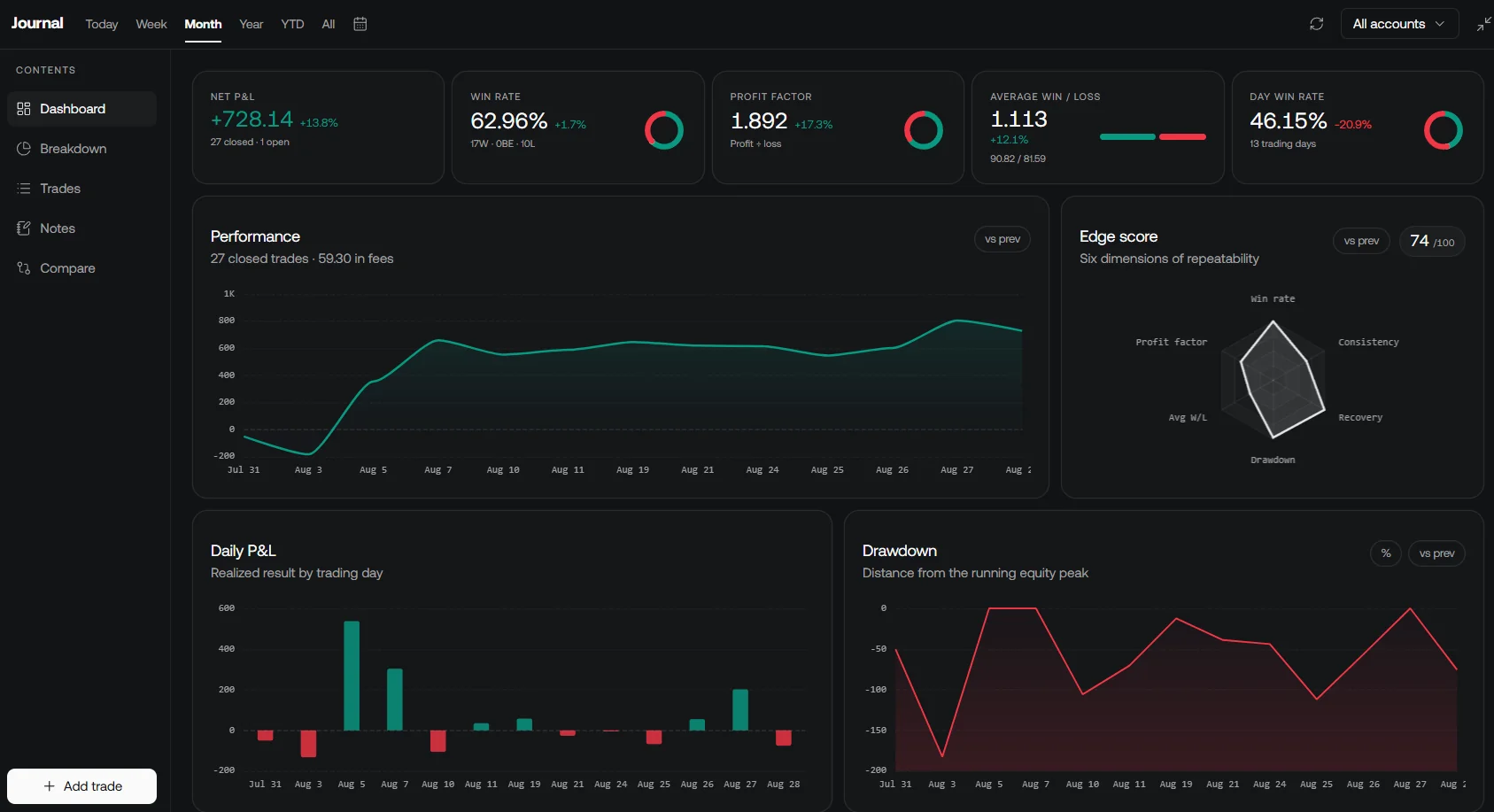
The workspace demonstration below shows how to organize related research. Keep your broker’s applicable rules and account notices alongside the trading plan so the strategy research and account checks remain connected.
A Daily Compliance Checklist
- Before trading: confirm the account’s applicable regime, current restrictions, equity and buying power.
- Before each new position: check its effect on margin and, where applicable, the legacy day-trade count.
- During the session: monitor broker notices and changes in house requirements; do not rely solely on a closing snapshot.
- After trading: reconcile executions, save notices and resolve any deficit promptly with the broker.
- When the broker migrates: replace the old checklist with its documented intraday-margin process and retain the transition notice.
The useful habit is a repeatable account check, not memorizing one threshold forever. Match the checklist to the broker’s current framework, keep position risk separate from maximum buying power, and use chart research and journals to support disciplined decisions.
Frequently Asked Questions
Does every day trader still need $25,000?
No. During the transition, firms may still apply the legacy PDT framework. Once a firm migrates to the new intraday-margin framework, the PDT-specific $25,000 minimum is removed, but other margin and equity requirements remain.
When did FINRA’s new intraday-margin rules take effect?
They took effect June 4, 2026, with firms permitted to transition through October 20, 2027. Ask your broker which framework currently applies to your account.
Are options exempt from day-trading requirements?
No. Securities options are not categorically exempt. Applicable margin and day-trading treatment depend on the account framework and position.
Does an OCO order prevent a day trade from counting?
No. Order organization does not change the classification of an executed round trip. Confirm complex execution counting with the broker.
Can LuxAlgo’s journal confirm live broker compliance?
No. It supports review of recorded trading activity. Use the broker’s current account information and notices to confirm restrictions, margin and any applicable day-trade count.
Read next