Success Story: How Algo Trading Transformed Equity Markets
Algorithmic trading changed how equity-market participants research opportunities, route orders and manage execution. Software can process information and apply rules faster than a person can act manually. The result is a different market structure, with benefits from competition and automation alongside new operational and liquidity risks. Faster processing does not guarantee better fills, lower total costs or profitable strategies.
How Trading Became More Systematic
Systematic investing and electronic execution are related but distinct developments. A strategy can follow written rules without using high-frequency infrastructure. An execution algorithm can divide or route an investor's order without predicting the next price move. Machine learning adds another method for estimating relationships, but it is not required for algorithmic trading.
Electronic quotation, order routing and matching developed over time rather than appearing as one fully automated system. Distinguish a screen displaying dealer quotes from a system that accepts and executes orders. Changes to price increments, venue competition and regulation also shaped trading, so improvements should not be attributed to algorithms alone.
Latency comparisons need a defined measurement. A calculation, network message, order acknowledgement and completed fill are different events. Hardware capable of a very short internal operation does not establish that every investor can trade at that speed or at the displayed price.
Renaissance Technologies: A Research-Driven Case Study
Renaissance Technologies describes its investment process as applying mathematical and statistical methods to the design and execution of investment programs. Its own history page dates the firm's founding to 1982 and describes a staff with scientific backgrounds, intensive research and proprietary quantitative strategies.
The firm's account of its process also emphasizes data and redundant computational facilities. That provides a useful institutional example: quantitative trading involves research, engineering and operational continuity together. A successful model alone would not eliminate the need for reliable inputs, controlled deployment and execution systems.
Medallion is central to the public success story surrounding Renaissance, but a performance comparison requires a defined fund, period, methodology and fee treatment. Gross and net returns are not interchangeable, and an arithmetic average is not the same as a compound growth rate. An isolated figure cannot explain exposure, leverage, capacity or the risks taken to produce it.
The public firm pages cited here do not provide a reproducible strategy or the detailed performance series needed to verify the original article's return, win-rate and correlation figures. They should not be treated as evidence that a retail trader can reproduce proprietary institutional results. The transferable lesson is to make research reproducible and operations resilient, not to infer an attainable return target from a celebrated fund.
What Changed for Equity Markets
Automation can support more frequent quote updates, order routing and systematic execution. Competition between liquidity providers can contribute to narrower quoted spreads in some settings. Whether an investor benefits depends on the actual order, available depth, price movement, fees and market impact.
Trading volume measures activity, while liquidity concerns the ability to transact at a given size and cost. A market can trade heavily while depth deteriorates. Displayed quotes can be cancelled, and a small quoted spread does not guarantee that a large order can execute near the best price.
Algorithms can incorporate information into prices quickly, but they can also react to similar signals or propagate faulty inputs. Price discovery is a process rather than a promise of instant correctness. Temporary imbalances and abrupt changes in participation remain possible.
Electronic access makes many research and execution tools easier to reach. It does not equalize data quality, capital, market access, latency or engineering resources. Compare a workflow against its own requirements rather than assuming every participant competes on identical terms.
| Change | Potential benefit | Important limit |
|---|---|---|
| Quote automation | More frequent updates and competition | Displayed interest can disappear |
| Order routing | Systematic venue selection | Fees, depth and market impact still matter |
| Data processing | Faster responses to information | Faulty inputs can propagate quickly |
| Research access | More tools for individual traders | Resources and execution access remain unequal |
Failures Show Why Controls Matter
The SEC’s Knight Capital enforcement release describes a deployment failure that produced erroneous orders and a loss of more than $460 million in August 2012. The lesson extends beyond the idea of a bad trading signal: deployment controls, risk limits, warnings and the ability to identify and stop unintended behavior are part of the trading system.
The May 2010 Flash Crash also requires more than a single-cause explanation. The SEC staff discussion of the joint analysis describes interactions between a large sell program, trading behavior and changing liquidity conditions. Later manipulation cases do not make spoofing a complete explanation of every mechanism involved in that event.
Treat order submission, acceptance, partial execution, cancellation and position closure as separate states. A process that stops calculating can still leave orders at the broker. Retries can create unintended exposure unless the system identifies what was already accepted or filled.
Test failures as deliberately as profitable-looking examples. Include stale data, rejected orders, interrupted connections, a restart with open positions and a deployment that changes an assumption. Preserve the evidence needed to reconstruct events instead of relying solely on an equity curve.
Oversight and Supervision
FINRA’s algorithmic-trading guidance addresses member firms' development, testing, implementation and supervision practices. Its scope matters: a firm's regulatory obligations should not be presented as a universal checklist of identical legal duties for every reader running a research script.
At a practical level, distinguish pre-trade limits, monitoring, post-trade review and recovery. Each addresses a different failure point. A size limit cannot detect every data error, and a daily loss threshold does not automatically cancel orders or close positions unless that behavior is implemented and verified.
Controls reduce particular risks; they do not guarantee stable markets or remove loss. Review the rules applicable to the actual activity and entity, and keep changes to the system accountable and documented.
Research with Current LuxAlgo Tools
Begin in LuxAlgo’s native charts with a precise question and an appropriate data source. Ask Quant, our coding agent, to implement or explain the rules. Inspect the generated code and run it yourself, then compare individual signals and trades against the specification before evaluating aggregate results.
Quant backtests a strategy against years of history, and Strategy Alerts provide notifications. Neither is proof of a broker fill. Differences in feeds, sessions, settings and execution assumptions can explain why platforms show different results.
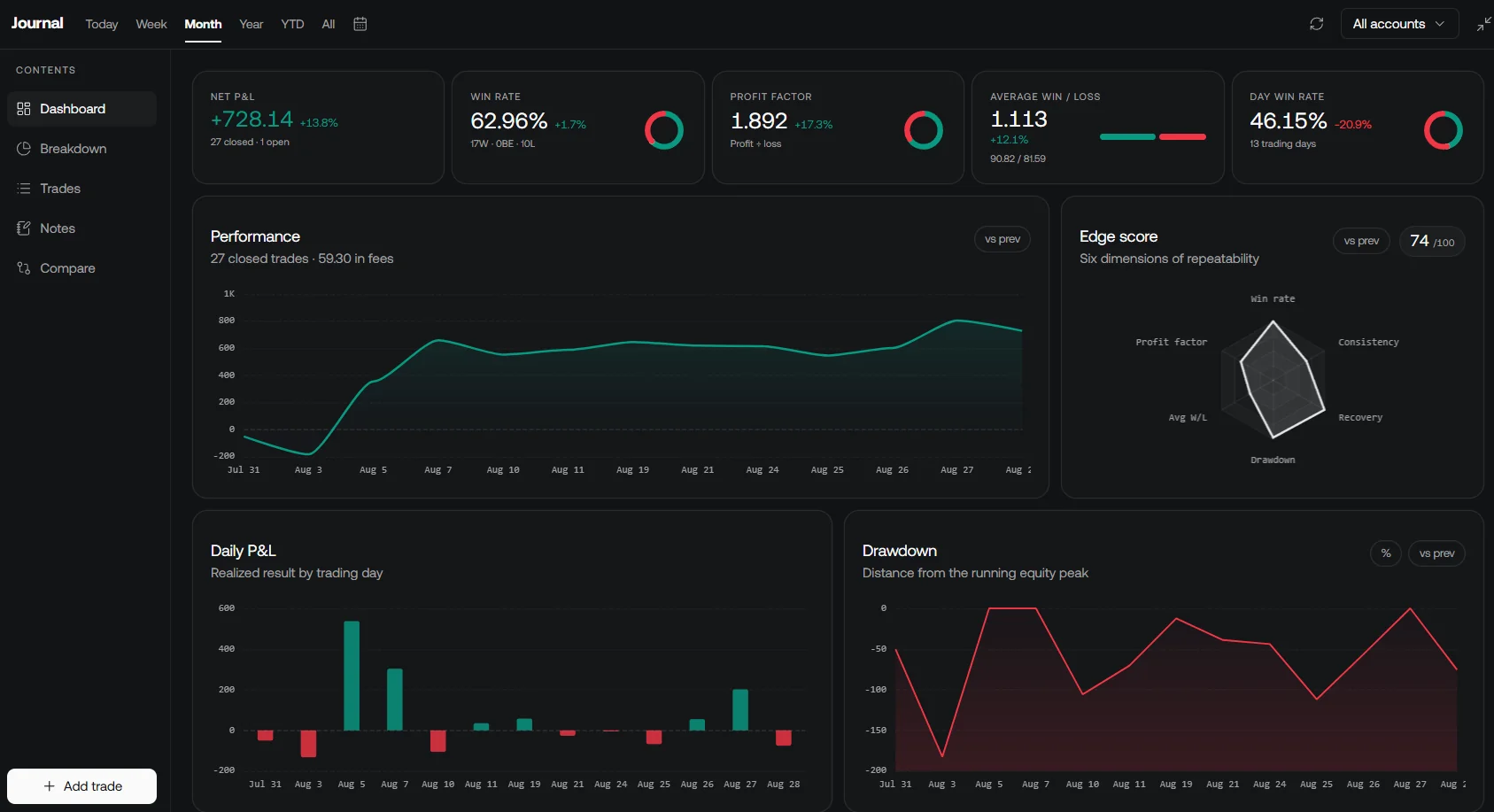
Review compatible recorded trades in LuxAlgo’s native journal, keeping simulated records distinct from actual fills. Use a workspace to organize baseline charts and related experiments. The purpose is to make the comparison traceable, not to assume that more indicators or a larger model must improve performance.
What the Next Phase Requires
Machine learning can add useful forecasts or classifications, but training, inference and retraining are separate steps. A deployed model does not automatically learn or remain suitable as conditions change. Evaluate later observations, costs and operational behavior as well as prediction scores.
Claims about emerging computing methods need benchmarks that match the intended task. Faster isolated calculations do not establish a profitable trading advantage after data acquisition, execution and costs. Treat research possibilities as possibilities until the relevant workflow has been demonstrated.
The strongest next step is a baseline you can explain and reproduce. State the rules, data, sizing and fill assumptions, test a documented change and review its limitations. The transformation of equity markets makes that discipline more useful, not less necessary.
Historical Commentary on Systematic Trading
The original Wealthspace video, published March 21, 2023, discusses Richard Dennis and trading discipline. It is third-party historical commentary, not a Renaissance case study or a primary record of equity-market development. Its headline claim about turning $400 into $200 million is not independently verified here and should not be read as an expected outcome.
Frequently Asked Questions
How did algorithmic trading change equity markets?
It expanded software-driven research, quote updates, order routing and execution. These changes can support competition and efficiency, but outcomes still depend on data, liquidity, costs and operational controls.
Does more trading volume mean more liquidity?
Not necessarily. Volume measures activity, while liquidity concerns how much can trade at a given cost. A busy market can still have little available depth or rapidly disappearing quotes.
Can individual traders reproduce Renaissance results?
The public firm pages do not provide a reproducible strategy or a detailed performance series. Institutional resources, capacity and risks differ; a celebrated fund is not a reliable return target for an individual workflow.
Are algorithms and high-frequency trading the same?
No. Algorithmic trading includes many rules and execution methods. High-frequency trading is a narrower activity with particular speed and infrastructure requirements.
How should I use LuxAlgo for research?
Start with native charts and precise rules. Ask Quant to implement or explain them, inspect the code and run it yourself. Review recorded outcomes and keep testing, alerts and actual broker fills distinct.
Read next