Tax-Loss Harvesting: Optimize Efficiency

Tax-loss harvesting means realizing an investment loss that may offset taxable capital gains and, within limits, other income. It can improve an investor’s after-tax outcome, but a deduction does not erase the investment loss. The decision should fit the portfolio, account type, expected tax treatment, and cost of reinvesting.
This guide focuses on U.S. individual investors holding stocks and funds in taxable accounts. Tax rules, filing status, state treatment, and individual circumstances matter; use a qualified tax professional for decisions about your return. The rules and provider details below were checked September 8, 2026.
- Calculate from tax lots: use adjusted basis and actual sale proceeds, not a chart’s percentage decline.
- Apply the netting rules: losses first offset gains; the ordinary-income deduction has a separate limit.
- Check the full wash-sale window: acquisitions before the loss sale count, as well as those afterward.
- Separate research from tax accounting: LuxAlgo charts and Quant can help investigate market behavior; broker records and tax calculations determine the deductible result.
How Tax-Loss Harvesting Offsets Gains and Income
The IRS capital gains and losses guidance distinguishes short-term holdings of one year or less from long-term holdings of more than one year. Net short-term gains generally face ordinary-income rates, while net long-term gains may receive preferential rates. Net losses within each category first, then apply the cross-category rules on Schedule D.
If total capital losses exceed gains, an individual can generally deduct up to $3,000 of net capital loss against other income per year, or $1,500 if married filing separately. Excess losses carry forward under the applicable rules. The $3,000 limit is not a cap on losses used to offset capital gains, and a deduction is not a dollar-for-dollar tax credit.
A Worked Tax-Loss Harvesting Example
Assume a single filer has $12,000 of realized short-term gains and realizes $18,000 of deductible short-term losses. There are no other capital transactions or carryovers, no wash-sale adjustment, and sufficient ordinary income to use the annual deduction. This simplified example ignores state taxes, surtaxes, fees, and other tax interactions.
| Calculation | Result |
|---|---|
| $12,000 gains − $18,000 losses | $6,000 net capital loss |
| Current ordinary-income deduction | $3,000 |
| Remaining loss carryforward | $3,000 |
| Illustrative current federal tax reduction at an unchanged 24% marginal rate | ($12,000 + $3,000) × 24% = $3,600 |
The $3,600 is conditional on the stated rate and assumptions. It is not $18,000 recovered in cash, and the $3,000 carryforward has not yet produced a tax benefit. Actual netting, taxable income, and future use determine the value. A loss offsetting a gain taxed at 0% may provide little immediate benefit.
Watch: How Harvested Losses Offset Gains and Income
This Wealthfront explainer was published November 3, 2021. It introduces the basic mechanism and includes provider promotion. Use the current IRS guidance and filing-status qualification above rather than assuming every viewer can deduct $3,000 or receives the same savings.
Finding Loss Harvesting Options
Review the Portfolio by Tax Lot
Start with the broker’s tax-lot records. A position purchased on several dates can contain both gains and losses even when the total position is profitable. Adjusted basis can reflect commissions, corporate actions, reinvestments, and earlier tax adjustments. The IRS basis overview explains why purchase price alone is not always the correct figure.
| Review item | Question to answer |
|---|---|
| Account and owner | Is the position in a taxable account, and whose return reports it? |
| Specific lot | What are its acquisition date, adjusted basis, and available shares? |
| Realized activity | What short- and long-term gains or losses already exist? |
| Potential sale | What loss would the selected shares realize after applicable costs? |
| Replacement and exposure | Would the new holding still fit the allocation and risk limits? |
| Household purchases | Could another account, reinvestment, or scheduled purchase create a wash sale? |
Do not assume a broker will sell the highest-basis shares automatically. Check the available cost-basis method and submit any specific-lot instructions within the broker’s required timeframe. Retain confirmation of the shares actually sold. A price alert can prompt a review; it cannot identify a deductible tax lot by itself.
When to Harvest Losses
Review opportunities throughout the year and when rebalancing, receiving a large distribution, or changing an investment thesis. Waiting until December can miss a temporary loss, but constant trading adds friction. A fixed monthly return average—such as an historically weak September—does not establish whether your own tax lots are below basis.
An index can rise while some constituent stocks decline. That dispersion creates potential stock-level opportunities, but it does not guarantee usable losses or a net benefit. New contributions can add lots with different bases; contribute according to the financial plan, not simply to manufacture more harvesting activity.
Avoiding Wash Sales
Understand the 61-Day Window
IRS Publication 550 explains that a loss can be disallowed when substantially identical stock or securities are acquired within 30 days before or after the loss sale, including certain contracts or options. A spouse’s purchase or a purchase by a controlled corporation can also matter. The 61-day span includes the sale date; it does not mean waiting 61 days after every sale.
Calendar example: for a loss sale on September 15, 2026, the window runs from August 16 through October 15, inclusive. October 16 is outside the post-sale 30-day window. Waiting until then does not undo an acquisition made during the pre-sale portion of the window. This date illustration assumes an ordinary stock sale and no other complicating transaction.
Check automatic purchases as carefully as manual ones. Fidelity’s wash-sale guide highlights dividend reinvestments and purchases across accounts. Small or fractional purchases can affect part of a loss; changing brokers does not eliminate the rule. Review scheduled investments, spouse activity, and employee-stock acquisitions before executing the sale.
What Happens to a Disallowed Loss?
For a typical taxable-account replacement, the disallowed loss is added to the replacement shares’ basis, and their holding period includes the period of the shares sold. The deduction is usually deferred rather than simply erased. Matching rules matter when fewer replacement shares are acquired than sold.
Partial-repurchase example: sell 100 shares with a $100-per-share basis for $80 each, creating a $2,000 loss before costs. Buy 25 identical shares at $81 within the window. Assuming these are the only relevant transactions, $500 of loss is disallowed and added to the $2,025 replacement cost, making basis $2,525. The other $1,500 remains potentially deductible.
An IRA replacement can have a more severe result. IRS Revenue Ruling 2008-5 addresses a taxable loss sale followed by acquisition of substantially identical securities in the individual’s IRA or Roth IRA: the loss is disallowed without increasing the IRA’s basis. It is not the ordinary taxable-account deferral described above.
Coordinate the household’s taxable and retirement activity, and obtain advice where an employer plan or unusual instrument is involved. Do not assume every retirement arrangement has identical rules. Selling at a loss inside an IRA or 401(k) generally does not create a deductible capital loss on the individual’s tax return; Schwab’s harvesting guide explains that account distinction.
Steps to Harvest Losses
- Estimate the tax result. Include existing gains, losses, carryovers, filing status, and the rate likely to apply.
- Select the lot. Confirm adjusted basis, holding period, quantity, and broker instructions.
- Review the wash-sale window. Check relevant acquisitions already made and those scheduled across the household.
- Choose the portfolio response. Evaluate a suitable replacement or temporary allocation without assuming it has identical market behavior.
- Execute and document. Retain confirmations and the rationale; then monitor subsequent purchases and reconcile the tax reporting.
Selecting New Positions
A replacement should satisfy both the investment objective and the tax analysis. A sector ETF, another company, or a fund following a different benchmark may change concentration, volatility, fees, and expected behavior. Moving from a growth stock to a value stock can materially alter the strategy even within one industry.
The IRS uses a facts-and-circumstances standard for “substantially identical.” A different ticker, issuer, or fund name is not a universal safe harbor. Compare holdings and structure, and get advice for uncertain fund pairs, convertible instruments, options, or other complex positions. A high correlation in a backtest does not resolve the legal question.
Keep an Audit Trail
Maintain acquisition and sale dates, quantity, adjusted basis, proceeds, lot identification, owner and account, replacement details, wash-sale adjustments, and carryforwards. Reconcile broker statements with the return. A broker’s reported wash-sale amount may not cover all relevant activity across other accounts.
The Form 8949 instructions explain adjustments and reporting, including code W for wash-sale losses. Schedule D summarizes the capital result. A missing adjustment on a broker form does not make an otherwise disallowed loss deductible.
Vanguard’s Minimum Tax (MinTax) method selects lots using a tax-oriented ordering approach. Vanguard explicitly says it does not guarantee the lowest total tax liability and does not identify or attempt to reduce wash sales. Treat a cost-basis selection method as one part of the process, not a complete household tax system.
Tools for Monitoring and Research
Compare Services by Their Actual Role
Managed harvesting services, broker lot-selection tools, and charting software perform different jobs. Provider terms below are a September 8, 2026 snapshot; verify eligibility, fees, and account restrictions before choosing a service.
| Tool or service | Role | Key distinction |
|---|---|---|
| Wealthfront S&P 500 Direct | Individual-stock indexing with automated tax-loss harvesting; stated $5,000 minimum and 0.09% annual advisory fee | A specific standalone product; other Wealthfront portfolios have different minimums and fees. |
| E*TRADE Core Portfolios | Managed portfolios; stated $500 minimum and 0.30% annual advisory fee | Tax-loss harvesting requires enrollment and an eligible taxable account. Fund expenses and other applicable costs also matter. |
| Vanguard MinTax | Selects lots when selling | Does not replace wash-sale monitoring or tax-return preparation. |
| LuxAlgo charts and Quant | Market analysis and strategy research | A chart backtest is not a tax-lot ledger, wash-sale determination, or automatic harvesting service. |
For any automated service, ask which accounts it coordinates, how it handles outside purchases, what securities it excludes, and how it calculates any advertised tax benefit. Harvested losses are not the same as taxes saved, and taxes saved today are not necessarily a permanent improvement after a later sale.
Use LuxAlgo to Investigate Replacement Exposure
Keep supported candidate symbols in a LuxAlgo watchlist. Use multi-chart layouts to compare the original holding, a proposed alternative, and a relevant reference over consistent dates and scales. Compare drawdowns, sector concentration, and reactions to market stress; verify fund holdings and fees in the issuer’s materials.
Indicators from the Library can describe market structure, trend, or momentum. They cannot establish adjusted tax basis or whether a security is a lawful replacement.
Prototype a Market Rule with Quant
Quant, our coding agent, can help write a reviewable strategy from defined inputs. For an educational comparison, specify one supported instrument, a start date, entry and exit timing, position size, and costs. Review the code before running it while signed in; do not describe the result as tax-optimized simply because it reports a profit.
For example, investigate holding a candidate for 31 calendar days after a specified entry date, exiting at the first defined tradable opportunity afterward. Require the code to distinguish calendar days from trading bars. This tests a market-exposure scenario, not whether the household satisfies the wash-sale rule; prior purchases, fund identity, and tax lots remain outside that price-based test.
Review net results, drawdown, trade count, and individual fills in the strategy viewer’s Trades Log. Compare alternative exposure with a consistent baseline and separately model the tax result. Do not add independent chart backtests and assume they reproduce shared portfolio capital or taxable-account accounting.
Review Implementation in the Journal
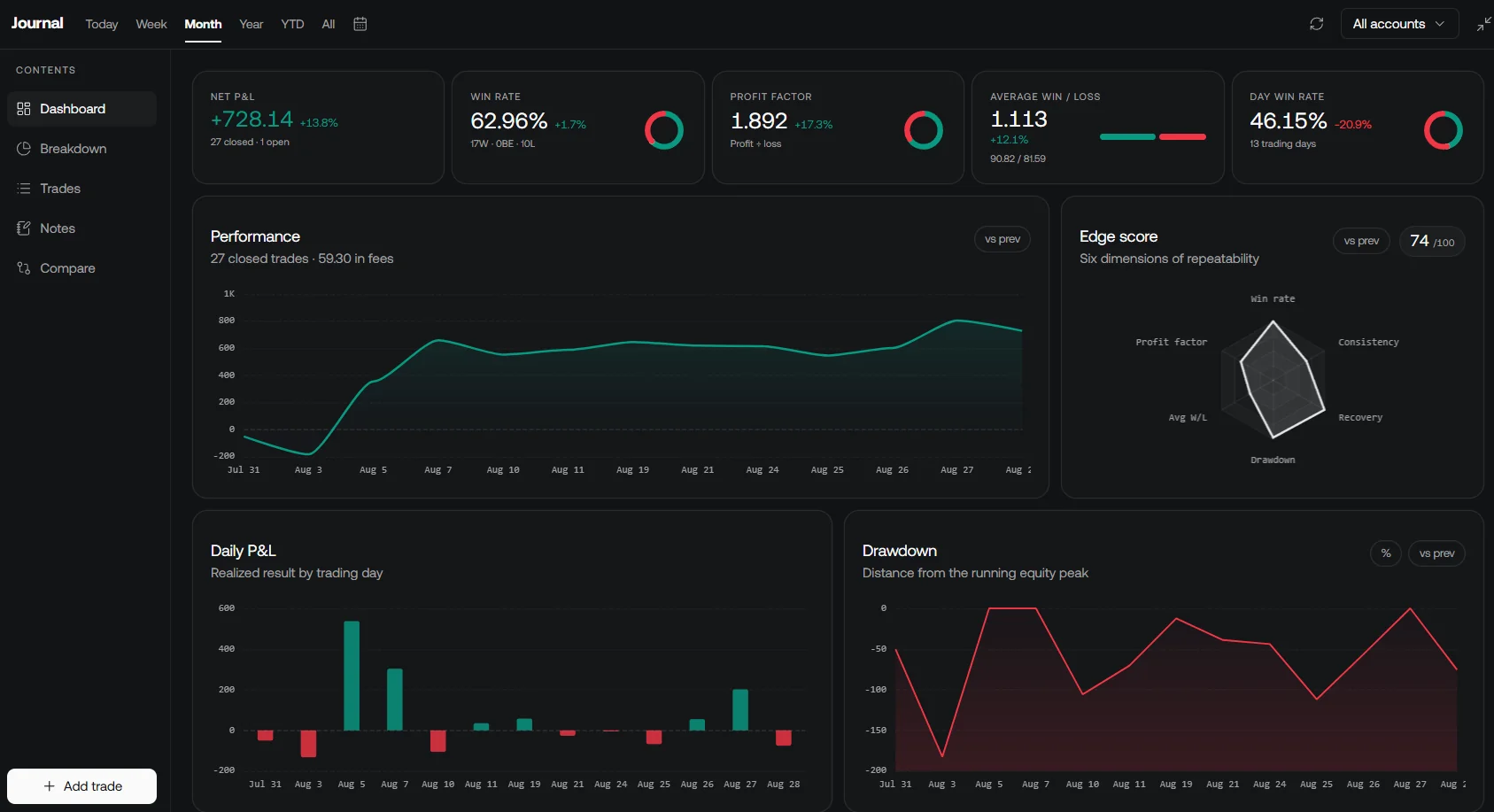
The LuxAlgo Journal helps review recorded trades and performance. Keep notes about the investment decision and compare actual execution with the plan. Reconcile entered or imported trades to the broker; retain the separate tax-lot records needed for filing.
Improving Loss Harvesting Results
Measure Deferral, Costs, and Portfolio Drift
A lower replacement basis can create a larger taxable gain later. In a simplified illustration, an investment with $10,000 basis falls to $8,000. Harvesting a usable $2,000 loss at an assumed 20% rate reduces current tax by $400. If a suitable replacement bought for $8,000 later sells for $10,000 at the same rate, that gain generates $400 of tax. Ignoring growth on retained cash and other differences, this is deferral rather than $400 permanently eliminated.
The ability to invest retained cash, different future rates, and later disposition choices can change the outcome. So can advisory fees, fund expenses, spreads, transaction costs, and replacement underperformance. Compare the full after-tax path rather than only the deduction in the first year.
- Transaction friction: estimate costs on both the sale and replacement, including spreads even where commissions are zero.
- State treatment: calculate separately rather than assuming federal loss rules apply unchanged.
- Distributions: consider fund distribution timing and automatic reinvestment before purchasing.
- Portfolio drift: check that the replacement has not added an unwanted sector or factor bet.
- Year-end timing: confirm the relevant transaction and broker deadlines, then continue checking purchases in January.
Coordinate Estate and Charitable Planning
Inherited property generally receives a basis tied to fair market value at death or an applicable alternative valuation, with exceptions. That can be a step down as well as a step up; see the IRS inherited-property guidance. Do not assume all assets, account types, or future laws receive the same treatment.
Unused personal capital losses generally do not carry beyond the taxpayer’s death, as explained in IRS Publication 544. Estate planning therefore requires more than assuming losses can be carried indefinitely to heirs.
Donating long-term appreciated securities may be worth comparing with selling and donating cash. A loss position raises a different question: selling first may preserve a deductible loss before a cash gift. Deductibility, qualified organizations, valuation, and limitations must be checked under the IRS charitable-contribution rules and the applicable tax year. These choices belong in the broader financial plan.
Conclusion
Tax-loss harvesting is a tax-aware portfolio decision, not a reliable way to outperform the market. Start with accurate lots and household records, check the full wash-sale window, estimate when losses can be used, and compare the investment and tax consequences of the replacement.
LuxAlgo charts, Quant, and the Journal can support market research and execution review. Combine them with broker records and professional tax analysis so a faster research workflow leads to a better-supported decision—not an unsupported claim of automatic tax savings.
References
- IRS Topic 409: capital gains, losses, and deduction limits
- IRS Publication 550: investment income and wash sales
- IRS Revenue Ruling 2008-5: IRA replacement purchases
- IRS Form 8949 instructions
- Vanguard MinTax methodology and limitations
- Wealthfront S&P 500 Direct: current product terms
- E*TRADE Core Portfolios: current terms and harvesting enrollment
Read next