Trading Psychology: Overcome Emotional Bias

Managing trading emotions starts with observable decisions. Instead of trying to feel nothing, write down the setup, position size and exit conditions before committing capital. Then compare what you actually did with that plan. Fear, greed and confidence become useful review topics when they are connected to specific actions.
A disciplined process can reduce avoidable improvisation, but it cannot make an unprofitable strategy profitable by itself. A losing trade can follow a sound plan, and an impulsive trade can make money. Review decision quality and financial results separately so that a lucky outcome does not reinforce a poor habit.
Find Your Emotional Trading Patterns
Fear, Greed and Overconfidence
| Pattern to investigate | Possible behavior | A practical check |
|---|---|---|
| Fear after a loss | Skipping a qualifying setup or exiting before the planned condition | Was the setup still valid, and was the size appropriate? |
| Greed or fear of missing out | Chasing an entry, increasing size or moving an exit without a rule | Would the same trade meet the plan without the recent price move? |
| Overconfidence after wins | Using more leverage or skipping preparation | Did anything in the strategy evidence justify the change? |
| Confirmation bias | Seeking only commentary that supports an open position | What evidence would invalidate the original idea? |
These are possible patterns, not diagnoses. Reducing a position can be a sensible response to risk; taking profit can follow a valid exit rule. The issue is whether the decision followed a defensible process and the information available at the time, rather than whether it looks good after the price moves.
FINRA’s guidance on social media and investing highlights how hype, peer pressure and confirmation bias can influence decisions. Check the source’s incentives and whether an idea fits your own goals and capacity for loss. A crowded discussion or confident prediction does not replace independent review.
Keep a Decision Journal
Record more than the entry, exit and profit or loss. Save the setup, planned size, invalidation condition, actual execution and reason for any change. A simple self-rating from 1 for calm to 10 for overwhelmed can help you describe your state consistently; it is a personal tracking scale, not a clinical measurement.
- Before entry: record the reason for the trade, the planned exit and your emotional state.
- During the trade: note any urge to add, cancel an exit or change the rules, including whether you acted on it.
- After the trade: record the actual result, costs and whether the plan was followed.
- During review: compare similar setups and market conditions rather than drawing conclusions from one memorable result.
For example, suppose you skip a planned short during a crude-oil downtrend after a recent loss. Record whether the entry conditions were actually present, whether the instrument and size were appropriate, and what concern led you to pass. A later price decline does not prove that taking the short was the right decision; use the contemporaneous record to evaluate the choice.
Separate Association from Explanation
If trades entered with high stress ratings perform poorly, that is a question to investigate. It does not prove that stress caused the loss: volatility, position size, setup quality and the time of day may differ too. Use a meaningful sample and compare like with like before changing the plan.
Reading your checklist aloud can be a simple pause before acting. It is not a proven method for eliminating bias. Similarly, journaling and stop orders should not be presented as producing a guaranteed percentage improvement in emotions or profitability.
Five Ways to Build More Consistent Decisions
1. Write Rules You Can Actually Check
Define the conditions for taking a trade before the session. Vague instructions such as “buy when it looks strong” leave room for reinterpretation when money is at risk. Include what would cause you to pass, reduce activity or stop for the day.
| Rule component | What to specify | How to review it |
|---|---|---|
| Entry | Symbol, timeframe, conditions and confirmation timing | Did all conditions exist before the order? |
| Exit | Invalidation, target if used, and time-based rules | Did the exit follow the rule or a documented exception? |
| Sizing | Planned loss allowance, exposure and instrument constraints | Was size within the preselected limits? |
| Session limits | Loss threshold, permitted activity and a pause procedure | Was the threshold respected, including existing positions? |
A daily profit target should not become a requirement to force trades. Reaching a loss threshold also needs an explicit action: stopping new orders is different from closing existing positions. Decide the procedure in advance and check what your platform or broker can enforce.
2. Use Order Controls with Clear Limits
Stop-loss, take-profit and trailing orders can express a plan, but each has execution constraints. Investor.gov explains stock order types: a stop becomes a market order when triggered, and its execution price is not guaranteed; a limit order may never execute. Confirm the specific broker’s behavior for the product and session.
A trailing stop follows a defined adjustment rule; it does not guarantee that a displayed unrealized gain will be retained. Position limits and daily thresholds likewise require monitoring for gaps, slippage, rejected orders and changing account conditions. Automation can enforce a rule only within the actual system’s capabilities.
There is no universal requirement that every trade have a 1:2 risk-reward ratio. Evaluate the realized win rate, average gains and losses, and costs together. In a simplified example, winning 40% of trades at an average 2R while losing 60% at 1R gives 0.2R expectancy before costs. A planned target does not establish that those averages will occur.
3. Make Pausing Part of the Routine
Choose a short break procedure for moments when you cannot follow the checklist—for example, after an unplanned size increase or an urge to recover a loss immediately. Account for any open positions before stepping away. A pause is a decision-control habit, not a promise of improved returns.
Regular rest, time away from screens and a sustainable schedule can support preparation. Some traders find quiet breathing or a brief walk useful before reviewing a plan. Avoid treating these habits as a specific cortisol-reduction formula or a substitute for dealing with an unsuitable risk level.
4. Test Rules Before Relying on Them
Use historical testing to investigate how a precisely defined strategy behaved, including losing periods. Keep commissions, slippage, position sizing and data assumptions explicit. Reserve later periods that did not determine the rules, then examine individual trades and forward-test where appropriate.
Repeatedly adjusting settings until the historical chart looks attractive can create false confidence. Change one documented hypothesis at a time and preserve the earlier version. A high win rate alone is not enough: a small number of large losses can outweigh many small gains.
5. Review Process Without Rewriting Every Loss
At the end of the session, identify whether an error involved execution, preparation, rule clarity or the strategy itself. Avoid labeling every losing trade an emotional mistake. If the rules were followed, evaluate the strategy over its intended sample rather than immediately changing the next entry.
Track a small set of process measures, such as the proportion of trades with a completed plan, unplanned size changes and exits that departed from the rules. Pair these with net results and drawdown. Better checklist adherence is evidence of process consistency, not proof of a profitable edge.
Managing Fear and Greed: Video
The retained Patrick Bailouni video, premiered June 23, 2024, discusses fear and greed in trading. Use its examples as prompts for reflection. The creator’s coaching and performance claims are separate from evidence that a particular strategy or psychological technique will work for you.
Use LuxAlgo to Connect the Plan with the Evidence
Start with LuxAlgo’s native charts to document the setup and compare relevant timeframes. Keep the symbol, data source and chart settings consistent when reviewing a trade. Saving the original context helps prevent a later chart from quietly replacing what you knew at entry.
For a supported chart strategy, ask Quant, our coding agent to implement explicit entry, exit and sizing rules. Inspect the generated code and run it manually. Review native strategy settings and individual trades to check that the code represents your hypothesis, uses realistic assumptions and behaves as intended.
Quant can help express and revise the rules; it does not establish that the strategy has an edge or that a broker will execute it as simulated. AI output can contain mistakes, and the human choice of data, objectives and settings can introduce bias. A repeatable calculation is useful, but it is not the same as an unbiased investment decision.
Use the native LuxAlgo journal to review recorded trading activity, then keep your decision notes alongside those results. Reconcile imported trades with broker records before interpreting a pattern. Do not infer an emotion from a profit-and-loss chart alone.
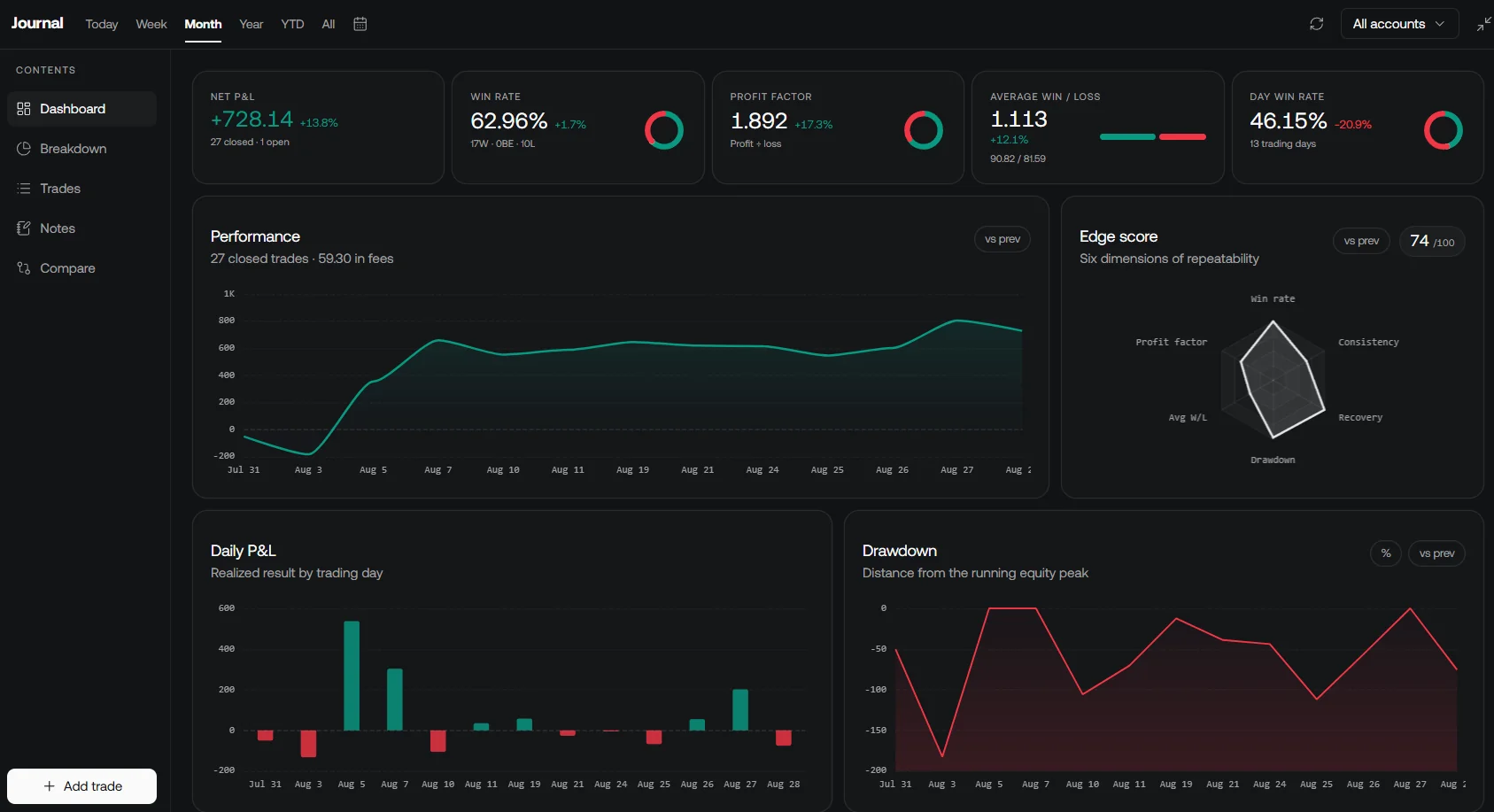
The workspace video below shows a way to organize related chart research. Keep each strategy version and its assumptions identifiable so that review is based on the plan used at the time.
What Other Trading Tools Can and Cannot Do
TradesViz is another journal and analytics service offering trade imports, dashboards and AI-assisted review. Its feature breadth does not prove that it eliminates emotions. Check whether your broker records import correctly and whether a reported pattern survives inspection of the underlying trades.
TradeSmith offers investment research and risk-oriented tools. A headline win-rate claim is not a substitute for a reproducible strategy test: identify the product, sample, holding periods, losses and costs before drawing a conclusion. Neither vendor’s marketing statistics establish a general improvement in trading psychology.
Choose tools for a specific job—capturing records, testing rules or reviewing exposure—and verify that output. Avoid handing an AI system an undefined instruction to “trade without emotion” and treating its response as a complete operating plan.
Build a Daily Trading Routine
| Stage | Activity | Record to keep |
|---|---|---|
| Before the session | Review relevant events, account conditions and strategy rules | Setup criteria, permitted risk and reasons to sit out |
| Before an order | Check the entry, size and exit procedure | Brief decision note and current emotional rating |
| During the session | Monitor positions and take planned pauses | Any rule changes, execution problems or broker notices |
| After the session | Reconcile trades and review adherence | One specific issue to investigate, rather than a new strategy after every loss |
Schedule deeper strategy changes outside the pressure of an open position. If you notice repeated impulsive additions, for example, investigate when they occur and introduce a testable restriction on new entries. Review whether you followed that restriction before crediting it with a financial result.
Other traders can offer useful feedback when the discussion focuses on process and evidence. Share an anonymized example and ask which rule was unclear or unsupported. Assess qualifications and incentives; a group’s agreement does not make a trade suitable, and a community built around urgent calls can amplify the same pressures you are trying to manage.
Begin with a manageable routine: one written plan, one contemporaneous decision record and one scheduled review. The goal is to notice when behavior departs from the plan and investigate why. Emotional control and sound strategy research support each other, but neither removes market risk.
Frequently Asked Questions
Can traders eliminate emotions completely?
That is not a useful requirement for a trading process. Focus on observable decisions, written rules and how you respond when you feel pressure.
Does a losing trade prove poor trading psychology?
No. A trade can follow the plan and lose. Review rule adherence separately from the strategy’s results over an appropriate sample.
What should an emotional trading journal include?
Record the setup, planned size and exit, emotional self-rating, actual action and reasons for changes. Compare the notes with executions and costs.
Can AI remove trading bias?
No. AI can help express rules and analyze data, but mistakes and bias can enter through its output, inputs and human choices. Inspect and test the work.
Does a stop-loss guarantee the planned maximum loss?
No. Execution can differ from the stop level because of gaps, slippage and order behavior. Confirm the broker’s rules and size positions with those limits in mind.
Read next