US Income Tax for Traders: An Essential Guide

The federal tax code has no category called "day trader." It has investors, dealers and traders in securities, and the IRS explains the differences in Tax Topic 429. Which label applies decides whether your expenses are deductible, whether the wash sale rule and the capital loss limit bind you, and whether an election is available that turns trading results into ordinary gains and losses. This guide follows that topic and the IRS pages it points to: what makes someone a trader, what changes when they are, how the section 475(f) mark-to-market election works and what it costs, how trading income is taxed without it, which expenses qualify, when estimated payments are due, and what records the IRS expects. It closes with how the Journal in Quant Charts holds the trade-level record those rules depend on. It covers federal rules only and is not tax advice; anyone considering trader status or the election should work with a credentialed preparer.
Investor, Trader or Dealer
Tax Topic 429 describes three kinds of taxpayers who buy and sell securities. Investors buy and sell for personal investment, expecting dividends, interest or appreciation; they report capital gains and losses on Form 8949 and Schedule D, are subject to the capital loss limit and the wash sale rule, and cannot deduct commissions except by adding them to basis. Dealers under section 475 have customers and earn income by making markets or selling securities to those customers. Traders in securities buy and sell for their own account as a business, even though they have no inventory and no customers.
To be a trader the IRS says you must meet all three of the following: you seek to profit from daily market movements in prices rather than from dividends, interest or capital appreciation; your activity is substantial; and you carry it on with continuity and regularity. The facts the IRS says it considers are the typical holding periods of the securities you buy and sell, the frequency and dollar amount of your trades during the year, the extent to which you pursue the activity to produce income for a livelihood, and the amount of time you devote to it. The topic gives no numeric thresholds, and it states plainly that calling yourself a trader or a day trader does not change the analysis: if the activity does not rise to a trade or business, you are an investor for federal income tax purposes. A taxpayer can also be a trader in some securities while holding others for investment, and the trader rules do not apply to the investment holdings.
What Trader Status Changes
Qualifying as a trader changes three things and leaves one unchanged. Traders report their business expenses on Schedule C, Profit or Loss From Business, rather than losing them as non-deductible investment expenses. Commissions and other costs of buying and selling still are not deductible as expenses; they go into basis, as they do for investors. Gains and losses from a trader's sales are not subject to self-employment tax. And, unless a further election is made, a trader's gains and losses remain capital gains and losses reported on Form 8949 and Schedule D, with the capital loss limit and the wash sale rule still applying. Trader status by itself, in other words, unlocks expenses, not a different treatment of the trading results.
| Item | Investor | Trader without election | Trader with 475(f) election |
|---|---|---|---|
| Gains and losses | Capital, Form 8949 and Schedule D | Capital, Form 8949 and Schedule D | Ordinary, Form 4797 Part II |
| Capital loss limit | Applies | Applies | Does not apply to trading securities |
| Wash sale rule | Applies | Applies | Does not apply to trading securities |
| Long-term capital gains rates | Available | Available | Not available on trading securities |
| Business expenses | Not deductible | Schedule C | Schedule C |
| Commissions | Added to basis | Added to basis | Added to basis |
| Self-employment tax on gains | No | No | No |
The Mark-to-Market Election
Traders, and only traders, may elect the mark-to-market method of accounting under section 475(f). With a timely and valid election, gains and losses from sales of trading securities are treated as ordinary gains and losses and reported on Part II of Form 4797, Sales of Business Property. The capital loss limit, the wash sale rule and certain other rules do not apply. Securities held for investment are excluded, but only if they are identified as such in the trader's records on the day they are acquired, for example by holding them in a separate brokerage account.
The timing rule is strict. The election must be made by the due date, not including extensions, of the return for the year before the year in which it is to take effect, by attaching a statement to that return or to an extension request. The statement must say that an election under section 475(f) is being made, name the first tax year it is effective, and name the trade or business it covers. A new taxpayer who was not required to file for the prior year can instead place the statement in their books and records within 2 months and 15 days of the start of the election year and attach a copy to that year's return. The IRS states that late elections generally are not allowed; a missed deadline means waiting until the following year. Once the election is in effect, mark-to-market is the only permitted method for those securities, a change from any other method requires Form 3115, and revoking the election requires both a notification statement filed by the same kind of deadline and a Form 3115, with a user fee if the revocation comes within five years of the election.
The trade-off is between losses and rates. A trader with large losses in a bad year gains the ability to deduct them in full against other income and to ignore the wash sale rule; the same trader gives up the lower long-term rates on trading positions and accepts a mandatory year-end marking of open positions to fair market value. Because the election has to be made before the year it governs, it is a forecast about a year that has not happened, which is why the decision belongs with a preparer who can model both outcomes.
How Trading Income Is Taxed Without the Election
For an investor or a trader who has not elected, trading results are capital gains and losses. Short-term gains, on positions held one year or less, are taxed as ordinary income at the graduated brackets, which for 2025 ran from 10% to 37% by filing status according to the IRS rates and brackets page. Long-term gains are taxed at 0%, 15% or 20% depending on taxable income, using the thresholds Tax Topic 409 publishes each year. Losses offset gains, and up to $3,000 of any excess ($1,500 married filing separately) offsets other income with the rest carried forward. Tax Topic 559 adds a 3.8% net investment income tax for taxpayers whose modified adjusted gross income exceeds $200,000 for single filers, $250,000 for joint filers or $125,000 for married filing separately. A frequent trader's results are almost entirely short-term, so the ordinary brackets, not the capital gains schedule, are the relevant rates.
Deductible Expenses for a Trader
Publication 334 gives the general test: a business expense must be ordinary, meaning common and accepted in the field, and necessary, meaning helpful and appropriate; it need not be indispensable. An expense that is partly personal must be split, and the personal part is not deductible. For a trader on Schedule C the usual items are market data, charting and analysis subscriptions, professional publications and education directly related to the trading business, a business computer and connectivity, and professional fees. Commissions remain in basis.
The home office deduction has its own rules on the IRS home office page. The space must be used regularly and exclusively for the business and must be your principal place of business. Two methods are available. The simplified option allows $5 per square foot of qualifying space up to 300 square feet, with no depreciation and with home-related itemized deductions such as mortgage interest claimed in full on Schedule A. The regular method deducts the business-use percentage of actual expenses, including mortgage interest, insurance, utilities, repairs and depreciation, with recapture of depreciation when the home is sold. Under either method the deduction cannot exceed the gross income from the business use of the home less other business expenses.
Estimated Taxes
Because no one withholds tax from trading gains, the IRS estimated taxes page applies. Individuals, including sole proprietors, generally must make estimated payments if they expect to owe $1,000 or more when their return is filed. The year is divided into four payment periods, each with its own due date, and paying too little in any period can produce a penalty even if a refund is due at filing. Payments are made with Form 1040-ES by mail or electronically through IRS online accounts and payment services. A trader with a strong first half and a weak second half can reduce the risk of over- or under-paying by recalculating the estimate each quarter from the Journal's realized results rather than annualizing one good quarter.
Trading Through an Entity
Some traders operate through an entity. The IRS S corporations page describes the form most often mentioned: a domestic corporation with no more than 100 allowable shareholders and one class of stock that elects, on Form 2553 signed by all shareholders, to pass its income, losses, deductions and credits through to shareholders' personal returns, avoiding entity-level tax on ordinary income. An entity does not by itself make anyone a trader; the Topic 429 tests are applied to the activity. What an entity can change is the mechanics of employee-type benefits and payroll, which is a decision with legal and state-tax dimensions beyond this guide and one to make with a professional.
Records the IRS Expects
Two record requirements sit on top of the general rules. Tax Topic 429 requires a trader to keep detailed records that distinguish securities held for investment from securities in the trading business, with the investment securities identified on the day they are acquired. And the facts that establish trader status in the first place, holding periods, frequency and dollar amount of trades, time devoted, and reliance on the activity for a livelihood, are all things that can only be shown from a complete trade-level record. The IRS record-keeping page's general periods then apply: three years from filing in the ordinary case, seven years for a worthless-securities claim, and records connected to property until the limitations period expires for the year the property is sold.
Where Quant Charts Fits
Quant Charts does not compute taxes, does not make elections and does not place orders; no LuxAlgo tool does. What it provides for a trader is the record that Topic 429 keeps returning to. The Journal in Quant Charts lives on your account rather than in a workspace, is included on every plan, and stores fills rather than summaries.
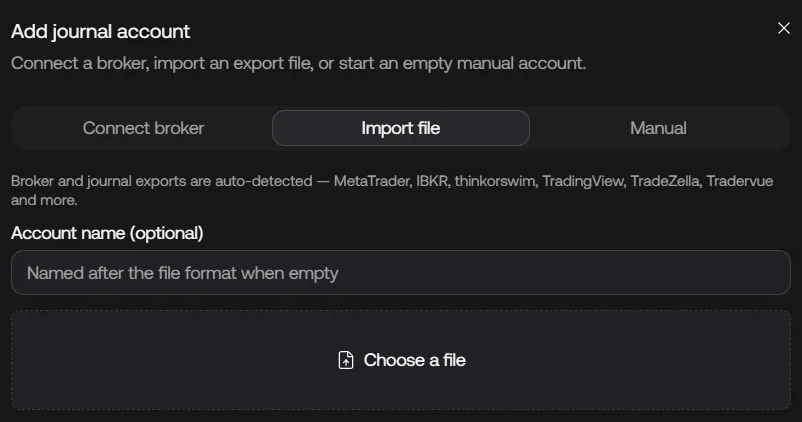
Keep the business book separate from the investment book. Topic 429 requires investment securities to be identified as such when acquired, and suggests a separate brokerage account as the way to do it. Journal accounts map onto that: a broker-synced or imported account for the trading business and a separate manual or imported account for long-term holdings keeps the two books apart, and the account picker filters every Journal page to one book or to all of them. Imports accept CSV, TXT and HTML exports from supported brokers and journals, and broker-connected accounts refresh daily.
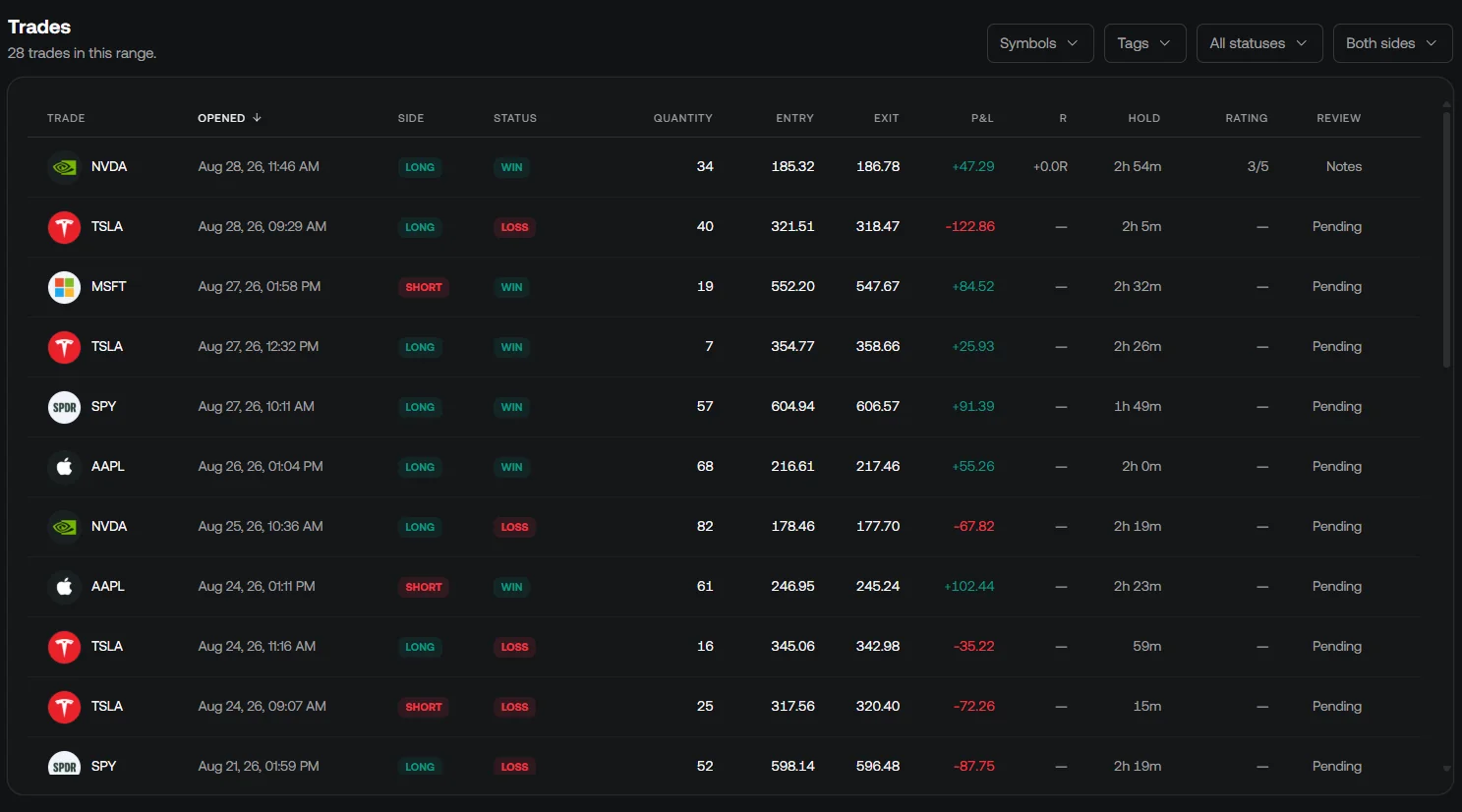
Show the facts behind trader status. The dashboard reports trade counts and results for any date range, the Trades page lists every fill with its execution time, and the Breakdown page groups results by hold time, day of week and time of day. Those are the same facts, frequency, holding periods and regularity, that the IRS says it weighs, and they are far easier to produce from a running Journal than to reconstruct from a year of broker statements.
The video below shows how an indicator is added from the popup in Quant Charts.
Treat the subscription as what it is. A charting and data subscription is an ordinary and necessary expense of a trading business under Publication 334's test, and for a Schedule C trader it is deductible; for an investor it is not. The same is true of any other tool, so the deduction question is really the trader-status question. Keep the invoice either way.
Backtests are not trades. When you describe a rule to Quant, our coding agent, inspect the Pine Script under Code and click Run, the Backtest Summary's net profit, trade count, win rate, max drawdown and profit factor describe hypothetical trades with commission and slippage set in the strategy's Properties. Nothing is bought or sold, so nothing is reported and nothing counts toward the frequency or regularity the IRS looks at. Only fills executed with a broker belong in the Journal account you use for the trading business.
FAQs
What makes someone a trader in securities for tax purposes?
Under IRS Tax Topic 429 you must seek to profit from daily market movements rather than from dividends, interest or appreciation, your activity must be substantial, and you must carry it on with continuity and regularity. The IRS weighs holding periods, trade frequency and dollar amounts, reliance on the activity for a livelihood and time devoted. There are no published numeric thresholds.
What does trader status change?
A trader deducts business expenses on Schedule C and pays no self-employment tax on trading gains. Without a further election, gains and losses stay capital gains and losses on Form 8949 and Schedule D, with the wash sale rule and the $3,000 loss limit still applying. Commissions go into basis in every case.
What is the section 475(f) mark-to-market election?
An election available only to traders that treats gains and losses on trading securities as ordinary, reported on Form 4797, and removes the wash sale rule and capital loss limit for them. It gives up long-term capital gains rates on those positions, requires open positions to be marked to market at year end, and must be made by the due date of the prior year's return.
Can a trader deduct a home office?
Yes, if the space is used regularly and exclusively for the trading business and is its principal place of business. The simplified option allows $5 per square foot up to 300 square feet; the regular method deducts the business-use share of actual expenses including depreciation.
Do traders have to pay estimated taxes?
Generally yes if they expect to owe $1,000 or more when filing, because no tax is withheld from trading gains. The IRS divides the year into four payment periods with due dates, and underpaying in a period can produce a penalty even if a refund is due at filing.
How does Quant Charts help with trader tax records?
The Journal keeps a fill-level record from broker sync, imports or manual entry, lets you keep trading and investment books in separate accounts as Tax Topic 429 requires, and reports trade counts, hold times and results by date range. Quant Charts does not compute taxes, and backtests create no taxable trades.
References
LuxAlgo Resources
- Journal overview, Accounts, Trades and Breakdown (LuxAlgo Docs)
- Making strategies with Quant and Reading a strategy backtest (LuxAlgo Docs)
- Long vs. Short-Term Gains: Tax Tips for Trades and Essential Tax Forms: A Guide for Investors (LuxAlgo Blog)
External Resources
- Topic No. 429, Traders in Securities, Topic No. 409, Capital Gains and Losses and Topic No. 559, Net Investment Income Tax (IRS)
- About Schedule C, About Form 4797, About Form 3115 and Revenue Procedure 99-17 (IRS)
- Federal income tax rates and brackets and Publication 550, Investment Income and Expenses (IRS)
- Home office deduction, Simplified option for home office deduction and Publication 334, Tax Guide for Small Business (IRS)
- Estimated taxes, S corporations and How long should I keep records? (IRS)
Read next