Warrants Explained: Leveraged Investment Tools
A warrant gives its holder contractual exposure to an underlying asset under specific exercise or settlement terms. Company-issued equity warrants commonly grant the right to buy newly issued shares. Structured warrants issued by financial institutions can instead reference shares, indexes or other assets and may settle in cash. Their risks and mechanics are not interchangeable.
Warrants can provide leveraged exposure because their purchase price is only part of the value of the referenced asset. That can amplify percentage gains and losses, including a complete loss of the amount invested. A small initial outlay is not the same as a small economic exposure.
- Read the contract: issuer, underlying, strike, entitlement ratio, currency, expiry and settlement determine the position.
- Separate product types: corporate warrants, cash-settled derivative warrants, MINIs and instalments can behave differently.
- Calculate the whole cost: premium, spread, fees, exercise funding and any financing charges matter.
- Test realistic outcomes: a correct view on the underlying can still produce a warrant loss.
Warrant Mechanics
Core Elements to Check
The SEC’s SPAC investor bulletin explains why warrant terms need individual review, including the shares purchasable, exercise period, redemption provisions and expiration. Do not assume a warrant becomes exercisable immediately when purchased or remains available until the date in a headline.
| Term | Question to answer |
|---|---|
| Underlying and issuer | What asset is referenced, and who owes performance? |
| Exercise price | What price applies, in which currency, and can it be adjusted? |
| Entitlement ratio | How many warrants correspond to one share or unit? |
| Exercise and expiry | When can exercise occur, and what deadlines apply? |
| Settlement | Are shares delivered, is cash paid, or does a cashless formula apply? |
| Redemption or barriers | Can the issuer call the warrant or can a trigger terminate it early? |
A company-issued warrant may raise additional capital when exercised for new shares, changing existing owners’ percentage interests. A bank-issued cash-settled warrant need not create shares in the referenced company. Likewise, a put warrant does not automatically cause that company to repurchase its stock.
Call and Put Warrants
A conventional call warrant has exposure that generally benefits from a higher underlying price, other things equal. A conventional put warrant generally benefits from a lower price. The actual payoff depends on the ratio, settlement calculation and terms; holding either is different from directly owning or shorting the underlying.
For a simple call with one warrant representing one share, intrinsic value is max(share price − strike, 0). For a comparable put, it is max(strike − share price, 0). If ten warrants correspond to one share, divide the per-share amount by ten. Currency conversion and contractual settlement conventions can add further adjustments.
For example, a $50 share and $40 call strike give $10 of intrinsic value with a one-to-one ratio. If the warrant trades at $12, the $2 difference is the premium above that intrinsic value. That premium reflects more than simply the number of days left: volatility, dividends, rates, issuer risk and liquidity can influence the quote.
Price Factors and Leverage
Distinguish simple gearing from price sensitivity. A commonly used gearing measure compares the underlying price with the warrant price after adjusting for entitlement. Delta estimates how the warrant price changes for a small underlying move; delta-adjusted effective gearing is therefore more informative than simple gearing alone. HKEX explains these pricing ratios.
For a one-to-one warrant priced at $10 against a $50 share, simple gearing is 5×. If delta is 0.6, effective gearing is approximately 3×. A small 1% share move would then suggest roughly a 3% warrant move, all else equal. This is a local estimate, not a fixed multiplier: delta, volatility, time and spreads can change, especially during a large move.
For ordinary option-like warrants, more expected volatility or time can increase optionality, other things equal. But calls and puts do not respond identically to rates or underlying-price changes, and barrier or financing-based products need their own model. A premium below its historical average is not sufficient evidence of undervaluation.
Warrants vs. Options and Futures
| Feature | Warrants | Listed options | Futures |
|---|---|---|---|
| Terms | Issuer- and product-specific | Exchange specifications with series-specific strikes and expiries | Exchange specifications including size and settlement |
| Duration | Short, long or sometimes open-ended | Short-dated through multi-year contracts | Contract-specific maturities |
| Holder position | Rights or structured payoff under the warrant terms | Buyer has rights; seller has assignment obligations | Both sides have contractual obligations |
| Funding | Purchase price, possible exercise payment or product financing | Buyer premium; seller collateral requirements vary | Margin and ongoing settlement |
| Share issuance | Possible for corporate warrants; not universal | Ordinary listed equity options generally transfer existing shares | Cash or delivery settlement per contract |
Options are not universally shorter than one year, and warrants are not universally longer. Futures positions can generally be offset before expiry, subject to market access and liquidity; “mandatory settlement” does not mean every trader must hold to delivery. Check the specific instrument rather than relying on a broad comparison label.
Warrant Types and Main Risks
ASX distinguishes trading and investment warrants, including MINIs, barrier products and instalments. Some MINIs are open-ended, while knock-out products can terminate when a barrier is reached. Instalments can involve a later payment to take ownership. These distinctions are why a generic warrant description is not enough.
A bearish or “short” MINI is typically a product an investor buys to obtain bearish exposure. It is not an instruction to sell a warrant short. Financing levels, stop-loss features, residual values and issuer terms need review. Such products are not automatically beginner-friendly because their initial purchase is small.
- Loss of the purchase price: a fully paid, purchased conventional warrant can expire worthless. Borrowing to buy it or exercising into shares creates additional financing or asset exposure.
- Expiry and time: an out-of-the-money conventional warrant can finish with no payoff. In-the-money settlement, automatic exercise and broker instructions differ; failure to act can forfeit value.
- Issuer calls and barriers: contractual redemption or knock-out provisions can shorten the expected holding period.
- Liquidity: low trading activity, wide spreads or unavailable quotes can prevent an exit at a theoretical value.
- Issuer and currency exposure: a correct underlying forecast does not remove the issuer’s credit risk or exchange-rate effects.
Understand which protections are contractual and which are merely order instructions. A stop order can execute away from its trigger price in a fast market, while a stop-limit order can remain unfilled. The SEC’s order guidance explains this distinction. Neither should be confused with an issuer-defined barrier or guaranteed feature.
A Worked Warrant Payoff Example
Assume a fictional conventional call warrant costs $5, has a $110 strike and represents one share. The share currently trades at $100. There are no calls, barriers, currency effects or other adjustments in this simplified example. Payoffs below are measured at expiration before fees and taxes.
| Share price at expiry | Warrant payoff | Profit/loss per warrant | Return on $5 cost |
|---|---|---|---|
| $100 | $0 | −$5 | −100% |
| $110 | $0 | −$5 | −100% |
| $115 | $5 | $0 | 0% |
| $120 | $10 | +$5 | +100% |
The share can rise 10% from $100 to $110 while the warrant loses its entire cost. At $120, the share is up 20% and the warrant is up 100% under these assumptions. Neither relationship is a general rule. The expiry break-even is $115: strike plus the $5 purchase cost for the one-to-one entitlement.
Buying 1,000 warrants costs $5,000. If physical exercise requires payment for 1,000 shares at $110, it requires another $110,000. The small premium did not pay for the shares. Selling the warrant before expiry or using an allowed cashless mechanism has different mechanics; consult the actual contract and broker deadlines.
With a ten-warrants-per-share ratio and a $0.50 warrant price, the comparable expiry break-even is still $115: $110 + 10 × $0.50. Always include the entitlement ratio before comparing apparently cheap warrant quotes.
Video: Stock Warrants Explained
This Zac Hartley video introduces buying and understanding stock warrants. Treat its examples as illustrations and verify the relevant issuer agreement; its discussion does not establish that every structured warrant follows the same rules.
Research and Trading Methods
Selection and Position Sizing
Start with a thesis about the underlying, then ask whether a warrant expresses it better than shares or another instrument after costs and expiry risk. Compare equivalent exposure rather than spending the same dollar amount on a more leveraged product and calling it a substitute.
Set a loss budget based on the amount that could actually be lost. For illustration, a $500 maximum purchase budget buys 100 warrants at $5 before fees; losing the full premium would lose $500. A planned exit at $4 does not transform the contractual maximum loss into $100 if a quote disappears or the warrant gaps lower.
Put warrants may form part of a hedge only when underlying, quantity, strike, dates and settlement match the exposure. Calculate the stock and warrant outcomes together, including premiums. Issuer credit risk and imperfect matching can remain even when the payoff diagram looks protective.
Using LuxAlgo for Underlying Research
Use the LuxAlgo Watchlist to organize underlying symbols and inspect available market, financial and news information. Store the warrant agreement, ratio, deadlines and issuer notices in your research record. Do not assume that a symbol list contains every warrant series or its legal terms.
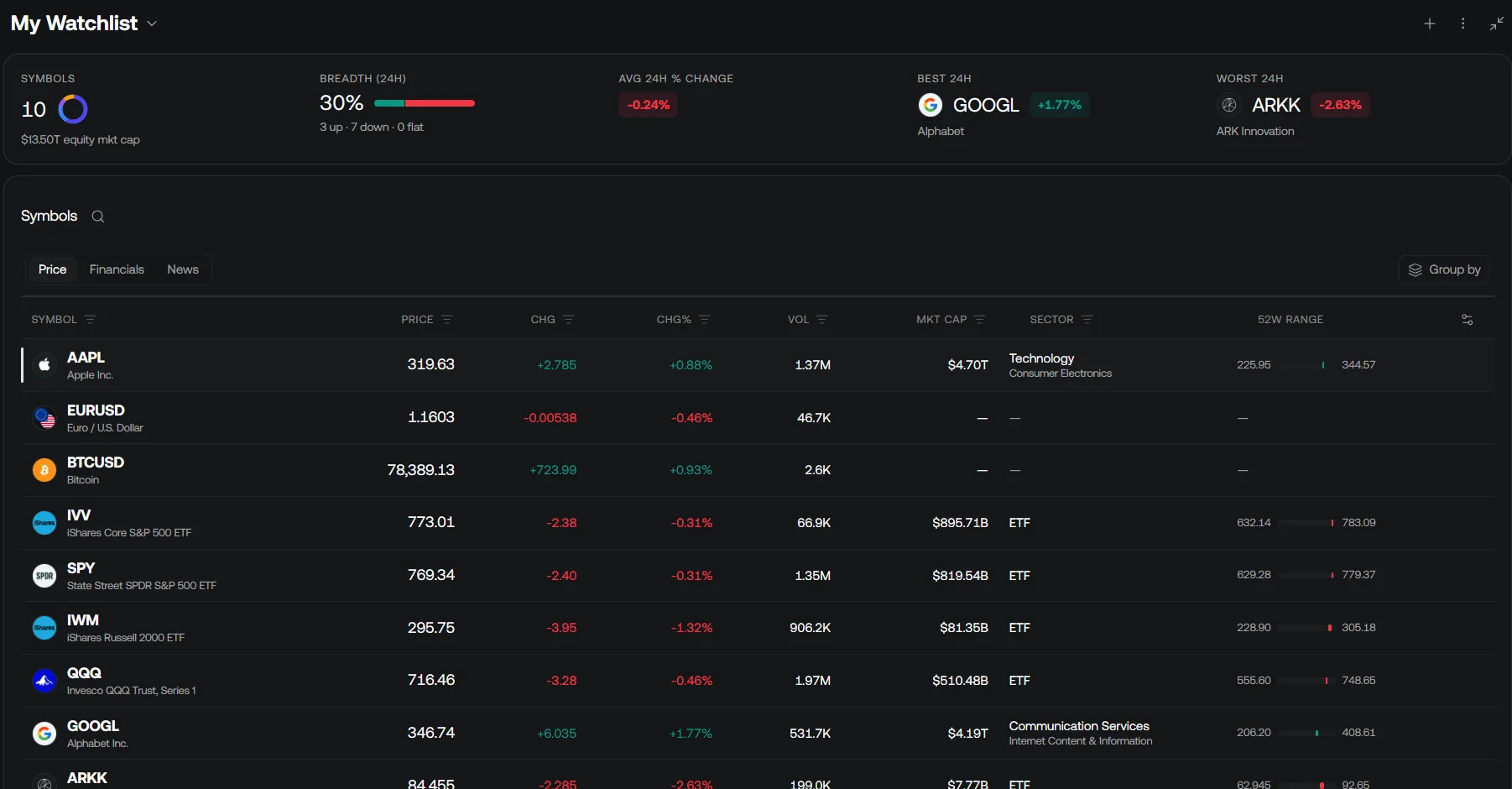
On LuxAlgo charts, examine the underlying’s price, trend and volume where data are available. Those observations can inform a timing hypothesis, but they do not value a warrant’s volatility, dilution, issuer call or financing features.
Ask Quant, our coding agent, to implement a precise chart-based timing rule. Review the code, run the strategy, and set capital, order size, commission and slippage. Inspect the backtest summary and Trades Log and evaluate an untouched period.
A test on the underlying is not a warrant backtest. Simulating warrant returns requires historical warrant quotes or an appropriate model plus changing terms, ratios, expiry, issuer events and execution assumptions. If those inputs are unavailable, label the result as underlying timing research. Generated code does not independently verify the contract or make a profitable strategy.
A Practical Review Before Trading
- Identify the exact series: verify issuer, product type, underlying, currency and entitlement.
- Read the lifecycle: note exercise windows, redemption conditions, barriers and settlement deadlines.
- Calculate scenarios: include a favorable move, no move, adverse move and total premium loss.
- Check execution and funding: confirm broker support, spread, exercise cash and any ongoing charges.
- Record the decision: keep the thesis, sizing, exit conditions and issuer notices together.
Warrants can change how capital is committed and how returns respond to the underlying. They do not automatically diversify a portfolio, preserve exposure like ordinary shares, or improve returns. The useful starting point is the exact contract and a complete calculation of its costs and possible outcomes.
Read next