Wheel Strategy Options Cash Flow Playbook

The wheel strategy alternates cash-secured puts and covered calls, with stock ownership between the two phases. It collects option premiums in exchange for taking stock downside and accepting limits on upside. Cash flow can be positive while the overall position loses money.
Use LuxAlgo’s native charts to develop the underlying-market thesis and Quant to help express reviewable price-based rules. Evaluate option quotes, strikes, collateral, and assignment separately in your broker’s tools. A wheel is a sequence of decisions, not an automatic income stream.
Why Use the Wheel Strategy?
The structure can suit a plan to acquire shares at an acceptable strike and later sell them at another acceptable strike. It requires willingness and sufficient funding to own the shares through adverse conditions. It can also miss a strong rally while you remain in cash or cap a rebound after assignment. Compare the whole result with simply holding the underlying or cash.
4 Steps of the Wheel Strategy
1. Sell a Cash-Secured Put
Choose an underlying you have researched, then review a specific put’s strike, expiration, premium, multiplier, and deliverable. Standard U.S. equity contracts generally represent 100 shares; adjusted contracts can differ. The OIC cash-secured-put guide explains the acquisition obligation and substantial remaining downside.
For a hypothetical $165 strike and a standard contract, assignment requires a $16,500 purchase. Follow your broker’s actual cash-reservation requirements. A support level on the stock chart can inform an acquisition thesis, but it does not prove the strike or option premium offers good value.
Use Sell to Open to establish the short put. To trade out of it, use Buy to Close for the same series and quantity. A working closing order leaves unfilled contracts exposed; see our buy-to-close guide.
2. Confirm Assignment and the Shares Acquired
If assigned, buy the specified deliverable at the strike. American-style equity options can be assigned before expiration. Being below the strike at expiration is not the only circumstance to understand, and an out-of-the-money regular-session close does not eliminate every exercise possibility. Read the OIC assignment FAQ and your broker’s deadlines.
Confirm the assignment notice, resulting shares, purchase cash, and any remaining orders. Record the premium separately. Subtracting net premiums from acquisition spending is useful for economic tracking, but do not assume this running figure is identical to the tax basis reported by your broker.
3. Write a Covered Call If the Sale Terms Fit
Sell a call only against the corresponding shares and deliverable you intend to cover. Choose a strike at which you are willing to sell. The OIC covered-call guide describes the tradeoff: premium offsets part of the downside, while the short call limits upside.
Suppose 100 shares cost $50 each and you sell a $55 call for $4.00 per share. If the shares are delivered at $55, the combined gross gain is $500 on the shares plus $400 premium, or $900 before costs. This is 18% of the $5,000 stock purchase, not an annualized or expected return. If the stock falls to zero, the combined loss is $4,600 before costs.
After a large stock decline, calls above your acquisition price may offer little premium. Selling a lower strike can cap a recovery and crystallize an overall loss if assigned. Premium collection alone does not resolve the damaged position.
4. Reassess Before Restarting
If the shares are called away, reconcile the complete cycle before selling another put. If a put or call expires without assignment, decide whether the next contract still fits the thesis. You can pause, close, or change the plan; there is no requirement to keep the wheel turning.
Do not accidentally add a second share-purchase obligation while already holding the stock. Selling another put alongside a covered call creates additional downside exposure if that put is assigned. The OIC’s wheel-strategy discussion distinguishes this covered-strangle position from the alternating wheel.
Risk Management Guidelines
Review the Business and the Actual Option Market
Consider financial condition, valuation, earnings and dividend events, concentration, and your willingness to own the shares after a steep decline. A familiar large-cap name, defensive sector, or dividend history does not make prices predictable.
Inspect the exact option series’ bid, ask, displayed size, and quote freshness. Stock volume, option volume, and open interest provide context, but none guarantees a tight executable market for your order. The OIC general FAQ discusses option liquidity. Wide spreads and repeated trading costs can consume premium.
Measure Total Return, Not Just Premium
A hypothetical $50 put sold for $2.00 produces $200 gross credit on a standard contract. Its maximum standalone profit is that credit; its stock-to-zero loss is $5,000 − $200 = $4,800 before costs. The ratio $200 ÷ $4,800 is about 4.17%. This is a premium-to-maximum-loss calculation for that one contract, not an annual return, a success probability, or a complete measure of risk.
Across a wheel cycle, count opening and closing option cash flows, stock gains or losses, fees, and any dividends or cash interest actually received. Value shares still held at their current market price. A high option win rate can coexist with a large stock loss, and reserved purchase cash is not loss protection.
Use Greeks with Their Limits
Delta measures local price sensitivity. A long put’s −0.40 delta is not a measured 40% probability of assignment. Absolute delta is sometimes used as an approximation for finishing in the money, but early exercise, dividends, changing conditions, and model assumptions complicate that interpretation. The short put has the opposite directional sensitivity from the long put quote.
Time decay may favor a short option with other factors unchanged, but a price move or rising implied volatility can overwhelm it. Near-expiration sensitivity can change quickly. No universal delta band or 30–45-day expiration rule establishes the best trade. Compare the actual premium, event calendar, exposure, and management burden.
The Wheel Strategy: Video Explanation
Strategy Implementation Guide
A Complete Hypothetical Cycle
The following example uses an unnamed stock and illustrative premiums, not current quotes. Assume standard 100-share contracts and ignore fees, taxes, dividends, and interest so the cash flows are clear.
| Step | Transaction | Cash flow |
|---|---|---|
| Put sale | Sell one $110 put for $2.00 | +$200 |
| Put assignment | Buy 100 shares at $110 | −$11,000 |
| Call sale | Sell one covered $115 call for $5.00 | +$500 |
| Call assignment | Deliver 100 shares at $115 | +$11,500 |
| Completed cycle | $200 − $11,000 + $500 + $11,500 | +$1,200 before costs |
The complete result is $12 per share: $2 put premium, $5 call premium, and $5 stock appreciation. Counting only the call premium and stock gain would omit the initial $200 put credit.
Now consider an unfavorable path. After the same put assignment and call sale, suppose the call expires worthless and the shares are worth $80 each. Net stock-acquisition spending after the two premiums is $10,300; the holding is worth $8,000. The economic loss is $2,300 before costs despite collecting $700 premium. If the shares become worthless after those premiums, the loss is $10,300. Future call sales and a recovery are not guaranteed.
Treat Adjustments as New Trades
| Situation | Decision to evaluate | Tradeoff |
|---|---|---|
| Put approaches the strike | Keep it, attempt a close, or roll | A roll realizes the old result and opens new exposure; it may cost a debit |
| Stock drops sharply | Reassess the holding and any call strike | More premium does not erase the stock loss; a low strike can limit recovery |
| Call moves in the money | Accept sale terms or evaluate a closing or rolling order | A higher strike or later expiration has a price and does not ensure assignment avoidance |
| Exposure becomes too large | Review actual quantities and a feasible reduction | Liquidity and execution costs affect the exit |
A roll normally buys the old short option to close and sells a new option to open. Judge the new trade on its own terms. Net credit from the combined order does not erase a loss realized on the old leg.
Stops can slip and limits may remain unfilled. A generic stop 10–15% below a stock level cannot guarantee a cap on the whole wheel’s loss. Maintain funding for obligations, define review conditions, and confirm actual fills and resulting positions.
Build the Underlying Thesis in LuxAlgo
In the native chart workspace, compare timeframes and mark price levels that would change your willingness to own or sell the underlying. Moving averages, RSI, and support-and-resistance indicators help describe context; they do not identify a universally optimal option strike.
Quant can help convert the underlying-price idea into explicit rules. For example, ask it to define a trend filter, show when the condition is evaluated, and make the exit logic reviewable. Inspect the code and test assumptions before interpreting the results.
That does not establish a historical wheel backtest. Option-chain history, bid-ask spreads, strike and expiration selection, exercise, assignment, and stock transitions require separate modeling. Do not assume Quant backtests option strikes directly or places, rolls, or manages broker options orders.
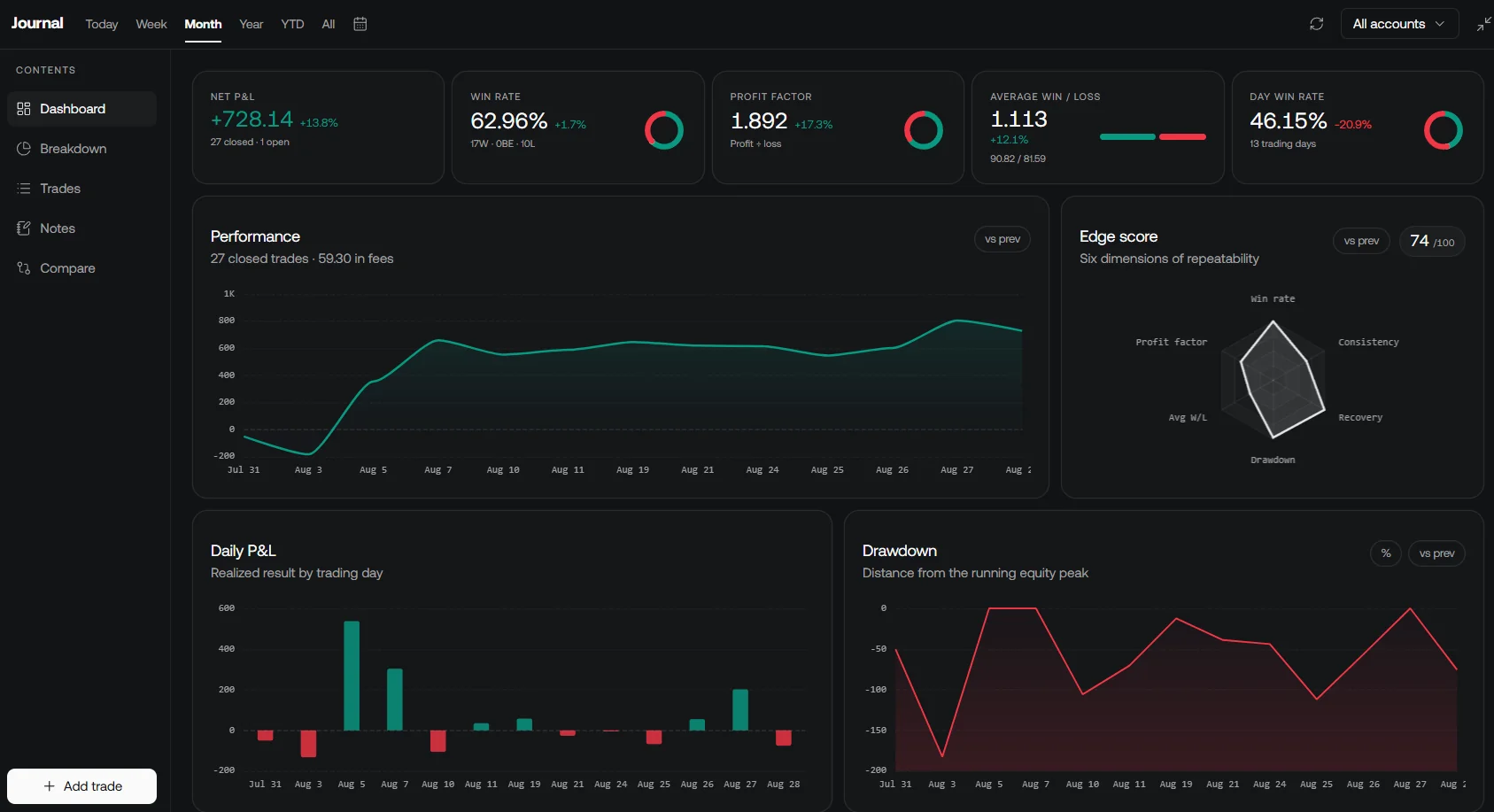
Use the LuxAlgo Journal to organize results and notes. Verify that supported imports or broker data include the option details you need, then supplement missing leg relationships, assignments, fees, and stock transactions. Review the complete cycle as well as individual trades.
Strategy Overview
The wheel exchanges some upside participation for option premium while retaining substantial exposure to a falling stock. Its repeatable steps can organize decisions, but they do not make returns consistent.
A Practical Review Checklist
- Research an underlying you are prepared to own, including adverse scenarios.
- Verify contract terms, executable quotes, collateral, and assignment procedures.
- Choose put acquisition and call sale prices you can accept.
- Keep the entire position and any adjustments within your exposure plan.
- Reconcile total returns before restarting the cycle.
FAQs
How does the Wheel Strategy help manage risk in options trading?
Cash-secured puts reserve purchase funding, and covered calls are backed by the corresponding shares. These structures address obligations but retain substantial stock downside. Premium only offsets part of a loss, and a stop does not guarantee an exit price. Review total exposure, assignment, and the complete cycle result.
What types of stocks work best for the Wheel Strategy?
Evaluate an underlying you are prepared to own and sell at the chosen strikes. Consider its business or fund exposures, events, concentration, and the liquidity of the exact option series. Large size, a familiar name, or dividend history does not guarantee stable prices or make a stock suitable for every account.
How can LuxAlgo tools help traders implement the Wheel Strategy effectively?
Native charts help organize the underlying-market thesis, Quant helps express and test price-based rules, and the Journal supports review and notes. Option pricing, strike selection, exercise, assignment, and broker execution need separate evaluation. Do not treat an underlying-price backtest as a complete wheel simulation.
Read next