Who Are You as a Trader? Trader Profiles Change How You Manage Your Portfolio

Your trader profile connects the money you can put at risk with the time, goals and responsibilities you actually have. It should guide position sizes, market selection, holding periods and portfolio reviews. A label such as “swing trader” is useful only if the underlying routine fits your circumstances.
Start with five questions: How much capital can you allocate? What return are you hoping for? What losses can you tolerate and afford? When will you need the money? How much time can you reliably devote to the process? If the answers conflict, change the plan before increasing risk.
Initial Capital
Separate trading capital from money needed for living costs, emergencies and near-term commitments. Account size affects minimum position sizes, costs and the instruments you can use, but it does not determine how much you should risk on a trade. A larger account can still be overexposed; a smaller account can still keep individual positions modest.
Limited capital does not make diversification impossible. Broad funds can provide exposure to many holdings, subject to access, fees and minimums. However, several overlapping funds or highly related positions may still concentrate risk. Investor.gov explains asset allocation and diversification in terms of goals, time horizon, risk tolerance and the investments actually held.
Leverage increases exposure without requiring the full position value upfront. It also magnifies losses relative to the capital committed and may introduce margin calls or forced liquidation. It is not a substitute for adequate capital or a reason to choose forex, crypto or derivatives. Check contract size, margin requirements, financing costs and account protections before comparing markets.
Target Returns and Risk
A desired return is a planning input, not a result the market owes you. Seeking higher potential returns generally involves accepting greater uncertainty or loss exposure; taking more risk does not guarantee a higher realized return. Avoid raising leverage simply because a modest account cannot generate the income you want.
Distinguish willingness from capacity. You may feel comfortable with a large drawdown while being unable to afford it because you need the money soon. Conversely, having financial capacity does not mean you will consistently follow a strategy through its losses. Write down both constraints and use the more restrictive one when reviewing the plan.
Do not rank entire product categories on one simple risk ladder. A fund’s risk depends on its holdings; a bond’s risk depends on factors such as issuer, maturity and currency; a derivative’s exposure depends on its contract and use. An allocation such as “60% derivatives and 40% bonds” does not establish diversification or suitability by itself.
Translate the Profile into Position Rules
For illustration, a $5,000 account considering 10 shares at $50 has $500 of position value. A planned exit at $48 implies $20 of price risk before costs, assuming execution at that price. A gap or a poor fill can make the actual loss larger. This example distinguishes position value from planned loss; it is not a recommended allocation or risk percentage.
Review combined exposure as well as each trade. Three positions sensitive to the same market move can lose together. Diversification can reduce concentration, but it cannot guarantee protection from loss. Set rules for position size, related exposures and when to pause or reassess the strategy.
Investment Horizon and Holding Period
Your financial time horizon is when you expect to need the money. A trade’s holding period is how long its rules keep a position open. These are related but different: money needed for a near-term expense does not become suitable for speculation just because each trade is brief.
| Approach | Typical holding pattern | Planning consideration |
|---|---|---|
| Long-term investing | Years or longer | Goals, diversification, contributions and periodic review |
| Swing trading | Days to weeks, sometimes longer | Overnight exposure, events and time for planned reviews |
| Day trading | Positions generally closed within a session | Reliable availability, execution costs and intraday monitoring |
| Scalping | Very short holds, often seconds or minutes | Execution sensitivity, frequent decisions and costs per opportunity |
These descriptions are broad conventions, not performance rankings. Short holding periods can make spreads, commissions and execution delays large relative to the move being targeted. Longer holds introduce other issues, including overnight events and extended drawdowns. No timeframe removes risk or guarantees an easier path to profit.
For a beginner, simulation and a routine with time to inspect decisions can be more manageable than rapid live trading. Test the actual rules and costs before choosing a style. Do not infer that most beginners scalp or that a particular holding period is automatically profitable.
Availability and Portfolio Management
Count the time you can reliably use, including research, order checks, recordkeeping and unexpected problems. A schedule that allows only an evening review may conflict with a strategy requiring decisions during the workday. Swing trading may reduce constant screen time, but it still needs a plan for open positions and important events.
- Before trading: review the relevant instruments, events, rules and existing exposure.
- During the planned session: check order status and follow the defined decision process.
- After trading: record outcomes, costs and rule deviations.
- At scheduled reviews: compare the portfolio with its intended allocation and check whether your circumstances have changed.
Automation changes the work rather than eliminating it. Signals, orders and account positions can diverge if a connection fails or an order is rejected. Define how you will detect problems, check the actual account and stop the process when necessary. More free time does not by itself justify a more complex portfolio.
Use LuxAlgo to Test a Routine That Fits
Start with LuxAlgo’s native charts to investigate a clearly defined technical question on the instrument, provider and timeframe you intend to study. Ask Quant, our coding agent to implement or explain the rule, inspect the generated code and run it manually. Include realistic sizing, trading costs and later-period testing; a historical result is not a promise of future performance.
Use the native strategy documentation to check how the test is configured. Save the baseline and compare variants that you could actually monitor. A strategy requiring frequent intraday decisions may be a poor operational fit even if its historical statistics look attractive.
Record compatible trades in the native journal and review whether you followed the planned schedule, sizing and exits. Keep simulated and actual results distinct, and use your account records to establish current positions and unresolved orders.
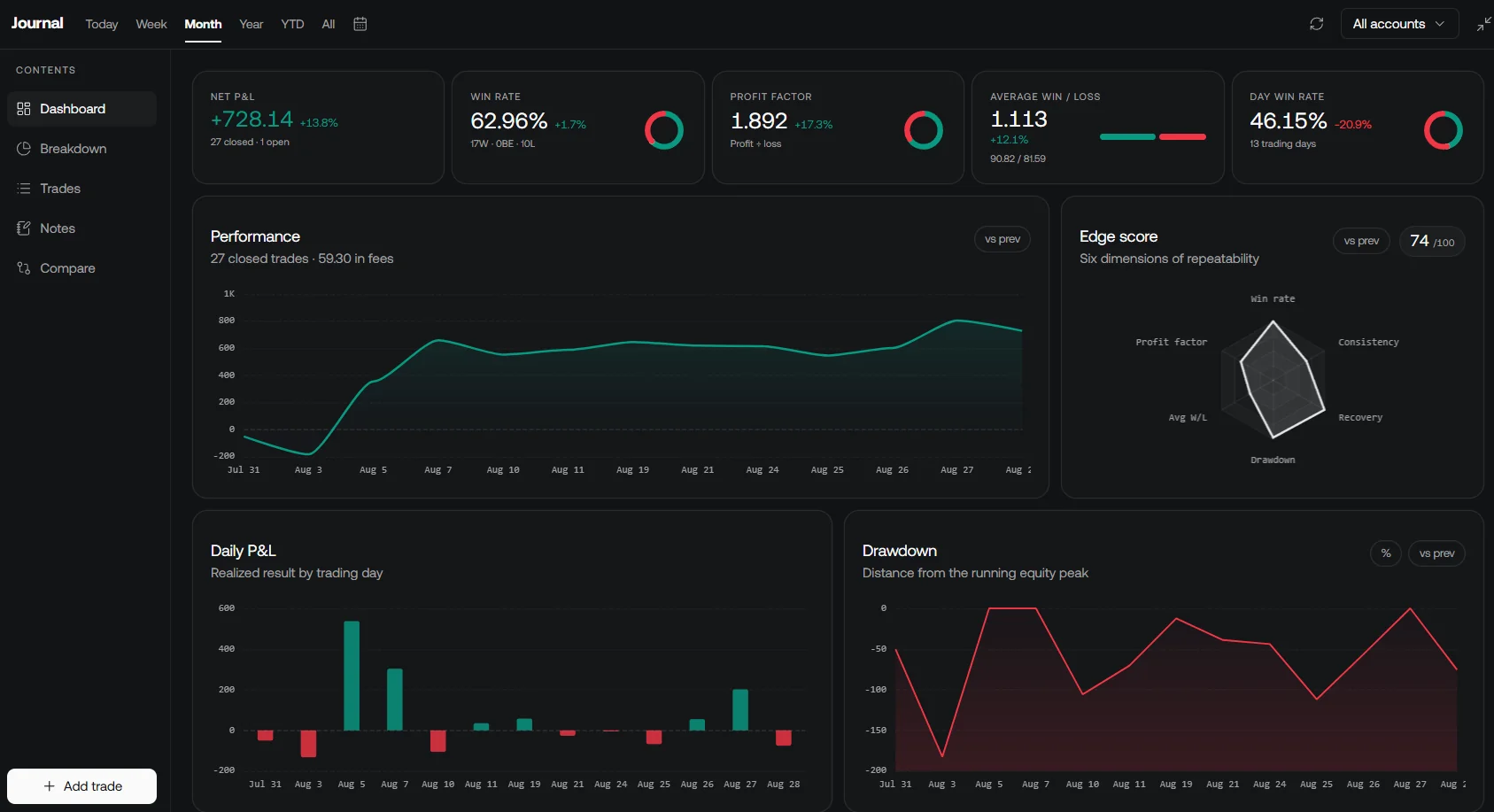
A workspace can keep the baseline chart and related experiments together. The demonstration below shows organization within LuxAlgo; it does not configure brokerage execution or choose a portfolio allocation.
Write a Profile You Can Review
| Question | Record in your plan |
|---|---|
| Capital | Allocated amount, essential cash kept separate and practical position minimums |
| Return objective | Goal, timeframe and assumptions; no required daily profit quota |
| Risk | Affordable loss, willingness to tolerate drawdowns and combined exposure limits |
| Horizon | When money is needed and which holding periods the rules permit |
| Availability | Research, monitoring, recordkeeping and interruption procedures |
Review the profile when your finances, schedule or responsibilities change, and at a planned interval. Use the journal to identify recurring rule deviations rather than changing styles after every loss. A useful profile makes the next decision more consistent; it is not a personality test or a guarantee of trading success.
Frequently Asked Questions
What is a trader profile?
It is a practical description of your available capital, return objective, loss capacity, time horizon and schedule. Use it to guide the rules and routines you can sustain.
Does a small account require leverage?
No. Leverage increases exposure and loss sensitivity. Review position minimums, costs and whether the activity fits your capital instead of using leverage to force an income target.
Is holding period the same as investment horizon?
No. Holding period describes an individual trade. Investment horizon describes when you expect to need the money for a financial goal.
Does diversification prevent losses?
No. It can reduce concentration across holdings and sources of risk, but investments can still decline together. Review underlying exposure rather than the number of positions alone.
How can LuxAlgo support this process?
Use native charts and Quant to investigate defined rules, inspect the generated code and run it manually. Review compatible recorded trades in the journal and compare the routine with your actual availability.
Read next