Why Your Mindset is Your Greatest Trading Tool

Your mindset influences how you prepare, respond to uncertainty and follow a trading plan. It matters in forex and other markets, but it does not replace a tested method, suitable exposure or reliable execution. Discipline can help you apply a process consistently; it cannot make an unprofitable strategy profitable by itself.
The practical goal is not to feel fearless or predict every move. It is to make decisions you can explain and review, including the decision not to trade. Treat the ideas below as habits to evaluate, not a promise that mental toughness produces consistent returns.
1. Emotional Awareness: Notice the Decision, Not Just the Feeling
Fear, excitement and frustration can accompany trading. The useful question is what you do next. The same feeling might lead one person to skip a valid setup and another to reduce exposure appropriately. Avoid assuming that every hesitation is a weakness or every confident decision is a good one.
| What you notice | Possible decision problem | A practical response to test |
|---|---|---|
| Fear before entry | Size feels unaffordable or the rule is unclear | Recheck the loss scenario and setup; do not force a trade to prove confidence |
| Excitement after a win | Increasing size or chasing a move outside the plan | Return to the written sizing and entry conditions |
| Frustration after a loss | Taking another trade mainly to recover the money | Use the predefined pause rule and review the next setup independently |
| Urgency during a fast move | Acting before the required information is available | Check whether the condition has actually completed and whether the opportunity still fits |
Record the trigger, the planned action and the actual action. “Entered before the signal candle closed after missing the previous move” is more useful than “I had a bad mindset.” It identifies behavior you can address through clearer timing rules, a simpler workflow or a pause.
A journal can help you spot recurring deviations, but it does not establish their cause automatically. Review the record alongside strategy rules, costs, order status and your availability. Some losses occur even when the process was followed correctly.
2. Accountability Without Blaming Yourself for Every Outcome
Replace the original idea of a “victim” or “victor” mentality with a distinction between controllable decisions and uncertain outcomes. You can take responsibility for preparation, size and rule adherence without claiming responsibility for every price move, outage or unexpected event.
If an order behaves unexpectedly, investigate the actual account and execution record. A broker, data feed or connection problem should be checked on evidence, not dismissed as an excuse. Equally, a valid fill that follows an unfavorable market move is not automatically a platform fault.
Separate process quality from the result. A trade that breaks your rules can make money by chance, while a correctly executed trade can lose. Over a meaningful record, review both adherence and net performance. Following a plan flawlessly does not guarantee profits if the plan lacks a viable basis.
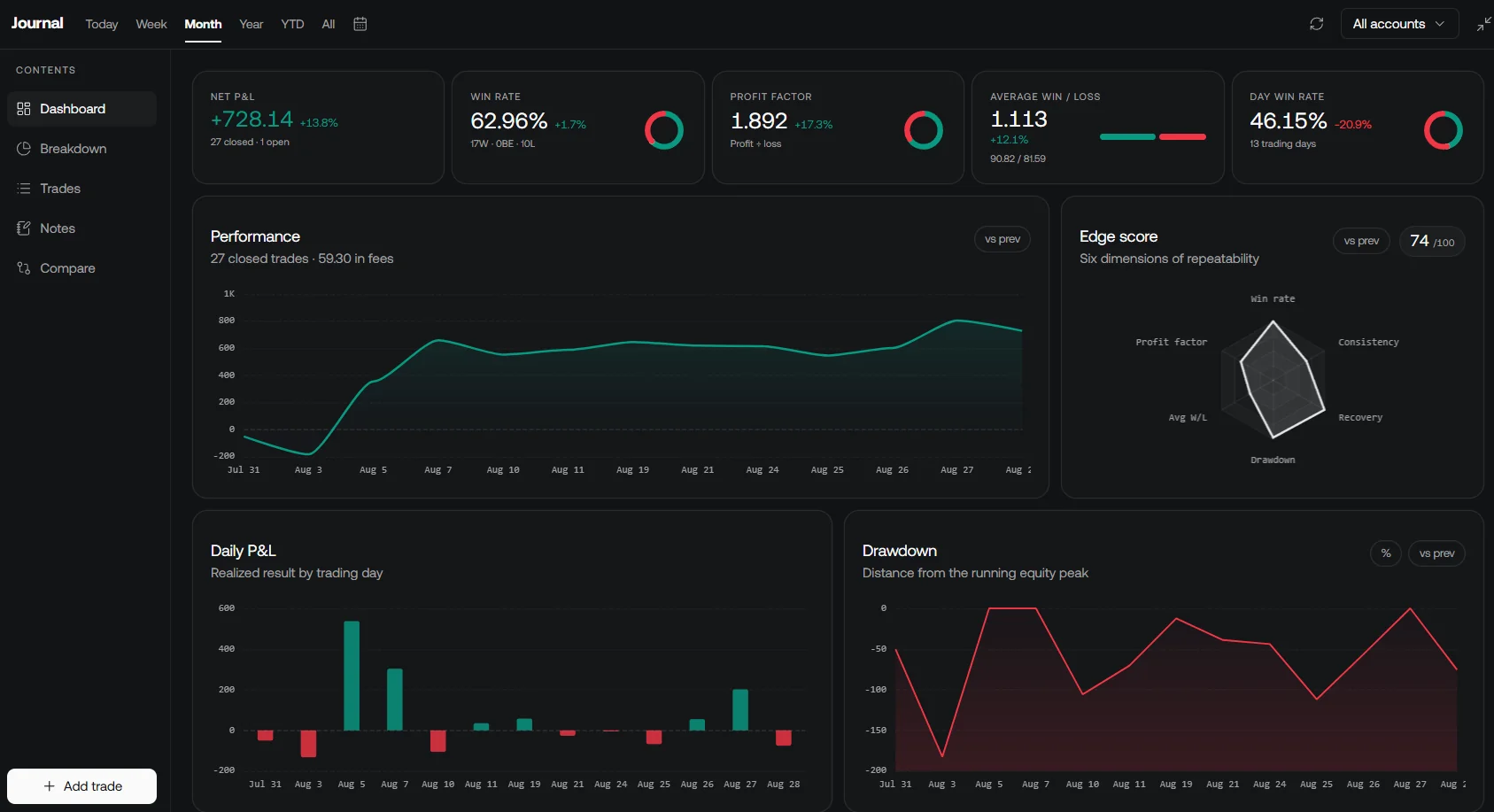
Use the LuxAlgo native journal for compatible recorded trades and keep simulated and actual outcomes distinct. Retain notes about rule deviations and use account records to verify current positions or unresolved orders.
3. Build a Routine You Can Actually Follow
A useful routine reduces avoidable decisions without turning trading into a daily profit obligation. Make it fit your schedule and the strategy’s holding period. A trader reviewing daily charts may need a different cadence from someone making intraday decisions.
- Before the session: review the market and event context, current exposure, permitted setups and operating limits. Confirm that you have time to monitor the process.
- Before an order: verify the instrument, quantity, entry condition, invalidation and exit instructions.
- After the session: reconcile fills and costs, record deviations and identify anything needing investigation.
- At a scheduled review: examine repeated patterns rather than rewriting the plan after each win or loss.
Use process goals such as checking every order or waiting for the specified signal. A daily money target can encourage unnecessary trades when no suitable setup appears. A session with no trade can be fully consistent with the plan.
Keep a baseline research version and organize related experiments in a workspace. The demonstration below shows organization within LuxAlgo; it does not manage an open brokerage position or replace account checks.
4. Patience and Discipline Include Knowing When to Pause
Wait for the conditions your strategy actually defines. Calling a setup “high probability” does not establish its reliability; that requires evidence from a relevant record and realistic assumptions. Patience should mean avoiding unplanned decisions, not waiting indefinitely for a losing position to recover.
Define entries, exits, exposure limits and permitted amendments before the trade. A stop order can be part of the plan, but its fill may differ from the trigger price. Investor.gov’s order guide explains that a triggered stock stop becomes a market order. “Accept small losses” should not be read as a guarantee that all losses will stay small.
Following a plan does not mean ignoring a rejected order, incorrect quantity or broken data feed. Include interruption procedures and verify the account when something is wrong. Changes based on new evidence should be documented; moving an exit simply because a loss feels uncomfortable is a different decision.
Small wins do not necessarily compound into long-term gains. Larger losses, costs and changing exposure can outweigh them. Judge the distribution of net outcomes and the risks taken to obtain it, not the emotional comfort of frequent winning trades.
5. Use the Four Stages as a Learning Framework
The four-stage competence model is a way to think about learning a skill. Gordon Training International attributes the model to Noel Burch. It is not evidence that every trader follows a fixed path to profitability or that trading should eventually require little attention.
| Stage | Practical interpretation | Example of something to learn |
|---|---|---|
| Unconscious incompetence | You have not yet recognized an important knowledge gap | Discovering that a stop price and fill price can differ |
| Conscious incompetence | You can identify a gap but cannot yet perform the task reliably | Learning to calculate position exposure and check orders |
| Conscious competence | You can perform a defined task with deliberate attention | Following a documented checklist in simulation |
| Unconscious competence | A practiced task becomes more familiar | Using a familiar interface while still checking quantity and account |
Apply the model to specific tasks, not your identity as a “successful trader.” You might be comfortable placing orders but still inexperienced at evaluating a backtest. Familiarity can also hide mistakes, so keep checks for consequential actions even when a task feels routine.
6. Build Confidence from Evidence and Keep It Revisable
Confidence is more useful when you can name the evidence behind it: a clear rule, a reproducible test, an understanding of losses and an ability to carry out the routine. A recent winning streak alone is weak evidence. Different outcomes between two traders can reflect sizing, costs, timing or chance as well as behavior.
On LuxAlgo’s native charts, ask Quant, our coding agent to implement or explain a defined hypothesis, inspect the generated code and run it manually. Preserve the symbol, provider, timeframe, sizing and cost assumptions so you can return to the same baseline.
Check native strategy settings and inspect individual trades as well as aggregate results. Compare later periods that did not determine the settings, and use simulation to practice the routine. A favorable historical result is not proof of future profitability or a configured live execution process.
Adapt when evidence justifies a change, while keeping the previous version for comparison. Changing rules after every loss can fit noise; refusing to review persistent problems can be equally unhelpful. Define when you will reassess the method and what evidence you will examine.
A Mindset You Can Put into Practice
Choose one observable habit to improve first: verifying quantity, recording the reason for entry, or following a defined pause rule. Review whether that behavior changed and whether the strategy remains suitable after costs and risk. Your mindset supports that work; it does not exempt you from uncertainty or make every outcome a judgment of your character.
Frequently Asked Questions
Can a good mindset guarantee trading profits?
No. Mindset can support preparation and rule adherence, but strategy quality, exposure, costs, execution and uncertainty still matter.
Should I blame myself for every losing trade?
No. Review your decisions separately from the outcome. A rule-following trade can lose, and genuine operational problems should be investigated on evidence.
Is taking no trade a failure of confidence?
No. If the setup is absent or the activity does not fit your constraints, not trading can be consistent with the plan.
Do the four learning stages prove I will become profitable?
No. They are a learning framework for specific skills, not a validated path to trading profitability or permission to stop checking your work.
How can a journal help with mindset?
Record what you planned, what you did and why they differed. Compare those observations with costs, execution and strategy rules rather than labeling every loss an emotional mistake.
Read next