AI Agents and Trading Psychology: Can Machines Improve Human Decision-Making?
AI agents can help traders make their process more explicit: organize evidence, turn rules into code and review decisions against a written plan. They do not remove bias, guarantee discipline or establish a profitable strategy. Whether they improve your decisions depends on the task, the information supplied and how you check the result.
A useful assistant can slow down an impulsive decision by asking for missing evidence. The same tool can increase overconfidence if you accept a persuasive explanation without verification. The practical goal is to measure better decision habits while keeping responsibility for risk and execution clear.
What AI Can—and Cannot—Contribute
| Task | Potential contribution | Necessary check |
|---|---|---|
| Research | Summarize supplied material and compare explanations | Verify sources, dates, missing context and conflicting evidence |
| Strategy development | Translate a defined hypothesis into code | Inspect the logic and test it with realistic assumptions |
| Trade planning | Compare a proposed action with written criteria | Confirm that the information and account constraints are current |
| Record review | Organize notes and identify possible recurring deviations | Check the underlying trades rather than accepting a generated narrative |
| Execution | Some configured systems can submit or manage orders | An assistant or coding agent does not automatically have this capability or permission |
An AI agent typically combines a model with tools or a workflow. Its capabilities depend on that setup. Some can browse permitted sources; others only analyze information supplied to them. A language-model response, a fixed-rule trading algorithm and a broker’s order controls are different systems. None should be credited with capabilities it has not been given and tested for.
There is also no universal speed comparison in which humans take hours and AI agents act in milliseconds. Data access, model generation, tool calls and order routing have different delays. Faster output is useful only when it remains accurate enough for the decision at hand.
Why Trading Decisions Become Emotional
Uncertainty, changing account value and pressure to act can make it difficult to follow a plan. Fear may lead to an unplanned exit, while fear of missing out may encourage a late entry. After a loss, a trader may increase size to recover quickly. After several wins, the same trader may become less careful about risk.
These are possible patterns to look for in your own records, not a diagnosis of every losing trade. A planned stop can be a sound decision even when price later reverses. A winning trade can still involve an unnecessary breach of the plan. Judge the process separately from the outcome.
| Pattern to investigate | Observable behavior | A practical response |
|---|---|---|
| Fear of missing out | Entering without the required setup after a fast move | Require the written entry criteria and a valid risk calculation |
| Loss chasing | Increasing size or frequency immediately after a loss | Use a prewritten stopping rule and review before resuming |
| Confirmation bias | Collecting only material that supports an existing position | Record the strongest contrary evidence and what would invalidate the idea |
| Overconfidence | Relaxing limits after a winning sequence | Keep the approved sizing rule unless a scheduled review changes it |
| Outcome bias | Calling a rule-breaking winner a good decision | Grade plan adherence before looking at profit or loss |
A journal, a position-sizing rule and a daily stopping point can make these choices easier to review. They do not prevent all impulsive actions by themselves. An AI assistant can compare a proposed trade with your checklist, but you still need to follow the result and verify the underlying facts.
AI Does Not Make a Decision Unbiased
A model does not need to experience fear or greed to produce biased output. Its training, selected sources, prompts and objectives can shape the answer. If you ask only for reasons to buy, the response may give you a convincing one-sided case. If the source data are stale or misleading, a polished summary can preserve the error.
The joint SEC, NASAA and FINRA investor alert on AI warns that generated information can be inaccurate, outdated or fabricated, including when the input is accurate. It also notes that chatbot interactions can encourage misinformed, emotional or impulsive investment decisions. An AI label is not evidence of reliability.
What the StockAgent Study Actually Shows
The July 2024 StockAgent research paper studied model-driven agents in a simulated stock market using GPT-3.5-Turbo and Gemini-Pro. The authors observed different trading tendencies and responses to external conditions across the models. They also identified the reliability of model-based recommendations as an area requiring further research.
That experiment was not a trial showing that human traders using an assistant outperform human traders working alone. It does not establish a benefit for your live account, current models or a specific commercial product. Its relevance here is narrower: model choice and simulation conditions can affect behavior, so a machine-generated decision should not be assumed impartial.
Use Questions That Expose Uncertainty
- What evidence supports this idea, and what evidence contradicts it?
- Which facts were supplied, which were independently checked, and which are assumptions?
- What information is missing or too old to use?
- What would invalidate the setup before entry?
- Does the proposed action break any of the written risk or execution rules?
These questions can improve the structure of a review, but asking them does not guarantee a correct answer. Open the cited sources, check the relevant figures and resolve contradictions before relying on the output. Do not treat a confident tone as a probability estimate.
A Practical Human-and-AI Decision Workflow
1. Write the Plan Before Asking for an Opinion
Define the instrument, timeframe, setup, entry condition, exit logic and planned exposure. Record the conditions under which you will not trade. A specific plan gives the assistant something to check and reduces the temptation to accept whichever explanation fits your current mood.
For a simplified share-sizing example, a $100 planned price-risk budget with a $2 entry-to-stop distance corresponds to 50 shares before costs. Commission, slippage, gaps and instrument constraints can change the realized loss. Use the actual contract value for futures or other products rather than applying the share formula blindly.
2. Separate Research from Permission to Act
Use the assistant to organize the evidence and flag unanswered questions. Keep the research output separate from an order instruction. A news summary or generated strategy is a hypothesis to assess, not permission to increase size or bypass a rule.
If the information concerns a recent event, verify its source and timestamp. Social posts, copied articles and generated summaries can repeat the same error, so several agreeing summaries do not necessarily provide independent confirmation. Check original disclosures or other relevant primary material.
3. Test the Rules Before Judging the Story
A plausible explanation is not a backtest. Translate the idea into explicit rules, check that the code matches them and include realistic costs. Keep a separate testing period and record the variants you tried. Repeatedly tuning to the same historical sample can select a lucky result rather than a durable pattern.
A historical test also cannot fully reproduce live fills, missing data or the pressure of holding a position. Follow it with appropriately designed practice and review. Treat an unexpected result as a reason to investigate the assumptions, not as automatic proof that the market or the software is wrong.
4. Review the Decision Without Rewriting History
After the trade, record what you knew at entry, the planned action, the actual action and any deviation. Ask the assistant to compare those records with the plan. Keep its interpretation separate from the original evidence, and correct inaccurate summaries.
For example, “entered before the confirmation candle closed” is an observable deviation. “The trader was afraid of missing out” is an interpretation unless you recorded that feeling at the time. This distinction makes a journal more useful and avoids turning every outcome into a convincing retrospective story.
Apply the Workflow with LuxAlgo
Start with LuxAlgo’s native charts to inspect the market and define the question. Use Quant, our coding agent to express entry, exit and sizing rules in code. Inspect the generated code and run the strategy yourself. Quant supports development; generated output is not automatically tested, profitable or ready for live execution.
Use native strategy testing with standard candles, realistic commission and slippage, and a separate testing period. Verify data coverage for the selected instrument. Compare weak periods, drawdowns and the sequence of losses as well as net profit.
Save the hypothesis, assumptions and rejected alternatives so the next review begins from evidence. A workspace can help organize this process, but it does not independently establish that a setup is valid.
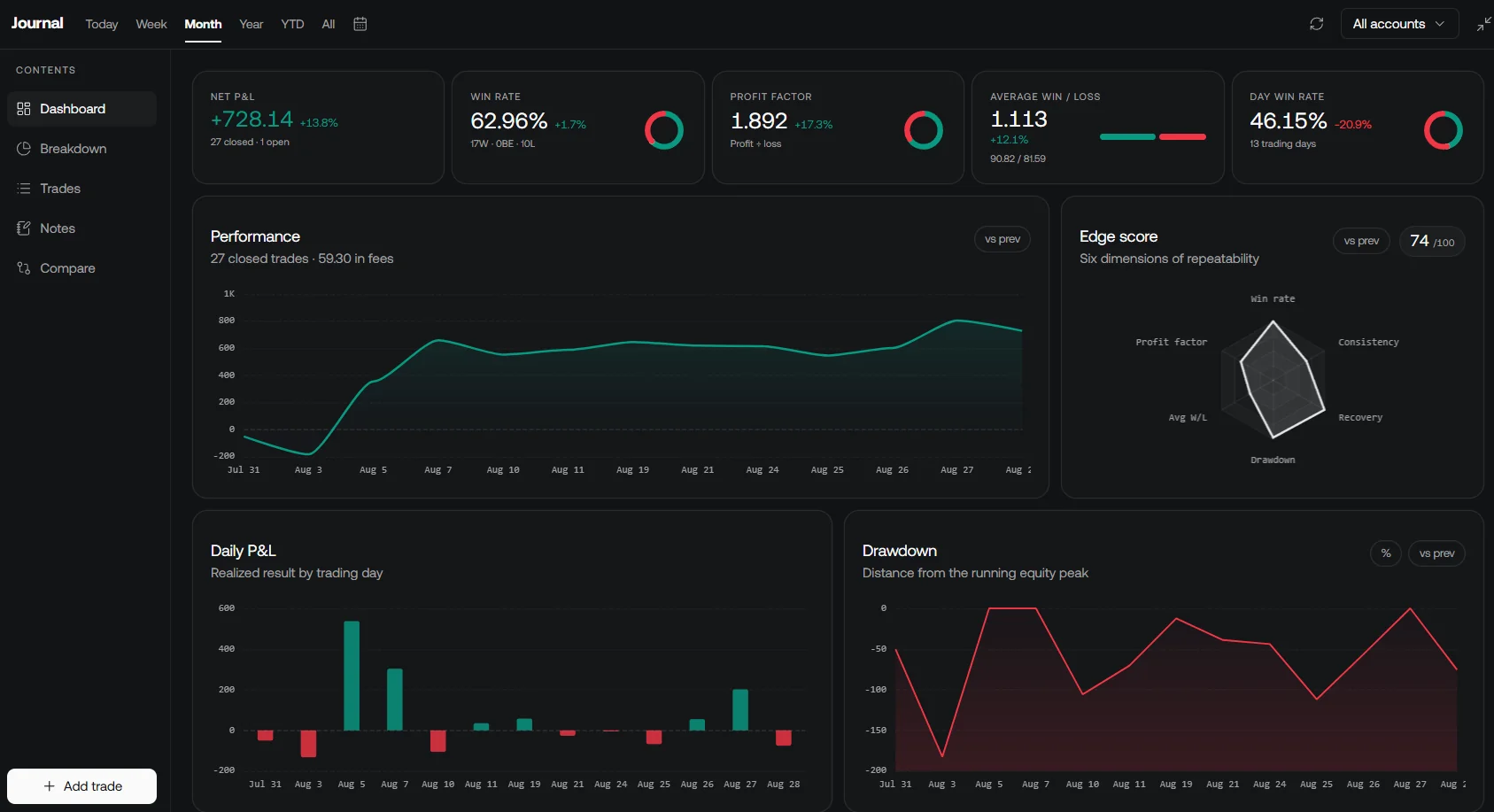
Use the native LuxAlgo journal to review supported trade records by session, instrument and strategy. Compare the records with your planned risk and entry conditions. Add your own contemporaneous notes where needed; a performance dashboard alone cannot determine what you felt or why you acted.
An alert is a notification under its configured conditions. It does not guarantee an execution price, prevent losses or ensure that a trader follows the plan. Confirm the capabilities and limits of any separate execution connection before relying on it.
Measure Whether the Assistant Is Helping
Choose the behavior you want to improve before adding a tool. Useful measures include trades without a written setup, position-size deviations, unplanned exits, missed checks and the time needed to complete a review. Track factual errors in the assistant’s output too.
Suppose 12 of 40 practice trades initially lacked the required checklist and 5 of the next 40 lacked it after introducing an assistant. That is a change from 30% to 12.5% in this example. It suggests improved checklist adherence in those observations; it does not prove the assistant caused the change or that the strategy became profitable. Market conditions, experience and extra attention may also have changed.
Review a meaningful run of decisions rather than one impressive answer or winning trade. Keep the underlying rules stable enough to compare periods. If the assistant adds false facts, increases impulsive trades or takes more review time than it saves, narrow its role or pause its use while investigating.
Keep Oversight Specific
- Verify important facts and calculations against the underlying source or record.
- Keep research, strategy generation, testing and live execution as explicit steps.
- Use written exposure limits and avoid changing them because an answer sounds confident.
- Share only the records needed for the task, and review the tool’s data-handling terms.
- Define what happens when data are missing, output conflicts or a connected service fails.
Human judgment is also fallible. Oversight works best when it means documented checks and clear limits, rather than a vague appeal to intuition. The aim is a process in which both the trader’s assumptions and the machine’s output can be challenged.
AI can be useful when it makes decisions easier to inspect and review. Its value should be demonstrated through the quality of that process, with financial outcomes assessed separately and no assumption that automation removes risk.
Frequently Asked Questions
Can AI agents eliminate emotional trading?
No. They can support checklists, research and record review, but traders can still act impulsively or overtrust generated output. Better discipline must be assessed from actual behavior.
Are AI trading decisions unbiased?
No. Models can reflect biases in their training, sources, prompts and objectives, and can generate incorrect information. Verify evidence rather than treating a machine-generated answer as impartial.
Does the StockAgent study prove AI-assisted traders outperform humans?
No. The cited July 2024 paper studied model-driven agents in a simulated market and found different tendencies across models. It was not a controlled comparison of human traders with and without AI assistance.
Does Quant automatically run a generated strategy for me?
Inspect the generated code and run the strategy yourself. Quant, our coding agent, supports strategy development; generated output does not establish a completed test, profitable method or live execution.
How should I measure whether AI improves my trading process?
Track defined behaviors such as checklist completion, sizing deviations, unplanned actions and review errors across a series of decisions. Assess costs and financial outcomes separately, and do not infer causation from a short before-and-after comparison.
Read next