Best Multi-Asset Prop Firms for Diverse Traders

The best multi-asset prop firm depends on the instruments you want to trade, the account rules and your eligibility. The Trading Pit offers separate CFD, futures and stock programs. ThinkCapital provides exposure to several CFD categories through its challenge programs. Apex and TradeDay focus on futures across different underlying markets. Hudson River Trading is an institutional quantitative firm, so it belongs in a separate comparison.
These are different routes to market exposure, not five interchangeable accounts. A CFD on a stock is not ownership of that stock; a futures contract has its own tick value, expiry and exchange session. Most retail evaluations and many funded stages use simulated accounts, with rewards governed by the provider’s agreement. This guide compares current official information checked in September 2026.
Quick Comparison: Markets, Programs and Payout Conditions
| Firm | Market access | Current economic distinction | Main limitation |
|---|---|---|---|
| The Trading Pit | Separate CFD, Futures Prime and Stocks programs | CFD and Futures Prime pages list 80% shares; reward conditions differ | Programs are not one combined account; CFD country restrictions apply |
| Apex Trader Funding | Futures across equity, currency, commodity and other sectors | New EOD accounts pay 100% of approved requested rewards, subject to caps and rules | New and legacy programs have materially different fees and risk terms |
| TradeDay | Permitted CME Group futures | Quick Pay uses a 50%/80% split by profit level; Fast Pass lists 80% | Funded Sim and Live are distinct; product restrictions can override the catalog |
| ThinkCapital | Forex, commodities, indices and crypto where the model permits | Challenge programs generally start at 80%, with conditional 90% options | Bolt excludes crypto; intraday and swing conditions differ |
| Hudson River Trading | Institutional multi-asset quantitative trading and liquidity provision | No comparable retail challenge fee or public retail profit-split offer | Relevant to employment or institutional services, not retail evaluation shopping |
A high share does not establish the amount you can withdraw. Qualifying days, payout caps, retained buffers, transfer fees and drawdown changes can matter more. Similarly, access to many instruments does not automatically diversify a strategy: several positions can still express the same equity, dollar or interest-rate exposure.
What Multi-Asset Access Actually Means
- CFD categories: one provider may quote currencies, indices, commodities, crypto and stock CFDs. Confirm the exact symbols, contract sizes, swaps and regional availability.
- Futures sectors: an account can cover equity indices, bonds, currencies, energy and agriculture through exchange-listed contracts while remaining a futures-only service.
- Separate programs: a brand offering both CFDs and futures may require separate purchases, platforms and risk calculations.
- Institutional trading: a quantitative firm can trade many asset classes with its own systems and employees without offering a retail funding challenge.
Start with two or three instruments you understand. Record each instrument’s tick or point value, session, expiry or rollover treatment, commission and permitted position size. Compare the account’s available loss cushion with the combined risk of those positions before considering the nominal account balance.
1. The Trading Pit: Separate CFD, Futures and Stock Programs
The Trading Pit now markets three program categories. Its CFD offering includes forex, commodities, indices, crypto and stock CFDs. Its Futures Prime program uses separate account sizes, contract limits and reward rules. The Stocks Challenge is another distinct simulated program on Volumetrica Web and Desktop.
| TTP program example | Target and risk limits | Price or duration | Important distinction |
|---|---|---|---|
| CFD Prime, selected $50K 1-phase | 10% target; 3% balance-based daily drawdown; 6% static maximum | Listed $349; three minimum trading days | 80% share; account size and creation date affect reward requirements |
| Futures Prime, $50K | Target $3,000; drawdown $2,000; daily pause $1,000 | Listed $99 once; 30 days; $79 reset; $99 extension | Challenge limit five standard / 50 micro contracts; earning-stage limits start lower |
| Stocks Challenge | 7% target; 2% daily pause; 5% maximum drawdown | Listed from €99; $25K or $50K simulated balance | Three minimum trading days and a 14-day inactivity limit |
CFD Costs, Leverage and Eligibility
The CFD instrument page lists leverage of 1:50 for forex, 1:10 for metals and energies, 1:15 for cash indices, and 1:2 for crypto and equities. Its displayed forex commission is $5.00, with spreads varying by symbol. Confirm the charging unit, whether a fee is per side or round trip, and swap treatment in the platform before using it in a cost model.
The same web table shows 0% for U.S. equity CFDs and 20% for EU and UK equity CFDs without a clear calculation basis. That wording is insufficient for a defensible all-in cost comparison. Ask for the actual contract specification rather than assuming it means a 20% charge on the value of every trade. A zero-commission label also does not remove spread or overnight financing costs.
Its CFD platform policy explicitly names cTrader and says other available choices appear before purchase in the Client Area. Check those choices for your region. TTP’s disclosures exclude residents of the U.S., Canada and Russia from CFDs, among other restricted jurisdictions. A futures or stock page under the same brand does not establish CFD eligibility.
The CFD rewards page lists an 80% share and requests every 14 days for amounts above $100 after requirements are met. It distinguishes accounts created before and after specific 2026 dates; for example, newer $100K and $200K 1-phase accounts have a 50% consistency rule based on positive-day profits. Confirm the exact purchased account’s requirements instead of treating one profitable-day rule as universal.
Futures Prime: Lower Earning-Stage Limits and Reward Caps
Futures Prime lists $50K, $100K and $150K challenges at $99, $189 and $289, with respective targets of $3,000, $6,000 and $9,000. Maximum drawdowns are $2,000, $3,000 and $4,500. The current page shows the usual $129 activation fee reduced to $0; check that offer at purchase rather than assuming it is permanent.
The Futures Prime drawdown policy trails the floor upward using end-of-day closed balance, stops at the starting balance and never lowers it after losses. The general maximum-loss policy still says touching or falling below the floor with equity breaches the account. End-of-day recalculation does not mean intraday losses can be ignored.
The earning stage starts with lower position limits than the challenge: two, three and five standard contracts for the $50K, $100K and $150K tiers while profit is at or below $2,500. Limits increase at specified profit levels. The advertised challenge maximum therefore is not necessarily the size you can trade immediately after passing.
For rewards, the Futures Prime page requires five profitable days of at least $150 each. It limits requests to 50% of realized profits, with caps of $2,500, $3,500 and $5,000 by tier; the lower limit applies. Traders receive an 80% share, and the next request requires the balance to exceed the previous post-payout balance by at least $0.01. Those are more useful details than an undifferentiated 80–85% headline.
Market-data costs also vary. The page says one Level 1 Chicago exchange feed is covered, with additional U.S. exchange packages, depth data and European derivatives data charged separately. Data add-ons expire at calendar-month end and must be repurchased. Include them alongside the challenge, reset and extension fees.
Stocks Challenge: Check the Trading Restrictions
The Stocks landing page lists unlimited challenge duration, despite also using “time-bound” marketing language. Its stock trading rules require trades to stay open at least one minute and profitable trades to earn at least $0.10 per share. Profits from shorter or smaller-range trades are excluded. New positions require a stock’s 14-day average volume to exceed 200,000 shares during regular trading hours.
The stock challenge also applies a 40% best-day limit against the total profit target; excess profit increases the target. Positions and pending orders are liquidated ten minutes before market close. The first payout requires three nonconsecutive profitable days of at least $100. These restrictions can make the program unsuitable for a strategy that depends on tiny price changes or overnight holdings, even if it trades the right stocks.
Best fit: traders who want a choice of market structures and are prepared to select a separate program for each. The tradeoff is the need to reconcile program-specific fees, platform access and reward rules.
2. Apex Trader Funding: Broad Futures Sectors, Distinct Account Generations
The Apex catalog groups products into equity, currency, agricultural, energy, metal and micro futures, with additional instruments and an Eurex category. Its page notes that certain exchanges are available only through Tradovate. Verify the selected platform’s instrument list; multiple futures sectors do not mean access to spot crypto or cash equities.
Apex’s new-product documentation separates end-of-day and intraday drawdown accounts from legacy products. The current new account selector covers $25K, $50K, $100K and $150K. The selected $25K Intraday example lists a $1,500 target, $1,000 drawdown and four mini or 40 micro contracts. Do not substitute the older $1,500 legacy drawdown for that new account.
New evaluations use a one-time fee, expire after 30 days and do not offer resets. Standard and no-activation-fee options can have different total costs. Legacy accounts have their own recurring fees and rules, and the site has advertised limited promotional returns of legacy products. The older seven-tier monthly price table is therefore not a current universal Apex comparison.
A 100% Share Still Has Payout Conditions
The new EOD payout policy describes 100% of approved requested payouts. It also requires five qualifying days, a minimum $500 request, consistency and a retained safety net. For the $50K tier, qualifying days require at least $250 profit and the minimum balance for a request is $52,600. A single day must remain below 50% of total profit under the policy.
EOD payout caps differ by account and request number. The $50K sequence is $1,500, $1,500, $2,000, $2,500, $2,500 and $3,000. After six payouts the Performance Account closes under this policy. A headline 100% share does not mean unlimited withdrawals, and these EOD rules should not be transferred to a legacy account without checking its agreement.
Apex describes its evaluations and simulated funded accounts as simulated services. Any later live invitation is a separate progression, not automatic exchange execution from the first evaluation trade. Platform routing, commission, market-data coverage and permitted trading times still need to match the strategy you intend to use.
Best fit: a futures trader who understands the selected drawdown model and reward schedule. The main comparison task is choosing the right account generation and calculating the full cost, rather than ranking Apex by a legacy price or an uncapped-profit claim.
3. TradeDay: Futures Access with Quick Pay and Fast Pass Choices
TradeDay’s current evaluation overview distinguishes Quick Pay and Fast Pass. Quick Pay requires five minimum trading days and a 30% consistency objective; Fast Pass has no minimum evaluation days and a 45% consistency objective. Passing leads into a funded journey that can include Funded Sim before Funded Live, rather than an unconditional immediate live brokerage account.
The selected Quick Pay Intraday pricing lists $25K, $50K, $100K and $150K accounts. The $50K example has a $3,000 target, $2,000 trailing drawdown, five standard or 50 micro contracts and no activation fee. Its current displayed monthly promotion is $59 against a $131 list price. End-of-day and Fast Pass configurations require their own comparison; a promotion should not be treated as a permanent fee.
Product Restrictions Override the General Catalog
TradeDay’s permitted-products policy covers selected CME, CBOT, COMEX and NYMEX futures. It excludes high-margin or illiquid products and currently displays restrictions introduced February 11, 2026 on standard Gold (GC), Silver (SI), Copper (HG) and Platinum (PL). It also limits Micro Gold and Micro Silver to four lots on the listed $50K, $100K and $150K tiers until further notice.
This means a symbol appearing farther down a product or commission table is not sufficient evidence that you can trade it today. The article’s older unrestricted metals list needed this qualification. Check the latest restriction notice and the actual platform before building a strategy around a particular contract.
Commission: Per Side Is Not Round Trip
The commission policy was updated in August 2026 and explicitly quotes fees per lot per side, including brokerage, NFA, clearing and exchange fees. Evaluation and Funded Sim results include simulated commission; Funded Live rates may differ slightly. The older article’s rates and unlabeled charging unit were unsuitable for an accurate backtest.
| Contract | Published per-side fee | One-contract round trip before slippage |
|---|---|---|
| ES — E-mini S&P 500 | $2.88 | $5.76 |
| MES — Micro E-mini S&P 500 | $0.95 | $1.90 |
| 6E — Euro FX | $3.10 | $6.20 |
| M6E — Micro Euro FX | $0.84 | $1.68 |
| CL — Crude Oil | $3.00 | $6.00 |
| MCL — Micro Crude Oil | $1.10 | $2.20 |
| MGC — Micro Gold, subject to restrictions | $1.20 | $2.40 |
| ZN — 10-Year T-Note | $2.30 | $4.60 |
| ZC — Corn | $3.60 | $7.20 |
For example, ten one-contract MES round trips cost $19 at the displayed rate before slippage. Ten ES round trips cost $57.60. Contract size also changes market risk, so choose a position using both price sensitivity and costs, not the cheaper commission alone.
Payouts, Platforms and Trading Hours
The Quick Pay Funded Sim policy uses a 50/50 split below its $4,000 current-profit threshold and an 80/20 split for qualifying amounts above it. A request crossing the threshold can have a mixed split. For example, the policy illustrates $6,000 profit followed by a $3,000 gross request producing $2,100 for the trader. Its drawdown continues to reflect gross profits, including prior payouts, so withdrawals can reduce the available cushion.
The Fast Pass Funded Sim policy lists an 80/20 split, a $250 minimum request and five qualifying profitable days. Newer accounts opened on or after July 26, 2026 also have a 45% best-day objective and payout caps of $750, $1,500, $1,875 and $2,250 across the $25K–$150K tiers. On the first request, an unfinished trailing floor moves to the starting balance. Pause trading until the payout is received and follow the policy’s next-session cycle rules.
TradeDay now supports CQG and Rithmic platform routes. CQG choices include Tradovate and NinjaTrader, with TradingView and Jigsaw connections requiring the appropriate user license. Rithmic supports other listed platforms, but the policy says NinjaTrader Desktop is not supported on its Rithmic accounts. The old Tradovate-only description was too narrow.
Its trading-times guideline requires positions closed ten minutes before the relevant product’s market close and restricts trading around designated Tier 1 releases. Overnight trading within an open session is allowed; holding through the daily close is not. Different products close at different times, and the provider warns traders not to rely on automatic liquidation to manage their orders.
Best fit: traders seeking a futures program with a choice of evaluation and platform routes. The tradeoffs are product-specific restrictions and payout economics that cannot be reduced to the old 75–80% summary.
4. ThinkCapital: CFD Categories with Program-Specific Access
ThinkCapital’s current platform and instrument policy describes ThinkTrader with TradingView integration and forex, commodities, indices and cryptocurrencies. It specifically excludes cryptocurrency trading from Bolt accounts. Do not promise crypto across every account type or retain the old article’s unverified MT4/MT5 platform list.
The same policy describes raw spreads. The older claim that ThinkTrader is universally commission-free, alongside a fixed $4 MT5 fee table, should not replace current account specifications. Inspect the chosen model’s actual symbols, charging units, swaps and platform before estimating strategy costs. A broker affiliation does not mean the prop evaluation itself is a regulated brokerage account; ThinkCapital describes its services as simulated trading and educational tools.
| ThinkCapital challenge | Current target structure | Risk distinction | Typical base share |
|---|---|---|---|
| Lightning | One phase, 10% target | 3% daily balance-based loss; 6% trailing maximum | 80%; conditional 90% option |
| Dual Step | 9%, then 5% | 4% daily; 7% maximum in challenge, 8% funded; Intraday and Swing differ | 80%; conditional 90% option |
| Nexus | 7%, 6%, then 5% | 4% daily; 8% static maximum | 80%; conditional 90% option |
The Lightning, Dual Step and Nexus pages list $5K–$100K challenge sizes and three minimum trading days. Current $5K examples start at $59 for Lightning and Dual Step Intraday, $82 for Dual Step Swing and $39 for Nexus. Add-ons and changing offers can alter the final price.
Dual Step Intraday uses equity-based daily drawdown and restricts news and weekend holding, while Swing uses a balance-based daily calculation and allows both under its program terms. Lightning lists 1:30 leverage and weekend holding with news restrictions; Nexus lists up to 1:100 and a separate news add-on. These distinctions matter more than describing higher leverage as inherently better.
The program pages list 14-day reward intervals with a seven-day add-on option and conditional increases from the standard 80% share. Eligibility, funded-stage restrictions and any scaling conditions still apply. Check the live offer for the intended country and strategy rather than assuming all programs share the same terms.
Best fit: an eligible CFD trader who values ThinkTrader’s TradingView connection and can select a program around holding period and risk rules. The principal limitations are model-specific asset access and regional eligibility.
5. Hudson River Trading: An Institutional Alternative, Not a Retail Challenge
Hudson River Trading describes itself as a multi-asset quantitative trading firm providing liquidity on global markets and directly to clients. Its public emphasis is research, engineering, modeling and risk management. Its careers route is relevant to people seeking roles in that environment.
HRT does not fit a retail table of challenge purchase prices, account resets or published trader profit splits. Institutional liquidity provision and employment are different relationships from paying for a simulated evaluation. Keep it in the comparison as an explanation of another meaning of proprietary trading, not as a retail account a reader can purchase alongside Apex or ThinkCapital.
The useful lesson for independent traders is methodological: test hypotheses, model execution costs and measure risk across the portfolio. An institutional firm’s technology does not establish that a retail strategy or account can reproduce its market-making economics.
Build a Multi-Market Plan with LuxAlgo
Use LuxAlgo’s native charts to compare the markets and timeframes in your shortlist. Work with Quant, our coding agent to define explicit entries, exits, position sizes and session conditions. Inspect the generated code and run the strategy yourself. A strategy that compiles is not automatically suitable for a prop firm’s contract.
In native strategy testing, use standard candles, realistic commission and slippage, and a separate testing period after development. Match futures contract rolls, CFD swaps and provider reset times where relevant. Check market-data availability before assuming every instrument or order-flow feature is supported; provider prices and fills can differ from chart data.
A simple combined-risk example is more useful than counting asset labels. If three correlated trades each risk $200, a shared adverse move can cost roughly $600 before slippage. With only $1,000 remaining above a drawdown floor, that concentration is substantial. Size the combined idea against the remaining cushion and account for other open losses.
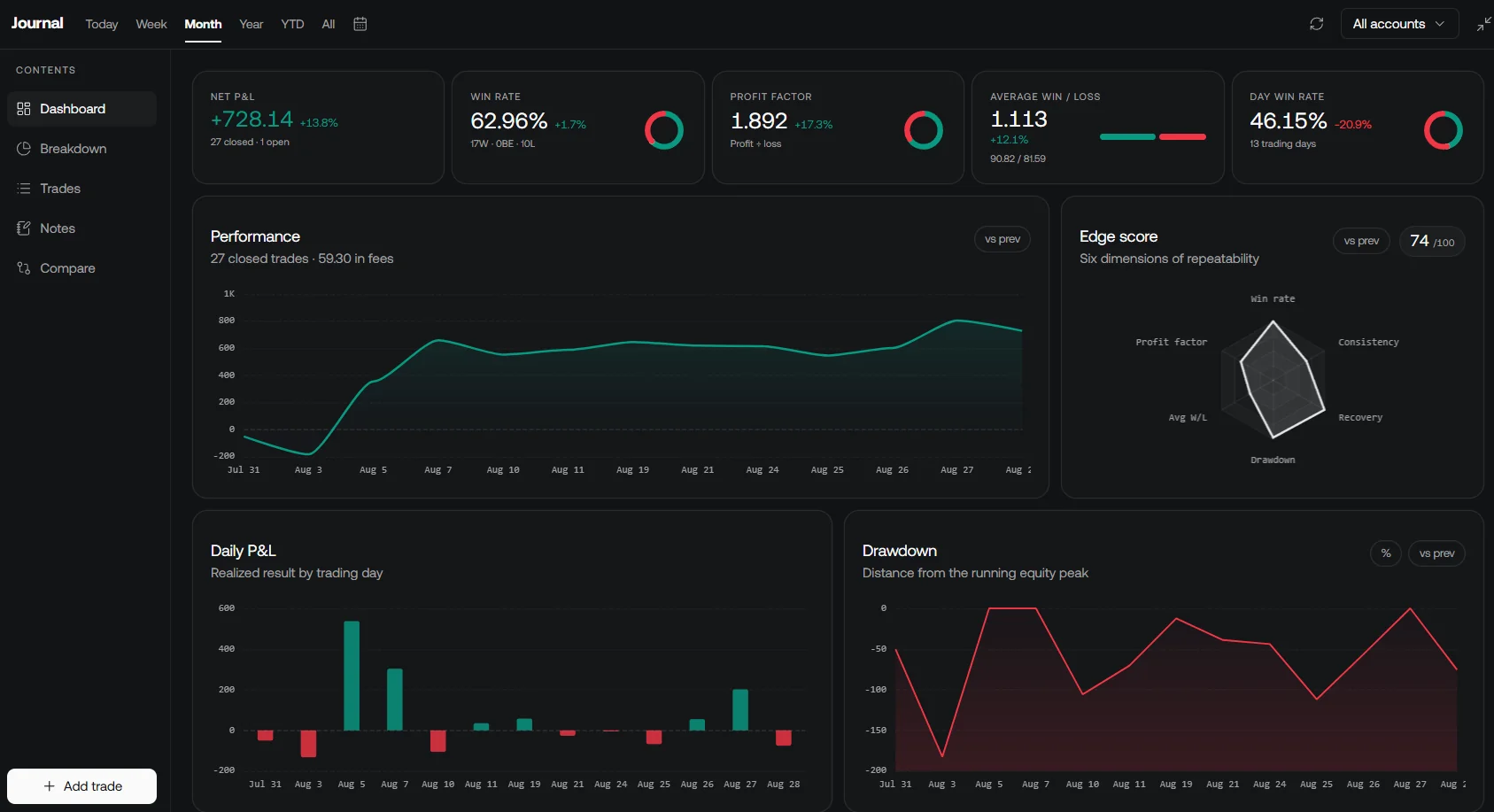
Use the native LuxAlgo journal to review supported trade imports and compare results by instrument, session and strategy. Include failed evaluation attempts, costs and rule mistakes. The provider’s dashboard remains the reference for its own qualifying days, loss limits and reward eligibility.
The Library’s market-structure, trend and momentum tools run on a Quant Chart and can help standardize a discretionary process, but indicator labels do not establish institutional positions or guarantee profitable trades.
Research capability does not imply permission to automate execution on a provider’s account. Check the exact account’s EA, copying and prohibited-practice rules and review current LuxAlgo access and pricing for the workflow you need.
The LuxAlgo Prop Firms portal can help organize comparisons and explore modeled scenarios. Check that reference rules match the current purchased account. Simulated outcomes depend on assumptions and are not observed personal pass probabilities; partner discounts also do not establish the lowest total cost or a suitable risk model.
Choose the Account That Fits the Whole Strategy
- Confirm eligibility and instrument access: check residence, nationality, platform, product restrictions and the exact contract.
- Compare combined risk: model correlated positions, floating losses, reset time and static versus trailing floors.
- Calculate total costs: include entry, recurring, activation, reset, extension, data, platform, commission, financing and transfer costs.
- Read the reward path: compare qualifying days, current-profit thresholds, caps, retained balances and post-withdrawal drawdown.
- Test the actual workflow: validate order entry and recordkeeping on the allowed platform before increasing exposure.
Choose The Trading Pit for a choice of distinct market programs, ThinkCapital for its eligible CFD workflow, or Apex and TradeDay for a futures-focused comparison. Treat HRT as institutional context. Broad asset access is useful only when the account rules and your research process support the trades you intend to make.
Frequently Asked Questions
Does a multi-asset prop firm provide all markets in one account?
Not necessarily. A firm may offer several CFD categories in one program or separate CFD, futures and stock accounts. Confirm the exact instruments and program before purchasing.
Are Apex and TradeDay multi-asset firms?
They focus on futures, which can provide exposure to several underlying markets such as equity indices, currencies, energy and agriculture. That does not mean their accounts also provide cash stocks, spot crypto or CFDs.
Why does the highest profit split not always produce the largest payout?
The amount received also depends on eligibility, payout caps, profit thresholds, retained buffers, costs and withdrawal effects on drawdown. Compare the full policy for the selected account and purchase date.
Can I buy a retail challenge from Hudson River Trading?
HRT is an institutional quantitative trading and liquidity-provision firm. Its public careers and institutional services are different from the retail evaluation programs compared here.
Does LuxAlgo automatically enforce prop firm rules?
No. LuxAlgo charts, Quant, strategy testing and the journal support research and review. You must inspect and run strategies, verify current account rules and separately confirm permitted execution methods.
Read next