Best Prop Firms for Traders Outside the US

The best prop firm for a trader outside the US is one that accepts their residency and identity documents, supports a usable payout method, and permits their trading approach. A large advertised account or high profit share is useful only after those conditions are met. Compare the specific program and account stage, not just the brand.
This guide reviews The5ers, For Traders, FXIFY, Alpha Capital Group, and the transition from OANDA Prop Trader to FTMO, using official sources checked in September 2026. The figures below distinguish simulated account balances, total allocation limits, and conditional scaling ceilings. None is cash you can withdraw simply by passing an evaluation.
OANDA update: OANDA announced that its prop-trading transition to FTMO would conclude on March 31, 2026. Its former program address now redirects to FTMO. The old Classic and Boost price tables are therefore historical, not a current buying recommendation. The section below explains the change and compares the current FTMO route.
Quick Comparison for International Traders
| Firm | Program choice | International consideration | Important tradeoff |
|---|---|---|---|
| The5ers | High Stakes, Growth and Bootcamp have different stages and scaling | Forbidden-territory terms and platform restrictions apply | High Stakes scales to $500K; the $4M headline belongs to other growth paths |
| For Traders | Forex, crypto and futures; challenge and instant models | Restricted list includes Pakistan, Bangladesh and the UAE | Outbound copying only; wallet withdrawal fees affect small rewards |
| FXIFY | One-, two-, three-phase, Lightning and Instant are distinct | Residency restrictions include Kenya, Ghana and Vietnam | Drawdown, news, automation and payout rules differ materially by program |
| FTMO, after the OANDA transition | 1-Step or 2-Step CFD challenge | Country policy includes exclusions and separate Australian service | 1-Step trailing rules differ from 2-Step; Swing is a separate account choice |
| Alpha Capital Group | Pro, Swing, One, Three and Direct policies | Restrictions apply to nationals as well as residents | 80% standard share; eligible add-on or Direct can provide 90% |
The country examples are not complete lists. Check the linked official eligibility policy before paying, especially if nationality differs from residence, you are relocating, or the payout provider requires separate verification. Being outside the US does not establish eligibility everywhere else.
1. The5ers: Compare the Growth Path, Not Just the $4M Headline
The The5ers terms describe eligibility, identity checks and forbidden territories. The list includes, among others, Bosnia and Herzegovina, Israel, Lebanon, Laos, Russia, Iran and several sanctioned regions. The terms also prohibit US residents from using MetaQuotes platforms. That is more precise than the old article’s blanket statement that 28 regions, including the US, were excluded.
The5ers offers different CFD programs. High Stakes is a two-stage evaluation. The current New version lists 10% and 5% targets, 5% daily and 10% maximum loss limits, and three qualifying profitable days per phase. A qualifying day requires at least 0.5% under the provider’s balance/equity formula; any small green day does not automatically count.
| The5ers program | Current structure | Risk and progression | Example or ceiling |
|---|---|---|---|
| High Stakes New | Two stages: 10%, then 5% | 5% daily / 10% maximum loss; three profitable days per phase | Sizes $2.5K–$100K; selected $2.5K lists $19; scaling up to $500K |
| Hyper Growth | One-step growth route with a 10% target | 6% stop-out level and 3% daily pause; 1:30 leverage | Starting sizes $5K, $10K, $20K; conditional growth up to $4M |
| Bootcamp | Three evaluation steps, each with a 6% target | 5% evaluation max loss; funded stage uses 4% max loss and 3% daily pause | Destination sizes $20K, $100K, $250K; conditional scaling up to $4M |
The Growth page distinguishes Pro Growth and Hyper Growth. A daily pause is not the same mechanism as permanent account termination at a stop-out level. Hyper Growth lists no minimum trades or days for completing its first level, but inactivity and other rules still apply. Its $4M ceiling is a progression path, not the starting account balance granted for a small entry fee.
The Bootcamp page illustrates why entry price and total cost must be separated. The selected $20K destination starts with $5K, $10K and $15K evaluation balances, lists $22 upfront, and adds $50 at the funded stage. The advertised destination is not the balance used throughout all three phases. Its current leverage is 1:30, replacing the older 1:10 figure in this article.
Payouts, Refunds and Trading Conditions
High Stakes begins with an 80% share and increases it at specified scaling levels. Its payout tab requires three profitable days, at least $150 profit, and a first request 14 days after receiving the funded account, followed by two-week cycles. The cycle resets when the account scales. Bootcamp also lists a first payout after 14 days and subsequent two-week cycles; do not assume every program has identical minimums.
Read the High Stakes fee breakdown carefully: the page lists 10% in Hub credits after Phase 1, 20% after Phase 2, and 70% as trading-account equity credits at the funded stage. Its broader refund wording is less specific. Treat internal purchasing credits and withdrawable rewards separately rather than promising a full cash refund at the first payout.
High Stakes lists MT5 Hedge and FX, metals, indices, oil and crypto. Overnight and weekend holding are allowed, but index swaps can be expensive. Executing orders within two minutes before or after high-impact news is prohibited, while holding an existing position through news is allowed. Accounts with more than 30 consecutive inactive days expire. Compare the exact current program’s payment methods and recipient requirements before registering.
Best fit: a trader who wants a defined progression path and can follow the selected program’s day-count, news and holding rules. The limitation is that different The5ers programs cannot be compressed into one universal fee, split or drawdown figure.
2. For Traders: Check the Wallet Costs and Copying Direction
For Traders offers separate forex, crypto and futures programs. Its restricted-country policy currently includes Pakistan, Bangladesh, the UAE, Iran, Syria, Myanmar, North Korea, Russia, Belarus, Cuba, Lebanon, Libya, Sudan and specified Ukrainian regions. Historical testimonials from a country are not proof that new residents there are currently accepted.
The current challenge comparison distinguishes Fast and Classic forex evaluations. Standard Fast uses one 9% target, a 3% daily limit and 6% trailing maximum drawdown in the selected configuration; a static option is also offered. Classic uses 8% and 5% targets, a 4% daily limit and 8% static maximum drawdown. Both list three minimum profitable days and biweekly rewards. Check the selected configuration because add-ons and other markets change the terms.
| For Traders item | Current detail | Why it matters |
|---|---|---|
| Fast / Classic entry prices | Advertised from $49 / $67 before promotions | Compare the actual size and selected risk model |
| Account size / allocation | Help policy lists $3K–$100K accounts and $300K combined Master/Instant allocation | A combined limit is not a single $300K starting account |
| Reward request | Account conditions, review, then credit to internal wallet | Wallet approval and external receipt are different steps |
| Wallet withdrawal of $100–$399 | Crypto transfer with a $25 fee | A $200 wallet request leaves $175 before any other costs |
| Wallet withdrawal of $400 or more | Rise payment with a $50 fee | A $400 request leaves $350 before other applicable costs |
| Challenge-fee bonus | Fourth reward request; excludes Instant and Pay After Pass | Do not assume a first-payout refund |
The allocation policy gives a $300K combined Master/Instant ceiling across forex, crypto and futures, while the homepage describes a tier-based route. Confirm how the account offered to you applies that ceiling. The challenge phase itself has no allocation limit under the help policy; buying more challenges does not increase the permitted funded allocation.
The withdrawal policy says risk review can take up to 48 hours before the reward enters the internal wallet. External wallet payments are usually processed within a few hours on working days. If a verification call is required, it is mandatory and the 48-hour window does not apply. Both the wallet credit and withdrawal minimum are $100; the fee schedule above can materially reduce smaller receipts.
The challenge-fee bonus is added to the fourth reward, excluding Instant and Pay After Pass accounts. This replaces the old table’s unqualified “Refund Fee: Yes.” The standard Fast configuration shows an 80% share, while the site advertises up to 90% for applicable arrangements.
Its permitted-practices policy allows copying outward from a For Traders account to your own external accounts, but prohibits copying external trades inward. EAs may assist your decisions; autonomous execution without direct input or approval is prohibited. Trades must last at least five seconds. These distinctions matter more than a blanket “copy trading supported” label.
Weekend holding is allowed. For forex Master accounts, new entries within five minutes before or after high-impact news do not earn recognized profits; qualifying pre-existing positions can be closed in that window. Crypto and futures news rules differ. The site lists MT5, cTrader and TradeLocker, but verify platform availability for the selected market and region.
3. FXIFY: Program-Specific Rules Are Essential
FXIFY’s current program page includes residency restrictions in its footer. Examples beyond the US include Kenya, Ghana, Vietnam, Algeria, Nicaragua and Zimbabwe. A worldwide marketing claim does not override that list or local restrictions. Identity and payment-provider checks are separate from buying an evaluation.
The old article used a single 80–90% range and a shared fee range for unrelated models. Current evaluation pages describe different targets, loss mechanics and optional upgrades; Instant Funding has different permissions again. The following examples are selected configurations, not a claim that every account under a brand shares these rules.
| FXIFY route | Verified program detail | Important qualification |
|---|---|---|
| One Phase | 10% target; 3% daily loss; 6% closed-balance trailing drawdown; five minimum days | Selected $25K fee $199 before promotion; drawdown locks at starting balance after sufficient gain or a payout |
| Two Phase Classic | Selected configuration: 4% daily loss, 10% static maximum loss, four minimum days | Classic, Standard and Pro are separate variants; selected Classic says no on-demand payout |
| Three Phase | Displayed target 5%; 5% daily and 5% static maximum loss; five minimum days | Selected $25K fee $149 before promotion; inspect each phase at checkout |
| Lightning | Advertised single 5% target, five-day pass window, up to $100K | Advertised $10K entry from $59; do not borrow the embedded Classic configurator’s rules |
| Instant Standard | No evaluation; 8% trailing maximum loss and 8% daily rule | Separate 80% base share / 90% add-on, no fee refund, and stricter automation/holding rules |
The Three Phase and One Phase pages describe a 15-percentage-point add-on that brings the performance share to 90%. Their first-payout text specifies at least $50 and five minimum trading days; later withdrawals are monthly or biweekly with the relevant add-on. Do not read “first payout on demand” as unconditional same-day cash.
The Two Phase page currently contains a selected Classic table saying no on-demand payout and a 14- or 30-day frequency, alongside older generic on-demand copy lower down. Resolve the exact selected variant and agreement before purchasing. Likewise, the Lightning landing page can display a Classic configurator by default; those are not Lightning risk limits.
The Instant program must be assessed separately. Standard rules require a first payout 14 days after the first trade and subsequent biweekly requests, with a $50 minimum and completed checks. Standard prohibits EAs, bots, copy trading and weekend holding, and has no scaling or fee refund. Its trailing floor can lock at starting balance on payout, so withdrawing all profits can eliminate the remaining cushion. Lite is a different model.
One- and Three-Phase evaluation pages list MT5, DXtrade or TradingView, with EAs and weekend holding permitted subject to the full rules. The platform name alone does not grant permission for every automated workflow. Check instrument availability, RAW versus All-In costs, news treatment and payment onboarding for the actual account. Avoid using headline cumulative payouts or review ratings as a guarantee of future reliability.
4. OANDA Prop Trader Transitioned to FTMO
The official OANDA announcement dated March 2, 2026 described migration incentives for active clients, applicable refunds for those declining the transition, and a March 31 conclusion date. OANDA said it would refocus on brokerage operations. Its old prop challenges should not remain in a current price ranking as if they were still independently offered.
For a current alternative, compare FTMO’s CFD challenges. The 1-Step route uses a 10% target, 3% daily limit, end-of-day trailing maximum-loss mechanism and a Best Day rule. The 2-Step route uses 10% and 5% targets, 5% daily and 10% maximum loss, and four minimum trading days per evaluation phase. Those differences can matter more than completing one fewer stage.
FTMO’s eligibility policy lists excluded locations including Indonesia, Kazakhstan, Belize and Seychelles, as well as sanctions-related restrictions. It distinguishes nationality and residency and provides narrowly defined exceptions for some nationals living in the EEA with an eligible traditional bank account. Australian clients are directed to its local affiliated service. Check that policy rather than assuming the former OANDA country coverage transfers automatically.
Current FTMO accounts are simulated. Standard starting sizes reach $200K; conditional scaling is separate. The 1-Step reward share is 90%; 2-Step starts at 80% with routes to 90%. The 2-Step challenge fee can be reimbursed with the first eligible reward; the 1-Step fee is not refundable under the same arrangement. Billing currency and the account’s nominal currency should also be distinguished.
The reward policy permits requests on day 14 or later after the first trade, with trades and pending orders closed. Review generally takes one to two business days, followed by sending within one to two business days after invoice approval. Supported methods and their limits differ; FTMO lists no additional withdrawal commission, with minimum closed profit of $20 for wire and $50 for crypto.
Standard and Swing permissions are distinct. A trader who needs weekend or news flexibility should check the current Swing option and its availability, rather than carrying over OANDA’s former news window. Broker-group regulation is not a blanket guarantee of prop-evaluation refunds or performance rewards; assess the actual contracting entity and terms.
5. Alpha Capital Group: Choose the Payout Model and Risk Rules Together
Alpha’s country policy applies to nationals as well as residents. It includes Russia, Belarus, Vietnam, the Republic of Congo, the Democratic Republic of Congo and specified Ukrainian regions, among others. Its older country guide and checkout list are not substitutes for that policy. Alpha describes its evaluation and Qualified Analyst stages as simulated, and says it is a prop firm rather than a broker accepting customer trading deposits.
| Alpha plan | Targets | Daily / maximum loss | Holding or payout distinction |
|---|---|---|---|
| Pro 8% | 8%, then 5% | 4% daily / 8% static | Three days per phase; no weekend hold on Qualified |
| Pro 10% | 10%, then 5% | 5% daily / 10% static | Three days per phase; payout option matters |
| Swing | 10%, then 5% | 5% daily / 10% static | Weekend holding allowed; on-demand only |
| One 10% | 10% | 4% daily / 6% trailing | One evaluation day; weekend holding allowed |
| Three | 8%, 4%, 4% | 4% daily / 6% static | Three days per phase; verify current purchase availability |
| Direct | No evaluation target | 3% daily / 5% trailing | No weekend hold or EAs; retained payout buffer and per-asset risk cap |
These figures come from the official plan policies. One also has 6% and 12% target variants with different loss limits. Pro 6% is another separate offer. Do not apply the table’s Pro 8% rules to every Pro account. Current policy states a $400K combined allocation across plans; that is different from the homepage’s individual account sizes.
The add-on policy specifies an 80% standard share and an optional 90% upgrade for all One plans and on-demand Pro plans, selected at purchase. Direct includes 90%. Swap-free is also an optional pricing arrangement: it replaces overnight financing with extra commission, is limited to eligible MT5 plans, and disables EAs. It is not cost-free overnight holding.
For biweekly Pro/Three rewards, the first request begins 14 days after the first Qualified trade, requires five qualifying trading days using the same strategy, and has a $100 gross minimum. On-demand rewards for Pro, Swing, One and Three require at least 2% gross profit and a best day no greater than 40% of the payout window’s total profit. On-demand does not mean there are no performance gates.
The Direct policy requires a retained 3% profit buffer, at least another 1% for a request, and a 15% best-day threshold. On $100K, $4,000 total profit with no day above $600 can support a $1,000 request above the buffer; a 90% share pays $900. A separate 1% per-asset open-loss limit applies from the first trade, including specified same-direction re-entry losses within ten minutes.
Alpha’s payment policy lists processing and payment within two business days, with the account locked until reset. Methods include Rise, Wise and bank transfer; crypto is available through Rise rather than a direct Alpha withdrawal. Close all trades before requesting. News windows and lot-exposure limits remain important even after passing.
Use LuxAlgo to Test a Plan That Fits Your Region and Schedule
Start with the firm’s current rules and a trading session you can consistently attend. LuxAlgo is a charting and AI platform: use native charts to inspect market structure, compare timeframes and identify the conditions you want to test. Then work with Quant, our coding agent to develop explicit entries, exits, position sizes and session rules. Inspect the generated code and run the strategy yourself.
Use native backtesting with standard candles, realistic commission and slippage, and a separate period for testing after development. Match exchange sessions and the firm’s daily-reset timezone, including daylight-saving changes. A test using your local midnight can understate a provider’s daily loss calculation if its reset occurs at a different time.
For example, a $100K account with a $4,000 remaining loss cushion should not be sized as if $100K were available to lose. Four planned $250 losses consume $1,000 before costs, while simultaneous positions may add correlated exposure. A withdrawal or rising trailing floor changes that cushion. Recalculate it before the next session instead of using a fixed percentage of the headline account size indefinitely.
The Library’s market-structure, trend and momentum tools open one click from a Quant Chart. Indicator labels do not establish institutional positions or guarantee that a trade complies with a prop contract.
Research capability is not permission to automate execution: For Traders’ direct-input requirement and Alpha Direct’s EA prohibition illustrate why compatibility and authorization must be checked at the account level. Consult current pricing for access and billing terms.
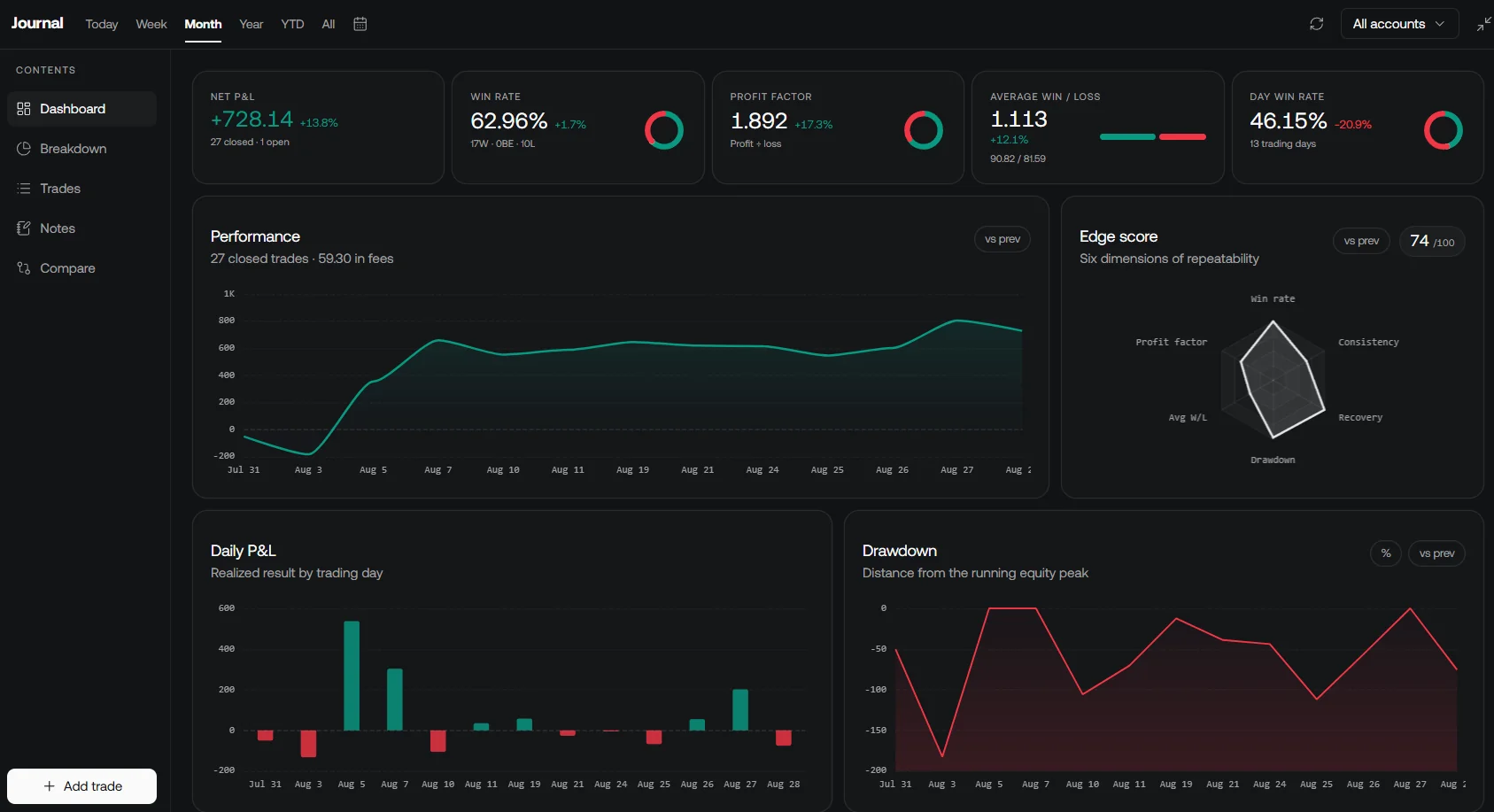
Use the native LuxAlgo journal to review supported trade imports and compare actual execution with the tested plan. Track news-window mistakes, oversized positions, fees and the practical effect of your local schedule. Keep the provider’s dashboard as the reference for its own eligibility and rule calculations.
The LuxAlgo Prop Firms portal can help organize comparisons and explore modeled scenarios. Verify that its reference rules match the current account: modeled outcomes are not observed personal pass probabilities. Compare the full fee and refund path, not just an advertised discount.
Make the Final Choice in This Order
- Eligibility: verify residence, nationality, permitted platform, identity documents and payment-provider access before paying.
- Strategy fit: compare news, weekend, copying, automation, inactivity and per-asset exposure rules at both evaluation and funded stages.
- Total economics: calculate evaluation and activation fees, upgrades, reward shares, withdrawal charges and currency conversion.
- Practical operation: check support hours, server reset time, expected review delays and the loss cushion remaining after a payout.
- Contract and records: retain the purchased rule version and payment records. Check local tax treatment with an appropriate local professional rather than assuming all performance rewards are treated alike.
There is no universal winner for every non-US trader. A firm unavailable in your country is not a candidate, and a higher split cannot compensate for a rule set your strategy routinely violates. Shortlist the programs that meet those requirements, test the workflow, and make the final comparison using the agreement offered to you.
Frequently Asked Questions
Can every trader outside the US join these prop firms?
No. Each firm has its own residency, nationality, identity-verification and platform restrictions. Payment providers can impose additional limits. Check the current official policy before purchasing.
Is OANDA Prop Trader still a current challenge option?
OANDA announced a transition to FTMO with a formal conclusion date of March 31, 2026, and its former prop-program address now redirects to FTMO. Compare the current FTMO offer rather than the old OANDA Classic or Boost tables.
Does a 90% profit split mean I receive 90% of every gain immediately?
No. Eligibility, review, payout caps, retained buffers, deductions and transfer fees can affect both the amount and timing. Some 90% shares also require a paid add-on or a particular account type.
Can LuxAlgo automatically make a strategy compliant with a prop firm?
No. LuxAlgo charts, Quant, backtesting and the journal support research and review. You must inspect and run strategies, verify the firm’s current rules and confirm whether the selected account permits automated execution.
Read next