FTMO Prop Firm Review: How to Pass in 2026

FTMO offers simulated trading accounts with performance-based rewards after you meet its evaluation requirements. The first decision is between its current 1-Step and 2-Step Challenges. They have different daily loss limits, maximum-loss calculations, reward shares, and fee-refund policies. A plan that fits one model may fail the other even with the same trades.
This review covers FTMO’s CFD programs. Its separate futures offering has its own rules. The advertised $10,000–$200,000 balances are simulated capital, not cash deposits or money you can withdraw. Passing the evaluation establishes eligibility for the next stage; account review and the FTMO Account Agreement still apply.
FTMO 1-Step vs. 2-Step: The Current Comparison
Use FTMO’s current comparison instead of older Standard-versus-Aggressive pricing tables. Standard and Swing are account types; 1-Step and 2-Step describe the evaluation process. Swing is available only with 2-Step.
| Feature | 1-Step Challenge | 2-Step Challenge |
|---|---|---|
| Evaluation phases | One Challenge | Challenge, then Verification |
| Profit targets | 10% | 10%, then 5% |
| Maximum daily loss amount | 3% of starting capital | 5% of starting capital |
| Maximum loss | 10% end-of-day trailing | 10% static |
| Minimum trading days | No separate minimum-day rule | Four opening-trade days in each phase |
| Trading period | Unlimited | Unlimited |
| Best Day Rule | Best day ≤50% of positive days’ profit | Not applicable |
| Starting FTMO Account reward share | 90% | 80%; 90% with qualified scaling or Premium Programme |
| Entry fee reimbursement | Not refunded | May be refunded with the first reward withdrawal |
| Account types | Standard | Standard or Swing |
Both programs require continuous compliance with their applicable Trading Objectives. Profit targets apply during evaluation, while loss rules continue on the subsequent FTMO Account. The 1-Step Best Day Rule also continues when determining reward eligibility.
Account Sizes, Fees, and Scaling
The following table shows USD-denominated account sizes and the corresponding displayed euro fees. They are different currencies. These are one-time fees; avoid converting them into fixed dollar prices without an exchange-rate date. The $100,000 selections currently show promotional prices alongside their list fees.
| Simulated account size | 1-Step fee | 2-Step fee |
|---|---|---|
| $10,000 | €79 | €89 |
| $25,000 | €199 | €250 |
| $50,000 | €319 | €345 |
| $100,000 | €499 list; €399 displayed promotion | €540 list; €439 displayed promotion |
| $200,000 | €999 | €1,080 |
Check the selected model, account currency, platform, and final price in FTMO’s current pricing selector. Promotions and regional availability can change. Paying the fee does not purchase an unconditional reward or make passing certain. FTMO’s refund FAQ says 1-Step fees are not refunded, while a 2-Step fee may be reimbursed with the first reward withdrawal using the original payment method.
Starting Allocation Is Different from Scaling
The combined allocation limit is $400,000 per trader or strategy before scaling, shared across 1-Step and 2-Step. Identically traded strategies across accounts count toward that limit; additional registrations do not create separate allowances.
FTMO’s Scaling Plan offers conditional 25% account increases after qualifying four-month periods, up to $2 million across FTMO Accounts. Requirements include at least four months under the same order, at least 10% net simulated profit within that period, at least two processed rewards, and a positive balance at scale-up. The 90% reward-share upgrade matters for 2-Step because 1-Step already starts at 90%. The $2 million ceiling is not the balance of a newly purchased Challenge.
Understand the Loss Rules Before Choosing Trade Size
Daily Loss Includes Open Positions and Costs
For both models, FTMO recalculates the daily equity floor at 00:00 CE(S)T, using the account balance at that time minus a fixed amount based on starting capital: 3% for 1-Step or 5% for 2-Step. Equity includes open-position profit or loss, swaps, and commissions. A position does not have to close for a loss-rule violation to occur.
On a $100,000 account, the first-day daily floor is $97,000 for 1-Step or $95,000 for 2-Step. If the next midnight balance is $102,000, those daily floors become $99,000 and $97,000 respectively. A profitable previous day therefore changes the following day’s floor. Track FTMO’s reference clock rather than assuming your local midnight matches it.
Static vs. End-of-Day Trailing Maximum Loss
The 2-Step maximum-loss floor stays at 90% of starting capital: $90,000 for a $100,000 account. The 1-Step floor trails the highest balance recorded at midnight CE(S)T, or starting capital if higher, minus 10% of starting capital. It can rise but cannot fall during that account cycle.
For example, a $100,000 1-Step account begins with a $90,000 maximum-loss floor. A highest midnight balance of $104,000 raises it to $94,000. A later midnight balance of $103,000 does not lower it again. The daily floor also applies, so satisfying the maximum-loss rule alone is insufficient. FTMO states that withdrawing a reward and receiving a new 1-Step FTMO Account resets its maximum-loss floor to 90% of starting capital.
The 1-Step Best Day Rule Uses Profitable Days Only
Your best day must account for no more than half of positive days’ profit, which sums the net results of profitable days. This differs from dividing the best day by overall net profit after losing days. Exceeding 50% is not itself a breach; you must continue until the ratio satisfies the rule before passing or qualifying for a reward.
Suppose your profitable days earned $6,000 and $4,000, and a losing day lost $1,000. Positive days’ profit is $10,000, so the best day represents 60%, even though overall net profit is $9,000. If the best day remains $6,000, positive days’ profit must reach at least $12,000 to meet the 50% limit. Do not increase size merely to force that denominator higher.
Four Trading Days Means Four Days with New Positions
In each 2-Step evaluation phase, a qualifying trading day is a CE(S)T calendar day on which at least one position is opened. Holding one position across four days does not satisfy four opening-trade days. Multiple trades opened on the same day still count as one day. The subsequent 2-Step FTMO Account has no minimum-trading-days objective.
Standard vs. Swing: News, Weekends, and Platforms
Choose the account type around the way your strategy holds risk. FTMO’s Swing account is available only with 2-Step and permits news trading and overnight/weekend holding, subject to the broader trading rules. A Standard account cannot later be converted to Swing, including during evaluation.
| Situation | Evaluation: either model | Subsequent Standard FTMO Account | Swing FTMO Account |
|---|---|---|---|
| Selected news releases | No specific news-window restriction; forbidden practices still apply | Affected instruments: no opening or closing within two minutes before/after selected releases, including pending-order execution | Exempt from this news-window restriction |
| Weekend or long market break | Holding permitted | Close before weekend market closure or a market break longer than two hours | Holding permitted |
| Strategy preparation | Test the rules of the intended later account too | Include relevant calendar and closure rules in the plan | Account for gap risk, swaps, and available margin |
Under the news policy, a stop-loss or take-profit executing in the restricted window can breach a Standard FTMO Account’s terms. Holding an earlier trade through the announcement does not exempt its exit orders. Use the official economic calendar for marked events and affected instruments. The holding policy applies to the later account even if the evaluation permitted the same overnight or weekend trade.
FTMO currently lists MT4, MT5, cTrader, and TradingView as platform choices for these programs. Select an available platform in its configurator and confirm eligibility for your region. FTMO’s TradingView execution option is separate from LuxAlgo’s native charts; access to one does not establish an order connection from the other.
FTMO permits discretionary trading and EAs within its strategy rules. A third-party EA can duplicate other traders’ strategies and create allocation-limit issues. Server activity limits and forbidden trading practices also apply. A profitable backtest does not establish that a strategy’s execution method is permitted.
Rewards: Eligibility, Review, and Payment
The reward FAQ allows a request on the 14th day or later after the first trade on the specific FTMO Account, with all open positions and pending orders closed and the applicable objectives met. FTMO reviews the request and says it normally responds within one to two business days. After approval and the required invoice information, sending the reward typically takes another one to two business days.
The standard reward share is 90% for 1-Step and 80% for 2-Step, with a qualified increase to 90% for the latter. A 1-Step reward cannot be left in the account to grow its balance. A 2-Step reward can be rolled over under the stated conditions. A reward-request date, approval, and receipt of funds are separate events; plan around all three.
How to Prepare for the FTMO Challenge
Preparation should demonstrate that your strategy can operate within the chosen account’s rules. No indicator, risk percentage, or routine guarantees a pass. Use the evaluation’s unlimited trading period to wait for defined conditions and examine losing sequences before paying for an attempt.
1. Translate Risk into Position Size
Start with the remaining dollar cushion to both loss floors, then consider existing positions, correlated exposure, and trading costs. A 1–1.5% risk setting is not universally safe: two losses near that size can consume most or all of a 1-Step daily allowance before additional costs.
For an illustration, 1% of a $100,000 nominal account is $1,000. If a currency pair has a $10 pip value per standard lot in your account currency and the planned stop is 50 pips away, $1,000 ÷ (50 × $10) gives two lots before costs and slippage. Those assumptions do not apply to every pair, contract, or account currency. Size down for costs and uncertainty; a stop order does not guarantee the planned fill.
The general calculation is position units = planned dollar risk ÷ loss per unit at the planned stop. Check pip or point value, minimum trade size, currency conversion, spread, and margin separately. Holding three trades driven by the same currency or index can concentrate exposure even when their symbols differ.
2. Write a Testable Trading Plan
- Market and session: specify the instruments and hours you trade, including the FTMO reset time and any restricted events.
- Entry and invalidation: define the condition that opens a trade and the price or event that proves the idea wrong.
- Exit and sizing: specify stop, target, management rules, and the maximum combined exposure.
- Pause conditions: define when a losing sequence, execution problem, or reduced daily cushion ends the session.
- Review: compare actual behavior with the plan rather than judging discipline solely by whether the day made money.
A 2:1 average reward-to-risk ratio breaks even at roughly a one-third win rate before costs, assuming those average outcomes are actually achieved. Fees, slippage, missed exits, and varying loss sizes change that relationship. Check reward-to-risk alongside win rate rather than selecting a target ratio in isolation.
3. Test Strategy Ideas Against the Account Constraints
| Strategy idea | Rule to define | Failure mode to test |
|---|---|---|
| Trend continuation | Higher-timeframe direction, pullback trigger, invalidation | Repeated small losses in a sideways market |
| Breakout and retest | Range boundary, close confirmation, acceptable retest | False breakouts and slippage during volatility |
| Mean reversion | Range context, extreme level, exit back toward the range | A persistent trend that never reverts |
| Session-based trading | Opening window, event exclusions, end-of-session exit | News-window conflicts and poor liquidity near the close |
These are research starting points, not proven challenge-passing strategies. Moving averages, Fibonacci retracements, and currency-strength tools can make conditions more explicit, but they must have a defined role. Adding several indicators that express similar information does not create independent confirmation.
4. Practice the Same Routine Before and After Evaluation
Avoid treating the Challenge as a sprint and the later account as a different strategy. Practice news restrictions and closing times that will apply to your selected FTMO Account. Accept losing trades, take planned breaks, and avoid increasing size after setbacks. A journal helps distinguish a valid losing setup from a rule violation that happened to make money.
Track drawdown, profit factor, average win and loss, costs, and performance by session over a meaningful sample. Compare results from different market conditions and a separate period that was not used to tune the strategy. A short winning streak is weak evidence of robustness.
Build and Review the Strategy with LuxAlgo
LuxAlgo is a charting and AI platform. Start in its native charts to compare market context, then use Quant, our coding agent to turn explicit entry, exit, and sizing conditions into strategy code. Inspect the code and run it yourself. Confirm that the implemented conditions match your written plan before interpreting the backtest.
In native strategy testing, use standard candles and account for commission, slippage, position sizing, and available history. Compare a separate test period and inspect individual trades. FTMO’s daily reset, intraday equity floor, and 1-Step end-of-day trailing floor are specific calculations; a single headline backtest drawdown statistic does not certify compliance with them.
For a pullback strategy, describe the trend filter, the retracement area, the exact entry confirmation, and the invalidation price. Test the simplest version first, then examine which market conditions produce losses. If you change a rule after seeing the results, retest on data that did not guide that change.
Use Library Tools for Their Specific Analytical Roles
The Library’s tools cover these roles on a Quant Chart: market-structure tools map structure, order blocks, fair value gaps and other price-based areas; trend tools supply confirmation and reversal context; momentum and money-flow tools cover the rest. These labels do not reveal verified institutional positions or guarantee an entry.
Define how a tool’s condition changes your decision: for example, whether a market-structure break is required before entering a pullback. Multi-condition custom alerts can prompt a review of that setup. An alert does not automatically calculate remaining FTMO loss capacity, guarantee execution, or make a forbidden trade permissible.
Review Actual Trades and Modeled Scenarios
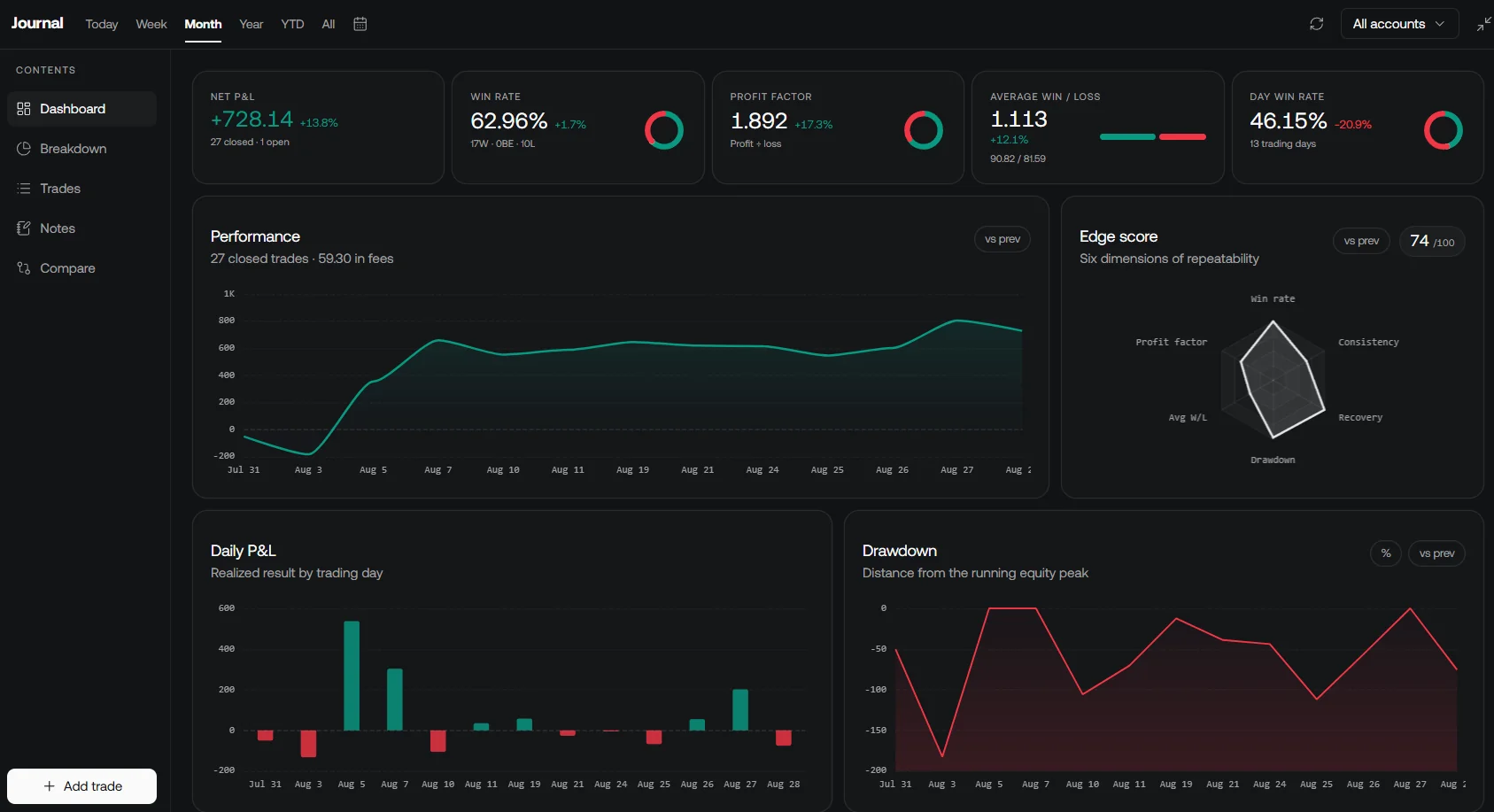
Use the native LuxAlgo journal to review supported imports and investigate deviations from the plan. Keep FTMO’s Account MetriX as the authority for the current account’s objectives and reward eligibility. LuxAlgo research tools do not replace that dashboard or automatically enforce FTMO rules.
The LuxAlgo Prop Firms portal provides another way to compare offers and explore scenarios using trading statistics. Its simulated results depend on assumptions and reference rule profiles; they are not an observed personal probability of passing. Cross-check the chosen FTMO model, current provider terms, and any promotional conditions before using a scenario to inform a decision.
Which FTMO Model Fits Your Process?
| Model | Potential benefit | Tradeoff |
|---|---|---|
| 1-Step Standard | One evaluation phase, lower displayed entry fee, 90% starting reward share | 3% daily allowance, end-of-day trailing maximum loss, Best Day requirement, no entry-fee refund or Swing option |
| 2-Step Standard | Static maximum loss, 5% daily allowance, potential fee reimbursement | Two phases and four trading days in each; later news and holding restrictions |
| 2-Step Swing | News and overnight/weekend flexibility on the later account | Choose Swing at purchase; still meet the evaluation and loss rules and account for gap/carrying risk |
Choose based on tested behavior and the total cost of an unsuccessful attempt. A shorter evaluation is not automatically easier, and a larger nominal balance does not remove the loss constraints. A clear plan, realistic testing, and careful execution improve the quality of preparation without guaranteeing funding or a reward.
Frequently Asked Questions
Does FTMO still use the Standard-versus-Aggressive comparison?
The current CFD comparison is 1-Step versus 2-Step. Standard and Swing are account types, with Swing available only through 2-Step. Older Aggressive pricing tables should not be used as current purchase terms.
Is the FTMO Challenge fee refunded?
The 1-Step fee is not refunded. FTMO says the 2-Step fee may be reimbursed with the first reward withdrawal using the original payment method; passing evaluation alone is not that withdrawal.
What does the 1-Step Best Day Rule measure?
The most profitable day must represent no more than 50% of the combined net profit from profitable days. Losing days are excluded from that denominator. Exceeding the ratio delays eligibility rather than automatically breaching the account.
Can LuxAlgo guarantee that I pass FTMO?
No. LuxAlgo charts, Quant, the Library, and the journal can support strategy research and review. They do not guarantee performance, enforce all FTMO objectives, or establish an execution connection to the account.
Read next