Prop Firms Are Changing the Landscape of Trading

Retail prop firms have introduced a different route into trading: pay for an evaluation, meet a defined rule set and potentially qualify for cash rewards or a later live stage. This can lower the upfront cost of entering an assessment. It does not eliminate personal expenses, guarantee funding or make a simulated account equivalent to owning the advertised amount of capital.
The meaningful changes are in how traders access programs, budget for repeated attempts, adapt strategies to contractual rules and use online research tools. Claims that prop firms caused an industrywide rise in scalping, drove brokers to zero commissions or removed the institutional advantage need evidence beyond marketing. This guide focuses on mechanisms and current examples checked in September 2026.
What Has Changed for Individual Traders?
| Change | Potential benefit | Important limitation |
|---|---|---|
| Online evaluation access | A trader can assess a program without applying for an institutional job | Eligibility, fees and performance conditions still apply |
| Defined account rules | Objectives and loss limits create a measurable assessment | Rule compliance does not guarantee a reward or a profitable strategy |
| Simulated reward programs | Some participants can receive cash based on qualifying simulated results | The displayed balance is not automatically real capital owned by the trader |
| Possible live progression | Certain firms offer a separate route to real-market trading | Passing an evaluation is not a universal guarantee of a live account |
| Accessible research tools | Charting, coding and record review can be organized online | Better tools do not establish better future returns or firm solvency |
Retail evaluation businesses also differ from traditional proprietary trading firms that hire employees to trade firm capital. Buying a challenge is usually a service relationship, not employment. Our prop firms versus hedge funds comparison separates evaluations, institutional careers and investing in a fund.
Lower Entry Costs, Not Zero Personal Risk
A fee can be smaller than the capital someone would choose to commit to a personal trading account. That makes an assessment easier to purchase, but purchase access should not be confused with a demonstrated ability to pass. The full cost includes time, practice, repeat attempts and any continuing service charges.
Providers use different billing models. The current Apex offering separates newer one-time-fee evaluations with 30-day expiry and no resets from legacy products. The Trading Pit Futures Prime page lists separate challenge, reset, extension and optional data costs. There is no universal one-time fee covering every stage at every firm.
Refund language also needs careful reading. FTMO’s fee policy says its 2-Step fee is reimbursed with the first Reward withdrawal after successful completion; passing alone is not the trigger. Its 1-Step fee is not reimbursed under that policy. A potentially refundable purchase remains an upfront cash expense until the conditions are met and the money is returned.
For a hypothetical budget, three $100 attempts plus $50 of activation and $30 of data charges total $380. If you later receive a $600 cash reward, the result is $220 before other expenses and tax. If no reward is paid, the same process costs $380. A screenshot of simulated profits does not show this cash history.
Avoid describing account closure as the only possible downside. Participants can lose paid fees and substantial time, face payout disputes or spend more on repeated attempts. Liability and other obligations depend on the agreement. Read the contract instead of assuming every firm guarantees that losses can never create additional obligations.
The $25,000 Day-Trading Comparison Has Changed
The older argument that every U.S. day trader needs $25,000 in a brokerage account is too broad and now misses a regulatory transition. FINRA’s new intraday margin requirements became effective June 4, 2026, with brokerage firms permitted to transition through October 20, 2027. The new framework removes the trade-count-based pattern day trader designation and its $25,000 minimum.
During the transition, a broker may still use the earlier day-trading framework. Ask which system governs your account. Under the new approach, firms assess intraday margin exposure and require deficits to be addressed promptly; repeated failures can lead to restrictions. Brokers can impose higher house requirements, so removal of the old minimum does not mean unlimited leverage.
FINRA’s frequent-trading guidance also distinguishes cash accounts, which have payment and settlement requirements, from margin accounts. Its guidance describes a $2,000 minimum for leveraged margin trading. Futures accounts and simulated evaluations are different arrangements again. Compare like-for-like instruments and account relationships rather than presenting a prop purchase as a universal workaround.
The decision should rest on total costs, ownership, permitted activity, withdrawal rights and the process you intend to follow. A lower purchase price alone does not establish that an evaluation is financially better than an appropriately sized personal account.
What “Funded” Means in Practice
Many assessments and funded stages are simulated. A firm may pay cash rewards calculated from qualifying simulated results, but the displayed balance is not proof of an equal live allocation. A nominal $100,000 account with a $3,000 loss cushion is not the same as $100,000 of freely deployable personal capital.
Some providers offer live progression. Topstep’s Live Funded Account policy describes real capital and real markets and distinguishes that stage from Express Funded Accounts. This is a provider-specific pathway, not a reason to assume all funded accounts route trades into the market.
The cash economics are also different. Paying an approved $800 reward from a $1,000 simulated gain is a real cash outflow for the firm. The remaining $200 simulated gain is not automatically real trading revenue. Our guide to prop-firm revenue models explains why evaluation fees, simulated rewards and live trading results must be separated.
A headline reward share does not establish the amount or timing of a withdrawal. Qualifying days, consistency tests, payout caps, retained balances and review conditions can all matter. Read the policy for the exact model and purchase date, including what happens to the loss floor after money is withdrawn.
Online Access Still Has Geographic Limits
Online programs can make participation possible without relocating to a financial center. They can also provide a shared platform and documented rules to people in different regions. That is a practical access change, but it does not mean eligibility regardless of location.
- Check residence, nationality and any restricted-jurisdiction conditions before purchase.
- Confirm the selected platform and instruments are available for your country and account model.
- Review identity verification, payment and payout-provider requirements.
- Ask about travel, connection and account-access policies if you expect to trade away from your normal location.
- Match permitted sessions and support hours to the market you intend to trade.
A company offering several programs may apply different restrictions to CFDs, futures or other products. A broker affiliation does not automatically extend regulatory protections to the evaluation agreement. Our retail prop regulation guide explains the importance of the legal entity, account status and contractual reward claim.
How Account Rules Shape Strategy Choices
A profitable-looking method can be incompatible with a particular assessment. A trailing floor, a daily equity test or a concentration limit can reject a path that eventually ends in profit. The sequence of returns, intraday losses and permitted holding periods matter alongside the final result.
Risk Should Be Sized Against the Remaining Cushion
The CME Group’s 2% Rule lesson explicitly calls the 2% threshold arbitrary. It is an educational sizing convention, not a universally appropriate prop-account rule. Applying 1–2% to a large nominal balance can consume a substantial portion of a much smaller allowable loss.
For example, 2% of a $100,000 displayed balance is $2,000. If the account has only a $3,000 loss cushion, that one planned loss uses about two-thirds of the cushion before commission and slippage. If the daily limit is smaller, the trade can be incompatible from the outset. Choose the risk amount from the actual constraints and your tested process.
Suppose a trader instead limits planned risk to $150 with $3,000 remaining. That is 5% of the cushion. Ten such losses total $1,500 before costs if size stays fixed. This is arithmetic for stress testing, not a recommended universal risk level; correlated positions, gaps, trailing adjustments and daily limits can produce a worse outcome.
Scalping Is Not Automatically Better
Small price moves can support an intraday strategy, but higher trading frequency also increases sensitivity to spreads, commission, slippage and latency. A larger nominal account does not remove those costs. Some programs restrict certain execution styles or impose holding requirements, so a generic claim that prop firms make scalping suitable for everyone is misleading.
Trend continuation, mean reversion and session-based approaches are hypotheses to test. None is inherently challenge-friendly. A trend method can experience repeated small losses; a mean-reversion method can fail during a persistent move; a session filter can reduce observations without creating an edge. Match the method to the account after measuring these behaviors.
| Rule or condition | What to test |
|---|---|
| Daily loss calculation | Open and closed losses, costs and the exact reset time |
| Static or trailing floor | How the threshold changes and whether equity can breach it intraday |
| Position and concentration limits | Combined exposure across correlated trades |
| Holding and event restrictions | News windows, session close, overnight and weekend rules |
| Reward eligibility | Qualifying days, consistency, caps and withdrawal effects |
Provider monitoring can enforce rules or close positions, but it should not replace your own controls. Do not assume an alert always arrives in time or liquidation occurs at the intended price. A rule can encourage disciplined behavior without proving that participants become consistently profitable.
Technology Expands the Toolkit, Not the Guarantee
Online platforms, accessible data and coding tools make it easier to organize research and review execution. Those developments extend beyond retail prop firms. Without reliable comparative evidence, it is not justified to claim that prop-firm competition caused brokers to cut commissions, created an industrywide scalping trend or delivered institutional-quality execution to everyone.
Evaluate the technology available in the actual account. A simulation may model fills differently from live execution. A data feed’s coverage, delay, session handling and contract specification can differ from another platform. Zero commission does not remove spreads, financing, slippage or other service costs.
AI-assisted coding and analysis can shorten parts of the research process, but generated output requires review. Fast iteration also makes it easier to overfit many variations to the same historical sample. Keep a separate testing period, record rejected ideas and explain the assumptions instead of selecting only the best-looking backtest.
Retail access to useful tools does not erase institutional advantages in specialized data, execution arrangements, financing or research resources. The practical benefit is the ability to build a more explicit and repeatable process with the tools available to you.
Research and Review with LuxAlgo
Start with LuxAlgo’s native charts to define the instrument, timeframe and trading question. Work with Quant, our coding agent to express entries, exits and sizing in code. Inspect the generated code and run the strategy yourself; a generated strategy is not automatically profitable or compliant with a provider’s rules.
Use native strategy testing with standard candles, realistic commission and slippage, and an independent testing period. Check data availability and document differences from the evaluation platform. Review weak periods and the path of losses, not only net profit or a high win rate.
Apply account conditions separately where the strategy test does not model them: reset times, floating-loss tests, reward caps and changes after withdrawal. Research software does not automatically enforce every provider’s rules or grant permission to automate execution.
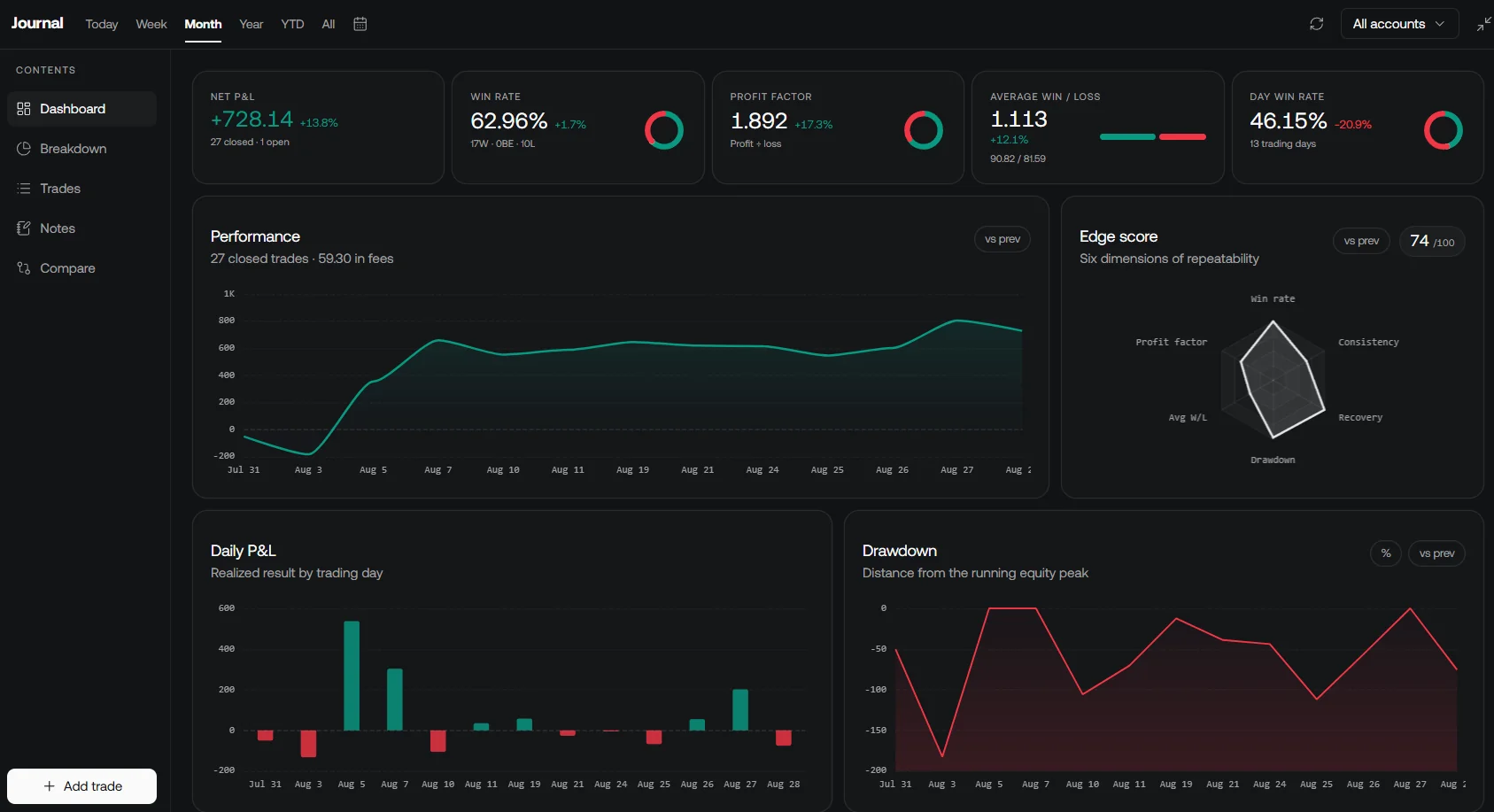
Use the native LuxAlgo journal to review supported trade records by session, instrument and strategy. Maintain a separate cash ledger of fees, refunds and rewards. The provider’s dashboard remains the reference for its own account limits and payout eligibility.
The LuxAlgo Prop Firms portal can help organize comparisons and explore modeled scenarios. Verify the reference rules against the selected account’s current agreement. A simulation depends on its inputs and assumptions; it is not an observed personal pass probability, a reliable forecast of required attempts or a guarantee of funding. Partner offers also do not establish the highest available discount or lowest total cost.
A More Useful Way to Judge the Opportunity
- Identify the exact service, legal entity and simulated or live account stage.
- Calculate the entire participation budget and set a limit before purchase.
- Test the strategy against the remaining loss cushion and account-specific rules.
- Confirm geographic eligibility, platform access and permitted execution methods.
- Track actual cash outcomes and review the process before buying another attempt.
Retail prop programs can broaden access to structured assessments and, for qualifying participants, rewards or live progression. Their value depends on the actual contract, economics and fit with a tested process. The opportunity is more credible when described with those limits than when presented as risk-free access to institutional capital.
Frequently Asked Questions
Do retail prop firms remove personal financial risk?
No. Participants can lose evaluation fees, repeat-purchase costs and time, and may face payout or contractual risks. Read the agreement rather than assuming account closure is the only possible downside.
Does passing an evaluation always provide real trading capital?
No. Many funded stages remain simulated, with cash rewards governed by the agreement. Some providers offer a separate live pathway, which must be checked for the selected program.
Is risking 2% of the nominal account balance appropriate for every prop account?
No. The allowable loss cushion can be much smaller than the displayed balance. Size risk around the actual daily and overall limits, combined exposure, costs and tested strategy behavior.
Do all U.S. day traders still need $25,000?
No. FINRA’s new intraday margin framework became effective June 4, 2026, with a broker transition period through October 20, 2027. A broker may still use the previous framework during transition, and other margin, cash-account and house requirements apply.
Can LuxAlgo predict my personal chance of passing a challenge?
Modeled scenarios depend on assumptions and are not observed personal pass probabilities. LuxAlgo charts, Quant, testing and the journal support research and review, but do not guarantee a pass, payout or future return.
Read next