How Retail Prop Firms Make Money

Retail prop firms can earn money from evaluation and service fees, and some also operate live trading programs. Their actual revenue mix depends on the business and account agreement. A simulated profit split is not automatically trading revenue, and public challenge prices alone cannot tell you whether a firm is profitable or able to meet future payouts.
To understand the model, follow the real cash: what customers pay, what the firm pays out, and whether trades actually reach a live market. This guide separates those flows, explains the incentives behind challenge rules and shows how to evaluate the total cost of participating. Provider examples reflect official information checked in September 2026.
Where the Money Comes From
| Cash flow | How it can work | What not to assume |
|---|---|---|
| Evaluation fees | A customer buys access to an assessment and associated services | The advertised simulated balance is not cash deposited for the trader |
| Subscriptions, resets and extensions | Some products charge recurring access or a new attempt fee | Every account renews monthly or offers a reset |
| Activation, platform and data fees | Charges may apply when entering a funded stage or adding services | The entire charge is profit; vendors and exchanges may receive part |
| Live trading results | An actual trading operation can earn or lose money after execution costs | All simulated gains are realized firm income |
| Broker or commercial arrangements | Disclosed referral, introducing or other agreements may generate income | Every provider receives spread markups or broker commissions |
These categories are possible mechanisms, not an audited breakdown of the industry. A firm can combine several of them, and different products under one brand can have different economics. Without reliable financial disclosures, claims that a particular percentage of revenue comes from failed challenges are estimates at best.
Evaluation Fees and Repeat Purchases
An evaluation fee typically purchases an assessment service with a simulated account, objectives and trading rules. It does not mean the firm has placed the advertised account balance into an account owned by the customer. The fee can support technology, staff and other services as well as contribute to the firm’s margin.
FTMO’s fee explanation identifies platform development, infrastructure, educational services and proprietary applications among the services covered. Its 2-Step fee covers both assessment stages and is reimbursed with the first Reward withdrawal after successful completion. Passing alone is not the reimbursement trigger. Its 1-Step fee is not reimbursed under the same policy.
That distinction changes a trader’s budget. A fee described as refundable is still an upfront cash expense, and recovering it depends on satisfying the stated conditions. Several unsuccessful attempts can cost more than the fee attached to the final successful account. Check whether a refund covers only that account’s purchase and how discounts, taxes or payment charges are treated.
Repeat Fees Are an Incentive, Not Proof of Misconduct
When customers pay for new attempts, repeated purchases can increase receipts. This creates an economic reason to examine how rules, marketing and reset offers influence behavior. It does not establish that every firm intentionally causes failures, that every unsuccessful trader buys again or that all fees become profit.
Pass-rate claims also need a denominator. The percentage of purchased attempts that pass is different from the percentage of individual customers who eventually pass after several attempts. Passing an evaluation is different again from receiving a reward or reaching a live account. Ask for the period, account models, sample size and outcome definition before using a headline statistic.
For your own planning, set a total spending limit before the first purchase. Include every attempt, renewal and add-on in that limit. Treat an offer for another discounted challenge as a new spending decision rather than a way to recover money already spent.
Subscriptions, Resets and Other Charges
Retail programs do not use one universal billing model. Some evaluations renew periodically until cancellation or completion; others use one payment for a fixed access period. A rule breach can close an account. Whether a paid reset, replacement account or extension is available depends on the product, rather than occurring automatically.
The current Apex account offering distinguishes newer evaluations with a one-time fee, 30-day expiry and no resets from legacy products with separate terms. A historical monthly Performance Account charge therefore should not be presented as the cost of every current Apex account.
The Trading Pit Futures Prime page separately lists challenge, reset and extension charges, plus optional market-data costs. Data add-ons can expire at calendar-month end. Buying access late in a month may therefore produce a different effective cost from assuming every data purchase lasts 30 days.
- Before purchase: record the entry fee, billing period, cancellation method and refund conditions.
- After passing: check activation, platform, exchange-data and continuing account charges.
- After a breach: determine whether the account closes, a reset is offered or a new purchase is required.
- At payout: include the trader share, minimum request, caps, retained buffer and transfer costs.
For a simple personal budget, three $100 attempts plus a $50 activation charge and $30 of data cost total $380 before any payout. If the eventual cash reward is $600, the remaining cash is $220 before other costs and tax. A $600 payout screenshot does not show this complete history.
Simulated Profit Splits Are Not Live Trading Revenue
A simulated trading balance is a record of hypothetical trading outcomes. A provider may promise cash rewards calculated from those outcomes, subject to its agreement. That creates a possible real cash obligation without establishing that the provider earned an equal amount in the market.
| Illustrative case | Trader receives | Meaning for the firm |
|---|---|---|
| Simulated gain of $1,000; 80% approved reward | $800 cash if the reward is paid | $800 cash outflow; the remaining $200 simulated gain is not automatically revenue |
| Live net trading gain of $1,000; 80% compensation | $800 under the assumed agreement | $200 remains from actual trading results before other business expenses |
| Simulated loss of $1,000 | $0 reward from that result | The displayed loss does not by itself prove a $1,000 cash gain for the firm |
The examples deliberately use simple assumptions. Real agreements can apply qualifying days, payout caps, buffers, transfer charges and other restrictions. The live example assumes the $1,000 is already net of execution costs; it is not a statement about any named provider’s compensation contract.
Some businesses keep their retail programs simulated. Others have a pathway to real-market trading. Topstep’s Live Funded Account policy explicitly describes real capital and real markets, with Express Funded Accounts closing when a trader is called up. It is therefore inaccurate to say that every retail prop account always remains simulated.
A firm may also manage separate trading activity or use participant information in its research, where its terms permit. You cannot infer a specific copying, hedging or market-routing arrangement from a simulated platform screen. Ask what stage you are purchasing and read the agreement for that stage.
Broker Commissions and Spreads Need Separate Evidence
A provider could receive compensation through a disclosed broker referral or introducing arrangement. It could also charge for a platform or service. Those possibilities do not justify assuming that every trade creates broker income for every prop firm, or that every displayed spread contains a markup paid to the firm.
A commission deducted inside a simulation changes the simulated result. That deduction alone does not prove an exchange received cash, a broker paid a rebate or the provider earned the same amount. Actual live brokerage charges and commercial agreements are separate evidence.
For example, TradeDay’s commission policy says it adds no additional commission above the broker’s charge. It includes simulated commissions in Evaluation and Funded Sim results and notes that Funded Live rates can differ. The published unit is per lot per side, so a one-contract round trip involves both entry and exit charges.
When comparing costs, separate spreads, commission, overnight financing, data subscriptions and payout-transfer charges. Confirm the unit and stage for each. A broker affiliation or recognizable platform is not, by itself, proof of the evaluation company’s financial condition or of protections applying to its reward agreement.
Operating Costs and Why Fees Do Not Guarantee Profit
Customer receipts must cover more than rewards. A provider can incur acquisition and affiliate expenses, platform and market-data costs, support, engineering, payment processing, administration and professional services. Refunds and chargebacks reduce available cash. Live trading can introduce its own losses and capital requirements.
The following is a hypothetical cash budget, not an estimate of industry margins or a named firm’s finances. It assumes receipts and payments occur in one period and ignores tax, financing and accounting timing differences.
| Hypothetical item | Cash amount |
|---|---|
| 1,000 purchases at $100 each | +$100,000 |
| Refunds | −$5,000 |
| Trader rewards | −$35,000 |
| Advertising and affiliate payments | −$20,000 |
| Platform and data costs | −$15,000 |
| Staff and administration | −$15,000 |
| Illustrative cash surplus before other items | $10,000 |
If rewards rise from $35,000 to $50,000 while the other assumptions stay unchanged, the result becomes a $5,000 cash shortfall. Higher purchase volume also may require more marketing, support and reward funding. Fee receipts alone do not establish a stable margin.
Timing matters as well. A firm can receive fees today but owe rewards or refunds later. Several traders qualifying at once can concentrate outgoing payments. Public prices and customer reviews cannot show whether sufficient reserves exist for those obligations. Avoid treating a low apparent market exposure as evidence that the business has no financial risk.
What Risk Rules Do for the Business
Daily loss limits, maximum drawdown, position limits and prohibited-practice rules define which activity the firm is willing to assess or reward. In a live stage, they can also constrain trading exposure. In a simulated stage, they can limit qualification and reward eligibility without representing an identical real-market loss limit on the firm’s finances.
Read how each rule is calculated. A trailing floor can rise as profits increase, while a static floor remains tied to a fixed level. An end-of-day adjustment can still have an intraday breach test. Payouts may reduce the remaining cushion or change the applicable floor. None of those mechanics can be understood from the account-size headline alone.
Rules can serve legitimate assessment and risk purposes while also affecting the frequency of repeat purchases. Evaluate whether they are clear, consistently documented and compatible with the strategy you intend to trade. Do not assume that stricter rules prove wrongdoing or that lenient rules prove a sustainable business.
Questions to Ask Before Paying
- Who is the contracting entity? Match the checkout and agreement to the company responsible for the service and rewards.
- What kind of account is this? Distinguish evaluation, simulated funded and actual live trading stages.
- What is the full cost? Compare realistic repeat attempts, renewals, activation, data and withdrawal charges.
- What triggers payment? Review qualifying days, consistency conditions, caps, minimum amounts, review rights and payout timing.
- What happens after withdrawal or failure? Check loss-floor changes, account closure and repurchase terms.
- What financial evidence is available? Separate verified disclosures from marketing, testimonials and unsupported profitability claims.
The LuxAlgo Prop Firms portal can help organize a shortlist and explore modeled scenarios. Verify its reference rules against the current purchased account. Modeled outcomes depend on assumptions and are not observed personal pass probabilities. A partner discount also does not establish the lowest total cost or the best account for your strategy.
Use LuxAlgo to Research the Strategy and Track the Costs
Start with LuxAlgo’s native charts to define the market, session and setup you intend to trade. Work with Quant, our coding agent to express entries, exits and position sizing clearly. Inspect the generated code and run the strategy yourself; code generation does not establish profitability or compliance with a prop agreement.
Use native strategy testing with standard candles, realistic commission and slippage, and a separate testing period after development. Match the instrument’s contract value and intended position size. Check data availability and account for differences between research prices and the provider’s execution environment.
Keep the evaluation budget separate from the strategy’s trading results. A backtest that shows a gain does not automatically include challenge purchases, resets, reward caps or the effect of a withdrawal on the remaining loss cushion. Test those account conditions separately using the current agreement.
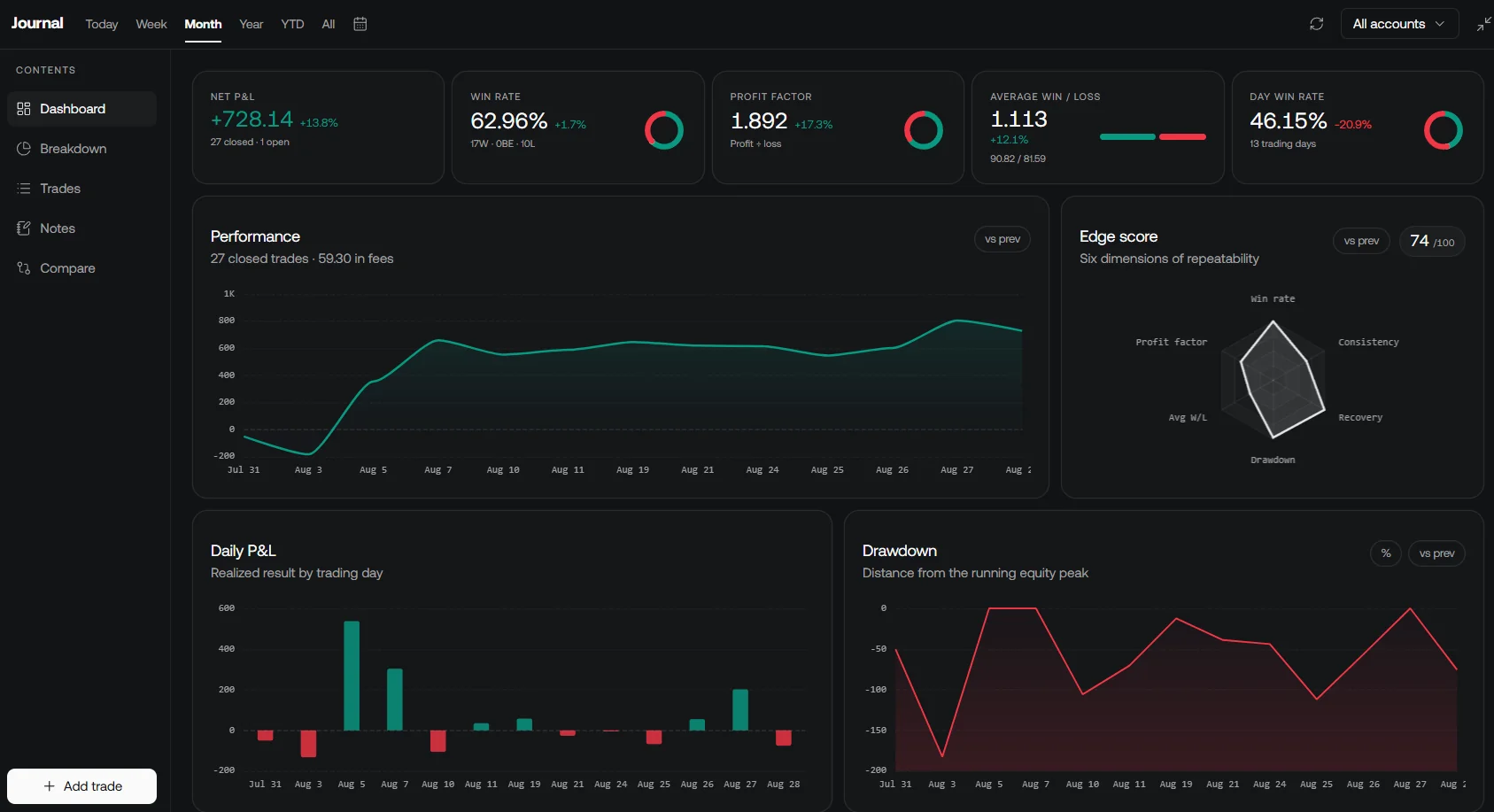
Use the native LuxAlgo journal to review supported trade records by strategy, instrument and session. Maintain a separate ledger of fees and cash rewards so an attractive trading record does not hide an expensive sequence of attempts. The provider’s own dashboard remains the reference for its loss limits and reward eligibility.
Confirm permitted execution methods with the provider and check current LuxAlgo plans for access to the tools you need.
These tools support a consistent research process. They do not guarantee that you will pass, receive a payout or recover evaluation fees. The useful measure is the complete record: trading behavior, rule compliance, every fee paid and actual cash received.
Frequently Asked Questions
Do retail prop firms only make money when traders fail?
No. Evaluation and service fees can contribute to income, and some firms also operate live trading programs. The actual revenue mix requires financial evidence; a failed simulated trade does not automatically create an equal cash gain for the firm.
Does a firm earn the remaining 20% of a simulated profit split?
Not automatically. If a $1,000 simulated gain qualifies for an 80% cash reward, paying $800 is a real cash outflow. The remaining $200 is a simulated amount, not proof of real trading revenue.
Are evaluation fees always refundable after passing?
No. Refund conditions depend on the product. FTMO states that its 2-Step fee is reimbursed with the first Reward withdrawal, while its 1-Step fee is not reimbursed. Read the exact purchased account’s terms.
How should I calculate my own prop trading result?
Track all cash rewards received minus evaluation purchases, repeat attempts, subscriptions, activation, data and other charges. Keep that cash record separate from simulated trading profit and account for any further costs and tax.
Read next