OpenAI Deep Research will Redefine How Traders Discover Opportunities
OpenAI Deep Research can help traders investigate a question, compare sources and develop a research brief. Its useful output is evidence to review, not an automatically executable trade. A report can reveal questions worth testing without establishing that an opportunity is profitable or still available.
The practical workflow is to define a question, verify the research, translate a hypothesis into rules and test those rules separately. LuxAlgo’s native charts, Quant and journal can support those later steps. Keeping each stage explicit makes it easier to identify weak assumptions before they affect a trading decision.
What Deep Research Does
OpenAI’s Deep Research documentation describes multi-step research models that search, analyze and synthesize sources into reports. Its API guide supports configured web, file and private-data sources, with additional analysis tools where enabled. It also explains that the API workflow differs from the clarification and prompt preparation used in ChatGPT.
The same guide notes that research tasks can take tens of minutes. That is a different use case from a streaming price feed or an execution system. Do not assume a completed report continuously updates itself, contains every relevant source or reflects the latest tradable price. Check the dates and information available to the specific research task.
| Research capability | Potential trading use | Important limit |
|---|---|---|
| Source synthesis | Compare company disclosures or explanations of a market event | Sources can be missing, outdated or contradictory |
| Structured analysis | Organize drivers, risks and unanswered questions | A coherent explanation is not proof of a price forecast |
| Citations | Trace material claims to supporting evidence | Open and verify the cited passage yourself |
| Configured data access | Include relevant files or connected sources where available | Access depends on the product, setup and permissions |
| Research report | Create a record of the thesis and its assumptions | Execution and strategy validation remain separate steps |
Current ChatGPT feature documentation also describes workflows using browsing, files, plugins and projects. Product interfaces, enabled tools and account access can differ. Confirm what is available in your own account rather than assuming that a particular model, integration or usage allowance is included everywhere.
Research Questions That Are Worth Asking
A narrow question produces a more reviewable result than “find a winning trade.” Ask for a defined market, time period, source standard and output format. Decide whether you need background on a business, a comparison of competing explanations or a checklist of events to investigate.
- Compare the revenue drivers and disclosed risks of three companies using their latest available filings.
- Summarize what changed between two policy statements, separating the actual wording from commentary.
- Build a timeline of an industry event using sources available by a specified cutoff date.
- Identify evidence that contradicts a proposed thesis and list the facts still needed to assess it.
These are examples of research tasks, not claims that the tool has complete access to every filing, paid feed or publication. Ask it to identify inaccessible sources and unresolved gaps. Several articles repeating one original claim should not be counted as independent confirmation.
An Example Research Brief
A useful request could be: “Compare the latest available annual and quarterly disclosures for these three companies as of my stated cutoff date. Prioritize company filings and regulator publications. Report segment revenue, major disclosed risks and upcoming events whose dates can be verified. Separate reported facts, management expectations and your inferences. Link material claims, explain conflicting figures and list missing information. Do not turn the report into a buy or sell instruction.”
Supply the companies and cutoff date yourself. Define the comparison period, currency and accounting basis where they matter. A report that compares annual revenue for one company with quarterly revenue for another can look polished while answering the wrong question.
Verify the Report Before Building a Thesis
- Open the sources supporting the main conclusion and confirm that they say what the report claims.
- Check publication dates, reporting periods and whether a later correction or disclosure exists.
- Recalculate important percentages and distinguish percentage changes from percentage-point changes.
- Separate historical facts, forecasts, management claims and the model’s interpretation.
- Record the strongest contrary evidence and what would invalidate the thesis.
For example, a margin moving from 20% to 22% rises by 2 percentage points, or 10% relative to the earlier margin. Those descriptions are not interchangeable. Small definition errors can materially change a comparison, even when the report includes a valid link.
The joint SEC, NASAA and FINRA investor alert warns that AI-generated information can be inaccurate, outdated or fabricated. It recommends checking underlying sources. A citation makes verification possible; it does not replace verification or guarantee an investment result.
From a Research Finding to a Testable Strategy
A fundamental observation and an entry rule answer different questions. A report might identify a change in a company’s outlook. It does not establish when to enter, how much to risk, what invalidates the trade or whether the information is already reflected in price.
Translate the idea into explicit conditions. Define the instrument, timeframe, entry trigger, exit logic, holding period and sizing. Explain which parts come from research and which are additional assumptions. If the strategy relies on an event, preserve when that information first became publicly available.
This timing matters in historical tests. Using a filing published after a simulated entry gives the strategy information it could not have known at the time. Revised economic series and today’s surviving-company list can create similar distortions. A plausible research narrative does not fix a test with unavailable-at-the-time inputs.
Keep a separate testing period, include realistic costs and retain a record of the variants you tried. Selecting the strongest result from many variations on the same sample can favor chance. Backtesting is evidence about rules under assumptions, not assurance that the next trade will work.
Build and Review the Idea with LuxAlgo
Start with LuxAlgo’s native charts to inspect the instrument and define the market conditions you want to test. Use Quant, our coding agent to express the entry, exit and sizing logic in code. Inspect the generated code and run the strategy yourself; generated output is not automatically a completed backtest or a live trading system.
Use native strategy testing with standard candles and realistic commission and slippage. Check data coverage for the instrument. Review weak periods, drawdowns and sensitivity to assumptions alongside the headline return. Confirm that the code implements the intended idea rather than an easier substitute.
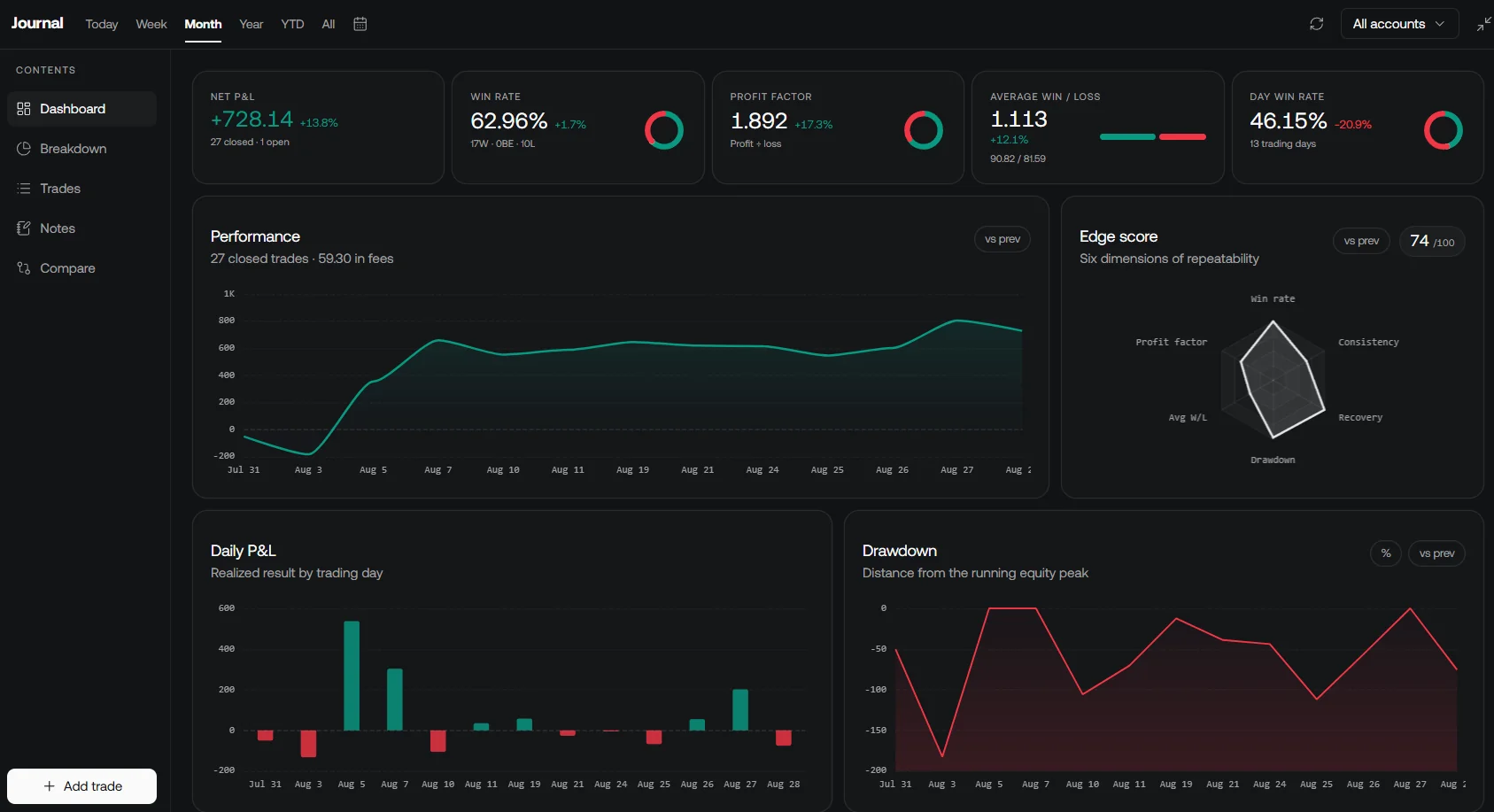
Keep the research brief, source dates and test assumptions together so you can revisit them when conditions change. The following workspace demonstration shows how research context can be organized; it does not demonstrate automatic transfer from OpenAI or automatic trade execution.
Use the native LuxAlgo journal to review supported trade records by instrument, session and strategy. Compare actual decisions with the planned conditions. A good research report can still lead to a poorly timed or oversized trade, so review execution separately from the quality of the original thesis.
Where the Other LuxAlgo Tools Fit
The Library adds market-structure, trend and momentum tools to a Quant Chart, and Quant can turn any of them into a strategy and backtest it against years of history. Strategy alerts are a separate step from a backtest.
A strategy found through a search still needs review for its assumptions, costs and suitability. An alert does not guarantee a fill or enforce every account rule. Check current plans and access and the relevant documentation instead of assuming every tool, export option or asset is available in every workflow.
How to Judge Whether the Workflow Saves Time
Measure time spent finding sources, checking facts, correcting the report and translating the idea into rules. A faster first draft can still be expensive if it creates many verification errors. Useful outputs include a clearer source trail, fewer unanswered questions and a test that another person can understand.
Review the same types of tasks over several attempts. Record factual corrections and missing sources, not just the length of the report. Keep research quality, strategy performance and execution quality as separate assessments; improvement in one does not prove improvement in the others.
Future integrations or model improvements may change what is possible, but they should be evaluated when documented and available. The current opportunity is concrete: use research assistance to organize evidence, then apply independent checks and an explicit testing process before making a trading decision.
Frequently Asked Questions
Is Deep Research a real-time trading signal service?
Treat it as a research workflow that produces a report. Do not assume continuous price monitoring, automatic report updates or trade execution. Verify source timestamps and use appropriate market data for time-sensitive decisions.
Does a cited research report guarantee accurate conclusions?
No. Check the cited passages, dates, definitions and calculations. Sources may be incomplete or contradictory, and generated interpretations can be wrong.
Can Deep Research automatically create and execute a LuxAlgo strategy?
This workflow does not establish an automatic connection. Translate the research into explicit rules, use Quant to develop code, inspect it and run the test yourself. Live execution is a separate step.
Does a successful backtest prove the research found a profitable opportunity?
No. Results depend on data, costs, timing and test design. Check information availability at each historical decision, use a separate testing period and assess live execution risks independently.
Read next