Prop Firm Review: FundedNext-Instant Funding
FundedNext Stellar Instant provides a simulated trading account without a challenge phase. The account balance is not cash deposited for you to withdraw. Eligible traders can receive Performance Rewards under the firm’s agreement, loss limits, and trading rules. LuxAlgo’s native charts and Quant, our coding agent, can support strategy research, but they do not certify compliance with those rules or prevent an account breach.
This review covers Stellar Instant for CFDs using official information checked September 8, 2026. FundedNext Futures is a separate offering. The key trade-off is immediate access to a simulated account in exchange for a one-time fee and a restrictive loss and reward framework.
Stellar Instant Plans and Costs
| Simulated account size | Standard one-time fee | Initial 6% loss allowance |
|---|---|---|
| $2,000 | $59.99 | $120 |
| $5,000 | $149.99 | $300 |
| $10,000 | $299.99 | $600 |
| $20,000 | $599.99 | $1,200 |
The official pricing table lists no recurring monthly account fee and a 10% surcharge for swap-free accounts. Temporary discounts are separate from these standard prices. The product page lists no account-fee refund and a discounted reset option; a reset is another purchase decision, not a restoration of lost rewards.
The advertised account size is much larger than the permitted loss allowance. A $10,000 account starts with $600 of room above its loss floor. Choosing a larger account also increases the purchase cost; it does not demonstrate that a strategy is safer or more likely to qualify for rewards.
Trading costs also matter. The commission guide lists $7 per forex lot, charged at opening rather than again at closing, and no index commission. Commodity, crypto, and stock CFD commissions use their own percentage schedules. Check contract specifications, spread, swaps, and any add-ons when estimating the total cost of a method.
FundedNext’s Stellar Instant Launch Video
This official FundedNext video premiered June 24, 2025. It is a historical launch promotion, not a complete statement of current rules. In particular, news trading and withdrawals remain subject to the restrictions explained below, even where the promotional wording sounds unrestricted.
The 6% Trailing Maximum Loss Limit
Stellar Instant has no separate daily loss limit, but its maximum loss rule trails upward with profitable balance growth. The initial allowance is 6% of the starting balance. The floor does not move down after losses and is capped at the account’s starting balance. Floating losses count when checking equity against the floor.
| First-cycle example: $10,000 account | Balance | Loss floor | Room above floor |
|---|---|---|---|
| Start | $10,000 | $9,400 | $600 |
| Close a $200 profit | $10,200 | $9,600 | $600 |
| Then lose $100 | $10,100 | $9,600 | $500 |
| Then make $400 | $10,500 | $9,900 | $600 |
| Then make $600 | $11,100 | $10,000 | $1,100 |
This example follows the firm’s trade-by-trade explanation before withdrawals. It distinguishes the account balance used in the example from equity, which includes open profit or loss. Do not assume that a closed-trade drawdown statistic alone captures every possible breach during an open trade.
The withdrawal guidance states that the floor does not reset lower when money is transferred out. Its example treats withdrawing the full profit at the capped floor as a breach. On a $5,000 account at $5,500 with a $5,000 floor, a $300 account deduction leaves $5,200 and only $200 of room. The reward received after the split is a separate amount.
Check the dashboard’s remaining allowance after each transfer and at the start of a new cycle. The firm’s examples describe additional trailing behavior across cycles, so a simple all-time balance-high formula should not be assumed to reproduce every withdrawal and scaling adjustment. Leave room for open losses and trading costs rather than targeting the exact boundary.
The Separate 3% Risk Ceiling
“No daily loss limit” does not mean unlimited position risk. The current risk policy sets a maximum of 3% at any given time, calculated against the initial account balance. It describes risk through stop placement and realized and floating losses, and includes entries belonging to the same trading idea even when split into several orders.
The first violation brings a warning and deduction of all profit from the violating trades. A second violation on the same account brings another deduction and permanent reclassification to a 1% cumulative risk limit. Further violations under that lower limit also trigger deductions. The policy excludes swap and commission charges from this particular risk-utilization calculation; that does not make those costs irrelevant to account equity.
Treat the risk ceiling and the trailing loss floor as separate constraints. A trade can fit one measure while leaving too little room under the other. LuxAlgo signals, a stop order, or a favorable backtest do not override either rule, and slippage can make a planned loss differ from the final result.
Performance Rewards and Scaling
Eligibility and Timing
The reward eligibility guide offers two routes: on-demand eligibility at 5% account growth, checked at the end of the day, or a 14-day cycle when growth is below 5% but at least 1%. Below 1% growth, a reward cannot be requested.
Reaching 5% during a session does not immediately enable a transfer. The end-of-day check must confirm eligibility. After the transfer option is enabled, placing another trade disables it until the next end-of-day check, when the account must still qualify. Reward deductions and account adjustments can affect the eligible amount.
The withdrawal instructions require completed KYC before transferring an eligible amount to the wallet. Review the balance, reward amount, news deduction, and breach warning before submitting. The guide says submitted requests cannot be cancelled and transfer gateway charges are the trader’s responsibility. Its 24-hour processing statement is the firm’s stated service timing, not an independently verified guarantee.
Reward Share and Tier Progression
The scaling guide lists a 70% reward share for Tiers 1–2 and 80% from Tier 3 onward. To advance within the initial scaling structure, the trader must complete at least one withdrawal and reach 10% cumulative withdrawal growth in the current tier. That measure uses rewards actually disbursed divided by the tier’s starting balance—not simply the profit displayed on the trading account.
For example, a $1,000 eligible profit split at 70% produces a $700 reward before applicable charges. On a $10,000 tier, $700 is 7%, not the 10% withdrawal-growth requirement. Transferring every available dollar can also leave the account at its loss floor; meeting a reward threshold and preserving an active account are different checks.
Initial scaling adds the original account size at each qualifying upgrade, up to ten times that size. Further growth toward the advertised $2 million ceiling is conditional. The guide distinguishes later-stage rules for accounts purchased or reset on or after January 12, 2026. Check the applicable program rather than treating the maximum ceiling as an automatic entitlement.
Platforms, News, and Account Rules
The platform guide lists MT4 and MT5 for Stellar Instant CFDs, with an important exception: U.S.-based traders use Match-Trader and do not have MT4/MT5 access. Confirm current regional eligibility and the platform available for the actual account before purchasing.
The agreement must be accepted during purchase before activation. There is no challenge profit target or minimum trading-day requirement, but account ownership, verification, prohibited-strategy rules, and any account-specific restrictions still apply. Weekend holding is listed as allowed; costs and gap risk remain relevant.
News Trading Is Allowed with Adjustments
Under the news rule, only 40% of profit from affected trades counts when execution occurs within five minutes before or after a listed high-impact event. Opening, closing, and triggered orders can qualify. A partial closure in that window affects the entire trade according to the guide.
News adjustments are calculated after the cycle and can reduce reward eligibility and account headroom. The firm describes a limited 1% equity adjustment for certain breaches caused by news-profit deductions, available at most three times per account. This is a specific adjustment mechanism, not a general extra 1% loss budget or a reason to assume trading around news is unrestricted.
Automation and Prohibited Practices
The EA policy allows qualifying MT4/MT5 Expert Advisors and bots with an additional usage fee, customization requirements, and strategy restrictions. Tools that only change stops, targets, or lot-size parameters can also count as EAs. The guide limits allocation per strategy and prohibits specified tools and integrations, so inspect the actual tool rather than relying on the label “risk manager.”
The account rules and prohibited-strategy policy restrict cross-person copying, cross-account hedging, latency exploitation, and other listed practices. The EA rules impose additional restrictions on duplicated strategies. General permission to copy between accounts with the same owner should not be read as blanket permission for every bot or account combination.
Using LuxAlgo for Preparation and Review
LuxAlgo’s native charts and Quant, our coding agent, help turn a defined trading idea into an editable indicator or strategy. Start with explicit entries, exits, sizing, session rules, and costs. Review Code and Run and the Inputs and Properties settings rather than assuming every generated study already simulates orders.
For a pullback strategy, specify the trend filter, entry trigger, stop distance, and handling of overlapping positions. Inspect individual simulated trades and test later data. If you want to model a prop-firm rule, explicitly implement and validate its balance, floating-equity, withdrawal, and cycle logic. Standard maximum drawdown is not automatically a Stellar Instant breach detector.
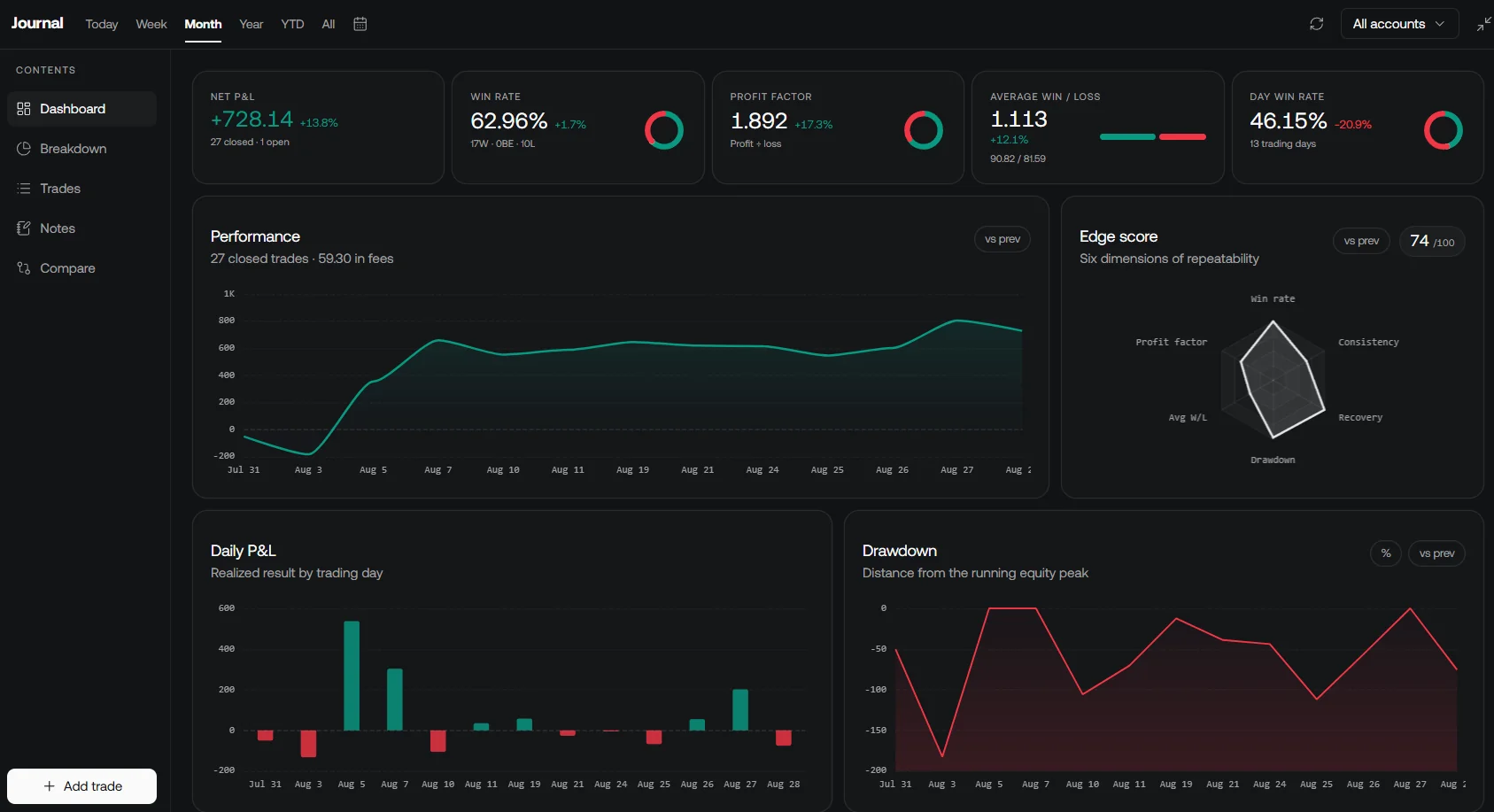
A useful review log separates the trading hypothesis from the account constraints: why the trade qualified, planned and actual risk, open exposure, distance to the loss floor, news timing, and any reward deduction. LuxAlgo’s native journal can help review trading records, while the FundedNext dashboard remains the authority for that account’s eligibility and limits.
LuxAlgo Subscription Costs
| Plan | Monthly billing | Annual total | Monthly equivalent billed annually |
|---|---|---|---|
| Free | $0 | $0 | $0 |
| Premium | $67.99 | $479.88 | $39.99 |
| Ultimate | $119.99 | $719.88 | $59.99 |
| Ultra | $229.99 | $1,439.88 | $119.99 |
Standard LuxAlgo prices exclude temporary promotions. Monthly credits are 500, 5,000, 25,000, and 100,000 respectively. Annual equivalents are not month-to-month prices, and these subscriptions are separate from FundedNext fees.
Pros, Cons, and Practical Fit
- Potential advantages: no evaluation phase, no minimum trading days, several starting sizes, and two reward-eligibility routes. These can suit someone who already understands the strategy and account rules.
- Trade-offs: the purchase fee, trailing loss floor, separate risk ceiling, reward deductions, and restrictions on trading methods. A larger simulated balance does not remove these constraints.
- Useful preparation: test a small, precisely defined strategy, record costs and open exposure, and compare the relevant dashboard limits before each trade and transfer.
- Limits of analysis tools: LuxAlgo can support research and review; it cannot ensure payouts, eliminate losses, or guarantee that a third-party firm accepts a trading method.
Stellar Instant is best evaluated as a paid simulated-account program with conditional rewards. Assess the fee you can afford to lose, the actual loss allowance, and the obligations in the agreement. LuxAlgo can contribute a structured research process, but the quality of that process must be judged from reviewed trades and realistic assumptions rather than promotional claims of safer or guaranteed growth.
FAQs
Does Stellar Instant have only one risk rule?
No. There is no daily loss limit, but the 6% trailing maximum loss limit, separate 3% risk ceiling, news adjustments, and prohibited-strategy rules still apply. Repeated risk-limit violations can lead to a permanent 1% risk restriction.
Can I withdraw immediately after reaching 5% growth?
On-demand eligibility is checked at the end of the day. A new trade disables the transfer option until the next eligibility check. The alternative 14-day route requires at least 1% growth, and KYC and other account rules still apply.
Can LuxAlgo guarantee compliance with FundedNext rules?
No. Quant and other LuxAlgo tools support research and simulation. A standard backtest does not automatically reproduce FundedNext’s floating-equity checks, withdrawals, news deductions, or account restrictions. Validate those separately and use the account dashboard for current limits.
Read next