Prop Firms with the Highest Account Sizes 2026

The highest advertised prop-firm account size is usually a conditional ceiling, not the amount a new trader can immediately use or withdraw. In this comparison, FTMO offers individual evaluations up to $200,000 and a $2 million scaling ceiling; The5ers Hyper Growth and FundedNext Pro advertise paths to $4 million; Funded Trading Plus extends its standard $2.5 million Express ceiling to $5 million with a paid checkout add-on. These figures describe different programs and should not be ranked as interchangeable cash grants.
The ten firms below appeared in the original comparison. Current purchase options, combined allocation limits, and scaling conditions are separated here, including legacy products and unavailable offers. MyFundedFX is retained as a historical entry because its successor’s prop business was reported closed. DNA Funded currently states that new orders are paused. Check the linked provider rules and your country’s eligibility before paying for an evaluation.
Compare Starting Accounts, Allocation, and Scaling
A starting account is the nominal balance assigned to one program. An allocation limit controls how many accounts or how much combined balance you can hold. Scaling increases eligible accounts after performance requirements. The drawdown allowance is the amount the account can lose before a breach; it is normally far smaller than the headline balance.
| Firm and example program | Starting size or purchase ceiling | Combined allocation or important limit | Conditional growth / availability |
|---|---|---|---|
| Goat Funded Trader | Selected current models list accounts up to $400,000 | $400,000 permitted allocation per trader in its merge policy | Homepage advertises up to $2 million; scaling follows separate time and payout milestones. |
| DNA Funded | Individual challenges up to $200,000 | Advertises up to $600,000 simulated funded capital | New orders paused; do not treat $600,000 as a single purchasable account. |
| FTMO | Up to $200,000 per evaluation | $400,000 per trader or strategy before scaling, across 1-Step and 2-Step | $2 million across all FTMO Accounts under the Scaling Plan. |
| The5ers Hyper Growth | $5,000, $10,000, or $20,000 | $40,000 combined evaluation starting capital for Hyper Growth | Published Hyper Growth ladder reaches $4 million. Other programs have different ladders. |
| FundingPips | Current 2-Step Flex lists $5,000–$100,000 | Homepage maximum allocation $400,000; PRIME has its own allocation accounting | PRIME can scale to $2 million per account after qualification and reward transfer. |
| Apex Trader Funding | New EOD / Intraday plans: $25,000–$150,000 | Up to 20 accounts advertised; each keeps its own risk and payout limits | $300,000 legacy evaluations appear in a limited return offer, with separate recurring fees and rules. |
| FundedNext Stellar 2-Step | $6,000–$200,000 | $300,000 aggregate across eligible Stellar accounts; lower country, platform, and Lite limits apply | FundedNext Pro: conditional 25% increases toward $4 million. |
| Topstep Trading Combine | $50,000, $100,000, or $150,000 | The tier describes buying power, not withdrawable cash | Live funding is a separate transition; do not label it unlimited account scaling. |
| MyFundedFX / Seacrest Funded | Historical offer | Not included as an available funding choice | Finance Magnates reported closure of Seacrest prop operations in February 2026. |
| Funded Trading Plus 1-Step Express | $10,000–$200,000 | Up to two simulated-live Express accounts, $200,000 total before scaling | Standard ceiling $2.5 million; $5 million requires the Scaling Add-On bought at checkout. |
This is a comparison of the named programs, not a claim that every model at each firm shares these terms. Nominal balances in simulated programs are virtual funds. A performance reward is paid only under the provider’s eligibility and account rules, and the nominal balance itself is not yours to withdraw.
1. Goat Funded Trader
Goat Funded Trader’s current site lists larger options than the original article’s $200,000 ceiling, with some model selections reaching $400,000. It advertises up to $2 million in simulated capital. Its 1-step, 2-step, and Instant models have different loss limits, payout timing, consistency rules, and add-ons, so a cheap entry price should not be attached to the largest account without checking the exact selection.
The merge policy sets a $400,000 combined permitted allocation per trader. Eligible funded accounts originating from evaluations can merge if they are untraded or reset after a payout and have the same account type, profit split, and add-ons. Evaluation accounts and all Instant Funding models cannot merge.
| Scaling level | Required funded time and successful payouts | Capital increase stated in policy | Reward split |
|---|---|---|---|
| 1 | 2 months and 4 payouts | 15% | 90% |
| 2 | 4 months and 6 payouts | 30% | 90% |
| 3 | 5 months and 10 payouts | 40% | 92% |
| 4 | 6 months and 15 payouts | 50% | 95% |
The scaling policy bases increases on the original account size, including when accounts have been merged. The homepage’s $2 million headline does not mean every account automatically reaches that amount by compounding the percentages above. Confirm the applicable model and progression; a 100% promotional or add-on split is not the standard split at every scaling level.
2. DNA Funded
DNA Funded advertises individual challenges up to $200,000 and up to $600,000 in combined simulated funded capital. Its current notice says new orders are paused while it works through a platform transition. That makes availability the first decision point, before comparing a fee or allocation ceiling.
Its standard 1-Phase schedule lists $5,000, $10,000, $25,000, $50,000, $100,000, and $200,000 accounts, with displayed fees of $59, $89, $179, $319, $619, and $1,209. The listed 1-Phase target is 10%, daily loss limit 4%, total loss limit 6%, and minimum trading days five. Other challenge models have different conditions.
The official FAQs distinguish an 80% base reward split from a 90% booster and a standard 14-day cycle from a seven-day add-on. Standard evaluation models may permit compatible EAs under their rules, while Instant Funding and the 24-hour model require manual trading. Platform compatibility must be checked again after migration. DNA Funded is a simulated prop service; a related broker’s regulatory status should not be presented as a licence for the prop program.
3. FTMO
FTMO offers both 1-Step and 2-Step evaluations up to $200,000 individually. The combined allocation limit is $400,000 per trader or strategy before scaling, across the two models. Buying multiple registrations or running an identical strategy across accounts does not bypass that limit.
| FTMO rule | 2-Step | 1-Step |
|---|---|---|
| Evaluation target | 10%, then 5% | 10% |
| Maximum daily loss | 5% | 3% |
| Maximum loss | 10%, static | 10%, end-of-day trailing |
| Minimum trading days | 4 | None |
| Best Day rule | None | 50% |
| Reward share | Up to 90% | 90% |
The Scaling Plan can raise simulated capital by 25% after each qualifying four-month period, up to $2 million across all FTMO Accounts. Requirements include at least four months on the same order, at least 10% net simulated profit over that period, at least two processed Rewards, and a positive balance when scaling. The 90% reward benefit is relevant to 2-Step; 1-Step already starts at 90%.
For example, scaling an eligible $200,000 account by 25% produces $250,000, not an immediate jump to $2 million. Compare the daily and total loss mechanics as carefully as the scaling ceiling. The same percentage label can behave differently when one model uses a trailing floor and another uses a static floor.
4. The5ers
The Hyper Growth program offers $5,000, $10,000, and $20,000 starting evaluations, with $40,000 maximum combined evaluation capital. Its published ladder reaches $4 million after the required milestones. The current Growth page also has a Pro Growth selector; that is a different ladder and should not inherit Hyper Growth’s maximum or rules.
| Hyper Growth balance | Profit target to progress | Published payout ratio |
|---|---|---|
| $5,000 / $10,000 / $20,000 | 10% at each level | 50% trader / 50% firm |
| $40,000 / $80,000 / $160,000 / $320,000 | 10% at each level | 75% / 25% |
| $640,000 / $1,280,000 | 10% at each level | 80%–100% |
| $4,000,000 | Final published level | 80%–100% |
The official table lists $4 million after $1.28 million; do not substitute a mathematical doubling sequence for the firm’s published final tier. Hyper Growth lists a 6% stop-out level, a 3% daily pause, 1:30 leverage, unlimited completion time, and no minimum profitable-day requirement. A daily pause is distinct from Pro Growth’s daily loss rule.
The5ers also offers High Stakes, Bootcamp, and other programs. Compare each selected program’s starting size, loss rules, and payout ladder separately. The headline “up to 100%” is a conditional higher-level range, not Hyper Growth’s starting trader share.
5. FundingPips
FundingPips’ current 2-Step Flex offering lists $5,000–$100,000 accounts, with fees of $32, $59, $159, $269, and a displayed $499 for the $100,000 tier. Its 10% and 6% evaluation targets, 12% maximum loss, 4% daily loss, and one minimum evaluation trading day are specific to Flex. Standard, Pro, 1-Step Flex, and Zero should not be combined into one fee-and-rule grid.
The Flex reward split is 85% by default, with 95% available as an add-on. The site advertises a $400,000 allocation limit and a separate PRIME progression. PRIME is not simply a larger challenge purchased at the original evaluation price.
Under the PRIME rules, traders may qualify after three received rewards and transfer the next qualifying reward into PRIME, or receive an invitation. At least 2% profit is needed, and up to 10% of the Master account size counts before the reward split. The eligible amount after that split is multiplied by 12.5 to set PRIME’s opening size. The originating Master account closes when PRIME opens; separate KYC and an agreement are required.
For example, an eligible $8,000 profit at an 80% split leaves $6,400 for the transfer, producing an $80,000 PRIME account. That $6,400 is used to unlock the account rather than simultaneously being received as a cash payout. PRIME rewards use an 80% split.
- Growth: each approved scale-up adds 10% of that level’s starting size. The first four scale-ups require 5% profit; the fifth onward requires 10%.
- Days: no profitable-day requirement at the first three scale-ups, four qualifying days at the fourth, and ten from the fifth onward. A qualifying day earns at least 1% of account size.
- Limits: $2 million per PRIME account; active PRIME allocation counts opening sizes toward $400,000, with different treatment for merged accounts. Scaling does not automatically increase the amount counted against that allocation.
- Risk: a 2% soft daily loss pauses trading; the 8% end-of-day trailing maximum loss eventually locks at 5% below the starting balance after 3% profit.
Investor capital through Tradin is a later, separate route. It should not be added to the PRIME ceiling as guaranteed funding or treated as an ordinary prop-account balance.
6. Apex Trader Funding
Apex’s newer EOD and Intraday Trail products offer $25,000, $50,000, $100,000, and $150,000 accounts. New evaluations use one-time fees, expire after 30 days, and cannot be reset. Legacy evaluations follow a separate recurring-billing model. The current limited legacy return offer includes a $300,000 tier; availability and its rules should not be confused with the new plans.
For context, the displayed legacy Tradovate list prices are $167, $197, $297, $497, $597, and $697 monthly for $25,000, $50,000, $100,000, $150,000, $250,000, and $300,000 tiers, plus the listed $125 one-time PA fee. Temporary discounts change the checkout amount. The $300,000 legacy evaluation has a $20,000 profit goal and $7,500 trailing threshold: the usable loss allowance is a small fraction of its nominal balance.
New EOD Performance Accounts pay 100% of an approved requested payout, subject to payout requirements and caps. They require five qualifying trading days, a $500 minimum payout, a safety net, and consistency. No single profitable day may contribute 50% or more of total profit since the last approved payout under the stated rule.
| New EOD tier | Minimum profit on each qualifying day | Minimum balance to request | First payout cap / sixth payout cap |
|---|---|---|---|
| $25,000 | $100 | $26,600 | $1,000 / $1,000 |
| $50,000 | $250 | $52,600 | $1,500 / $3,000 |
| $100,000 | $300 | $103,600 | $2,000 / $4,000 |
| $150,000 | $350 | $154,600 | $2,500 / $5,000 |
Each new EOD PA permits a maximum of six payouts and then closes, regardless of additional profit generated. The account’s drawdown allowance plus $100 forms a lifetime safety net; only profit above it is eligible for withdrawal. This is materially different from an unlimited-payout claim. Intraday and legacy accounts need their own rule checks.
7. FundedNext
FundedNext’s Stellar 2-Step lists $6,000, $15,000, $25,000, $50,000, $100,000, and $200,000 accounts. Standard displayed fees range from $59.99 to $1,099.99 before promotions. Its evaluation targets are 8% and 5%, with a 5% daily loss limit, 10% static maximum loss, and five minimum trading days.
The allocation policy allows $300,000 combined across eligible Stellar accounts, rather than a $300,000 standard single purchase. Stellar Lite has a $200,000 allocation cap. Cambodia, Mongolia, Slovakia, Slovenia, Taiwan, Ukraine, the Czech Republic, and Pakistan have a $50,000 limit under the cited policy. Platform availability also matters: the policy restricts $100,000 and $200,000 purchases on Match-Trader and cTrader, with an exception for U.S. Match-Trader users.
The current FundedNext Pro plan offers conditional 25% increases toward $4 million and a 90% reward share. Initial eligibility requires four received Performance Rewards, at least 4% growth in each qualifying reward cycle, and a minimum two-month presence. A cycle below 4% does not count but does not disqualify the account. Merged accounts cannot participate.
Stellar challenges purchased or reset before January 12, 2026 retain the previous scale-up criteria. Stellar Instant has a separate starting balance and progression. Keep these paths distinct; neither a higher advertised split nor the $4 million ceiling overrides current risk, payout, or country restrictions.
8. Topstep
Topstep’s $50,000, $100,000, and $150,000 Trading Combine tiers are futures buying-power labels. Standard monthly prices are $49, $99, and $199, with a $149 activation fee per Express Funded Account. No Activation Fee plans are $95, $149, and $229 monthly. Resets and optional services add to the total cost.
The Maximum Loss Limits are $2,000, $3,000, and $4,500 respectively. The floor rises with end-of-day balance highs, but open losses can breach it intraday. An Express Funded Account begins at a zero balance; the tier does not deposit $150,000 of spendable cash into it.
Under the payout policy, new traders generally use a 90/10 split, while a qualifying older cohort retains the first-$10,000 exception. Standard XFA payouts require five qualifying $150-net-profit days and other conditions. The alternative Consistency path uses three trading days and a 40% consistency requirement, with different caps. Neither path makes all displayed buying power withdrawable.
Live funding follows a separate review and allocation process, with reserves and unlocking conditions. Trading is intraday: positions must be closed by the applicable daily cutoff. A strategy that requires weekend or overnight exposure may therefore fit poorly even when the nominal account size looks attractive.
9. MyFundedFX / Seacrest Funded: Historical Entry
MyFundedFX should no longer appear here as an available $600,000 funding recommendation. Finance Magnates reported that MyFundedFX had rebranded as Seacrest Funded and that Seacrest Markets announced the closure of its prop accounts and open positions on February 6, 2026, while focusing on its CFD brokerage business.
The report gave February 28, 2026 as the deadline for eligible refund and final payout requests; that historical deadline is not a current application route. The original App Store link is also unavailable. This entry explains why older rankings may still show the brand. It does not imply that the separate brokerage or similarly named futures firm offers the old program.
10. Funded Trading Plus
Funded Trading Plus offers 1-Step Express accounts from $10,000 to $200,000, while current Instant and 2-Step Classic options top out at $100,000. Express has a 10% evaluation target, 6% balance-based trailing maximum loss, 4% daily loss, and an 80% standard reward split. The $100,000 Express list fee is $549 before promotions and optional extras.
The account-allocation rules allow up to two simulated-live Express accounts with a combined $200,000 value. Classic permits one simulated-live account and cannot be held alongside an Express simulated-live account under the stated rule. Instant has a separate account-count policy. Passing more challenges does not automatically remove these allocation limits.
The Express scaling plan requires 10% new profit at each level, held in the closed balance, with no open trades at the scaling request and a risk review. Previous-level profit cannot be used to skip levels. The standard starting-balance ceiling is $2.5 million; $5 million requires the Scaling Add-On purchased at checkout, which cannot be added later.
A $100,000 account reaching $110,000 can progress to a $210,000 balance with a $200,000 static floor under the published table. The retained $10,000 profit is therefore important to the post-scale loss cushion. Scaling increases buying power; it does not make the whole new balance withdrawable. Scaling approval remains subject to the firm’s review and discretion.
Choose by Usable Risk and Total Cost
Start with the strategy’s loss distribution and position requirements. A hypothetical $100,000 account with a $3,000 loss allowance gives much less room for error than its headline suggests. A $500 planned loss consumes one-sixth of that allowance before commissions and slippage. Correlated trades, daily limits, and trailing floors can make the effective cushion smaller.
- Compare the same stage: evaluation, simulated funded, and live accounts can use different rules.
- Model fees: include the initial fee, rebills, activation, resets, add-ons, data, and software; budget without assuming a payout.
- Check withdrawals: eligibility days, consistency, safety nets, per-request caps, and post-withdrawal floors change usable capital.
- Check execution: permitted instruments, sessions, automation, copying, news windows, and platform support must fit the method.
- Verify availability: country restrictions, paused orders, legacy offers, and program closures can override an attractive comparison-table number.
Research the Account Fit with LuxAlgo
Use LuxAlgo’s Prop Firms portal to compare firms, challenges, and available offers, then open the selected provider’s current rules. Its simulator uses Monte Carlo scenarios and reference profiles; a modeled pass probability is not your measured probability of passing. The portal’s reference dataset and assumptions may differ from a provider’s latest rules, particularly after the program changes described above.
In native LuxAlgo charts, develop and review a strategy with Quant, our coding agent. Define entries, exits, position sizing, and trading hours; inspect the generated code and run it explicitly. Set appropriate costs and test outside the period used to develop the rules. Review losing streaks and drawdown alongside returns.
A chart backtest may not reproduce a firm’s intraday breach checks, payout consistency calculations, or account resets. Apply those rules to the trade sequence separately and validate the permitted execution setup. A native strategy is not automatically a compatible EA or an approved connection to a prop account.
Hundreds of chart-analysis tools in the Library are one click from a Quant Chart. Choose the workflow that supports the research question and your permitted platform.
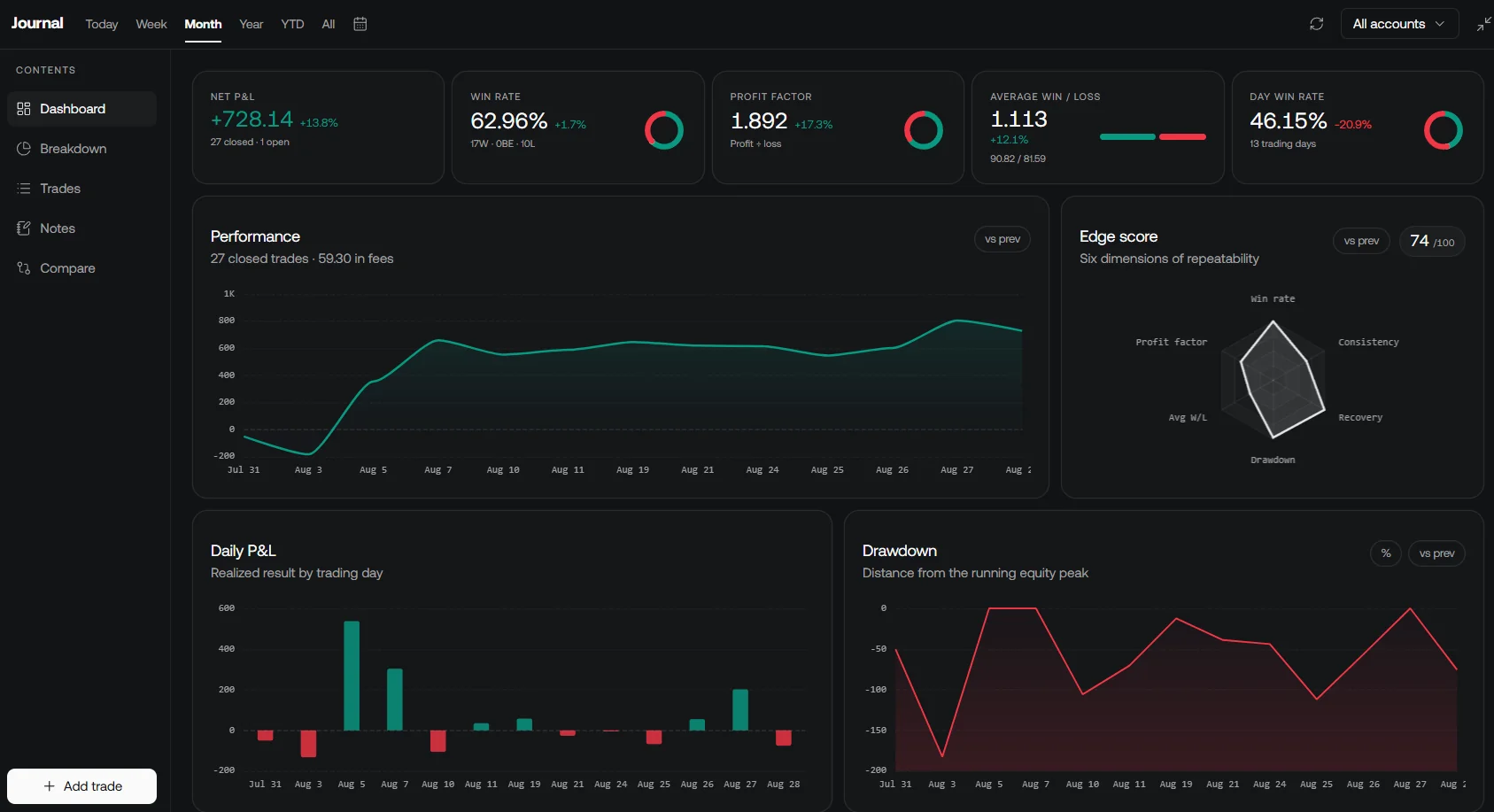
The native LuxAlgo journal supports trade review and compatible imports. Track fees, realized results, position sizes, and rule adherence across attempts. Journal statistics can identify a mismatch between the method and the account; they cannot certify eligibility for a provider’s payout or scaling review.
The strongest account choice is the one whose cost, loss allowance, trading conditions, and payout rules fit a method you have tested and can follow. A multimillion-dollar ceiling is useful context only after those nearer-term requirements are satisfied.
FAQs
Which prop firms offer the highest scaling limits?
Among the programs compared here, The5ers Hyper Growth and FundedNext Pro advertise paths to $4 million. Funded Trading Plus Express has a $2.5 million standard ceiling and a $5 million ceiling with its checkout Scaling Add-On. Each requires performance milestones and applicable reviews; these are not starting cash grants.
Is a $300,000 allocation the same as a $300,000 account?
No. An allocation can be the combined nominal balance of several accounts. FundedNext, for example, generally caps eligible Stellar accounts at $300,000 combined, while the Stellar 2-Step purchase tiers listed here top out at $200,000 and further restrictions can apply.
Can LuxAlgo guarantee that I pass a prop-firm evaluation?
No. LuxAlgo charts, Quant, and the journal support strategy research and review. Backtests and simulated probabilities depend on assumptions and may not reproduce every provider rule, execution condition, or payout requirement.
Read next