Retail Prop Firms vs Hedge Funds: Which Path to choose

A retail prop evaluation and a hedge-fund job are different ways to participate in trading. An evaluation is usually a paid service with performance conditions and possible contractual rewards. A hedge-fund role is employment or another professional arrangement within an investment business. Investing your own money in a hedge fund is a third, separate decision.
Choose by the relationship you want, the evidence you can demonstrate and the financial risk you can absorb. A low entry fee does not make an evaluation a dependable income source, while a salaried investment role does not guarantee job security. This comparison uses official information checked in September 2026 and separates account access, hiring, fund fees and employee pay.
Start with the Right Comparison
| Question | Retail prop evaluation | Hedge-fund career | Hedge-fund investment |
|---|---|---|---|
| How do you enter? | Buy an eligible program and meet its conditions | Apply, interview and meet the role’s requirements | Meet the offering’s investor criteria and subscribe |
| What do you contribute? | Fees, time and trading decisions | Professional work, research and judgment | Your own investment capital |
| How might you receive money? | Approved rewards under the account agreement | Salary, incentives or another negotiated arrangement | Returns on your fund interest, after costs |
| Main personal exposure | Fees, time, income uncertainty and payment risk | Career, employment and performance risk | Investment loss and restricted liquidity |
| What must be checked? | Rules, total costs, simulated/live status and payout terms | Actual duties, compensation, restrictions and culture | Offering documents, manager, fees and redemption terms |
Accredited-investor requirements concern investing in an offering; they are not a general requirement for applying to a hedge-fund job. Similarly, a fund’s management fee is revenue of the investment-management business, not the salary automatically paid to each analyst or trader.
Traditional proprietary trading firms add another distinction. An institutional prop firm can hire employees to trade its own capital without selling retail evaluations. Do not assume that every business using the word “prop” follows the challenge model described here.
How Retail Prop Evaluations Work
Assessment, Simulated Rewards and Possible Live Progression
A retail evaluation commonly begins with a simulated account, a profit objective and limits on losses or trading practices. Passing can qualify the participant for another stage, often still simulated. The word “funded” does not establish that every trade is executed with real money or that the displayed balance belongs to the participant.
Some providers have a separate live pathway. Topstep’s Live Funded Account policy explicitly describes real capital and real markets and distinguishes that stage from Express Funded Accounts. Check the selected provider’s actual progression rather than assuming passing any challenge creates an immediate live brokerage account.
The fee purchases a service under an agreement. It is not an investment in a hedge fund and generally does not make the participant an employee. Read the legal entity, account status, eligibility restrictions and permitted trading methods before treating the program as a career plan.
Rules Define the Usable Opportunity
Compare daily loss calculations, static or trailing drawdown, equity versus balance tests, position limits, permitted sessions and payout conditions. A nominal $100,000 account with a $3,000 loss cushion gives a different practical risk budget from $100,000 of freely deployable capital. Account size alone is a poor basis for comparing opportunities.
For example, if only $1,000 remains above the applicable loss floor, three correlated positions each risking $250 would expose roughly $750 before slippage. The platform may permit those positions, but a shared adverse move could consume most of the cushion. Model combined exposure and open losses rather than counting each trade independently.
Payout rules can include qualifying days, consistency limits, caps, buffers and reviews of prohibited practices. A high advertised share applies within those conditions. An 80% share of $1,000 of simulated profit does not necessarily mean an immediately withdrawable $800; the amount must first qualify under the agreement.
Entry Cost Is Not the Full Cost
Formal finance qualifications are often not part of a retail challenge purchase, but eligibility, identity checks and location restrictions still apply. “Work from anywhere” is too broad: residence, travel, platform access, trading hours and program rules can constrain participation. Easy purchase access also does not demonstrate readiness to pass.
Add evaluation purchases, recurring charges, resets, activation, data and transfer costs. The billing model varies. The current Apex offering, for example, distinguishes newer one-time-fee evaluations with 30-day expiry and no resets from legacy products. Historical monthly charges should not be transferred to every current account.
Our guide to how retail prop firms make money separates service fees, simulated reward obligations and actual live trading income. For a participant, the useful result is cash received minus every associated expense, not the highest simulated balance reached.
How Hedge Funds and Their Teams Work
The Fund and the Investment Manager
A hedge fund pools investor capital under a defined mandate. Its investment manager makes decisions for that pool; employees can work in investment research, trading, engineering, risk or supporting functions. Those responsibilities differ, and joining a team does not mean receiving immediate authority over the whole fund.
Strategies can include company-focused long/short equity, macroeconomic positions, relative-value trades or systematic models. Holding periods and research methods depend on the mandate. It is misleading to assign all hedge funds a long-term style or all retail prop traders a short-term one. Both settings can use systematic or discretionary processes.
The SEC’s hedge-fund investor guide describes private pooled funds with flexible strategies and potential use of leverage, short selling and derivatives. It also highlights investor eligibility, fees, valuation and redemption restrictions. These are fund-investment considerations, distinct from employee hiring requirements.
Fund Regulation Is Not the Same as Mutual-Fund Regulation
A private fund and its adviser are separate parts of the legal structure. The SEC’s private-fund overview explains that private funds use exclusions from investment-company registration, while advisers generally register with the SEC or state authorities unless an exemption applies. Antifraud rules still apply.
The same SEC overview distinguishes offering routes: Rule 506(b) generally prohibits general solicitation, while Rule 506(c) permits it subject to its conditions. The older claim that hedge funds must always rely on private introductions was therefore too broad. Registration, offering and disclosure obligations depend on the actual structure.
Institutional risk and compliance systems do not guarantee investor returns, financial stability or an employee’s job. Nor should readers assume every hedge fund publicly publishes an audited performance history. Examine the relevant documents, firm policies and role instead of treating the industry label as a universal protection.
Getting Hired: Credentials Depend on the Role
A hedge-fund career can begin through an internship, graduate program, experienced analyst role, quantitative research position or another specialist route. The appropriate preparation depends on the work. A fundamental equity role may emphasize accounting, valuation and company research; a quantitative role may emphasize statistics, programming and experimental design.
Current hiring evidence contradicts the idea that everyone needs an advanced degree and years of capital-management experience. Citadel’s 2027 U.S. Equities Associate Program accepts applications from undergraduates graduating between December 2026 and July 2027 and says prior finance experience is not required. It emphasizes analytical ability, communication, academic performance and interest in investing.
That is one selective program, not a promise that every fund offers the same route. Experienced portfolio-manager positions can require a much different record. Read current job descriptions and build evidence for the role you want rather than collecting credentials without a clear purpose.
- For fundamental research: prepare a company thesis, valuation, catalysts, downside case and explanation of what would change your view.
- For systematic research: document the hypothesis, data, implementation, costs, validation period and failure cases.
- For trading or execution: explain market mechanics, order choices, liquidity and operational controls.
- For every role: communicate uncertainty, accept criticism and make the work reproducible.
A retail evaluation result can be one part of a personal record, but it is not automatically an institutional investment track record. Explain whether results were simulated or live, what fees and constraints applied, and how much history was observed. Do not describe a nominal funded balance as assets you independently managed for outside investors.
Compare Pay Without Mixing Fee Models
Retail Rewards: Measure Cash After Costs
Retail evaluation income is usually contingent on performance and approval conditions. A participant may receive no reward while still incurring fees and spending substantial time. Budget from money you can afford to spend, not an assumed monthly payout.
Suppose three attempts cost $100 each, additional charges total $80, and you eventually receive a $700 cash reward. The cash result is $320 before other expenses and tax. If no reward arrives, the same activity costs $380. This hypothetical example is not a forecast or a provider’s published success rate.
Employee Compensation: Read the Actual Offer
A hedge-fund employee may receive a base salary plus discretionary or formula-based incentives, depending on the contract. Benefits, deferred compensation, performance conditions and termination terms can materially affect the comparison. Do not budget a discretionary bonus as guaranteed income.
The Citadel role cited above lists a New York base salary range of $125,000–$135,000 plus eligibility for a discretionary incentive program and benefits. Those figures apply to that advertised role at the time checked. They are not an industry average, a typical first-year total or evidence that every applicant can obtain that compensation.
“Two and Twenty” Is a Fund Fee Example
A management fee and performance fee are charged under the investor’s fund agreement. They are not a standard employment pay formula. Actual rates, fee bases, hurdles, high-water marks and expense allocations vary. Compare the contract instead of assuming every fund charges exactly 2% and 20%.
For illustration, assume $1 million invested, a 2% management fee calculated on starting capital and a 20% performance fee applied to gains after that management fee, with no hurdle or high-water-mark adjustment. A $100,000 gross gain would be reduced by $20,000 of management fees and $16,000 of performance fees, leaving $64,000 before other expenses and tax. Different calculation rules change the result.
That arithmetic describes a hypothetical investor fee arrangement. It does not tell you an analyst’s salary, a portfolio manager’s bonus or the owner’s net profit after running the business. Keep those separate when comparing a retail reward share with a hedge-fund career.
Lifestyle, Risk and Career Stability
| Dimension | Retail evaluation participation | Hedge-fund employment |
|---|---|---|
| Autonomy | Often independent, within the provider’s account rules | Depends on seniority, mandate and team oversight |
| Schedule | Market sessions, platform access and account restrictions matter | Role, market coverage, meetings and employer location policies matter |
| Research feedback | Often self-directed; quality of external feedback varies | May include analysts, portfolio managers, engineers and risk teams |
| Income planning | Rewards can be irregular or absent | Base salary may support planning; incentives and employment remain uncertain |
| Risk controls | Account loss limits and contractual eligibility tests | Portfolio exposure, liquidity, concentration, compliance and operating controls |
| Progression | Provider-specific scaling or live pathways, if offered | Role-specific development, promotion or movement between teams |
Neither column implies a universal lifestyle. Some investment businesses support remote or hybrid work; others require close office collaboration. Independent trading can still require fixed session hours. Confirm the actual location, travel and availability requirements rather than choosing from a remote-versus-office stereotype.
Risk oversight also serves different purposes. A retail rule can determine whether a simulated account remains eligible for rewards. A fund’s controls can address portfolio liquidity, leverage, counterparty exposure and investor obligations. Both require discipline, but one set of limits is not a substitute for the other.
Career stability is conditional. Salary reduces dependence on each individual trade, but a firm can close a strategy, reduce a team or terminate employment. A retail program can change its offer or cease operating. Our retail prop regulation guide explains why account status, legal entity and contractual payment rights need separate review.
Which Path Fits Your Current Position?
Consider a Retail Evaluation When the Budget and Process Are Ready
This route may fit someone who wants to test an independent process against a specific rule set and can absorb the fees without depending on rewards for essential expenses. Start by demonstrating repeatable execution in an appropriate practice environment, then calculate the full cost of the selected account.
It is a poor substitute for a salary when you need reliable near-term income. Repeated purchases without a tested process can turn a low advertised fee into a substantial expense. Set a maximum budget and a review point; a failed attempt should trigger analysis, not an automatic new purchase.
Pursue a Fund Role When You Want Professional Research Work
This route may fit someone who enjoys developing investment evidence, collaborating and working within a mandate. Choose a role family first, then compare its required skills with work you can already demonstrate. Targeted research projects and clear communication can be more useful than a generic claim that you enjoy markets.
If you need an employment income path, focus on applications, role preparation and a broader job search. Buying evaluations is not a necessary prerequisite for applying to an investment team. Check the employment contract for personal trading, outside activities, confidentiality and intellectual-property restrictions before combining the two.
Investing in a Fund Requires a Separate Suitability Decision
If your goal is to allocate savings rather than perform trading work, neither a career comparison nor a retail challenge is the right starting point. Review investor eligibility, strategy risk, fees, valuation and liquidity. A fund subscription exposes your own invested capital; it is not employment and does not provide a salary.
The offering documents determine the actual redemption rights. A fund can have lockups, notice periods or suspension provisions, so money needed for near-term spending may be unsuitable. Meeting an eligibility test does not make a particular investment appropriate or safe.
Develop Evidence with LuxAlgo
Use LuxAlgo’s native charts to make the research question explicit: the instrument, timeframe, entry, exit and risk assumptions. Work with Quant, our coding agent to express a systematic idea in code. Inspect the generated code and run the strategy yourself. Generation does not establish an edge, employment qualification or compliance with a prop agreement.
Use native strategy testing with standard candles, realistic commission and slippage, and a testing period separate from development. Check data availability and document assumptions about fills, session boundaries and contract size. Include weak periods and failed ideas instead of presenting only a favorable chart.
For a retail program, test account-specific loss and reward conditions separately where the strategy test does not represent them. For a career portfolio, explain why the hypothesis should work, how you tried to disprove it and what the results cannot establish. Fundamental roles also require business and valuation work beyond a technical chart.
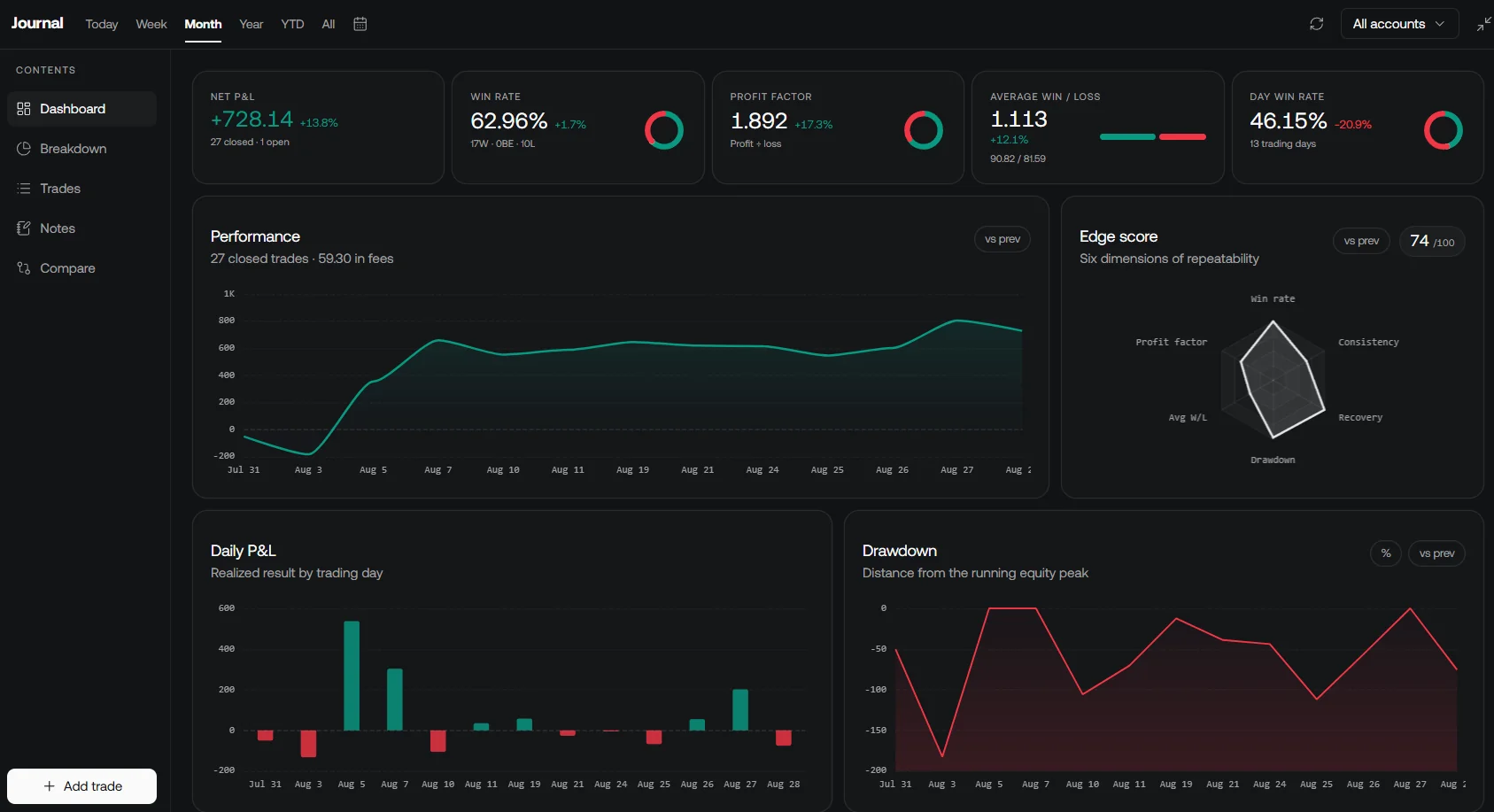
Use the native LuxAlgo journal to review supported trade records by instrument, session and strategy. Keep evaluation costs and actual cash rewards in a separate ledger. A concise explanation of decisions and mistakes is more informative than a profit screenshot without context.
The Library adds market-structure, trend and momentum tools to a Quant Chart, and Quant can turn any of them into a strategy and backtest it against years of history. Review current plans and access for the workflow you intend to use.
The LuxAlgo Prop Firms portal can help organize account comparisons and explore modeled scenarios. Verify reference rules against the current purchased program. Simulated outcomes depend on assumptions and are not observed personal pass probabilities; partner discounts do not establish suitability or the lowest total cost.
Choose the next step you can justify with evidence: a bounded evaluation budget, a role-specific application project or an investment review. A clear understanding of the relationship and its costs matters more than choosing the label that sounds most prestigious or accessible.
Frequently Asked Questions
Do I need to be an accredited investor to work at a hedge fund?
Accredited-investor criteria relate to investing in certain offerings, not a general hiring requirement. Job requirements depend on the employer and role, and may concern research, technical skills, education, experience and work eligibility.
Is a retail funded account the same as a hedge-fund job?
No. A retail program usually provides a service and possible rewards under an account agreement. A hedge-fund job involves professional duties and an employment or other negotiated work arrangement. Simulated funded status does not establish employment.
Do all hedge-fund jobs require an advanced degree?
No. Requirements vary by role. Some firms offer undergraduate entry programs, while specialist or experienced positions can require different qualifications and evidence. Check current official job descriptions.
Is a hedge fund’s 20% performance fee the trader’s bonus?
Not automatically. A performance fee belongs to the fund’s investor fee arrangement. Employee compensation is set separately and can include salary, discretionary incentives or another negotiated formula.
Can LuxAlgo guarantee a passed evaluation or a hedge-fund role?
No. LuxAlgo charts, Quant, strategy testing and the journal support research and review. You must inspect and run strategies, verify account rules and demonstrate the skills required for a role. Results and hiring outcomes are not guaranteed.
Read next