Top 5 CFD Prop Trading Firms in 2026 for Retail Traders

Compare CFD prop trading firms by the account you can actually obtain, its loss rules, and its reward conditions. A large scaling ceiling, a low entry fee, and a high advertised profit split may belong to different programs. This review examines DNA Funded, Funded Trading Plus, ThinkCapital, FTMO, and FundedNext, with that distinction kept visible throughout.
These providers offer simulated trading programs and conditional performance rewards. Nominal account balances are virtual funds, not deposits you can withdraw. DNA Funded currently says new orders are paused, so it is included for continuity and existing-account context rather than presented as an available purchase recommendation.
Quick Comparison: Starting Accounts vs. Scaling
| Firm / example model | Starting accounts and fee example | Reward share | Allocation or scaling distinction |
|---|---|---|---|
| DNA Funded 1-Phase | Listed $5,000–$200,000; $59 entry, but new orders paused | 80% base; 90% booster | Advertises $600,000 combined simulated capital |
| Funded Trading Plus Express | $10,000–$200,000; $100,000 list fee $549 | 80% base | Express allocation $200,000 before scaling; $2.5M conditional standard ceiling |
| ThinkCapital Nexus | $5,000–$100,000; $39 for $5,000 | 80%; 90% through add-on or scaling | Current program pages describe scaling up to $1M |
| FTMO 2-Step | $10,000–$200,000; fees from €89 | 80%; qualified increase to 90% | $400,000 combined before scaling; $2M conditional ceiling |
| FundedNext Stellar 2-Step | $6,000–$200,000; standard fees from $59.99 | Check selected model and add-ons; Pro share 90% | $300,000 eligible aggregate; Pro progression toward $4M |
Fees exclude optional upgrades unless stated. FTMO’s euro fees are not dollar prices, even when the selected trading account is denominated in USD. Temporary promotions should be compared separately from list prices. The limits above do not imply identical risk capacity, reward eligibility, or execution conditions.
1. DNA Funded: New Orders Currently Paused
DNA Funded’s current notice says MT5 accounts are migrating to TradeLocker, affected clients are notified directly, and new orders are paused. It also says other trading remains unaffected. Existing traders should use their account-specific migration instructions; new buyers should verify that ordering has resumed before comparing purchase terms.
The listed 1-Phase schedule offers $5,000, $10,000, $25,000, $50,000, $100,000, and $200,000 accounts at $59, $89, $179, $319, $619, and $1,209 respectively. Its current listed target is 10%, daily loss limit 4%, maximum loss 6%, and minimum trading days five. These replace older Single Helix figures; do not apply them to every DNA model.
DNA advertises up to $600,000 in combined simulated funded capital, which differs from its largest individual challenge. Its official FAQs distinguish the 80% base share from a 90% booster and a standard 14-day reward cycle from a seven-day add-on. Compatible EAs may be permitted on standard evaluation models, while Instant Funding and the 24-hour model require manual trading. Platform compatibility needs a fresh check after migration.
The original comparison included Single Helix, Double Helix, and a timed Pro model. Those older prices and targets should not be treated as an active offer during the current transition. A related broker’s regulatory status also does not establish that the simulated prop program itself holds that licence or provides the same protections as a brokerage account.
2. Funded Trading Plus: Express and Instant Are Different
Funded Trading Plus offers 1-Step Express accounts from $10,000 to $200,000. Current Instant and 2-Step Classic selections top out at $100,000. Express uses a 10% evaluation target, a 6% balance-based trailing maximum loss, a 4% daily loss allowance, and an 80% standard reward split. The $100,000 Express list fee is $549 before promotions or extras.
Under the Express rules, maximum loss trails the closed-balance high-water mark by a fixed 6% of starting size and stops trailing when the floor reaches starting balance. The daily rule uses the previous trading day’s closed balance and resets at 23:59 server time. Overnight and weekend holding are permitted on Express. At least one trade must open and close in each 30-day period.
After passing and receiving the FT+ Trader account, Express permits a reward request when in profit from day one, with a $50 minimum and subsequent seven-day intervals, subject to review and processing. That is an eligibility window, not a promise of cash arriving the same day.
The Instant program skips evaluation but has its own price and risk rules. Its standard $5,000 entry lists $249, with 6% relative maximum and 6% daily loss limits. It requires Friday position closure, unlike Express. Do not attach Instant’s rules to Express merely because both programs can permit early reward requests.
The allocation policy allows up to two Express simulated-live accounts totaling $200,000 before scaling. Classic has a separate one-account restriction and cannot be held alongside an Express simulated-live account under that policy. Instant has a separate account-count policy.
Express scaling requires 10% new profit at each level, retained in the closed balance, no open trades when requesting the scale, and a risk review. Its standard ceiling is $2.5 million; a $5 million ceiling requires the Scaling Add-On bought at checkout. The former article’s “up to 100%” reward-share claim should not replace the selected program’s current starting share.
3. ThinkCapital: Compare Lightning, Dual Step, and Nexus
ThinkCapital currently separates one-, two-, and three-step evaluations and a separate Bolt Instant program. Its program pages list $5,000–$100,000 evaluation accounts. The low $39 entry belongs to Nexus, a three-phase challenge, rather than every plan.
| Program | Displayed $5,000 fee | Profit targets | Daily / maximum loss |
|---|---|---|---|
| Lightning | $59 | 10% | 3% balance-based daily; 6% trailing maximum |
| Dual Step Intraday | $59 | 9%, then 5% | 4% equity-based daily; 7% challenge / 8% funded static maximum |
| Dual Step Swing | $82 | 9%, then 5% | 4% balance-based daily; 7% challenge / 8% funded static maximum |
| Nexus | $39 | 7%, then 6%, then 5% | 4% balance-based daily; 8% static maximum |
The Lightning page describes a 6% trailing maximum that locks at starting balance after a 6% gain. It lists 1:30 leverage, three minimum trading days, no overall time limit, and at least one trade every 30 days. A shorter evaluation does not necessarily provide a larger loss buffer.
Dual Step distinguishes Intraday from Swing: their daily-loss reference differs, and the funded Intraday version restricts news and weekend holding while Swing permits both under the stated program rules. Both list 80% starting rewards, with 90% through scaling or an add-on, and a 14-day reward cycle that can be shortened by an add-on.
Nexus has three targets and an 8% fixed maximum loss. Its page lists three minimum trading days, unlimited time, weekend holding, and a news-trading add-on. Read the current account terms before assuming an EA permission or news option applies across all programs and stages.
The current evaluation pages describe a $1 million scaling ceiling, replacing the original article’s $1.5 million figure. They advertise a 20% increase after a qualifying 10% return over three months; confirm the complete eligibility conditions before relying on that progression. ThinkCapital’s disclosure says it provides simulated trading services and does not accept deposits or act as a broker. Its relationship with ThinkMarkets should not be described as a guarantee of regulatory protection for the prop account.
4. FTMO: Choose the Evaluation and Account Type Separately
FTMO’s current comparison is 1-Step versus 2-Step. Standard and Swing are account types, with Swing available only through 2-Step. Both models list $10,000–$200,000 simulated accounts, but their objectives and refund policies differ.
| FTMO feature | 1-Step | 2-Step |
|---|---|---|
| Evaluation targets | 10% | 10%, then 5% |
| Daily loss amount | 3% of starting capital | 5% of starting capital |
| Maximum loss | 10% end-of-day trailing | 10% static |
| Minimum trading days | No separate minimum-day rule | Four opening-trade days per phase |
| Best Day Rule | ≤50% of positive days’ profit | Not applicable |
| Starting reward share | 90% | 80%; 90% when qualified |
| Entry fees | From €79; not refunded | From €89; may be reimbursed with first reward |
FTMO’s daily loss rule uses the midnight CE(S)T balance minus the fixed daily allowance, and equity includes open profit or loss, swaps, and commissions. Its 1-Step maximum trails the highest midnight balance, while 2-Step keeps a static floor. The 1-Step Best Day calculation uses profitable days only; exceeding 50% delays passing or reward eligibility rather than automatically breaching the account.
The combined allocation limit is $400,000 per trader or strategy before scaling, shared across these models. The Scaling Plan can add 25% after qualifying four-month periods toward $2 million, requiring the specified profit, reward, activity, and balance conditions. It is not a $2 million starting account.
The later Standard FTMO Account restricts affected instruments around selected news and requires closure before weekends or market breaks longer than two hours. These restrictions differ from evaluation-stage permissions; Swing is exempt from those specific restrictions. For worked loss examples and the current fee table, see the detailed FTMO review.
5. FundedNext: Keep Stellar Models and Scaling Versions Distinct
FundedNext’s Stellar 2-Step lists $6,000, $15,000, $25,000, $50,000, $100,000, and $200,000 accounts. Standard displayed fees range from $59.99 to $1,099.99 before promotions. Its evaluation targets are 8% and 5%, with a 5% daily loss limit, 10% static maximum loss, and five minimum trading days.
The allocation policy allows $300,000 combined across eligible Stellar accounts, rather than a $300,000 standard single purchase. Stellar Lite has a $200,000 allocation cap. Cambodia, Mongolia, Slovakia, Slovenia, Taiwan, Ukraine, the Czech Republic, and Pakistan have a $50,000 limit under the cited policy. Platform availability also matters: the policy restricts $100,000 and $200,000 purchases on Match-Trader and cTrader, with an exception for U.S. Match-Trader users.
The current FundedNext Pro plan offers conditional 25% increases toward $4 million and a 90% reward share. Initial eligibility requires four received Performance Rewards, at least 4% growth in each qualifying reward cycle, and a minimum two-month presence. A cycle below 4% does not count but does not disqualify the account. Merged accounts cannot participate.
Stellar challenges purchased or reset before January 12, 2026 retain the previous scale-up criteria. Stellar Instant has a separate starting balance and progression. Keep these paths distinct; neither a higher advertised split nor the $4 million ceiling overrides current risk, payout, or country restrictions.
Stellar Instant skips the challenge and uses its own reward thresholds, drawdown, fees, and scaling path. A current Instant offer therefore should not be paired with Stellar 2-Step’s $200,000 starting option or its Pro progression. A headline “up to 95%” share also does not mean every new account starts at 95%. Read the model’s standard share and any paid upgrade separately.
Pros and Cons: Which Tradeoffs Matter?
| Reader priority | Options to investigate | Important tradeoff |
|---|---|---|
| Lower entry cost | ThinkCapital Nexus; smaller Stellar or FTMO accounts | More evaluation phases or less usable dollar loss capacity |
| Earlier reward-request window | Funded Trading Plus Express or Instant | Eligibility, reviews, minimum requests, and different holding rules still apply |
| Static maximum loss | FTMO 2-Step, ThinkCapital Dual Step/Nexus, Stellar 2-Step | Daily limits and other risk rules remain |
| Swing positions | FTMO 2-Step Swing or ThinkCapital Dual Step Swing | Select the appropriate account type and account for gaps and carrying costs |
| Conditional long-term scaling | FTMO, FundedNext Pro, Funded Trading Plus | Requirements differ; nominal ceilings are not starting balances |
| Existing DNA account | Current migration and account-specific instructions | New orders remain paused during the stated transition |
Compare total cost, including resets, commissions, spreads, swaps, platform fees, add-ons, and withdrawal conditions. A low fee is not evidence of a suitable risk profile. Scalping is not interchangeable with prohibited high-frequency or latency-exploitation methods, and permission to use an EA does not authorize every strategy it can execute.
Prepare a Rule-Based Strategy with LuxAlgo
LuxAlgo is a charting and AI platform. Use native charts to study market context, then work with Quant, our coding agent to develop explicit entries, exits, session rules, and position sizing. Review the generated code and run the strategy yourself. Confirm that its behavior matches the written plan before judging its historical results.
In native strategy backtesting, use standard candles, realistic commission and slippage assumptions, appropriate sizing, and enough history to cover different conditions. Test a separate period that did not guide development. A historical maximum drawdown statistic is not automatically the same as a prop firm’s intraday equity floor, midnight reset, or trailing-loss formula.
Translate the Rules into Dollar Exposure
For a $100,000 account with a 5% daily allowance, the nominal allowance is $5,000, but the remaining cushion depends on the rule’s reference balance and current equity. Existing positions, correlated trades, and costs consume that cushion. A planned $500 risk on each of four closely related trades can create roughly $2,000 of concentrated exposure before gaps or slippage; separate symbols do not necessarily diversify risk.
Write down the profit target, current loss floors, reset time, news window, holding restrictions, and conditions for a reward request. Then define your own smaller session risk limit and pause conditions. An alert can prompt you to check the plan; it does not guarantee a stop fill or enforce the firm’s rules.
Test a Small Number of Clear Setups
- Trend continuation: define the higher-timeframe trend, acceptable pullback, entry confirmation, and invalidation level.
- Breakout and retest: define the range and confirmation needed, then test false breaks and execution costs.
- Mean reversion: specify the range conditions that justify the trade and what ends the reversion premise.
- Session rules: trade a defined window and test how exclusions around news and market closure change results.
These are starting points for research, not strategies proven to pass current challenges. Avoid choosing a system solely because its historical result barely reaches a target. Inspect losing streaks, costs, and performance outside the development sample.
Keep Chart Tools and Firm Rules Distinct
The Library’s market-structure, trend and momentum tools on a Quant Chart have specific analytical roles. Use a condition only when it has a defined place in the strategy: require a structure break before a pullback entry, for example, rather than treating an order-block label as a guaranteed reaction zone. No tool proves institutional positioning or makes a setup compliant with a firm’s rules. Check current LuxAlgo plans for access and billing terms.
Review Trades and Compare Model Assumptions
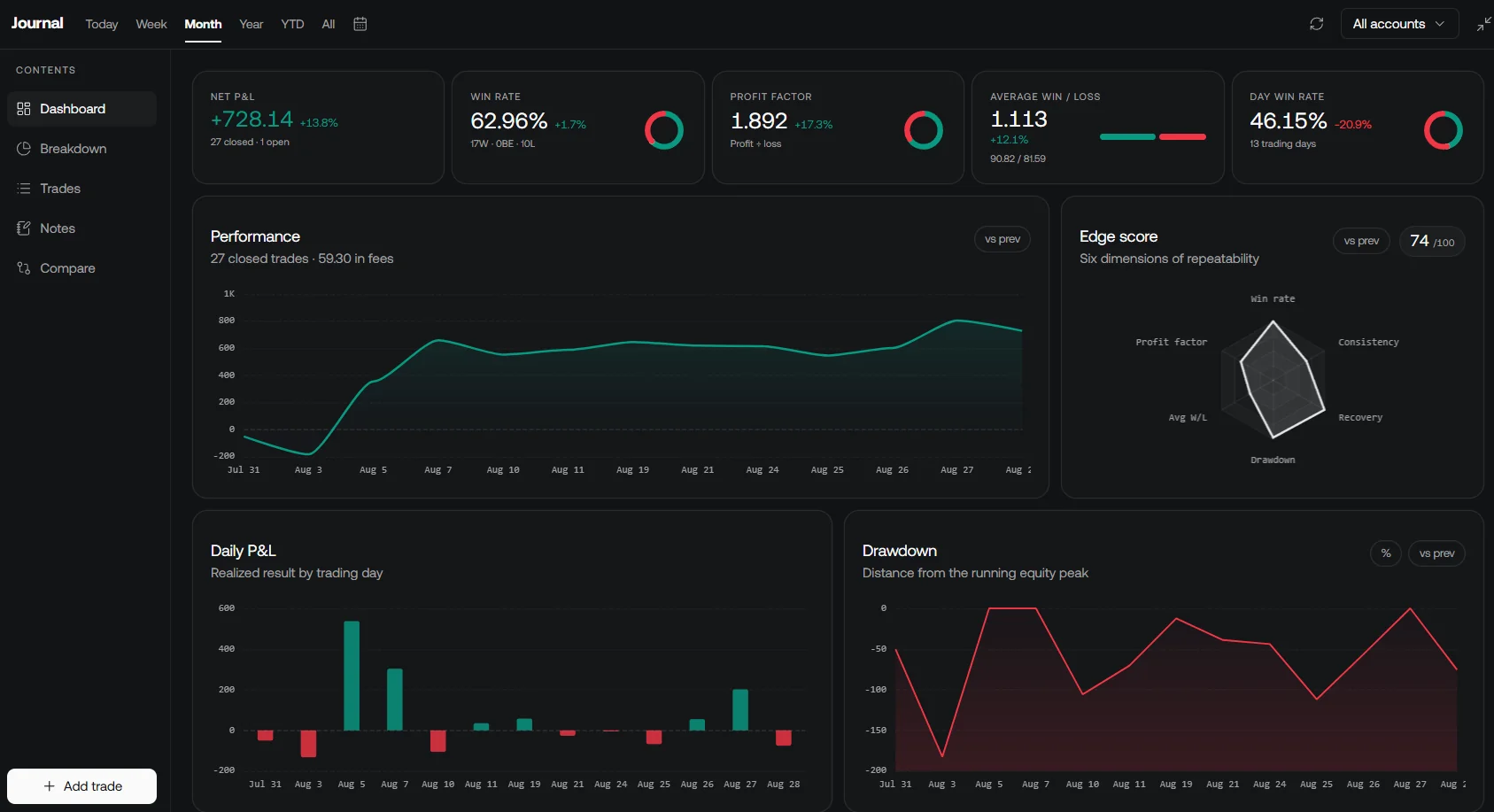
Use the native LuxAlgo journal to review supported trade imports and compare actual behavior with your plan. Keep the provider’s dashboard as the authority for account limits and reward eligibility. A profitable strategy backtest or journal record does not guarantee a reward.
The LuxAlgo Prop Firms portal can help compare offers and explore modeled scenarios using trading statistics. Its results depend on assumptions and reference rule profiles; they are not an observed personal pass probability. Match the selected model to the provider’s current rulebook. Verify discounts and their conditions rather than assuming an offer is the highest available or a reason to buy an unsuitable account.
Frequently Asked Questions
What should I compare before choosing a CFD prop firm?
Compare the specific model’s starting size, fee, loss calculations, reward conditions, platform, and permitted strategies. Check current availability and regional restrictions before considering a scaling ceiling.
Are the advertised maximum funding amounts comparable?
Not directly. They may describe one account, combined allocation, or a conditional scaling ceiling. Calculate the actual dollar loss allowance and distinguish starting capital from later growth.
Is DNA Funded accepting new orders?
Its current public notice says new orders are paused during a platform transition. Existing-account trading and migration instructions are separate; verify an official reopening before purchasing.
Can LuxAlgo guarantee a passed challenge?
No. LuxAlgo charts, Quant, toolkits, and the journal support strategy research and review. They do not guarantee performance, enforce every provider rule, or establish an execution connection to a prop account.
Read next