Top 5 Futures Prop Firms in 2026 Compared

A futures prop firm’s advertised account size tells you far less than its drawdown, payout rules, and total fees. This comparison covers Apex Trader Funding, Take Profit Trader, BluSky, Elite Trader Funding, and Earn2Trade. Each offers a different route through evaluation, simulated funded trading, and, where available, a separate live-account transition.
The figures below reflect official pages checked in September 2026. A simulated $50,000 account is not $50,000 of cash you can withdraw or lose: its permitted loss may be only $2,000. Compare the exact program, purchase date, platform, and funded-stage agreement before paying. Temporary discounts are identified separately from standard prices.
Quick Comparison of Five Futures Prop Firms
| Firm / example | Entry cost and size | Evaluation structure | Reward terms to examine |
|---|---|---|---|
| Apex, new Intraday Trail | 25K example: $167 list fee; new sizes 25K–150K | 30-day evaluation; one-day minimum; separate PA terms | New EOD PA: 100% of approved payout, five qualifying days, safety net and payout caps |
| Take Profit Trader | 25K $150/month; 50K $170/month; up to 150K | Three-day minimum, EOD drawdown and profit consistency | PRO 80%, buffer required; PRO+ live 90% |
| BluSky Launch | 50K $59/30 days plus $99 after passing | Evaluation, Buffer Zone, then Sim Funded | 90% standard share; daily requests with minimums and rolling caps |
| Elite Trader Funding 1-Step | 50K $207 list / $62.10 displayed sale per 30 days | Five-day minimum; intraday unrealized-profit trailing drawdown | Up to 100% SIM rewards; account-specific cycles; LIVE ELITE 80% |
| Earn2Trade TCP25 | 25K from $150/month; Gauntlet Mini 50K from $170/month | No separate minimum-day rule; 30% consistency remains | 50% or 80% depending on withdrawal size; TCP400 has fixed 60/40 split |
These examples are not equivalent offers. Apex’s new evaluation fee is nonrecurring but its access expires after 30 days; the other examples renew while in evaluation. Activation, data, resets, and payment charges can add to the cost. “Daily payouts” generally describes an eligible request or processing schedule, not guaranteed same-day arrival in a bank account.
1. Apex Trader Funding: Separate New and Legacy Accounts
Apex’s current product selector offers new Intraday Trail and EOD Trail accounts at $25,000, $50,000, $100,000, and $150,000. It distinguishes these from legacy accounts originating before March 1, 2026. The site also advertises a limited-time return of legacy evaluations, so availability must be checked separately from the standing new-product range.
For the new 25K Intraday Trail example, Apex lists a $1,500 profit target, $1,000 maximum drawdown, four mini or 40 micro contracts, and a one-day minimum to pass. The displayed standard evaluation price is $167 before its current coupon. Access lasts 30 days, with no recurring billing and no evaluation reset. Standard and No Activation Fee selections differ, so include the selected Performance Account cost when comparing checkout totals.
An intraday trailing floor follows favorable equity movement during the session. An EOD trailing model changes the reference at the end of the day, but that does not mean the account can ignore its current floor intraday. Confirm the selected account’s daily-loss and scaling rules rather than repeating the old blanket claim that Apex has no daily loss restriction.
Payout Rules on New EOD Performance Accounts
The new EOD payout policy pays 100% of the approved request. It requires five qualifying profit days, a safety net, a $500 minimum request, and consistency: no single profit day may account for 50% or more of profit since the last approved payout. The older “100% of the first $25,000, then 90%” formula should not be applied to these new EOD accounts.
| New EOD PA | Profit needed on each of five qualifying days | Balance required to request at least $500 | First payout maximum |
|---|---|---|---|
| 25K | $100 | $26,600 | $1,000 |
| 50K | $250 | $52,600 | $1,500 |
| 100K | $300 | $103,600 | $2,000 |
| 150K | $350 | $154,600 | $2,500 |
The safety net is the drawdown allowance plus $100, added to starting balance, and must be retained throughout the PA’s life. Each PA is limited to six approved payouts, with size- and cycle-specific caps; after the sixth it closes. Qualifying for another PA requires another evaluation. A 100% split therefore does not make all displayed profits immediately withdrawable.
Apex may appeal to traders who want to choose between intraday and EOD trailing structures, or compare multiple-account arrangements. Its site advertises up to 20 accounts, but correlated trades across accounts can multiply the same risk. Use the rulebook for the actual product and purchase date; the old $300,000 legacy table, seven-day evaluation minimum, and recurring fees are not a reliable description of the new offer.
2. Take Profit Trader: Understand the PRO Buffer
Take Profit Trader uses a Test → PRO → PRO+ pathway. Test and PRO accounts are simulated; PRO+ sends orders to the live market through its broker. PRO pays an 80% trader share. PRO+ has a 90% share, EOD drawdown, and no PRO-style buffer requirement. Paying the standard $130 PRO activation fee does not itself purchase a 90% share; promotions may waive that fee.
| Account size | Standard monthly Test price | PRO balance threshold before withdrawing profits above buffer |
|---|---|---|
| 25K | $150 | $26,500 |
| 50K | $170 | $52,000 |
| 75K | $245 | $77,500 |
| 100K | $330 | $103,000 |
| 150K | $360 | $154,500 |
The 50K Test currently lists a $3,000 target, $2,000 EOD trailing drawdown, and six mini or 60 micro contracts. Its former $1,100 daily loss limit is shown as removed. The current consistency rule requires at least three trading days and a largest profit day below 50% of total net profit. An oversized winning day does not automatically fail the test; it can require additional profit before passing. Check the dashboard’s adjusted target as well as the ratio.
For example, a $2,000 best day and $3,100 total net profit produces a consistency percentage of about 64.5%. Hitting the normal $3,000 target is insufficient in that case. That is a performance-distribution rule, not a reason to add unnecessary trades solely to finish quickly.
The PRO withdrawal policy permits day-one requests after sufficient profit is built above the buffer. On 50K, the buffer threshold is $52,000. Withdrawing profits inside the buffer requires account termination and uses separate conditions and reduced-share rules; it should not be confused with ordinary ongoing withdrawals.
The PRO rules differ materially from the Test: the drawdown trails intraday peak equity, including unrealized gains, until its floor reaches starting balance. All trades must be manually executed; bots and automated trading are prohibited. PRO also requires weekly trading activity and prohibits positions and open orders one minute before, during, and one minute after specified news, including CPI, NFP, and FOMC announcements, with additional instrument-specific events.
TPT supports platforms through CQG and Rithmic, including NinjaTrader and Tradovate, and advertises up to five PRO/PRO+ accounts combined and up to three PRO resets. The relevant advantage is a clear withdrawal pathway once eligible; the tradeoff is that the PRO drawdown and news rules can differ from the conditions under which the trader passed.
3. BluSky: Evaluation, Buffer Zone, and Sim Funded
BluSky’s current plans include Launch, Propel, Orbit, and an Instant Funding selection. The old Premium/Advanced subscription table no longer describes the main offer. The current pricing selector lists the 50K Launch at $59 per 30 days plus a $99 launch fee after passing. Its 50K Propel selection displayed a $160 standard subscription, discounted to $112; use the selected plan’s current terms rather than treating the lowest advertised entry as universal.
The Launch rulebook separates three stages. On 50K, evaluation requires $3,000 profit within a $2,000 EOD trailing drawdown and 50% consistency. After passing, the $99 fee is due within 14 days; the subscription stops. The Buffer Zone then requires another $3,000 profit, the same $2,000 drawdown, and 34% consistency. This is not a direct jump from a two-day evaluation into unrestricted withdrawals.
| Launch size | Evaluation target / drawdown | Fee after passing | Buffer target | Sim Funded balance / seven-day payout cap |
|---|---|---|---|---|
| 50K | $3,000 / $2,000 EOD | $99 | $3,000 | $3,000 / $2,500 |
| 100K | $6,000 / $2,500 EOD | $149 | $3,500 | $3,500 / $3,000 |
| 200K | $6,000 / $2,000 static | $179 | $3,000 | $3,000 / $2,500 |
Launch consistency divides the largest profitable day by the sum of profitable days, excluding losing days. That differs from TPT’s net-profit denominator. A trader with $1,000 as the best day, $3,400 in positive days, and a $600 losing day has a 29.4% ratio under BluSky’s stated method, versus 35.7% if divided by $2,800 net profit. Drawdown rules still count losses even when the consistency denominator excludes them.
Under the payout policy, the standard split is 90% to the trader, subject to risk-team review. Eligible requests before 11 a.m. ET are normally processed that trading day, while transfer time may be one to three business days. Standard minimum requests are $250 above the relevant starting-balance threshold. Daily availability does not remove account-specific caps or the requirement for meaningful trading between requests.
The Sim Funded rules allow up to three accounts and impose rolling seven-day payout limits. They require stopping trading while a withdrawal is pending until funds are removed, and during a risk review. They also require stopping for the day at $5,000 profit and for the week at $10,000 profit; review is required around $10,000 total profit per account for possible brokerage progression. These restrictions make the website’s brokerage “no caps” message unsuitable as a description of the Sim Funded stage.
BluSky also advertises coaching and a trading community. Its structured buffer phase may suit traders who want to separate evaluation from reward eligibility, but compare both targets and reset costs. Launch evaluation resets currently cost $49/$59/$69 by size; the Buffer Zone has its own escalating reset fees. Passing one phase does not eliminate the cost of mistakes in the next.
4. Elite Trader Funding: Match the Plan to the Drawdown
Elite Trader Funding’s plan selector distinguishes 1-Step, Direct to Funded, Static, Diamond Hands, End of Day, and Fast Track. Its current 1-Step purchase cards list 50K, 100K, and 150K, even though some surrounding site copy still references larger older sizes. Use the selectable product and its rulebook rather than a legacy maximum-balance claim.
The 50K 1-Step example lists a $3,000 target, $2,000 drawdown following realized and open profit, eight mini or 80 micro contracts, no separate daily loss limit, and five minimum evaluation days. Its $207 standard 30-day subscription was displayed at $62.10 during the current sale. The card lists a $47 evaluation reset and funded billing options, including a $177 one-time activation option; confirm the chosen billing model and optional add-ons.
- 1-Step: the loss floor follows intraday unrealized profit. A winning open trade can raise the floor before it closes.
- Static: the loss floor stays fixed. Profits build distance from that floor, but the initial allowance can be small.
- End of Day: the trailing reference is based on realized results at the close, with a separate daily-loss hard breach.
- Diamond Hands: intended for overnight/weekend holding, with EOD and daily-loss conditions. Verify the selected plan before holding through a close.
- Direct to Funded: skips the evaluation but retains its own drawdown, qualifying-day, and reward restrictions.
- Fast Track: has current 10K variants and separate funded billing and payout tables. Do not assume the old 14-day description or another plan’s reset permission applies.
The current reward rulebook is more specific than the general payout page. For a new 50K 1-Step account, the first cycle requires eight Active Trade Days and allows a $250–$1,000 request. Later cycles require ten ATDs, with maxima of $1,250, $1,500, and $1,750 from the fourth cycle. Purchase-date exceptions apply to older accounts; an ATD is a qualifying day under the plan, not simply any day the platform is opened.
ETF describes up to 100% simulated rewards and a $25,000 cap per trader per SIM round, across accounts, before qualification for LIVE ELITE. Its FAQ separately gives a $150,000 lifetime SIM reward cap, relevant if a trader later returns to SIM after live re-entry. The LIVE ELITE payout overview states an 80% trader share, a $250 minimum, business-day withdrawals, and a 48-hour approval guarantee. This replaces the old blanket first-$12,500/90% description.
ETF offers several ways to align drawdown mechanics with a strategy. The extra choice also demands more careful comparison: daily limits, ATDs, activation billing, and reward caps vary. Distinguish the nominal account balance from the much smaller amount that can be lost, and keep the dashboard’s exact plan and purchase date with your trading records.
5. Earn2Trade: Career Progression or a Target Account Size
Trader Career Path (TCP) offers starting evaluations of 25K, 50K, or 100K and a defined progression after funding. TCP25 starts from $150 per month and progresses toward 200K; TCP100’s plan reaches 400K after the required intermediate milestones. The Gauntlet Mini starts at 50K and offers up to 200K, with the funded account initially matching the selected evaluation size; its 50K entry starts from $170 per month.
| Evaluation example | Profit target | EOD drawdown | Daily loss limit | Contract ceiling subject to progression |
|---|---|---|---|---|
| TCP25 | $1,750 | $1,500 | $550 | Up to 3 |
| Gauntlet Mini 50K | $3,000 | $2,000 | $1,100 | Up to 6 |
| TCP100 | $6,000 | $3,500 | $2,200 | Up to 12 |
Current program pages say there is no separate minimum trading-day requirement, replacing the old ten-day figure. The 30% consistency requirement still prevents a single outsized day from qualifying on its own. Approved trading hours, the progression ladder, daily loss, and drawdown continue to apply. News trading is advertised as permitted, but that does not remove the need to flatten within approved hours.
Earn2Trade distinguishes LiveSim from Live. The former is simulated and uses EOD drawdown; the latter uses real capital and a trailing drawdown under its account terms. The program includes educational videos and study guides, but neither study access nor passing an evaluation guarantees a live placement or a profitable trading career.
The Withdrawal Split Is Not Always 80%
The July 2026 withdrawal policy bases the split on the size of each request, not accumulated lifetime profit. TCP25 requests below $1,500 use a 50% share, while $1,500 or more uses 80%. For TCP50 and Gauntlet Mini 50K, the 80% threshold is $2,250; for TCP100 and GM100 it is $3,000. TCP400 has a fixed 60/40 split. LiveSim also has program-specific withdrawal ceilings.
Requests must reach the prop firm by 2 p.m. CT on Friday for the following Wednesday’s processing cycle. The minimum net withdrawal is $100, and payment-provider fees and regional availability apply. A smaller early request can therefore produce a different net outcome from waiting until a higher share applies; compare the rules without assuming future profits or taking more risk to reach a threshold.
The funded fee policy lists a $139 one-time activation fee for nonprofessional LiveSim traders, deducted from the first profitable withdrawal. Live account data fees are listed at $140 per exchange per month through Rithmic or $156 through NinjaTrader, with commissions and exchange-related trading costs additional. “No subscription once funded” does not mean trading is cost-free.
How to Choose: Risk Capacity Before Headline Balance
Start with the strategy’s normal adverse movement, holding time, execution method, and expected losing streak. An EOD trailing plan may handle open-profit retracements differently from an intraday trailing plan. A static plan can be easier to model, but its fixed allowance may be too small for the contracts and stop distances you use. A bot-based strategy is incompatible with a program that requires manual execution.
Risk example: a 50K account with a $2,000 loss allowance has a $2,000 starting cushion, not a $50,000 risk budget. Four planned $250 losses consume half that cushion before costs. If the trailing floor has risen or open trades are losing, the remaining room can be smaller. Calculate risk from current equity to the actual floor and include commissions, slippage, and correlated positions.
- Compare evaluation subscription, expected renewals, resets, activation, market data, platform extras, and payout fees as one total cost.
- Check whether passing changes drawdown, news rules, contract limits, automation permissions, or minimum activity.
- Calculate reward eligibility after the buffer, qualifying days, consistency formula, minimum request, split, and per-cycle caps.
- Verify country eligibility, identity requirements, supported platforms, and the funded agreement before treating a low fee as a suitable offer.
Prepare and Review a Futures Strategy with LuxAlgo
LuxAlgo is a charting and AI platform. Begin with native charts to study the market and work with Quant, our coding agent to develop explicit entry, exit, session, and sizing rules. Inspect the generated code and run the strategy yourself. Use the provider’s platform and dashboard for account execution and rule monitoring; chart research does not establish a connection to a prop account.
In native strategy backtesting, use standard candles, realistic costs, appropriate contract sizing, and a separate period that did not guide development. Model the provider’s actual session boundaries and loss rules separately: an ordinary maximum-drawdown statistic does not reproduce every intraday equity breach or payout formula. Check data coverage for the selected contract; LuxAlgo’s paid CME coverage is candles, so do not assume a CME footprint or full exchange order book is available.
For trend continuation, define the higher-timeframe trend and the pullback that invalidates it. For a breakout, define the range, confirmation, and failed-break exit. For mean reversion, define the conditions that make the range valid and when trending behavior ends the premise. Test each idea across different sessions and volatility conditions before narrowing its settings.
Library tools for market structure, trend and momentum are one click from a Quant Chart. Order blocks and fair value gaps are analytical patterns, not proof of institutional orders or guaranteed reactions. Nothing here overrides a firm’s manual-trading requirement.
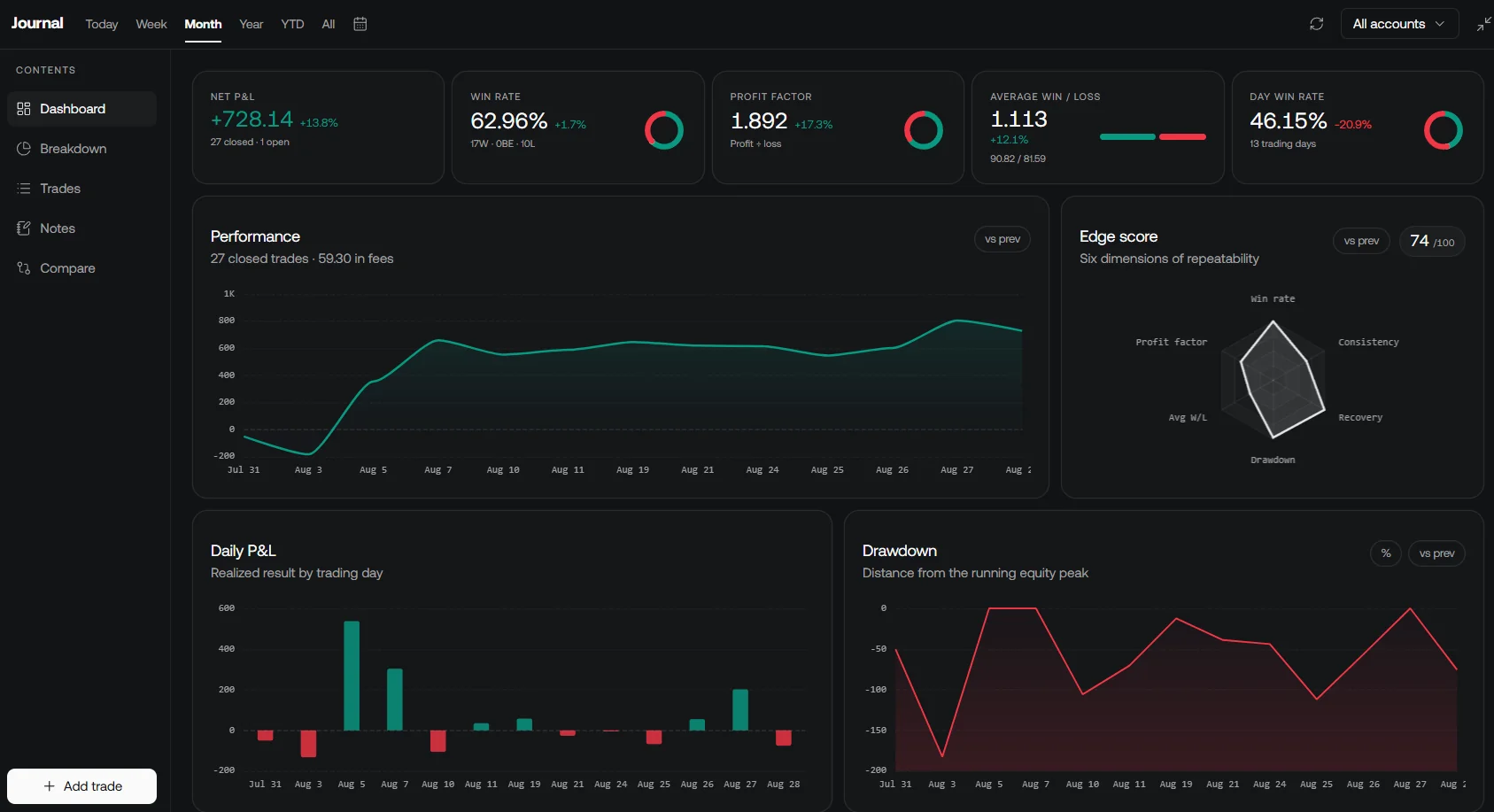
Use the native LuxAlgo journal with supported trade imports to compare the plan with actual behavior. Review early exits, oversized positions, repeated session losses, and differences between historical fills and execution. Keep the prop dashboard as the authority for current loss floors and reward eligibility.
The LuxAlgo Prop Firms portal helps compare offers and explore modeled scenarios. Its estimates depend on assumptions and reference rule profiles; they are not an observed personal probability of passing. Cross-check the exact provider model and current terms, especially when a legacy plan or temporary promotion is involved.
Frequently Asked Questions
Which futures prop firm is best?
There is no universal winner. Compare the specific plan’s loss allowance, trailing method, total fees, trading restrictions, and reward eligibility against the strategy you actually trade.
Does a $50,000 funded account provide $50,000 of risk capital?
No. The nominal balance may be simulated and the permitted loss can be much smaller. Calculate the distance from current equity to the applicable loss floor and include trading costs.
Do daily payouts mean I can withdraw immediately after passing?
Not necessarily. Programs may require another buffer stage, qualifying profit days, a minimum request, consistency, or a payout cap. Processing time and bank arrival are also different.
Can LuxAlgo guarantee that I pass a futures prop evaluation?
No. LuxAlgo charts, Quant, and the journal support research and review. They do not guarantee returns, automatically enforce every provider rule, or replace the selected firm’s trading agreement.
Read next