Top Benefits of Trading with a Retail Prop Firm

A retail prop firm can offer a structured evaluation, access to a larger nominal account and the possibility of cash rewards or later live trading. Those benefits depend on the program, its costs and your ability to satisfy the agreement. Buying an evaluation does not guarantee funding, income or a professional trading career.
The most useful comparison starts with what you actually receive: a simulated or live account, a defined loss cushion, specific services and conditional reward rights. This guide examines six potential benefits, the limits that matter and a practical way to prepare with LuxAlgo. Provider examples were checked in September 2026.
Six Potential Benefits at a Glance
| Potential benefit | What it can offer | What to verify |
|---|---|---|
| Account access | An assessment without committing the full advertised account balance | Simulated or live status, fees and allowable loss |
| A defined participation budget | A planned amount to spend on evaluation access | Retries, renewals, activation and contractual obligations |
| Structured rules | Measurable objectives and loss constraints | Exact calculations, prohibited practices and review conditions |
| Conditional rewards | Cash payments for qualifying results | Share, caps, retained balances and approval requirements |
| Learning and feedback | Resources, record review and community discussion | What is included and whether mentoring is actually provided |
| A development pathway | A repeatable practice process and possible progression | Scaling criteria, additional costs and live-stage terms |
A retail challenge is also different from employment at a traditional proprietary trading firm. Paying for an assessment usually creates a service relationship, not a salaried job with an assigned portfolio manager. Our prop firms versus hedge funds guide separates retail evaluations from institutional careers.
1. Access to an Account Without Depositing Its Full Nominal Balance
The advertised account size can be much larger than the fee paid to enter an evaluation. This allows someone to explore a defined trading program without depositing that entire nominal balance. It can make assessment access more affordable, but the displayed number should not be treated as cash you own or can withdraw.
Many evaluations and funded stages remain simulated. A company may pay real cash rewards based on qualifying simulated results. Other programs have a separate live stage. Topstep’s Live Funded Account policy explicitly describes real capital and markets at that stage, distinct from its Express Funded Accounts. Check the status of the exact account you are considering.
The Loss Cushion Matters More Than the Headline Size
Consider a hypothetical $100,000 nominal account with a $3,000 loss cushion. Planning a $2,000 loss because it represents 2% of the displayed balance would consume about two-thirds of the cushion before commission or slippage. The useful question is how much room remains before a breach, including the daily limit and any trailing adjustment.
A larger nominal account does not automatically justify larger positions. Contract limits, instrument value, stop distance and combined exposure still determine the possible loss. Treat the account size as one specification among several rather than a measure of money available to spend.
Scaling Is a Conditional Opportunity
Some firms offer larger accounts, higher position limits or live progression after qualifying performance. The rules can include a minimum period, review, retained profits or other conditions. Do not assume progression is automatic, based only on returns or free of additional costs.
Before assigning value to a scaling plan, ask what changes: the displayed balance, the loss allowance, the contract limit, the reward cap or the execution environment. A higher headline number with an unchanged loss cushion may provide less practical flexibility than expected.
2. A Participation Budget You Can Plan in Advance
An evaluation can let you set a cash budget for access without depositing the full nominal trading balance. That can be useful if the agreement and billing model are clear. It is not the same as having no personal financial risk: fees, repeat purchases, tools and time are real costs.
Billing varies. The current Apex offering distinguishes newer one-time-fee evaluations with 30-day expiry and no resets from legacy products. Never carry a rule from one account generation into another without checking. A low promotional entry price may not represent the full cost of continuing.
Refund conditions also matter. FTMO’s fee policy says the 2-Step fee is reimbursed with the first Reward withdrawal after successful completion. Passing alone does not trigger reimbursement, and the policy says its 1-Step fee is not reimbursed. Count an expense as paid until a qualifying refund actually arrives.
Use a Cash Ledger, Not Only the Trading Dashboard
Suppose two attempts cost $100 each, activation costs $50 and a data service costs $30. Total cash spent is $280. If you later receive a $600 reward, the cash result is $320 before other expenses and tax. If no reward is paid, the result is a $280 cost, regardless of what a simulated profit chart showed.
- Set an affordable maximum for total attempts and continuing services before purchase.
- Record each payment, refund and received reward separately.
- Check renewal, cancellation and expiry terms for the selected model.
- Read liability, dispute and payout provisions rather than assuming account closure is the only possible consequence.
- Review the reason for a failed attempt before spending on another one.
A defined budget can support discipline, but repeated small purchases can still become a large expense. The comparison should include the value of time spent preparing and trading. Our prop-firm business model guide explains the distinction between service fees, simulated rewards and live trading revenue.
3. A Structured Framework for Risk and Consistency
Written objectives can make practice more measurable. Daily limits, an overall loss floor, position caps and holding restrictions give a trader concrete conditions to plan around. This structure may encourage smaller positions, a daily stopping point and more deliberate trade selection.
The benefit comes from using the rules thoughtfully. Passing an assessment does not prove a durable trading edge, and a restrictive rule set is not automatically appropriate for every strategy. A method that produces a positive final result can still fail because of its intraday path or the timing of its losses.
- Write down whether the daily loss test includes open positions, commission and other costs.
- Identify the reset time and how a trailing floor changes after gains.
- Check combined exposure across correlated positions rather than treating each trade independently.
- Review news, overnight, weekend and execution restrictions before testing a method.
- Confirm which conditions affect reward eligibility as well as account survival.
For example, a $500 daily allowance does not leave room for three $200 planned losses plus costs. An alert or platform liquidation feature should not be assumed to prevent every breach at the intended price. Your own risk controls need a buffer for execution differences and should follow the actual rule calculation.
Automated monitoring also does not mean every decision is mechanical. Providers can have review procedures, prohibited-practice clauses and contractual discretion. Read the agreement and obtain clarification when a term is unclear; a dashboard showing a target met does not by itself establish an approved payout.
The useful professional habit is a repeatable routine: plan exposure, document execution, stop when the plan requires it and review deviations. It is inaccurate to describe every retail program as an institutional trading floor with mandatory reports reviewed by an experienced portfolio manager.
4. The Possibility of Cash Rewards
Qualifying participants may receive a share of eligible results without supplying the advertised nominal balance themselves. That is a potential benefit, but the payout policy determines its value. The reward percentage alone cannot tell you the amount you will receive or how soon it will arrive.
For example, Apex’s newer EOD payout policy states a 100% share of approved requested payouts, alongside qualifying-day requirements, consistency conditions, retained safety balances and caps. That is not unrestricted access to every dollar displayed as profit, and it should not be generalized to legacy accounts or other firms.
A scheduled payout window creates an opportunity to request a payment. It does not make income predictable. Results may fail to qualify, a request may require review, and withdrawal can change the remaining account cushion. Keep essential spending independent of an assumed future reward.
Compare Net Cash Outcomes Fairly
If a hypothetical eligible reward base is $1,000 and the applicable share is 80%, the gross payment is $800 before other deductions or tax. Subtract the participant’s full cash costs when evaluating the outcome. If a cap, retained balance or eligibility rule applies, even that simple calculation may overstate what can be requested.
A prop share is not inherently higher than what a trader keeps in a personal account. Personal-account net results belong to the account holder after applicable costs and taxes, while the trader also bears the capital loss. These are different economic arrangements; compare risk, ownership, costs and withdrawal conditions together.
5. Learning Resources and a Trading Community
Education, discussions and examples from other traders can help someone identify mistakes and build a review process. Their value depends on the quality of the material and whether it addresses the instrument and account rules being used. Community access does not establish that members have profitable methods.
A concrete example is Topstep Learning, which lists resources including educational articles, videos, a podcast, a newsletter and an introductory futures course. TopstepTV also advertises free live group coaching open to futures traders at any level. Group sessions are different from an assigned personal mentor.
Some useful resources are publicly available, so do not count all of them as an exclusive benefit of buying an evaluation. Before paying for educational access, identify what is actually included, whether it costs extra and who provides the feedback. A suggested reading list is not the same as included books or a tailored curriculum.
- Does the program provide general content, group discussion or individual review?
- Are the instructors’ examples relevant to the product and rules you will trade?
- Can you ask questions and receive specific feedback on documented decisions?
- Are additional courses, subscriptions or coaching fees required?
- Can you use the public resources first to assess their usefulness?
Use a community to question assumptions and improve recordkeeping. Avoid copying positions, sharing restricted account access or following a confident claim without checking the evidence and provider policy. Neither testimonials nor mentor access establishes your personal probability of passing.
6. A Practical Development Path Through Practice and Review
An evaluation can create a clear project: define a method, rehearse the rules, review errors and decide whether to continue. That process can support skill development when it is used as feedback rather than a reason to chase a target. There is no guarantee that a paid challenge produces better learning than careful practice on a suitable demo platform.
Separate three activities. Historical strategy testing examines rules against past data. Demo trading rehearses decisions and platform use as the market develops. A statistical scenario model explores possible paths under assumed inputs. These methods answer different questions and should not be treated as interchangeable.
A model cannot reproduce the emotional consequences of paying a fee or losing a live position. A demo account can still support a realistic routine if you impose the intended limits and maintain honest records. The quality of practice depends on how it is designed, not simply whether the software labels it a challenge.
Prepare with LuxAlgo’s Native Charts and Quant
Start with LuxAlgo’s native charts to define the market, timeframe and setup. Use Quant, our coding agent to express entry, exit and sizing logic in code. Inspect the generated code and run the strategy yourself. Generated output requires review and does not establish a profitable or provider-compliant method.
Use native strategy testing with standard candles, realistic commission and slippage, and a separate testing period. Check data coverage against the evaluation platform. Review losses and weak periods rather than choosing only the highest-return historical variation.
Apply conditions the test does not model separately, including daily resets, floating-loss checks, payout limits and the effect of withdrawals. Research software does not automatically enforce every provider’s rules or authorize automated execution.
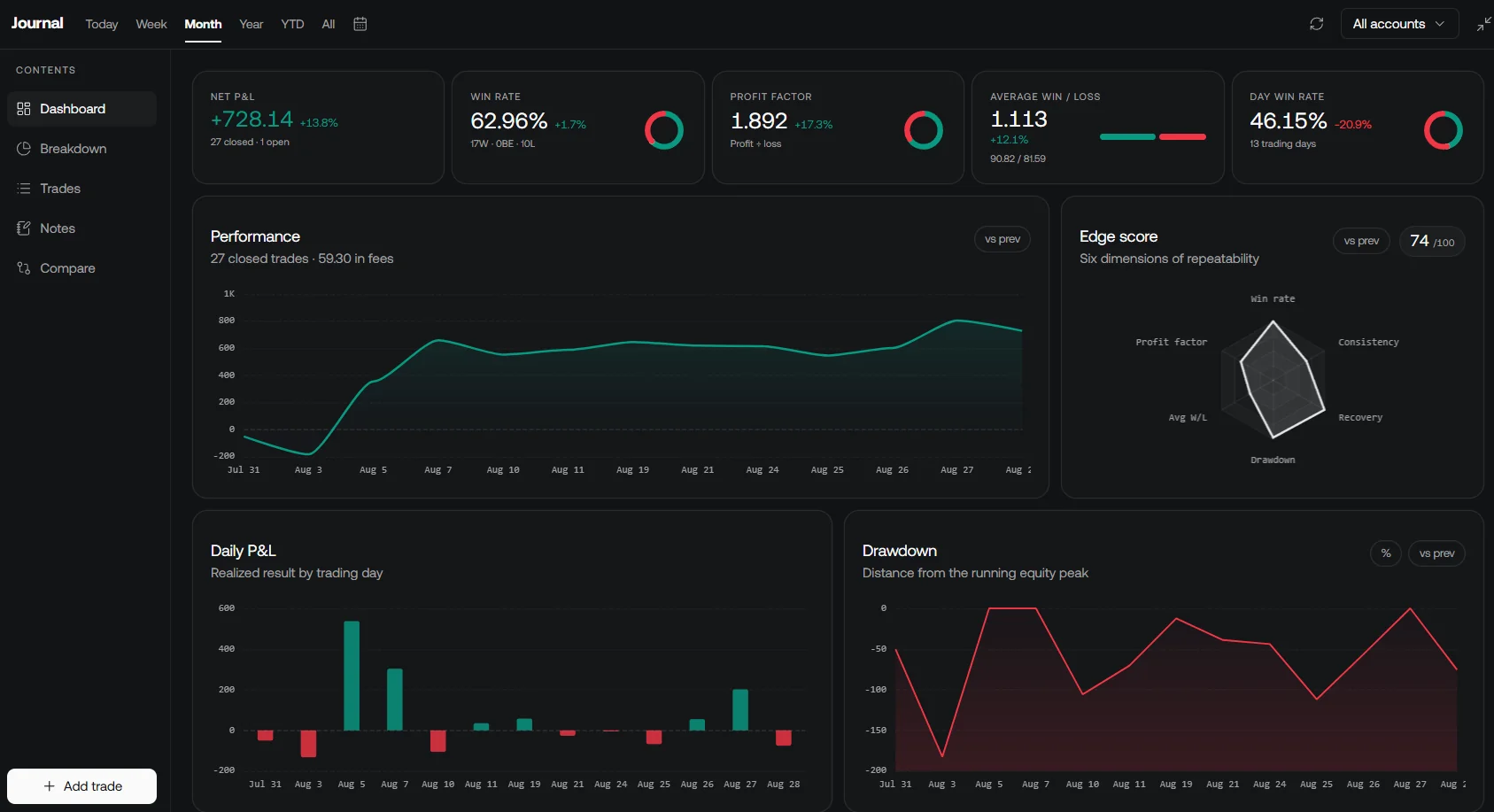
Use the native LuxAlgo journal to review supported trade records by instrument, session and strategy. Record rule breaches and execution deviations as well as returns. Keep evaluation expenses and received rewards in a separate cash ledger, and use the provider’s dashboard for its official limits and eligibility calculations.
The LuxAlgo Prop Firms portal can help organize comparisons and explore modeled scenarios. Verify reference rules against the current agreement for your account. Simulated paths depend on assumptions; they are not observed personal pass probabilities, dependable estimates of required purchases or psychological training. Partner offers do not establish the lowest total cost.
Retail Prop Firm or Personal Trading Account?
| Factor | Retail prop program | Personal trading account |
|---|---|---|
| Ownership and account status | Contractual service and reward rights; stages may be simulated | Account holder owns eligible assets and net results, subject to account terms |
| Cash commitment | Fees and other program costs; nominal balance is not a deposit | Capital committed to trading plus applicable service and execution costs |
| Loss constraints | Provider-specific daily, overall and activity rules | Your controls plus broker, margin and regulatory requirements |
| Payments or withdrawals | Eligibility, review, caps and retained balances may apply | Available cash, settlement, margin and broker conditions apply |
| Learning resources | Included services vary; some resources are public | Resources can be obtained independently, free or paid |
| Main tradeoff | Conditional access and rewards within a restrictive agreement | More direct ownership with responsibility for capital losses |
Neither route is automatically better. A retail program may fit a trader whose tested method matches the rules and whose budget can absorb the full participation cost. A personal account may better fit someone who values ownership and flexibility and understands the capital risk. Continued practice is also a valid choice when neither arrangement is suitable yet.
Before buying, verify the legal entity, jurisdictional eligibility, account status and dispute process. Our retail prop regulation guide explains why a broker connection does not automatically protect evaluation fees or contractual rewards.
The strongest benefit of a retail prop program is a clearly understood opportunity that fits a measured process. Account size, a high reward share and a community are useful only when the underlying rules, costs and services support the way you intend to trade.
Frequently Asked Questions
What is the main benefit of trading with a retail prop firm?
A program can provide access to a structured assessment and potential rewards without requiring a deposit equal to the advertised nominal balance. The value depends on account status, loss limits, total costs and the agreement.
Does a funded account always contain live trading capital?
No. Many funded stages remain simulated and pay conditional cash rewards. Some providers offer a separate live pathway; verify the exact program rather than relying on the word funded.
Are prop-firm payouts a predictable source of income?
No. A payout schedule is a request window, not a guarantee of qualifying results or approval. Shares, caps, retained balances, review conditions and expenses affect the cash outcome.
Do all retail prop firms include personal mentoring?
No. Services vary, and public educational resources or group coaching are different from individual mentoring. Confirm what is included and whether additional charges apply.
Can LuxAlgo help me prepare for an evaluation?
LuxAlgo native charts, Quant, strategy testing and the journal support research and review. Inspect generated code, run tests yourself and check provider rules separately. Tools and modeled scenarios do not guarantee a pass, payout or future return.
Read next