Unusual Whales: Signal Analysis Guide
Unusual Whales helps investigate options activity, alerts, and related market data. Its classifications can organize a large amount of information, but they do not identify every trader, reveal complete portfolios, or establish that a trade will be profitable.
Begin with the underlying-market thesis in LuxAlgo’s native charts. Quant can help express and test price-based rules. Use Unusual Whales for options-specific context, then evaluate the actual contract and execution in your broker’s tools. Each step answers a different question.
Reading Unusual Whales Alerts
Alert Components
Identify the precise alert type and its supporting transactions before interpreting it. A notification may aggregate several executions rather than represent one investor’s decision.
| Component | What it describes | What to verify |
|---|---|---|
| Contract | Underlying, call or put, strike, and expiration | Multiplier, deliverable, and exercise style; the strike is not a price forecast |
| Volume and open interest | Trading activity and outstanding contracts | Session or interval, update timestamps, and related activity |
| Underlying price | The stock or index level associated with the record | Whether it is contemporaneous or a later quote |
| Implied volatility | A pricing-model input inferred from the option | Its units, source, and change around events |
| Premium | Quoted option price or aggregate cash amount, depending on the field | Whether the multiplier and quantity are already included |
| Side and flags | Execution classification and available trade context | Quote timing, closing trades, and possible multi-leg relationships |
A $2.00 quote is generally $200 for one standard 100-share contract, before costs. Gross premium traded is not the same as the risk of an unknown portfolio. Nor does a large premium total prove that the participants are institutions.
Distinguish Current Flow Alerts from Legacy Alerts
The vendor’s Unusual Options Alerts documentation explicitly labels that older feed a legacy feature that is no longer updated and directs readers to Flow Alerts for current activity. Its old 10 a.m.–4 p.m. schedule should not be treated as the schedule of every current alert tool.
Check the current feed, filter settings, data entitlement, and notification channel in your account. An alert’s arrival time can differ from the underlying transaction time. A period with fewer notifications can reflect filtering or delivery behavior rather than an absence of market activity.
The Flow Status documentation also distinguishes trades received by the platform from those pushed into the live display. Review the status indicator and refresh behavior when activity is heavy.
Interpret Direction as a Hypothesis
The Flow Feed documentation describes bid-ask classifications and multi-leg context. A buy-side label does not establish Buy to Open; it can represent a closing purchase. A call or put can also form part of a spread or hedge.
Net-flow and sentiment summaries depend on their calculation rules and selected universe. Read those definitions before using a positive or negative number as a market view. Neither a label nor agreement between several related indicators proves a trader’s intent.
Signal Analysis Methods
Combine Evidence Without Double-Counting It
Separate three questions: what activity occurred, what the underlying market is doing, and whether an option trade offers acceptable exposure at the current price. Several displays derived from the same prints are not necessarily independent confirmation.
- Inspect the exact contract and supporting executions.
- Check related strikes and expirations for spread or roll context.
- Review news and scheduled events known at the time.
- Write an underlying-price thesis with conditions that would invalidate it.
- Evaluate the option’s spread, time, IV, payoff, and assignment obligations separately.
The Options Industry Council’s open-interest explanation is useful here. Both sides opening increases open interest, both closing decreases it, and one opening while the other closes leaves it unchanged. Session volume above prior open interest cannot, by itself, identify new institutional positioning.
Test What Was Knowable at the Time
Record the filter version and every qualifying alert, including failed setups and trades you passed on. Preserve the timestamps of quotes, events, and open-interest updates. A next-day confirmation must not be inserted into a same-day entry rule.
Include spreads, fees, realistic entry and exit assumptions, and a defined benchmark. Reserve later data for evaluation. Selecting only successful examples or repeatedly changing filters after seeing outcomes can make weak evidence look convincing.
Understand Off-Exchange Stock Prints
Dark pools are alternative trading systems with nondisplayed pre-trade interest. Off-exchange equity trading also includes activity outside those systems. FINRA’s explanation of stock trading venues describes how off-exchange transactions are reported and included in consolidated market data.
A completed print is different from a hidden order waiting to execute. Its price and size do not independently tell you which party initiated the trade, whether it was a hedge, or where the stock will go next. Review the feed’s venue classification and report conditions rather than treating every off-exchange print as a bullish institutional purchase.
A cluster of prints near a price can provide context for further research. It does not establish a guaranteed support level or confirm an unrelated option signal. Avoid importing a market-wide percentage into a claim about a particular stock without matching data and dates.
Video: Following Large Option Order Flow
Trading with Unusual Whales Signals
Build an Explicit Review Process
Define the contract universe, alert condition, review window, and rules for discarding ambiguous records. A saved filter should state what it selects, not imply that every match is an informed trade.
Use LuxAlgo’s native chart workspace to compare timeframes, mark levels, and examine trend or momentum. Moving averages, RSI, and price structure can organize the underlying thesis without identifying the participants behind an options print.
Quant can help turn price-based conditions into reviewable code. Specify entry timing, exit logic, and assumptions; inspect the result before running it. Testing a combined flow-and-price strategy additionally requires the relevant historical flow data and an appropriate options model.
Do not assume Quant automatically imports Unusual Whales data, monitors option whales, or models historical option quotes, IV surfaces, exercise, and assignment. An underlying backtest does not establish the profitability of buying an option around its signals.
Keep Notifications Separate from Risk Limits
A price alert notifies you of a condition; it does not close a position. Replacing a stop with an alert does not guarantee protection or prevent manipulation. A stop can also slip, and a limit order may remain unfilled.
| Risk question | Practical check |
|---|---|
| How much can the position lose? | Evaluate the complete payoff, premium, short-leg obligations, and any shares |
| Can I execute the intended exit? | Review the current spread, liquidity, order type, and possible gaps |
| What changes near an event or expiration? | Review time, IV, exercise, assignment, and broker deadlines |
| Did the order finish? | Confirm actual fills, remaining orders, and resulting quantities |
Size the trade for the whole account and correlated exposure. An observed large order or off-exchange print does not determine the right size for your position. Our options contract guide explains basic obligations and payoff examples.
Evaluate Examples as Evidence
Suppose an alert highlights unusually active calls ahead of earnings. Your review finds a wide spread and possible related puts. The underlying trend is positive, but the option already prices a large move. That combination may justify more investigation or passing on the trade; it is not automatically a confirmed bullish setup.
If you do trade, record the actual entry, costs, planned exit, and outcome. A later high in the option quote is not proof that any trader realized that return. Cryptocurrency-wallet profits and selected political-trading gains also do not establish the success of an options-alert method.
Public holdings or political disclosures can be research inputs, but they may be delayed, incomplete, or reported in value ranges. Do not interpret them as a live, fully specified portfolio that can be copied at the original price.
Signal Analysis Software
Choose the Current Product and Data Access
The current Unusual Whales pricing page separates Dashboard & Tools, API access, and bundled products. Dashboard plans cover the website and app; a data-only API plan is not the same subscription. Check billing period, current promotions, limits, and entitlements before purchasing.
The page describes paid real-time data and limited delayed data for free accounts. Features and limits vary by tier. Verify the specific flow tools, alerts, exports, or programmatic access you need rather than relying on an old monthly price or assuming every annual plan includes API access.
Exposure and sentiment dashboards are model-based summaries. Their usefulness depends on assumptions, selected contracts, and data quality. Treat a gamma-exposure estimate as a model output rather than an audited inventory of every dealer’s positions.
Use LuxAlgo’s Tools for Their Intended Context
LuxAlgo’s Quant Charts and Quant support underlying-market research. Modeled money flow is not direct evidence of identifiable institutional transactions.
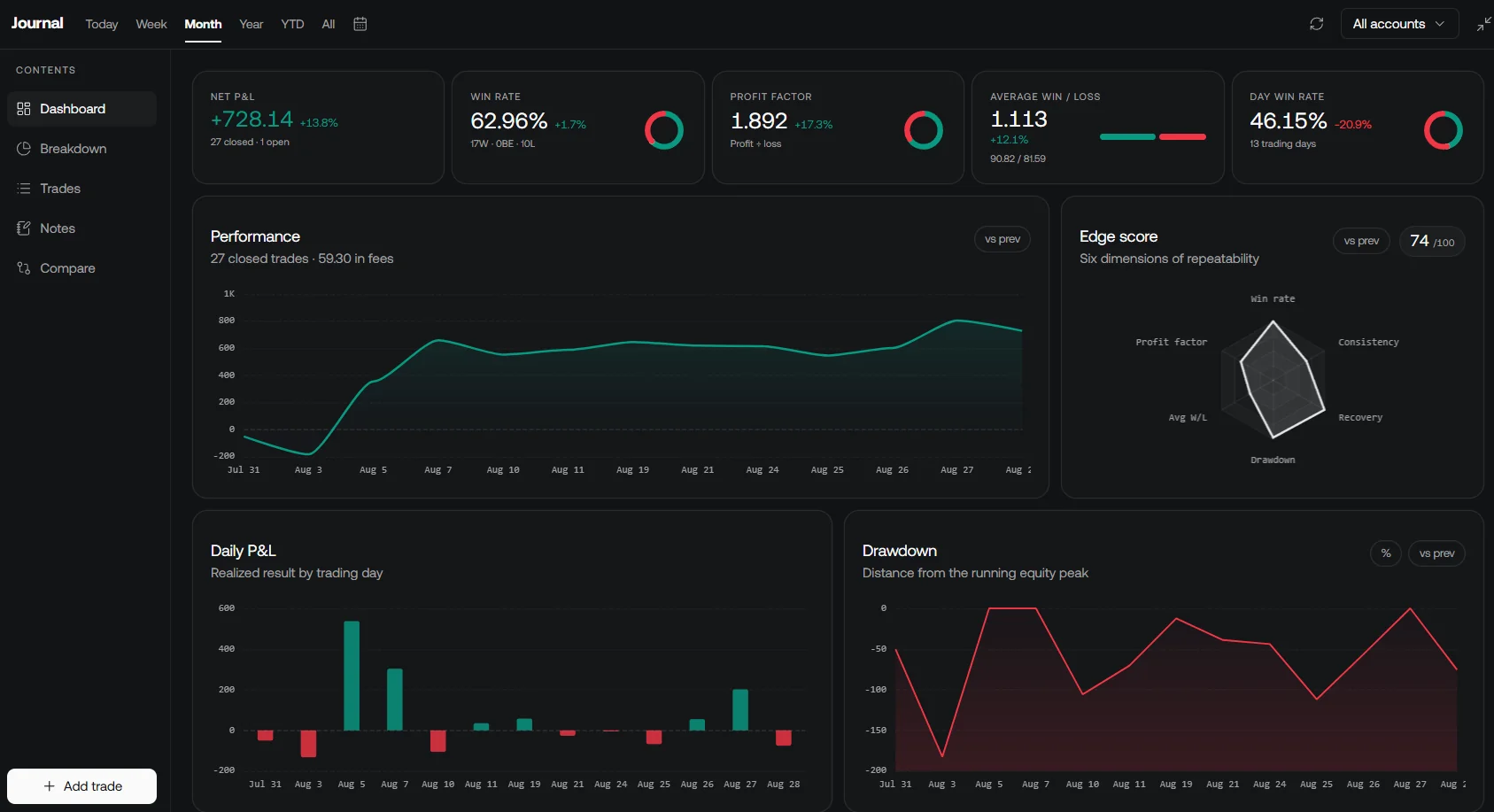
The LuxAlgo Journal supports review and notes. Check what your supported import or broker data includes, then supplement missing option legs, alert details, assignment effects, and fees.
Keep the Workflow Verifiable
- Use the current options-flow platform to identify activity and inspect supporting records.
- Use native charts to formulate the underlying thesis.
- Test explicit price-based rules with Quant where appropriate.
- Evaluate the contract and place any authorized trade in the broker platform.
- Record actual fills, costs, and outcomes for later review.
Programmatic integrations require the relevant data access and implementation. Using two products in a research process does not mean they are automatically connected or that alerts execute orders.
Conclusion
Main Points Review
Unusual Whales can organize options activity and related data into a research process. Signals remain observations to investigate, with limits around attribution, timing, and position context. Native charts and Quant can support an independent underlying thesis while options-specific analysis and broker controls address the trade itself.
Getting Started Steps
Choose the current tool and data entitlement, build a clearly defined filter, review a sample of alerts, and record all outcomes. Establish the risk and execution plan before trading. Evaluate the method on evidence across the full sample, not a handful of impressive results.
Read next